Why there are Amazon links here: Brave Review is paid a commission for qualifying Amazon purchases made through the links below. Your price does not change, and using our links is entirely optional. How this works
Best Medication Reminder Device for Daily Pills and Dementia Care
Missing a dose is rarely about forgetfulness alone — it is about timing, hearing, and having the right cue in the right place. This guide covers five medication reminder devices that solve that problem in different ways: loud talking alarms for people with hearing or memory loss, a large-format day clock for dementia care, a 31-day organizer system, and a simple reusable pill tracker for people on the go. Buyers shopping for an elderly parent, a partner with Parkinson’s, or themselves as an ADHD adult will find a match below. The overview table comes first so a decision can be made in under a minute.
Overview of the Picks
| Product | Key Spec | Best Use | Price Tier |
|---|---|---|---|
| Odaro Reusable Medication Tracker, 2 Pack | Reusable 7-day tracker, 2-pack | Travel and on-the-go pill tracking | Budget |
| Digital Talking Medication Alarm Clock for Seniors | Digital talking alarm | Simple spoken dose reminders | Budget |
| ORKA Talking Clock | Voice-recordable, extra-large display | Dementia and low-vision care | Mid-range |
| MedCenter 31-Day Pill Organizer System | 31-day system, 4-time talking alarm | Full-month planning with alarms | Premium |
| TabTime Pill Reminder & Timer | Up to 8 daily alarms, battery operated | Heavy daily schedules and Parkinson’s | Mid-range |
1. Odaro Reusable Medication Tracker, 2 Pack
Type: Reusable pill tracker
Format: 7-day replacement tracker
Pack Size: 2 pack
Mounting: Lanyard or sticker
Intended Use: Elderly and ADHD users
Reusability: Replace weekly

This is the simplest device in the roundup, and that is the point. The Odaro tracker is a reusable seven-day marker that fits most standard pill bottles, with easy date marking so a user can see at a glance whether today’s dose has been taken. It attaches by lanyard or sticker, which makes it work on a keyring, a cabinet handle, or directly on the bottle itself. The two-pack means one tracker can live on the daily bottle and a spare can go in a travel bag. It suits ADHD adults and elderly users who already manage their own bottles but lose track of the day.
It earns its place as the budget pick because it adds a visual check without batteries, alarms, or setup. Buyers who want a device that never needs charging and never beeps will prefer it to a talking clock.
Trade-off: It is a passive marker, so it cannot alert anyone who forgets to look at it — it only confirms a dose after the fact.
2. Digital Talking Medication Alarm Clock for Seniors
Type: Digital talking alarm clock
Intended Use: Senior medication reminders
Alert Style: Spoken voice alarm
Display: Digital
Setup: Alarm-based scheduling

Digital Talking Medication Alarm Clock for Seniors
This clock does one job well: it speaks up when a dose is due. The digital talking format announces the alarm in a voice rather than a beep, which matters for anyone who has trouble hearing high-pitched tones or who needs a spoken cue to understand what the alarm is for. The digital display keeps the time readable, and the alarm is set the same way as a standard bedside clock. It is a natural fit for a nightstand or kitchen counter where pills are kept.
It earns its place for buyers who want a single, affordable reminder point in the home and do not need a full organizer. The spoken alarm is also less jarring than a buzzer for light sleepers.
Trade-off: A single alarm point means the device cannot track whether a pill was actually swallowed, and a user who is out of the room at alarm time may miss the cue entirely.
3. ORKA Talking Clock
Type: Talking alarm clock
Display: Extra-large digital day clock
Voice: Recordable custom voice
Alarms: Multiple customized alarms
Intended Use: Dementia, hearing and visually impaired seniors
Color: White

The ORKA is built for the hardest cases: dementia, significant hearing loss, and low vision. Its extra-large day clock spells out the day and date in big characters, so a user who has lost track of time can reorient without help. The voice-recordable feature lets a family member record a personal reminder — a familiar voice saying "time for your blue pill" lands very differently than a generic beep. Multiple customized alarms cover a morning and evening schedule, and the white casing keeps it visible on a shelf or bedside table.
It earns its place as the dementia-care pick because it combines orientation and reminder functions in one device. Families who act as caregivers will find the recordable voice the most useful feature on the list.
Trade-off: Recordable-voice clocks depend on someone setting them up and re-recording messages, so they are a poor fit for a user living entirely independently with no family support.
4. MedCenter 31-Day Pill Organizer System with 4-Time Talking Alarm
Type: Pill organizer system with alarm base
Capacity: 31-day supply
Alarms: 4-time talking alarm
Intended Use: Monthly medication management
Format: Count-based organizer pack

MedCenter 31-Day Pill Organizer System with 4-Time Talking Alarm
The MedCenter system is the most complete option here. It holds a full 31-day supply in dated compartments, so pills are sorted once a month rather than once a week, and the base unit adds a four-time talking alarm that can be set for up to four dose times a day. The combination of physical sorting and spoken alerts covers both halves of the problem: the organizer answers "did I take it," and the alarm answers "is it time." It suits people on a stable monthly regimen and the family members who refill for them.
It earns its place as the premium pick because it replaces a weekly ritual with a monthly one and adds a loud spoken cue. Caregivers managing multiple prescriptions will get the most value from it.
Trade-off: A 31-day system is bulky and takes real counter or shelf space, and a missed refill day can leave an entire week empty — it rewards routine more than smaller organizers do.
5. TabTime Pill Reminder & Timer
Type: Pill reminder and timer
Alarms: Up to 8 daily alarms
Power: Battery operated
Alert Style: Loud reminder
Intended Use: Seniors, elderly, dementia and Parkinson’s
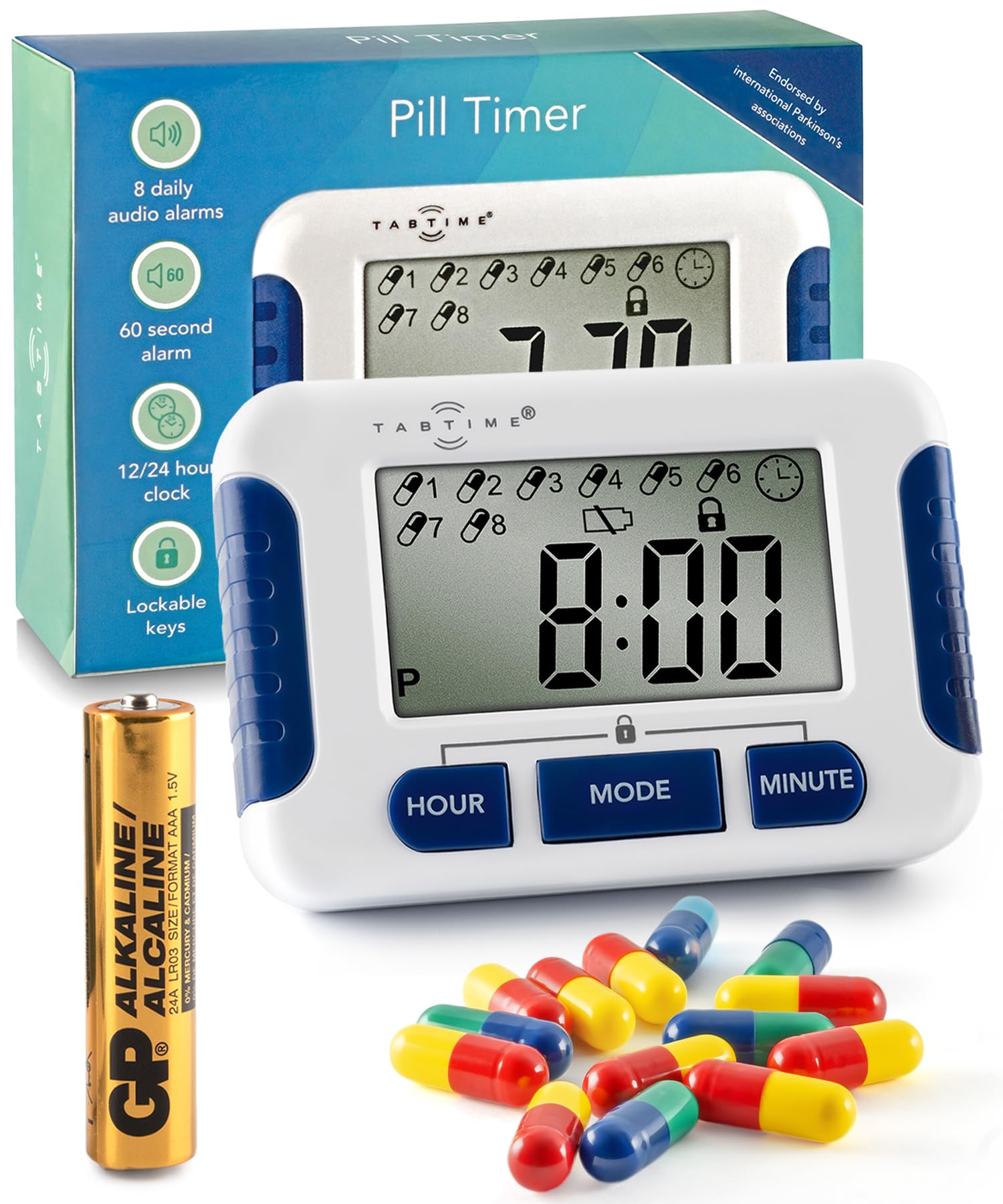
The TabTime is the schedule-heavy option. It supports up to eight daily alarms, which covers complex regimens with multiple doses spread across the day, and the loud reminder is designed to cut through for seniors, dementia patients and people with Parkinson’s. Battery operation means it does not depend on a wall outlet, so it can move between rooms or travel without losing its settings. The timer function adds a second use: timing a dose interval rather than only a clock time.
It earns its place for buyers whose medication schedule is the hard part, not the sorting. Parkinson’s patients with tightly spaced doses are the clearest fit.
Trade-off: Eight alarms take real effort to program, and a loud multi-alarm device can become background noise in a busy household if the user starts tuning it out.
Before You Buy
- Alert type: A spoken voice works better than a beep for hearing loss and for anyone who needs to know what the alarm is for, not just that it fired.
- Capacity: A 7-day tracker suits a single daily bottle; a 31-day system suits a stable monthly regimen with multiple prescriptions.
- Number of alarms: Count the actual dose times per day before choosing — a single-alarm clock cannot cover a four-times-daily schedule.
- Power source: Battery-operated units travel and relocate easily; plug-in units stay put but never need a battery swap.
- Setup effort: Recordable-voice and multi-alarm devices need a family member or caregiver to program them properly on day one.
- Who checks the dose: Passive trackers confirm a dose after the fact, while alarms prompt before it — most households need one of each.
- Footprint: Monthly organizers and large-format day clocks take counter space; confirm where the device will live before buying.
Frequently Asked Questions
-
What is the best medication reminder device for someone with dementia?
The ORKA Talking Clock is the strongest fit, because the extra-large day display helps with time orientation and the recordable voice gives a familiar, personal prompt. -
Do these devices work for hearing-impaired users?
The talking and loud-alarm models are designed with hearing loss in mind, and the ORKA adds a large visual display for anyone who cannot rely on sound alone. -
Can a reminder device track whether a pill was actually taken?
Only the organizer-style devices confirm a dose physically; alarm clocks prompt at the right time but cannot verify that a pill was swallowed. -
How many alarms are needed for a typical schedule?
Most people need two to four dose times a day, which the MedCenter’s four-time alarm covers; the TabTime’s eight alarms suit tighter or more complex regimens. -
Is a battery-operated reminder better than a plug-in one?
Battery operation suits users who move between rooms or travel, while plug-in units are better for a fixed bedside or kitchen spot. -
Can a family member set these up remotely?
Setup is done on the device itself, so a caregiver typically programs it in person — recordable-voice models make that one-time visit worth planning for.
Bottom Line
For most families, the ORKA Talking Clock is the best medication reminder device on this list: the recordable voice and extra-large day display solve both the prompt and the orientation problem that dementia and hearing loss create. Buyers who need full monthly sorting should step up to the MedCenter system, and anyone on a tight, complex schedule should look at the TabTime. Check the current price on Amazon before deciding.