Why there are Amazon links here: Brave Review is paid a commission for qualifying Amazon purchases made through the links below. Your price does not change, and using our links is entirely optional. How this works
UDPOWER S1200 Portable Power Station Review: A 1,191Wh Solar Bundle for Home Backup
The UDPOWER S1200 is a portable power station sold as a bundle with two 120W solar panels, aimed at households that want a working backup for outages and a power source for camping or job sites. This review covers what the unit is built to do, how the solar pairing changes the ownership experience, and where the package asks more of the buyer than a simple battery box would. Readers deciding between a solar bundle and a bare station should find the answer here, and the CHECK PRICE link goes straight to the current Amazon listing.
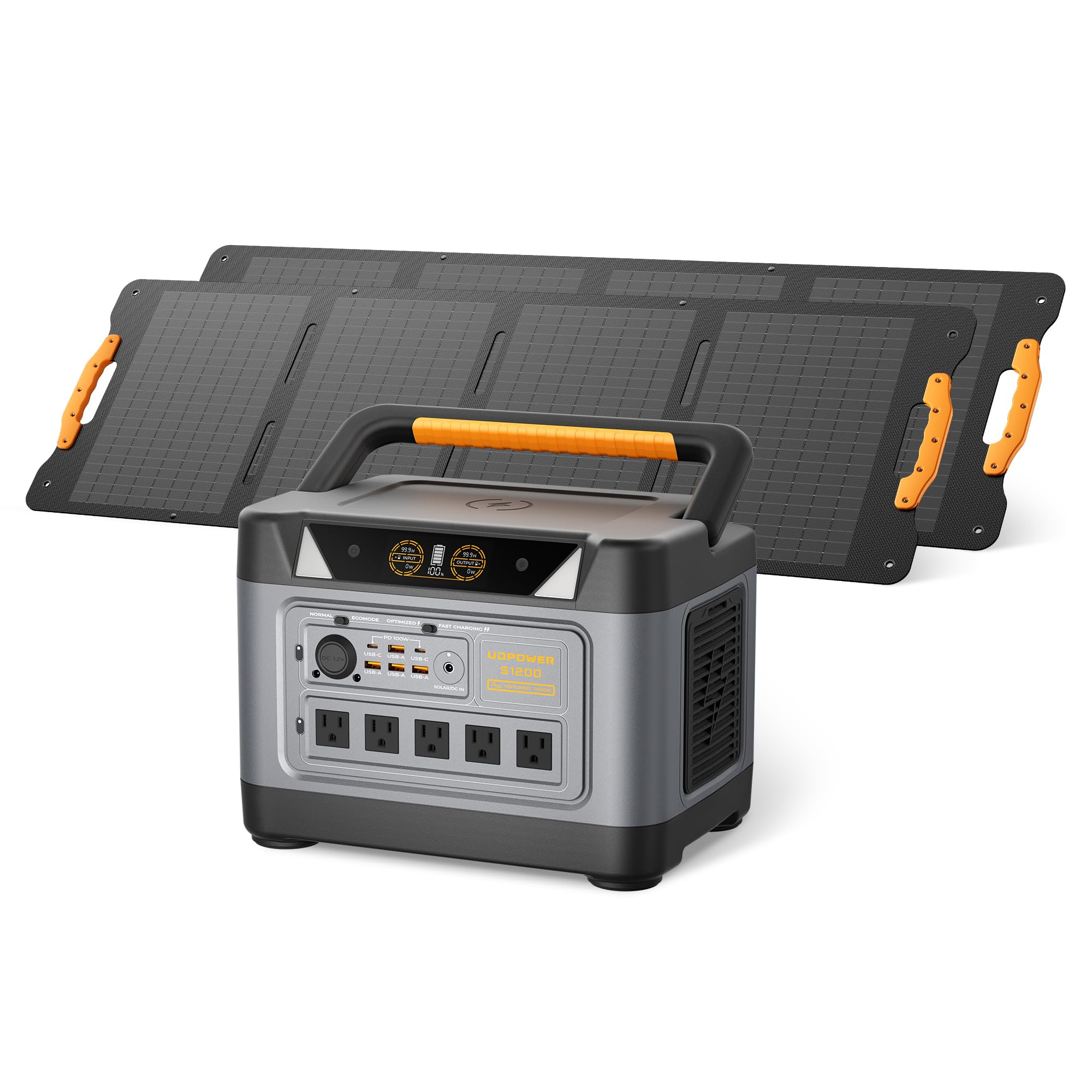
Features and Specifications
Battery Chemistry: LiFePO4 (lithium iron phosphate)
Battery Capacity: 1,191Wh
AC Output: 1,200W
Solar Input: 2 x 120W panels included
Intended Use: Home backup, outdoor, emergency
Type: Portable power station / solar generator bundle
The headline figure is the 1,191Wh battery, and the chemistry behind it matters as much as the number. LiFePO4 cells are the long-life branch of the lithium family, chosen for backup gear because they hold up to repeated charge cycles and tolerate being stored at partial charge better than older lithium formulations. For a unit that spends most of the year sitting in a closet waiting for a storm, that storage behavior is the practical argument in its favor.
The 1,200W AC output sets the ceiling on what the station can run. That figure covers the ordinary loads of an outage — a refrigerator cycling on, lamps, a router, a laptop, a fan, a small television — and it is the number to check against any appliance before plugging in. The bundle’s two 120W panels are the other half of the package, and the "120W" in the keyword is really the solar side of the story rather than the station’s output.
Build and Design
A station in this capacity class is a heavy, box-shaped unit with a carry handle, and the weight is the first thing a new owner notices. The battery alone accounts for most of the mass, and the enclosure, inverter and ports add the rest. Moving it from a garage shelf to a kitchen counter is a two-handed job, and hauling it up a flight of stairs is not something to plan on doing often. That is normal for the capacity, not a defect, but it reframes the product: this is a stationary backup unit that can be relocated, not a handheld battery.
The LiFePO4 pack inside is the reason the case can stay reasonably compact for the capacity. The chemistry packs more usable energy into less space than lead-acid alternatives, which is why a unit this size can carry roughly a kilowatt-hour without becoming a wheeled cart. Buyers who have only handled older sealed lead-acid jump packs will find the density surprising in a good way.
Port layout on a unit like this typically spreads across a front panel: AC outlets, USB ports for phones and small electronics, a 12V socket for car-style accessories, and a dedicated solar input. The practical point is that the station can charge phones and run a fridge from the same box, which is what makes it useful in a real outage rather than a single-appliance gadget.
Capacity: What 1,191Wh Actually Covers
Capacity is where buyers make their biggest mistake, so it is worth being blunt about the arithmetic. A 1,191Wh battery does not deliver 1,191Wh to an appliance; the inverter loses some energy in conversion, and the usable share is lower than the label. As a rule of thumb, plan on something closer to four-fifths of the rated figure reaching devices, and treat any estimate as an upper bound rather than a promise.
In practical terms, that reserve is enough to keep a modern refrigerator running through a long evening and overnight, to recharge phones and laptops many times over, and to run lights and a fan for a stretch. It is not enough to run a space heater, an electric kettle, a microwave for long, or any appliance with a heating element as its main job. Those loads drain a kilowatt-hour in minutes, and no station at this capacity is built for them.
The capacity also determines recharge time from the wall. A battery this size pulls a meaningful amount of energy to refill, so a full recharge from empty is an hours-long affair on AC. That is fine for a planned outage — charge it when a storm is forecast — but it is the reason the solar panels in the bundle exist.
Power: Output, Loads and the Solar Bundle
The 1,200W AC output is the number to match against appliance nameplates. A refrigerator’s running draw is modest, but its compressor startup surge can be several times higher, and stations in this class are generally built to ride out brief surges above the continuous rating. Buyers with a specific appliance in mind should check its label for both running watts and startup watts before assuming the station will carry it.
The two 120W panels change the ownership math more than any other part of the package. Together they give the station a way to refill without a wall outlet, which matters for camping, tailgating, job sites and multi-day outages where the grid is down and the wall is not an option. Solar charging is slow compared with AC, and panel output depends on sun angle, cloud cover and shade, so the panels are a top-up strategy rather than a fast charger.
The bundle also brings its own friction. Two separate panels mean two objects to unfold, aim and cable together, and the setup wants direct sun to perform. Buyers who picture themselves deploying panels in a driveway on a sunny afternoon will get along fine; buyers who want to press one button and forget it will find the solar half of the package more chore than feature. That trade-off is the honest heart of this bundle.
Maintenance and Ownership
LiFePO4 packs are low-maintenance compared with the lead-acid batteries of a generation ago, but they are not maintenance-free. The station should be stored in a dry, temperate space, kept away from freezing conditions and extreme heat, and topped up periodically rather than left flat for months. A unit that sits at zero charge for a long stretch is a unit that ages faster than it should.
The solar panels need their own care: glass kept clean, cables checked for wear, and storage that keeps the frames from being stacked under heavy gear. Panels are durable but not indestructible, and a cracked panel is a dead panel. Buyers should also expect to re-check the station’s charge level every few months, because a backup battery that is empty when the power fails is worse than no backup at all.
The ownership picture overall is a seasonal routine rather than a weekly chore: charge it before storm season, check it once a quarter, and store it sensibly. That is a reasonable ask for a device whose entire job is to work on the one day it is needed.
Trade-off: The bundle pairs a heavy, stationary-capacity station with two panels that must be unfolded and aimed in direct sun, so buyers who want effortless, push-button backup are paying for a solar capability they may never use.
Who the UDPOWER S1200 Suits and Who It Does Not
This package fits households that want a genuine multi-hour backup reserve for outages and are willing to do a small amount of setup to get solar charging as a bonus. It also suits campers and job-site users who need to run small electronics and a cooler-style load away from outlets, and who have sun and patience. Buyers in that group get a coherent kit: one box, two panels, no separate shopping.
It does not suit buyers who want to run heavy appliances during an outage. A space heater, an electric range, a large air conditioner or a well pump will overwhelm a 1,200W output, and no amount of capacity fixes an output ceiling. Buyers whose outage plan centers on heating or cooling a whole house need a different class of equipment entirely.
It also does not suit anyone who wants a grab-and-go battery for a backpack or a small apartment shelf. The weight and footprint put it in the relocate-and-leave-it category. Buyers who mainly want to charge a phone and a laptop during a short outage are overbuying here and would be better served by a much smaller station.
FAQ
-
What can a 1,200W portable power station run?
A station with a 1,200W AC output is built for ordinary household loads: a refrigerator, lights, fans, a router, a television, laptops and phones. It is not built for heating appliances, large air conditioners or anything with a motor far above its continuous rating. The appliance label is the deciding document. -
How long will a 1,191Wh battery last during an outage?
It depends entirely on the load. A handful of small devices and a fridge cycling on and off will stretch across many hours; a single high-draw appliance will flatten it quickly. Buyers should add up the watts of what they plan to run and expect less runtime than a simple division suggests, because of inverter losses. -
Is LiFePO4 better than other lithium batteries for backup power?
LiFePO4 is generally the preferred chemistry for backup stations because it handles repeated cycles well and tolerates storage better than older lithium formulations. It is also considered a safer chemistry under abuse. The trade-off is weight and cost, both of which show up in a unit this size. -
Do the two 120W solar panels charge the station quickly?
Solar charging is slower than wall charging and depends on sun angle, cloud cover and shade. The panels are best understood as a way to extend runtime off-grid or during a long outage, not as a fast refill. Buyers who need speed should plan on AC charging when the grid is up. -
Can this station be used indoors during a power outage?
A battery station with no fuel and no exhaust is the type of backup that can be used indoors, unlike a gas generator. Placement still matters: the unit should sit on a stable surface, away from water and heat, with clearance for ventilation. Buyers should follow the manufacturer’s placement guidance in the manual. -
How should the battery be stored between uses?
Store it dry, at a moderate temperature, and not fully drained. A partial charge is healthier for a LiFePO4 pack than an empty one, and periodic top-ups keep it ready. Freezing conditions and long stretches of extreme heat are the two things to avoid. -
Is 1,191Wh enough to run a refrigerator overnight?
For a typical modern refrigerator cycling on and off, a reserve this size can carry an evening and overnight in many cases, especially if other loads are kept small. Older or larger refrigerators draw more, and startup surges matter. Buyers should check their appliance’s label rather than assume. -
Does a solar generator bundle replace a gas generator?
It replaces one for quiet, exhaust-free, moderate loads and short-to-medium outages. It does not replace one for high-draw appliances, whole-house coverage or multi-day storms with heavy heating and cooling needs. Many households end up wanting both for different jobs. -
What is the difference between the 1,200W output and the 120W panels?
The 1,200W figure is how much AC power the station can deliver to devices. The 120W figure describes each solar panel’s charging capability. One is about what goes out; the other is about what comes back in. Confusing the two is the most common mistake buyers make with solar bundles. -
Who should skip this bundle?
Buyers who need to run heaters, ranges or large air conditioners, buyers who want a light handheld battery, and buyers who will never deploy solar panels. In each case a different product class fits better than a 1,191Wh solar bundle.
Bottom Line
The UDPOWER S1200 Portable Power Station is a coherent answer for households that want a real multi-hour backup reserve plus an off-grid charging option in one purchase. Its 1,191Wh LiFePO4 battery and 1,200W output cover the ordinary loads of an outage, and the two included 120W panels add a capability that a bare station cannot match. The costs are honest ones: serious weight, a slow solar refill, and a setup routine that rewards planning over convenience. Buyers who match that profile get a sensible kit; buyers who need to run heating appliances or want a pocket-sized battery should look elsewhere.