Why there are Amazon links here: Brave Review is paid a commission for qualifying Amazon purchases made through the links below. Your price does not change, and using our links is entirely optional. How this works
Kasa Matter Smart Plug: Four Plugs, One App, Any Platform
The Kasa Matter Smart Plug 4-pack is the practical answer for a household that wants smart plugs to work across Apple Home, Alexa and Google Home without buying into a single ecosystem. This review covers what the plugs do, how the Matter standard changes the setup story, where the energy monitoring fits, and which buyers should look elsewhere. Buyers ready to commit can check the current price at Amazon and move on.
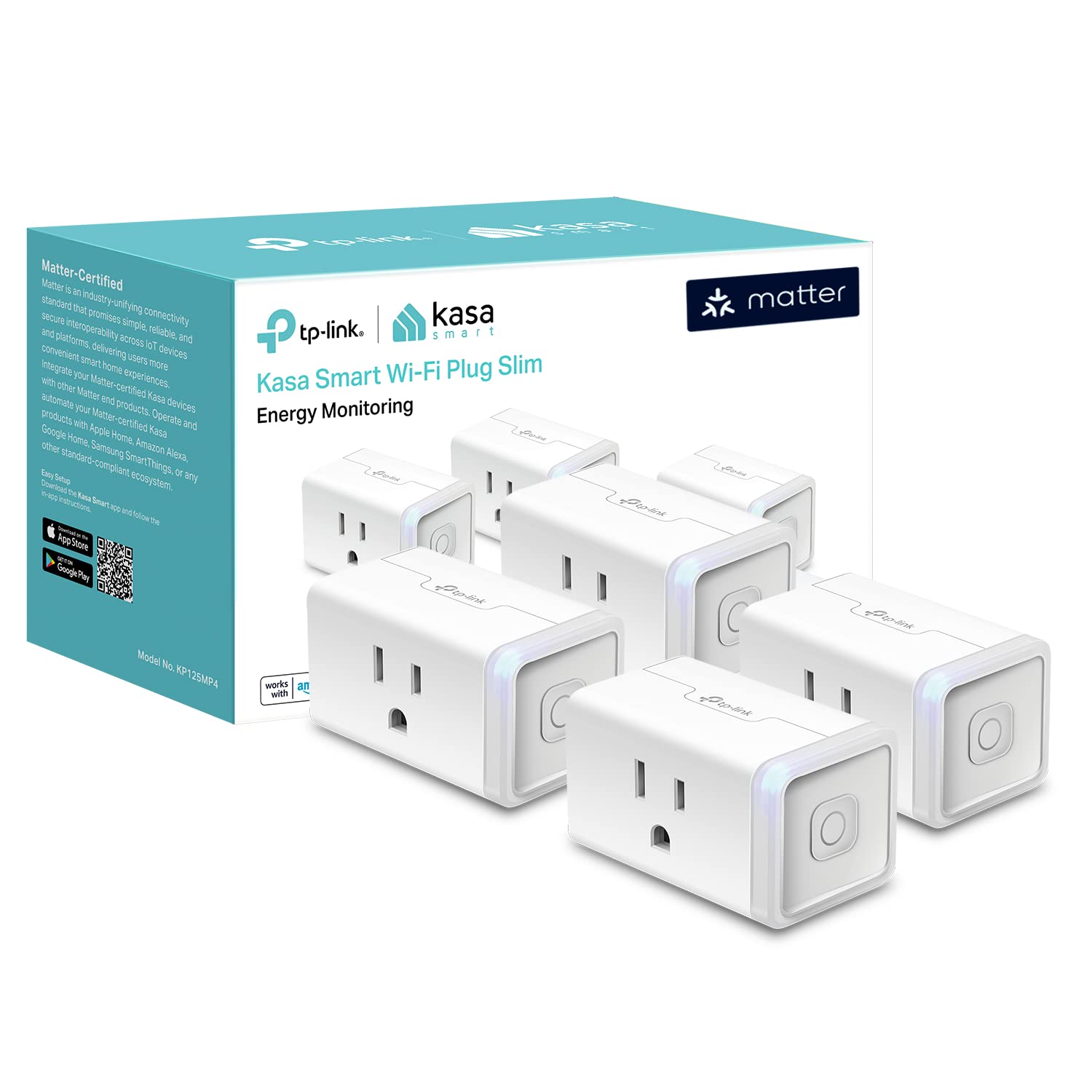
Features and Specifications
Type: Matter-certified smart plug, four-pack
Platforms: Apple Home, Alexa, Google Home
Connectivity: 2.4GHz Wi-Fi
Power Rating: 15A / 1800W max
Certification: UL Certified
Color: White
Notable Feature: Energy monitoring
Matter is the headline here. It is an open smart-home standard backed by the major platforms, and it exists to solve the oldest annoyance in the category: a plug that only talks to one assistant. A Matter plug pairs once and can then be shared with Apple Home, Alexa and Google Home rather than being locked to the app that set it up. For a household with an iPhone user and an Echo user under the same roof, that is the difference between one plug everyone can control and a running argument about whose app wins.
The 15A/1800W ceiling puts this in the general-purpose bracket. That covers lamps, fans, chargers, holiday lighting, a coffee maker, a space heater on a low setting and most small kitchen appliances. It is not a circuit for a clothes dryer or an EV charger, and buyers with those loads need a different class of device entirely.
The 2.4GHz-only Wi-Fi is standard for this product type and worth stating plainly: the plugs will not join a 5GHz-only network, so the router needs a 2.4GHz band broadcasting during setup. Most home routers do this by default, but a mesh system with band steering turned on can complicate the first pairing.
UL Certification is the safety stamp that matters on a device sitting in a wall outlet pulling current all day. It is not a marketing line; it is the listing a buyer should look for on any plug that will be left unattended.
What Matter Support Actually Changes
The value of Matter is not a feature on a spec sheet — it is the absence of a problem. Older smart plugs often required the manufacturer’s app for setup and then a separate skill or bridge to reach a voice assistant. A Matter plug is designed to be commissioned once and then adopted by the platform of choice.
In practice, that means a buyer can set the plugs up in Apple Home and still hand a guest access through Google Home, or run routines in Alexa without the Kasa app open. The Kasa app remains useful for firmware and for the energy data, but it is no longer the gatekeeper.
The catch is that Matter support varies by platform and by hub. Apple Home needs a home hub — an Apple TV, HomePod or iPad left at home — for remote access and automation. Alexa and Google Home have their own requirements that shift with app versions and device generations. Buyers on older hardware should confirm their hub is Matter-capable before assuming the plugs will slot in.
Energy Monitoring and What It Is Good For
Energy monitoring turns a dumb outlet into a measuring tool. The plug reports how much power whatever is plugged into it is drawing, which lets a household find the real cost of a space heater, a gaming PC, a window AC unit or an older fridge. Over a month, that data is often more valuable than the automation itself — it tells a buyer which device is worth unplugging.
The monitoring is per-plug, so the four-pack is best deployed on four separate loads rather than four lamps in the same room. A buyer who wants to compare a dehumidifier against a portable heater needs two plugs; a buyer who wants to schedule four lamps needs the plugs but will ignore the data.
Accuracy on consumer-grade monitoring is good enough for comparison, not for billing. It is a tool for spotting the outlier, not for auditing the utility company.
Build, Size and Placement
The compact design matters more than it sounds. A smart plug that is bulky blocks the second outlet in a duplex receptacle or fouls the space behind furniture. Kasa’s design here is aimed at fitting where a normal plug would, which is the difference between a four-pack that gets used and a four-pack that sits in a drawer.
The white housing suits visible placements — kitchen counters, living room lamps, a hallway outlet. It is not a decor piece, but it does not draw attention either.
Four plugs in one box is a deliberate choice by the manufacturer: it pushes the per-plug cost down and assumes the buyer has more than one thing worth automating. That is usually true. It also means a buyer who only needs one plug is paying for three extras.
Trade-off: The 2.4GHz-only Wi-Fi and platform-dependent Matter setup mean buyers on 5GHz-only networks or with older hubs may hit friction before the plugs ever connect.
Setup and Daily Use
Setup runs through the Kasa app and a Matter pairing code. The plugs need to be on a 2.4GHz network, and the phone doing the pairing should be on the same network during commissioning. Once paired, control moves to whichever platform the buyer prefers, with the Kasa app available for energy history and firmware.
Daily use is voice control, schedules and routines. A lamp on a schedule, a fan that runs only when the room is occupied, a coffee maker that starts before the alarm — these are the jobs. The plugs handle them without drama, which is the correct outcome for this category.
The failure mode to plan for is Wi-Fi. A plug at the far end of the house on a weak 2.4GHz signal will drop offline intermittently. Buyers with dead zones should fix the network before blaming the plug.
Who Should Buy the Kasa Matter Smart Plug
This four-pack suits a household that already has a mix of Apple, Alexa and Google devices and wants one set of plugs that works with all of them. It also suits buyers who want to measure what their appliances actually cost to run, since the monitoring is baked in rather than sold as an add-on.
It is a weaker fit for a buyer who needs a single plug, who has a 5GHz-only network, or who wants a plug with a physical button override for guests and kids — the design here leans on app and voice control rather than a big manual switch. Buyers with high-draw appliances like dryers or EV chargers should look at a different product class entirely.
FAQ
-
Does the Kasa Matter Smart Plug work with Apple Home?
Yes. The plug is Matter-certified and lists Apple Home among its supported platforms, alongside Alexa and Google Home. Apple Home remote access requires a compatible home hub. -
Does it need a hub to work?
The plug connects directly over 2.4GHz Wi-Fi. A hub is only needed for remote access and automation on platforms that require one, such as Apple Home. -
What is the maximum wattage?
The rating is 15A / 1800W max. That covers lamps, fans, chargers, coffee makers and most small appliances, but not high-draw devices like dryers or EV chargers. -
Does it work on 5GHz Wi-Fi?
No. The plug connects on 2.4GHz Wi-Fi only, which is standard for this product type. The router needs a 2.4GHz band available during setup. -
What does energy monitoring actually measure?
The plug reports the power draw of whatever is connected to it, so a household can compare appliances and spot the ones that cost the most to run. -
Is the plug safe to leave unattended?
It carries UL Certification, which is the safety listing buyers should look for on a plug that stays in the wall. It is rated for the loads described above. -
Can four plugs be controlled separately?
Yes. Each plug in the four-pack is its own device with its own schedule, routine and energy data. -
Does it work with Google Home and Alexa at the same time?
Matter is designed to let one plug be shared across platforms, so a household can use Apple Home, Alexa and Google Home together rather than picking one. -
What happens if the Wi-Fi goes down?
App and voice control stop working, but the plug keeps passing power to whatever is connected. Schedules stored locally may continue depending on the platform. -
Is the four-pack worth it for a small apartment?
Only if there are four loads worth automating or measuring. A buyer with one lamp and one fan is paying for plugs that will sit unused.
Bottom Line
The Kasa Matter Smart Plug four-pack is the right buy for a multi-platform household that wants smart plugs to just work across Apple Home, Alexa and Google Home, with energy monitoring as a genuine bonus rather than a gimmick. Buyers with a single load, a 5GHz-only network or an older hub should think twice, but for everyone else this is a straightforward pick — check the current price at Amazon before the snapshot goes stale.