Why there are Amazon links here: Brave Review is paid a commission for qualifying Amazon purchases made through the links below. Your price does not change, and using our links is entirely optional. How this works
8 Best Battery Storage With Solar Panels – Power That Actually Lasts
Solar panels only pay off when the energy they collect has somewhere to go. That is why the best battery storage with solar panels matters more than the panel itself: the battery decides whether a system runs a fridge overnight, keeps a boat topped up through winter, or simply charges a phone on a campsite.
The top pick for most households is the Jackery HomePower 3600 Plus & 2x200W Solar Panels — a high-capacity expandable unit that pairs its own panels with the battery. For a full whole-home setup with an inverter included, the ECO-WORTHY Solar Complete System is the more serious build.
These eight picks were chosen on capacity, continuous output, whether solar charging is included, and how well each unit scales as needs grow. Smaller trickle chargers and power banks sit alongside full home systems because the search covers both — the sections below make the split clear.
At a Glance
| Product | Key Spec | Best Use | Price Tier |
|---|---|---|---|
| Jackery HomePower 3600 Plus & 2x200W Panels | 3584Wh, expandable to 21kWh, 3600W AC | Whole-home backup | Premium |
| ECO-WORTHY Solar Complete System | 6x 590W panels, 48V 314Ah battery pair, 10kW inverter | Off-grid home build | Premium |
| Anker SOLIX C1000 Gen 2 with 200W Panel | 1,024Wh LiFePO4, 2,000W rated / 3,000W output | UPS and outdoor use | Mid |
| Jackery Solar Generator 1000 v2 & 200W Panel | 1070Wh, 1500W AC, 1-hour fast charge | RV and off-grid living | Mid |
| Portable Solar Generator 300W with 60W Panel | 280Wh, 300W, pure sine wave | Camping and van life | Budget |
| MPPT Solar Controller & 20W Panel Kit | 20W 12V panel, MPPT controller, IP67 | Boat, RV, motorcycle | Budget |
| POWOXI 7.5W Solar Trickle Charger | 7.5W 12V, waterproof controller | Battery maintenance | Budget |
| Solar Power Bank with Hand Crank | 20000mAh, 10W solar panel, 3 built-in cables | Phones and gadgets | Budget |
Top 8 Best Battery Storage With Solar Panels Reviews
Jackery HomePower 3600 Plus & 2x200W Solar Panels
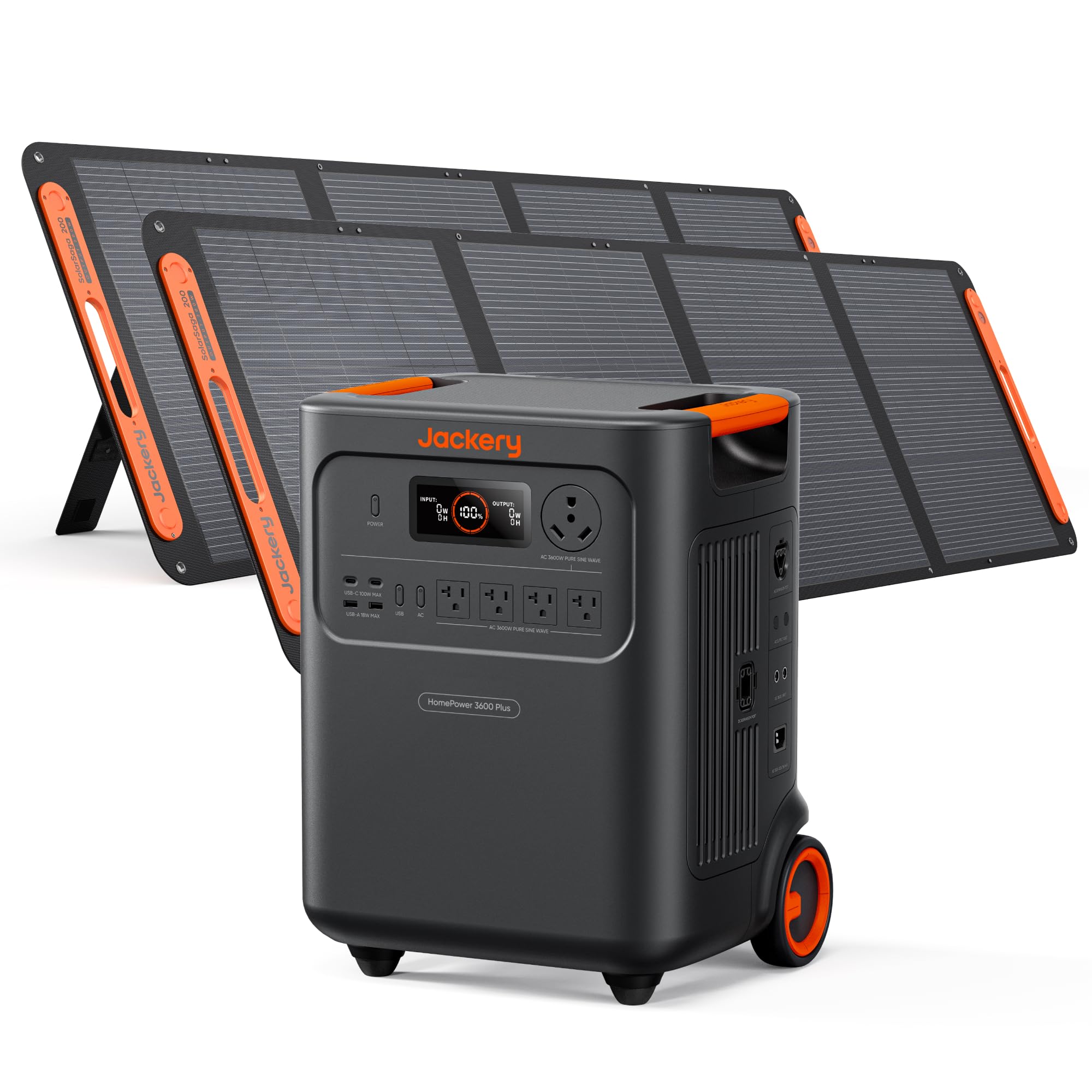
Battery Type: LFP (LiFePO4)
Capacity: 3584Wh
Expandable To: 21kWh
AC Output: 3600W
Solar Input: 2x200W panels included
Intended Use: Home backup, emergencies, RV
This is the unit that turns a solar panel purchase into a household power plan. The 3584Wh starting capacity covers a fridge, lights and router for a stretch, and the expandable design means a buyer can add capacity later instead of replacing the whole box.
Real-world use is mostly about outage insurance. The 3600W AC output runs high-draw appliances that smaller stations cannot touch, and the paired 200W panels let the system refill from sunlight rather than a wall socket. LFP chemistry is the right call here — it holds up over years of partial charging far better than older lithium blends.
The weak spot is the price of entry. This is a premium purchase, and the full 21kWh ceiling only arrives after buying additional batteries. Buyers who just want to keep a freezer cold through a storm are paying for headroom they may never use.
Trade-off: The expandable ceiling is the selling point, but reaching it means buying more battery modules on top of an already expensive starting kit.
Check the current price on Amazon
ECO-WORTHY Solar Complete System
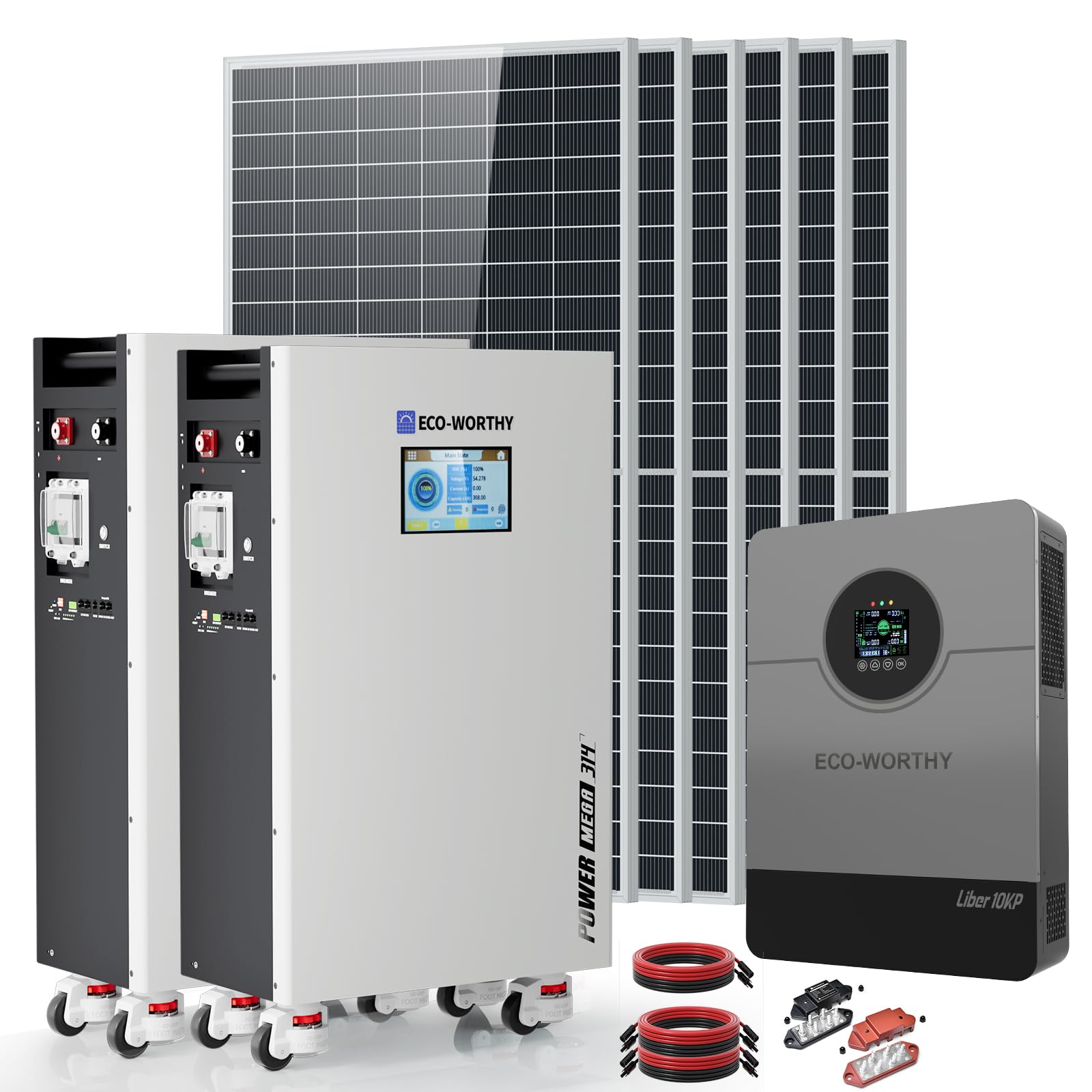
Solar Panels: 6x 590W N-Type
Battery: 48V 314Ah LiFePO4 (2 pack)
Inverter: Liber 10KP 10kW hybrid
System Type: Complete home backup kit
Intended Use: Whole-home energy storage
A genuine component kit rather than a sealed appliance. Six N-Type panels, a large 48V LiFePO4 battery bank and a 10kW hybrid inverter arrive together, which means the buyer is not hunting down a compatible inverter after the fact.
This is the pick for someone building storage into a property rather than rolling a box into a garage. The hybrid inverter allows both solar and grid interaction, and the 48V battery pair is sized for sustained household loads instead of short bursts. N-Type panels are the newer, more heat-tolerant cell type, which suits roof or ground arrays in warm climates.
The caution is installation. A kit at this scale involves real wiring, mounting and often a licensed electrician, so the delivered price is not the installed price. Buyers wanting plug-and-play should look elsewhere in this list.
Trade-off: It is the most capable system here, but it assumes the buyer has the skills or the budget to have it professionally installed.
Check the current price on Amazon
Anker SOLIX C1000 Gen 2 with 200W Solar Panel
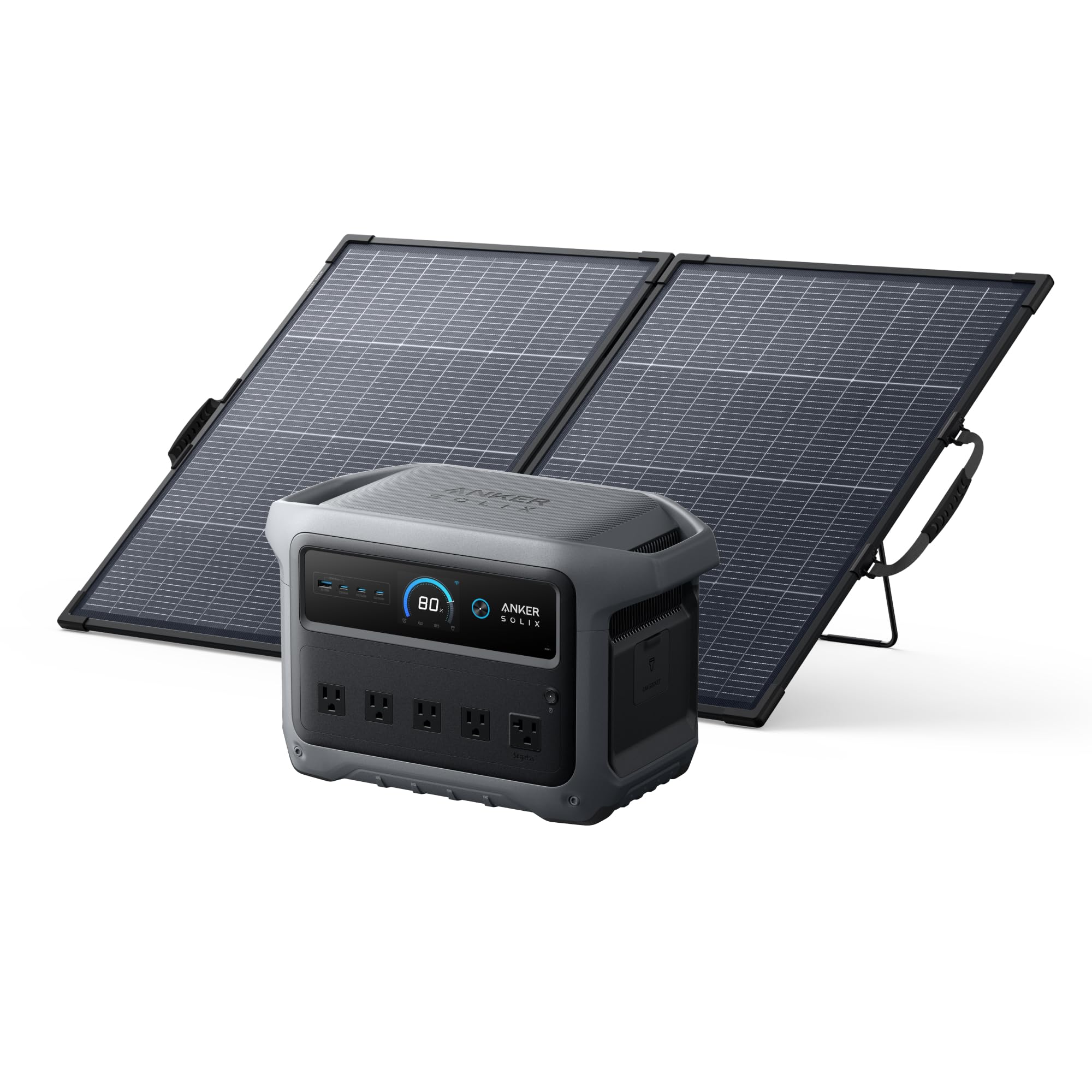
Battery Type: LiFePO4
Capacity: 1,024Wh
Rated Output: 2,000W
Peak Output: Up to 3,000W
Solar Panel: 200W included
Intended Use: UPS, home, outdoor
The middle of the market, done well. A 1,024Wh LiFePO4 battery with 2,000W continuous output covers the gap between a camping toy and a home system, and the 200W panel included in the box means solar charging works from day one.
The UPS angle is what separates it from pure outdoor stations. Plugged into a wall, it can keep a router, desktop or medical device running through a short outage, and the 3,000W surge handles motor startup on tools and fridges. LiFePO4 chemistry gives it a long service life relative to its size.
The limitation is honest: 1,024Wh is one day of light use, not a week. A household that loses power for days will drain it quickly, and there is no expandable battery architecture here to fix that.
Trade-off: Lightweight and genuinely useful as a UPS, but the fixed capacity means it cannot grow with a household’s needs.
Check the current price on Amazon
Jackery Solar Generator 1000 v2 & 200W Solar Panel

Capacity: 1070Wh
AC Output: 1500W
Battery Type: LiFePO4
Fast Charge: 1 hour
USB-C Output: 100W
Solar Panel: 200W included
Intended Use: Outdoor, off-grid living, RV, emergency
Built for people who move their power around. The 1070Wh capacity and 1500W AC output sit in the same class as the Anker above, but the 1-hour fast charge and 100W USB-C output push it toward road and off-grid use.
RV owners and van dwellers are the natural audience. The 200W panel tops it up during the day, the 100W USB-C port charges a laptop without an adapter brick, and the LiFePO4 cells tolerate being cycled constantly. The one-hour recharge from a wall outlet is genuinely useful when shore power is available briefly.
The catch is the 1500W ceiling. It runs a coffee maker or a small microwave, but not both, and large appliances with high startup draw will trip it. Buyers planning to run serious tools should step up to a higher-output unit.
Trade-off: Excellent for mobile living, but the 1500W output limits it to light household appliances and small devices.
Check the current price on Amazon
Portable Solar Generator 300W with 60W Solar Panel

Capacity: 280Wh
Output: 300W
Waveform: Pure sine wave
Outlets: AC, DC, USB QC3.0
Solar Panel: 60W included
Intended Use: Camping, smart devices, RV, van, outdoor
The entry point for solar storage. At 280Wh and 300W, this is a weekend camping unit — phones, a laptop, a small fan, a camera battery — with a 60W panel to keep it fed.
Pure sine wave output is the detail worth noting at this price. It means sensitive electronics charge without the buzz or heat that modified sine wave inverters cause, so a laptop or a drone battery is safe on it. The QC3.0 USB ports add fast phone charging, and the whole unit is light enough to carry to a tent.
Expectation management matters here. 300W will not run a kettle, a heater or a full-size fridge, and 280Wh empties fast under any real load. It is a convenience purchase, not a backup plan for a house.
Trade-off: Cheap and genuinely portable, but the small capacity and 300W ceiling rule out anything beyond small devices.
Check the current price on Amazon
MPPT Solar Controller & 20W Panel Kit

Panel: 20W, 12V
Controller: MPPT
Rating: IP67 waterproof
Mounting: Adjustable bracket
Intended Use: Boat, car, RV, motorcycle, marine, automotive
A maintenance kit rather than a power station. The 20W panel keeps a 12V battery topped up while a vehicle or boat sits unused, and the MPPT controller extracts more from a small panel than a basic regulator would.
The IP67 rating and adjustable bracket are what make it practical. It can be mounted on a deck, a roof rack or a trailer and left in the weather, with the bracket angled toward the sun. MPPT matters on a panel this small because every watt counts when the goal is stopping a battery from going flat over winter.
The limitation is scope. 20W maintains a battery; it does not charge a depleted one quickly or run any load directly. Buyers expecting usable power from this kit will be disappointed — it exists to prevent sulfation, not to power a fridge.
Trade-off: A reliable battery maintainer, but 20W is far too little to recharge a flat battery or run appliances.
Check the current price on Amazon
POWOXI 7.5W Solar Trickle Charger
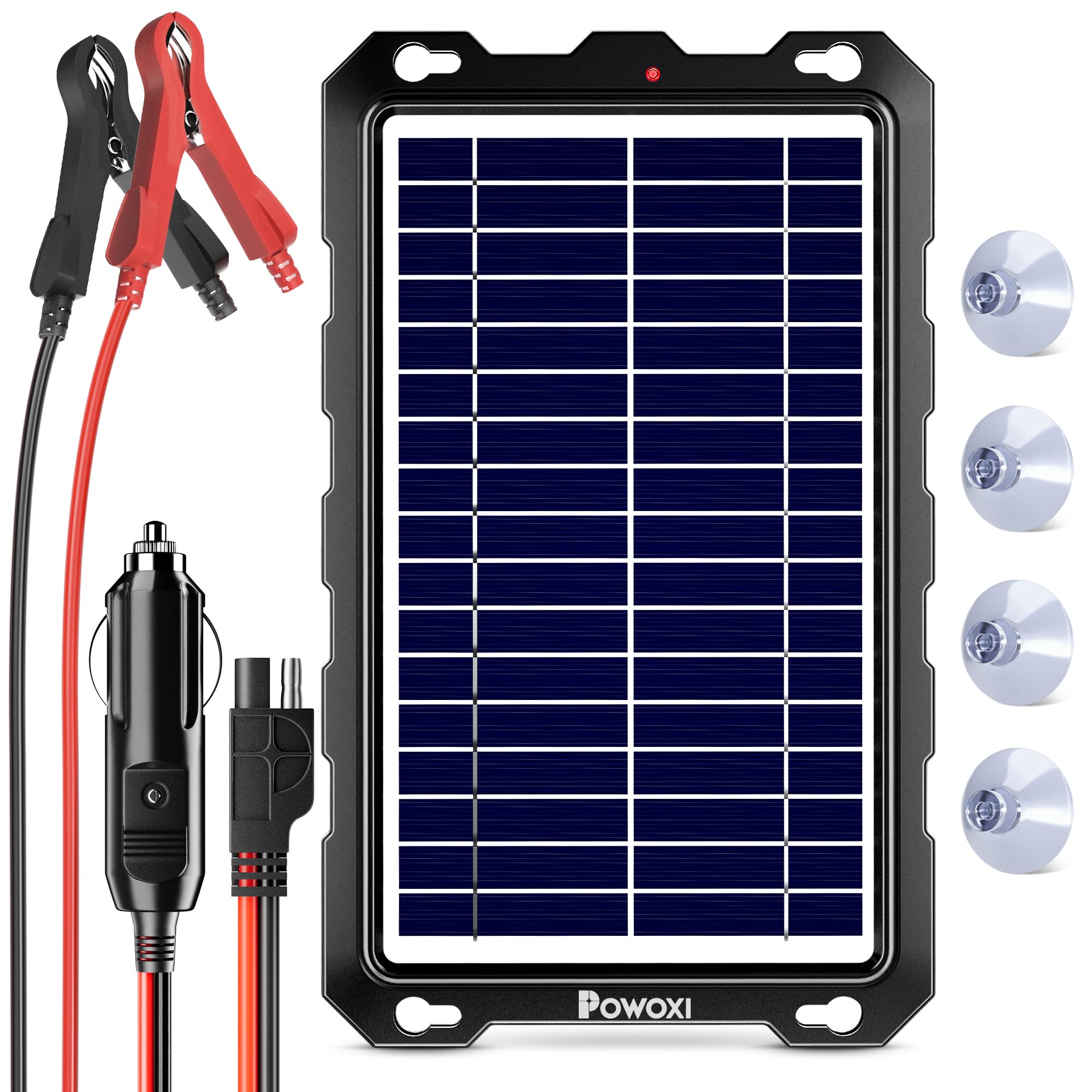
Panel: 7.5W, 12V
Controller: Smart charge, waterproof
Protections: Intelligent safety protections
Intended Use: Boat, marine, RV, automotive, motorcycle, trailer, car
The simplest tool in the roundup. A 7.5W panel with a built-in smart controller, designed to sit on a dashboard or a boat cover and trickle power into a 12V battery that would otherwise self-discharge.
This is the pick for seasonal equipment. A motorcycle stored for winter, a trailer parked for months, a boat on a mooring — all of them lose charge quietly, and a trickle charger stops that. The waterproof controller and intelligent protections mean it can be left connected without supervision.
The honest caveat is that 7.5W is tiny. It will hold a healthy battery at charge, but it cannot rescue one that is already dead, and it will not keep up with any parasitic drain beyond normal self-discharge.
Trade-off: Perfect for long-term storage, but its output is too small to do anything beyond holding a healthy battery steady.
Check the current price on Amazon
Solar Power Bank with Hand Crank
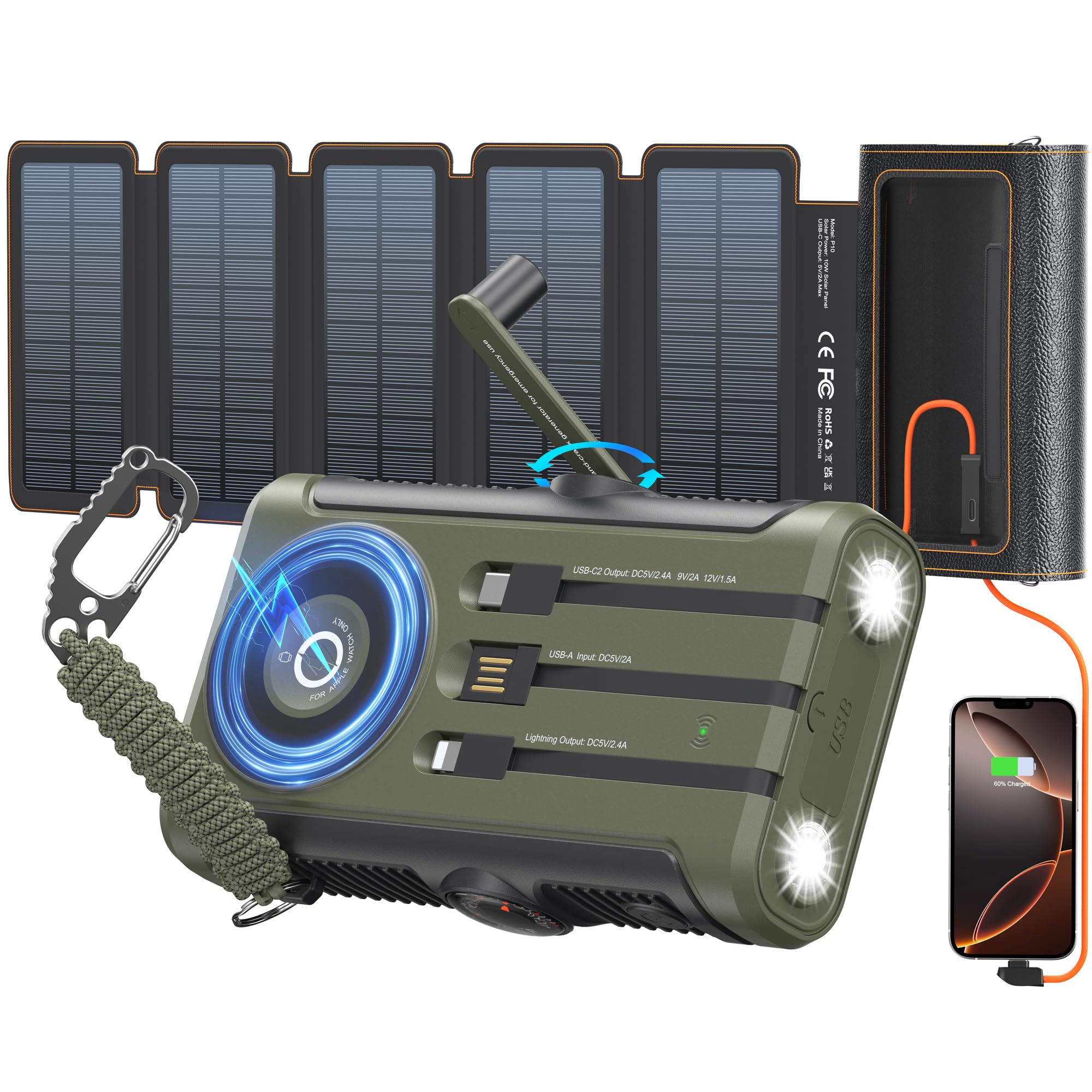
Capacity: 20000mAh
Solar Panel: 10W
Charging: 20W fast charging, 15W magnetic wireless
Built-in: 3 cables, flashlight, hand crank
Intended Use: Cell phones, camping
The smallest form of solar storage here, and the one most likely to actually be carried. A 20000mAh bank with a 10W solar panel, three built-in cables, magnetic wireless charging and a hand crank for the worst case.
The redundancy is the point. Built-in cables remove the most common failure — forgetting the right cord — and the hand crank means a dead bank is never truly dead if there is time and patience. The flashlight suits camping and emergency kits, and 20W fast charging keeps a phone topped up quickly when the sun is out.
The realistic limit is that solar charging on a bank this size is slow. The 10W panel supplements rather than replaces wall charging, and the hand crank is an emergency measure, not a routine one.
Trade-off: A genuinely useful emergency gadget, but the small panel makes solar a backup to wall charging rather than a replacement.
Check the current price on Amazon
Before You Decide
Match the battery to the job, not to the biggest number on the box. A whole-home system is wasted on a camper, and a 280Wh camping pack will not keep a freezer running. The three questions that settle it: what needs to run, for how long, and whether the buyer is willing to install anything.
What It Changes
- Overnight solar becomes usable — power collected during the day runs loads after dark.
- Outages stop being disruptive when a charged battery sits ready.
- Stored vehicles and boats avoid dead batteries and the replacement cost that follows.
- Fuel generators become optional rather than essential for short outages.
- Off-grid living and remote work become practical without a permanent hookup.
- Small devices stay charged on multi-day trips without hunting for outlets.
The Buying Guide
Capacity And Runtime
Watt-hours decide how long a battery lasts, and the figure should be matched to actual loads rather than aspirational ones. A fridge plus lights plus router is a different calculation from a phone and a lamp. The Jackery HomePower 3600 Plus sits at the top of the range for a reason, while the Portable Solar Generator 300W covers only small devices.
Output And Surge Rating
Continuous watts determine what runs at once; surge watts determine what can start. Motors and compressors draw several times their rated power for a moment, so a unit with headroom handles a fridge where a smaller one trips. The Anker SOLIX C1000 Gen 2 is the clearest example of a unit rated for both.
Battery Chemistry
LiFePO4 is the current standard for storage because it tolerates deep cycling and holds up over years of use. Older lithium blends are lighter but shorter-lived, and lead-acid is cheaper but bulky. Almost every serious pick in this list uses LiFePO4, from the Jackery 1000 v2 upward.
Solar Input And Included Panels
A battery is only solar storage if panels can refill it. Buying a station and panels together removes compatibility guesswork, which is why the paired kits here are easier for first-time buyers. The ECO-WORTHY complete system takes that furthest by including panels, battery and inverter in one purchase.
Expandability
Households change, and a system that can grow avoids a full replacement later. Expandable architecture costs more upfront but protects the investment. The Jackery HomePower 3600 Plus is the only pick here designed to scale to whole-home capacity.
Installation And Maintenance
Sealed power stations need nothing beyond charging. Component kits need wiring, mounting and often a licensed installer, and trickle chargers need only a connection to a battery. The POWOXI 7.5W trickle charger is the lowest-effort option in the roundup.
FAQ
-
What size battery storage is needed to run a house on solar?
A typical home needs multiple kilowatt-hours to cover an evening and overnight, and more to ride out a long outage. The Jackery HomePower 3600 Plus starts at 3584Wh and expands to 21kWh, which is the realistic range for whole-home backup. -
Can a solar panel charge a battery directly without a controller?
Not safely. A controller regulates voltage and prevents damage, which is why the MPPT kit and the POWOXI trickle charger both include one built in. -
How long do LiFePO4 solar batteries last?
LiFePO4 chemistry is chosen for long service life and tolerance of deep discharge. It outlasts older lithium blends and requires far less maintenance than lead-acid. -
Is a portable power station the same as home battery storage?
No. A portable station is sealed, movable and limited in capacity, while home storage is installed, expandable and wired into a property. The ECO-WORTHY kit is the home-storage example here. -
Do these systems work in cloudy weather?
Solar output drops in cloud, so a larger panel array or a bigger battery buffer matters in less sunny regions. Paired panel kits reduce the guesswork. -
What is the difference between a trickle charger and a solar generator?
A trickle charger maintains a battery that is already charged; a generator stores and delivers usable power. The POWOXI unit maintains, the Jackery units generate.
Bottom Line
For most buyers, the Jackery HomePower 3600 Plus & 2x200W Solar Panels is the best battery storage with solar panels because it pairs serious capacity with expandability and ships with its own panels. Buyers building a permanent whole-home system should go straight to the ECO-WORTHY Solar Complete System, which includes the panels, battery bank and hybrid inverter in a single kit.