Why there are Amazon links here: Brave Review is paid a commission for qualifying Amazon purchases made through the links below. Your price does not change, and using our links is entirely optional. How this works
Best Smart Alarm Siren for a Home: 5 Picks That Actually Integrate
A smart siren is only as useful as the system it talks to, and that single fact splits this market in half. This guide covers five sirens for three kinds of buyers: the tinkerer running Home Assistant or Hubitat, the renter who wants a cheap Wi-Fi siren on a phone app, and the homeowner who wants a siren bundled with door and window sensors. The overview table below shows the key differences at a glance; each review follows with the trade-offs that decide the purchase.
Overview of the Picks
| Product | Key Spec | Best Use | Price Tier |
|---|---|---|---|
| YoLink Smart Security Siren YS7103 | 110 dB, LoRa, hub required | Long-range outbuilding and garage coverage | Mid |
| Wi-Fi Smart Siren Alarm (105 dB, Smart Life) | 105 dB, 24 sounds, Alexa/Google | Budget app-based alerting | Budget |
| WiFi Alarm Home Security System with Sensors | 120 dB, sensor kit included | One-box shed and garage setup | Mid |
| WiFi Siren Alarm RGB (105 dB, Smart Life) | 4 volume levels, RGB, 24 tones | Tuning loudness and tone per room | Budget |
| Zooz Z-Wave Long Range Smart Siren ZSE50 | Z-Wave 800 LR, siren and chime | Existing Z-Wave hubs and automations | Mid |
1. YoLink Smart Security Siren Alarm YS7103 — Best for Long-Range Coverage
Type: Hub-based smart siren
Protocol: LoRa (YoLink)
Sound Output: 110 dB
Range: Up to 2034 feet
Key Features: Remote siren control, panic alerts, Home Assistant support
Hub: Required (YoLink hub)

Check the current price on Amazon
The YoLink siren is built around a low-frequency radio link rather than Wi-Fi or Zigbee, and that is the whole point of the product. LoRa signals push through walls and across distance that ordinary Wi-Fi drops, so a siren can sit in a detached garage, a shed or a far corner of a large property and still respond to commands. The unit is a straightforward box with a 110 dB output, remote siren control and a panic-alert function that can be triggered from the app. Home Assistant users get a documented path in, which matters for anyone building automations rather than relying on a manufacturer’s app.
This pick earns its place for properties where range is the hard constraint. A buyer with a workshop 200 feet from the house will get more reliable triggering from this than from any Wi-Fi siren at twice the price. The caution is structural: it needs a YoLink hub to do anything at all, so the hub cost belongs in the budget, and it will not speak to a Smart Life, Alexa-only or Z-Wave ecosystem without extra work.
Trade-off: The hub requirement and single-ecosystem lock-in make this a poor fit for anyone who already runs a mixed smart home and does not want another bridge.
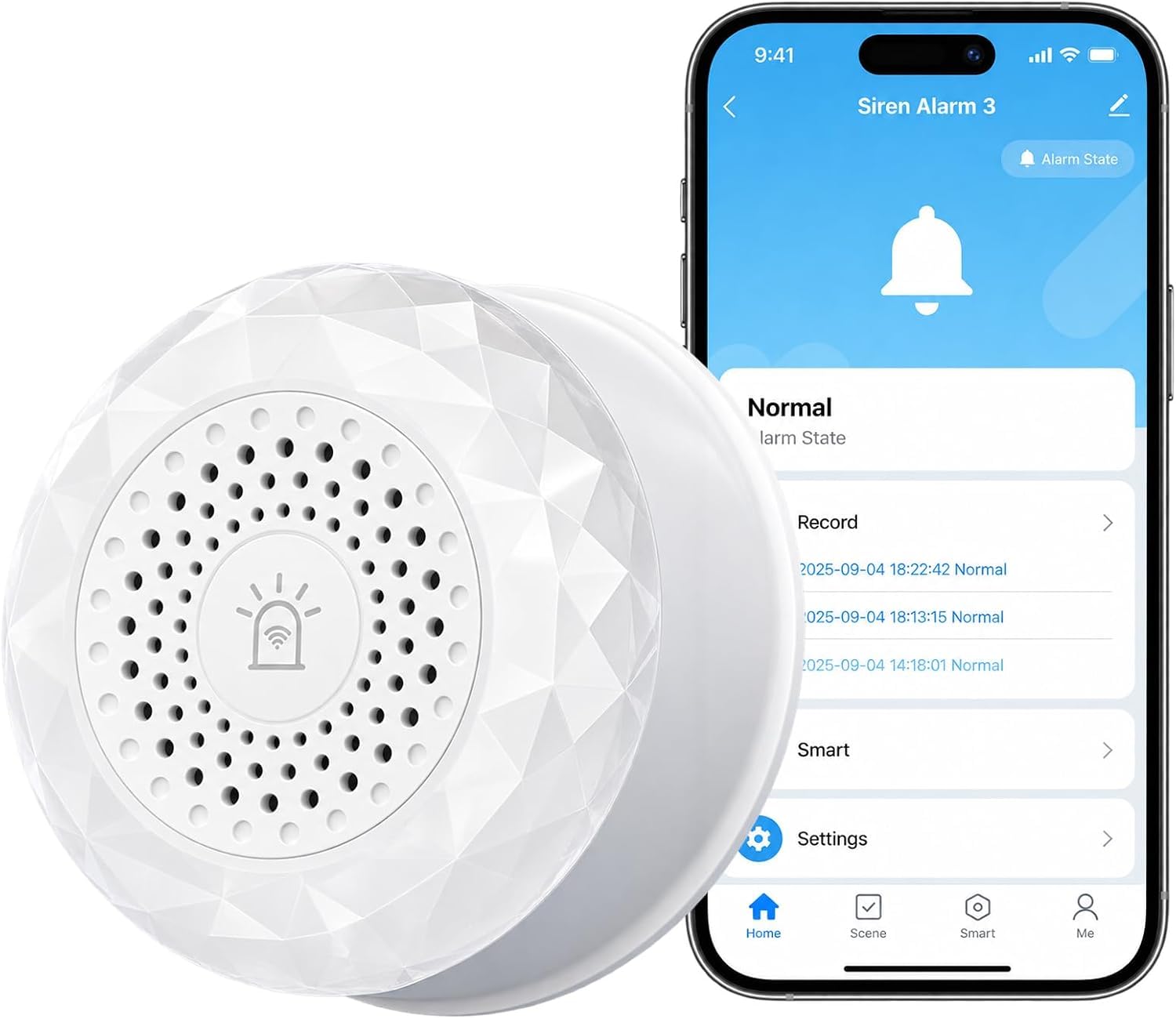
2. Wi-Fi Smart Siren Alarm (105 dB, Smart Life) — Best Budget App Siren
Type: Wi-Fi smart siren
Sound Output: 105 dB
Alert Method: App push alerts
Sound Options: 24 sounds
Compatibility: Smart Life/Tuya, Alexa, Google
Automation: Links with compatible Smart Life/Tuya devices
Check the current price on Amazon
This is the simplest route into a smart siren: a wireless sounder that joins a 2.4 GHz Wi-Fi network and reports through the Smart Life app. The 105 dB output is loud enough to be uncomfortable in a hallway and audible through interior doors, and the 24-sound library lets a buyer pick something distinct from a smoke alarm. Voice alerts and Alexa/Google support mean it can also be used as an announcement chime for doorbells or sensor triggers, not just an emergency siren.
It suits renters and first-time smart-home buyers who want push alerts on a phone without buying a hub. The value is in the automation hooks: any compatible Smart Life or Tuya sensor can trigger it, so a cheap door contact turns into a working alarm. The limitation is the radio itself — Wi-Fi sirens depend on a strong access point nearby, and a siren in a brick outbuilding or at the end of a garden will drop offline when it matters.
Trade-off: Wi-Fi-only connectivity and cloud dependency make this the least reliable option for outbuildings or any location with weak signal.
3. WiFi Alarm Home Security System with Sensors — Best All-in-One Kit
Type: Wi-Fi alarm system with siren
Sound Output: 120 dB
Included: Motion sensor, window/door sensors, remote control
Power: Mains-powered siren unit
Best For: Shed, garage, small premises

Check the current price on Amazon
This is the only pick in the group that arrives as a working system rather than a single device. The box includes a 120 dB siren, a motion sensor, window and door contacts, and a remote control, which means a buyer can arm and disarm without opening an app. The 120 dB rating is the loudest here, and the remote is genuinely useful in a shed or garage where a phone is not always at hand.
It fits the buyer protecting a single outbuilding or a small property who does not want to research sensors separately. Setup is self-contained: pair the sensors to the siren, mount them, and the system works. The trade-off is flexibility — bundled kits tend to expand only with the same brand’s accessories, and the sensor count is fixed out of the box, so a larger property will need a second kit rather than a few extra contacts.
Trade-off: The kit format limits expansion to the manufacturer’s own accessories, and the included sensor count may fall short on anything bigger than a shed or small garage.
4. WiFi Siren Alarm RGB (105 dB, Smart Life) — Best for Custom Alerts
Type: Wi-Fi smart siren
Sound Output: 105 dB
Sound Options: 24 tones
Volume Levels: 4
Alarm Duration: 10–1800 seconds
Lighting: RGB
App: Smart Life

Check the current price on Amazon
This siren is the adjustable one. Four volume levels let a buyer run it quietly as a door chime during the day and at full 105 dB as an alarm at night, and the alarm duration can be set anywhere from ten seconds to half an hour. The RGB lighting adds a visual alert for anyone who is hard of hearing or wears headphones, and the 24 tones cover everything from a standard siren to a spoken-style chime. It runs on the Smart Life app and pairs with Tuya sensors for automation.
It suits buyers who want one device to do double duty as an alarm and a notification chime, and who value being able to dial the noise down. The caution is the same Wi-Fi dependency as the other budget pick, plus the app-first design: without a phone or a working cloud connection, the automation logic stops.
Trade-off: Cloud and app dependency means the siren’s smart features stop working if the internet or the Smart Life service is unavailable.
5. Zooz Z-Wave Long Range Smart Siren ZSE50 — Best for Z-Wave Hubs
Type: Z-Wave smart siren and chime
Protocol: Z-Wave 800 Long Range
Functions: Siren and chime
Compatibility: Z-Box, Home Assistant, Hubitat, HomeSeer
Hub: Required (Z-Wave hub)

Check the current price on Amazon
The Zooz ZSE50 is aimed squarely at people who already run a Z-Wave network. It is a combined siren and chime on the 800 series Long Range standard, which extends Z-Wave reach well beyond the older mesh and removes the need for repeaters in many homes. It works with Z-Box, Home Assistant, Hubitat and HomeSeer, so automations can trigger it from any sensor on the network rather than from a single vendor’s app.
This is the pick for the buyer whose hub is the center of the smart home and who wants local control with no cloud in the loop. The siren and chime modes mean it can announce a door opening during the day and sound an alarm at night. The drawback is the entry cost: it needs a compatible Z-Wave hub, and it is the most expensive single device here, so it only makes sense for someone already invested in that ecosystem.
Trade-off: Without a Z-Wave hub the device is inert, and the price premium over Wi-Fi sirens is only justified for existing Z-Wave users.
Before You Buy
- Hub vs. Wi-Fi: Hub-based sirens (YoLink, Zooz) need a matching controller but stay reliable and local; Wi-Fi sirens are cheaper and easier but depend on the cloud and a strong access point.
- Sound output: Ratings here run from 105 dB to 120 dB. Higher is not automatically better for indoor use — a 120 dB siren in a hallway is painful, and adjustable volume matters more.
- Range and placement: LoRa and Z-Wave Long Range reach outbuildings that Wi-Fi cannot. Match the radio to the distance, not the price.
- Ecosystem compatibility: Check that the siren speaks to the app or hub already in use — Smart Life/Tuya, Home Assistant, Hubitat or HomeSeer. A mismatch means a second app and no shared automations.
- Expansion: Bundled kits limit extra sensors to the same brand. Single sirens pair with any compatible sensor on the network.
- Power and mounting: Sirens are usually mains-powered and wall-mounted. Confirm an outlet and a mounting spot near the coverage area before buying.
Frequently Asked Questions
-
Does a smart siren need a hub?
Not always. Wi-Fi models connect directly to a router and work through an app. LoRa and Z-Wave models require a matching hub, which adds cost but improves range and local reliability. -
How loud should a home alarm siren be?
Around 105 dB is loud enough to startle and alert within a home. Higher outputs such as 120 dB suit garages and outbuildings where the sound has to carry further. -
Can a smart siren work with Alexa or Google?
Many Wi-Fi sirens do, including the Smart Life models here. Hub-based sirens usually integrate through the hub or a platform like Home Assistant instead. -
Will a Wi-Fi siren work in a detached garage?
Only if the Wi-Fi signal reaches it. For outbuildings, a LoRa or Z-Wave Long Range siren is the more dependable choice. -
Can a siren double as a door chime?
Yes. Models with multiple tones, volume levels or a dedicated chime mode can announce doors during the day and switch to alarm volume at night.
Bottom Line
For most homes, the best smart alarm siren for a home is the YoLink Smart Security Siren YS7103: its LoRa range covers garages and outbuildings that Wi-Fi cannot, and the Home Assistant support keeps it useful for years. Buyers already running a Z-Wave hub should take the Zooz ZSE50 instead, and anyone on a tight budget who only needs indoor app alerts will be well served by the Smart Life Wi-Fi sirens.