Why there are Amazon links here: Brave Review is paid a commission for qualifying Amazon purchases made through the links below. Your price does not change, and using our links is entirely optional. How this works
Best Wired Backhaul for Mesh Nodes for Fast, Stable Whole-Home Wi-Fi
A mesh system only reaches its full speed when its nodes talk to each other over Ethernet instead of Wi-Fi, and that is exactly what wired backhaul delivers. This guide covers five TP-Link Deco WiFi 7 mesh systems that each include 2.5G ports built for that job, from a single-unit starter to a three-pack for large homes. Budget buyers, apartment dwellers and owners of big multi-floor houses will all find a fit below. The overview table sums up the differences; the reviews explain who each pick suits and where it falls short.
The Picks at a Glance
| Product | Key Spec | Best Use | Price Tier |
|---|---|---|---|
| Deco 7 Pro BE63 (2-Pack) | Tri-band BE10000, 4x 2.5G ports each | Fast two-node wired setup | Premium |
| Deco 7 Pro BE63 (3-Pack) | Tri-band BE10000, 4x 2.5G ports each | Large homes, multi-floor | Premium |
| Deco 7 BE23 (1-Pack) | Dual-band BE3600, 2x 2.5G ports | Small homes, starter node | Budget |
| Deco 7 BE23 (2-Pack) | Dual-band BE3600, 2x 2.5G ports | Mid-size homes on a budget | Budget |
| Deco 7 BE23 (3-Pack) | Dual-band BE3600, 2x 2.5G ports | Whole-home coverage, value | Budget |
1. TP-Link Deco 7 Pro BE63 Tri-Band WiFi 7 BE10000 (2-Pack)
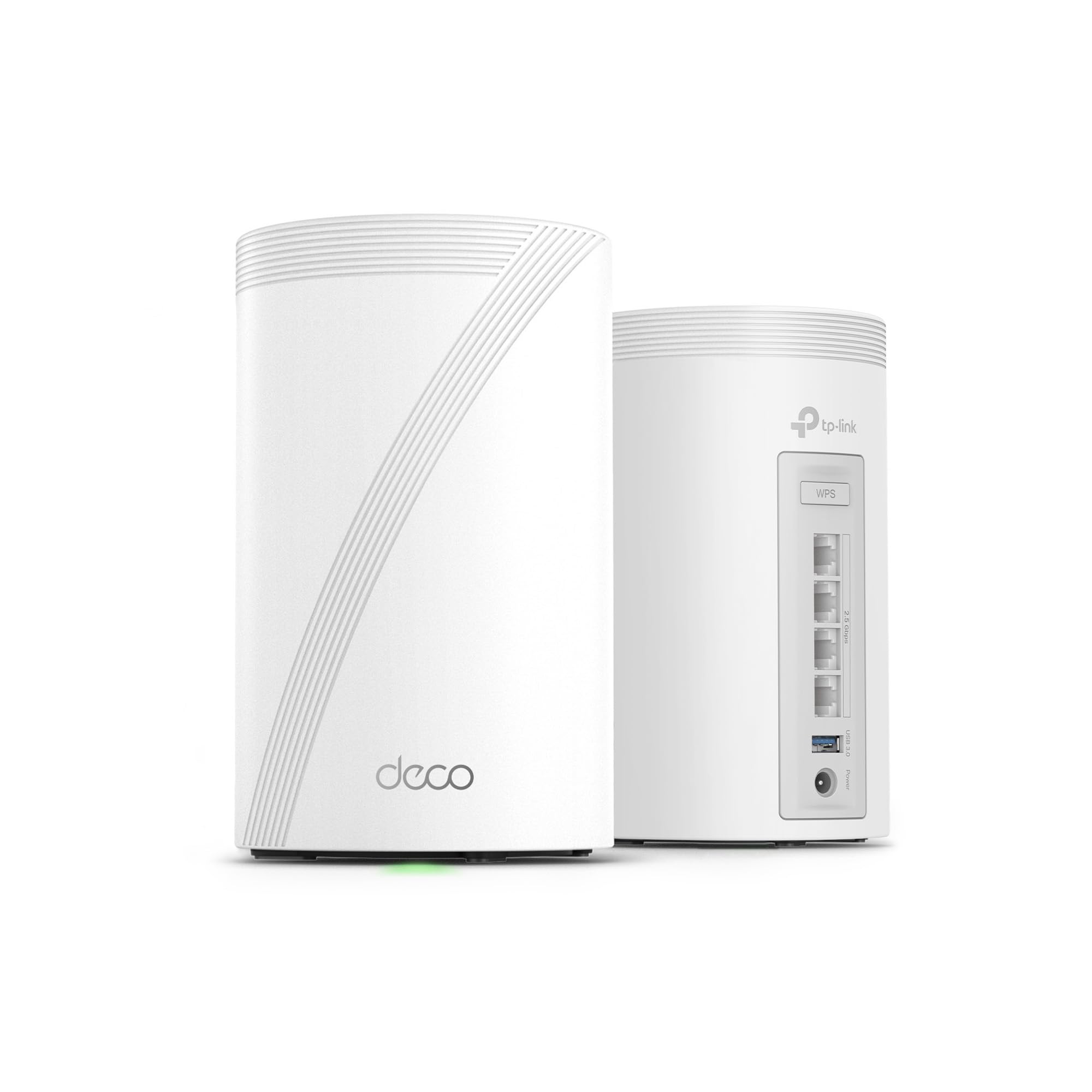
Wireless Standard: WiFi 7, tri-band
Speed Class: BE10000, 6-stream, 10 Gbps
Wired Backhaul Ports: 4x 2.5G per unit
Antennas: 4x smart internal
Security and Features: VPN, HomeShield
Pack Size: 2-pack
Check price on Amazon: TP-Link Deco 7 Pro BE63 2-Pack
The BE63 two-pack is the high-performance entry into wired backhaul. Each node carries four 2.5G ports, which is unusually generous — one can feed the modem, one can link the second node, and two stay free for a NAS, a desktop or a console. The tri-band BE10000 design spreads traffic across three radios, so the dedicated backhaul link and the client devices do not fight over the same airtime. Smart internal antennas keep the units clean-looking on a shelf or side table.
This pick suits households with gigabit-plus internet and several heavy devices, especially anyone who wants to wire a node in another room and still have spare Ethernet for local hardware. It is the strongest choice for a two-node setup in a house where the modem and the second node can be joined by a cable.
Trade-off: The premium tri-band hardware costs noticeably more than the BE23 line, and a two-pack leaves larger homes short of a third node.
2. TP-Link Deco 7 Pro BE63 Tri-Band WiFi 7 BE10000 (3-Pack)
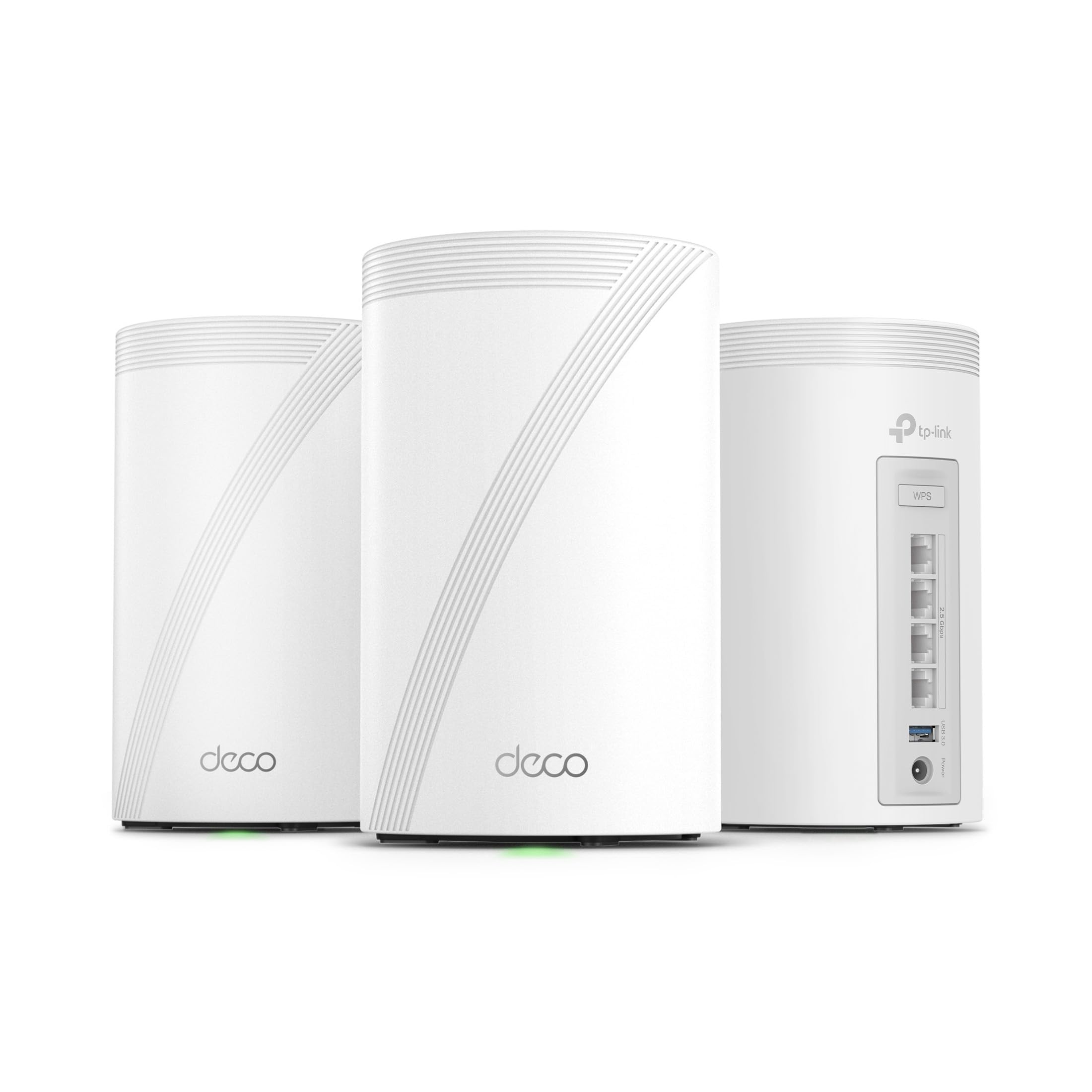
Wireless Standard: WiFi 7, tri-band
Speed Class: BE10000, 6-stream, 10 Gbps
Wired Backhaul Ports: 4x 2.5G per unit
Antennas: 4x smart internal
Coverage: Up to 7,600 sq.ft
Security and Features: VPN, HomeShield, AI-Roaming
Pack Size: 3-pack
Check price on Amazon: TP-Link Deco 7 Pro BE63 3-Pack
The three-pack version of the BE63 adds a third node to the same tri-band BE10000 platform, pushing stated coverage to 7,600 square feet. Every unit keeps the four 2.5G ports, so a three-node wired backbone can run through the house while still leaving Ethernet free at each location. AI-Roaming helps devices hand off between nodes as the user moves from room to room. HomeShield and VPN support round out the software side.
This is the pick for large, multi-floor homes where a cable run to each node is practical. Buyers with a big house, a busy household and a fast internet plan get the most from it, and the wired links keep the tri-band radios free for devices.
Trade-off: Three nodes plus the premium tri-band hardware make this the most expensive option here, and the extra node is wasted in a compact home.
3. TP-Link Deco 7 BE23 Dual-Band BE3600 WiFi 7 Mesh Router (1-Pack)

Wireless Standard: WiFi 7, dual-band
Speed Class: BE3600, 4-stream, 3.6 Gbps
Channel Width: 160 MHz
Wired Backhaul Ports: 2x 2.5G
Coverage: Up to 2,500 sq.ft
Security and Features: VPN, MLO, HomeShield
Pack Size: 1-pack
Check price on Amazon: TP-Link Deco 7 BE23 1-Pack
The single BE23 is the cheapest way into this lineup and a sensible starting point for a wired mesh. It is a dual-band BE3600 unit with two 2.5G ports, so one port can take the incoming connection and the other can run a cable to a future node. MLO support lets compatible devices use both bands at once, and 160 MHz channels help on the 5 GHz side. The stated coverage of 2,500 square feet suits an apartment or a small house.
This pick suits renters, first-time mesh buyers and anyone who wants one strong node now and plans to add a second later over Ethernet. It also works as an extra node added to an existing BE23 setup.
Trade-off: A single unit gives no mesh redundancy until a second node is bought, and the dual-band design has less headroom than the tri-band BE63 for very dense device loads.
4. TP-Link Deco 7 BE23 Dual-Band BE3600 WiFi 7 Mesh System (2-Pack)

Wireless Standard: WiFi 7, dual-band
Speed Class: BE3600, 4-stream, 3.6 Gbps
Channel Width: 160 MHz
Wired Backhaul Ports: 2x 2.5G per unit
Coverage: Up to 4,500 sq.ft
Security and Features: VPN, MLO, AI-Roaming, HomeShield
Pack Size: 2-pack
Check price on Amazon: TP-Link Deco 7 BE23 2-Pack
The two-pack BE23 is the value sweet spot for wired backhaul. Two nodes cover a stated 4,500 square feet, and each keeps the pair of 2.5G ports, so a cable between the two units forms a fast dedicated link while the radios serve devices. AI-Roaming is included here, helping phones and laptops switch nodes cleanly. MLO and 160 MHz channels keep the wireless side current with WiFi 7 hardware.
This pick suits mid-size homes and buyers who want a real mesh with a wired link but do not need tri-band throughput. Anyone wiring a modem to a living-room node and a second node at the back of the house gets a stable, fast setup for the money.
Trade-off: The dual-band platform has less capacity than the BE63 for households with dozens of active devices, and the 2.5G port count limits how much wired hardware each node can host.
5. TP-Link Deco 7 BE23 Dual-Band BE3600 WiFi 7 Mesh System (3-Pack)

Wireless Standard: WiFi 7, dual-band
Speed Class: BE3600, 4-stream, 3.6 Gbps
Channel Width: 160 MHz
Wired Backhaul Ports: 2x 2.5G per unit
Coverage: Up to 6,500 sq.ft
Security and Features: VPN, MLO, AI-Roaming, HomeShield
Pack Size: 3-pack
Check price on Amazon: TP-Link Deco 7 BE23 3-Pack
The three-pack BE23 stretches the same dual-band platform to a stated 6,500 square feet. Three nodes mean a wired backbone can reach the far corners of a long house or a home with thick walls, and each node still offers two 2.5G ports for local hardware. AI-Roaming, MLO and HomeShield carry over from the two-pack. It is the most coverage per dollar in the lineup.
This pick suits large homes on a budget, especially where cable runs are already in place or easy to add. Buyers who want whole-home coverage without paying tri-band prices get the best balance here.
Trade-off: Three dual-band nodes share limited radio capacity, so a very dense household may still feel congestion at peak times compared with the BE63 line.
Before You Buy
- Ports: Confirm each node has enough 2.5G ports for the modem, the backhaul cable and any wired devices; the BE63 offers four, the BE23 offers two.
- Cable: Wired backhaul needs Ethernet runs between nodes, so plan the route and length before choosing a pack size.
- Coverage: Match the stated square footage to the home, and add a node rather than stretching one too far.
- Wireless tier: Tri-band BE10000 suits heavy, dense households; dual-band BE3600 suits typical homes and budgets.
- Compatibility: All five units are Deco WiFi 7 models, so nodes from the same family can be mixed to extend a network.
- Features: VPN, HomeShield, MLO and AI-Roaming vary by model, so check which ones matter for the setup.
- Pack size: A single unit is a starter, a two-pack covers mid-size homes, and a three-pack suits large or multi-floor houses.
Frequently Asked Questions
-
What is wired backhaul for mesh nodes?
It is an Ethernet cable connecting mesh nodes so they pass traffic to each other over wire instead of Wi-Fi, which usually means faster and more stable links. -
Do all five picks support wired backhaul?
Yes. Every model here lists 2.5G ports for wired backhaul, with the BE63 offering four ports per unit and the BE23 offering two. -
Is a three-pack always better than a two-pack?
No. A three-pack suits large or multi-floor homes, while a two-pack is enough for mid-size spaces and costs less. -
Does wired backhaul need special cable?
Standard Ethernet cable works; the 2.5G ports simply allow faster links than older gigabit ports when the cable and hardware support it. -
Can a single BE23 be expanded later?
Yes. The one-pack is a starter node, and a second BE23 can be added over Ethernet to form a wired mesh. -
Which pick is best for a large house on a budget?
The BE23 three-pack covers the most area for the lowest outlay, while the BE63 three-pack is the choice for maximum performance.
Bottom Line
For most buyers, the TP-Link Deco 7 Pro BE63 3-Pack is the best wired backhaul for mesh nodes: four 2.5G ports per unit, tri-band BE10000 performance and enough coverage for a large home. Budget-focused buyers in mid-size homes should look at the BE23 two-pack instead.