Why there are Amazon links here: Brave Review is paid a commission for qualifying Amazon purchases made through the links below. Your price does not change, and using our links is entirely optional. How this works
EBL 2400W Portable Power Station: Whole-Home Backup Without the Generator
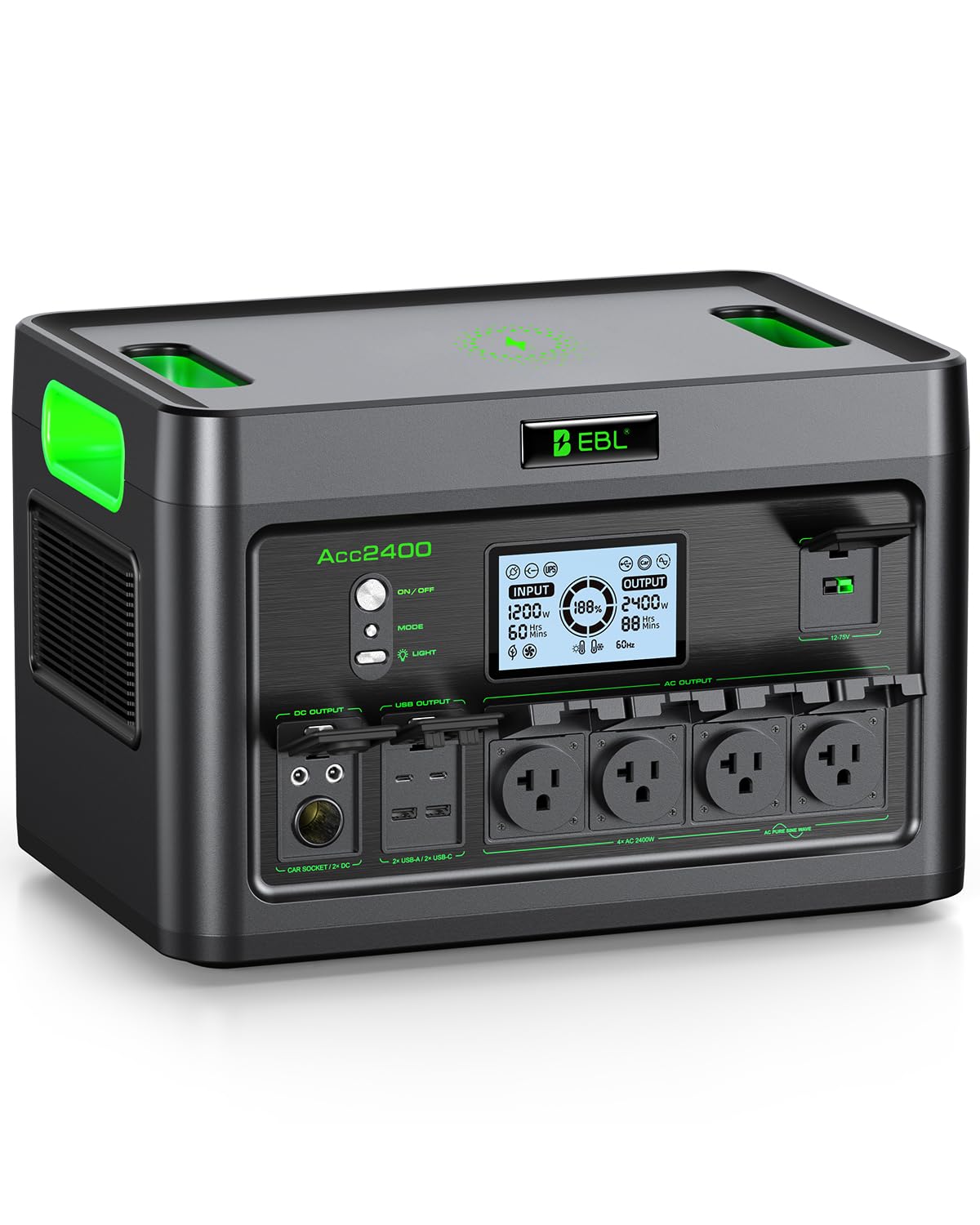
The EBL 2400W portable power station is a large-capacity home battery backup built around a 1843.2Wh LiFePO4 battery and 2400W of AC output spread across 12 outlets. It is aimed at households that want to keep the fridge, router, lights and a few small appliances running through an outage — without pulling a gas generator out of the garage. This review covers how the unit is built, what its capacity and power figures actually mean in daily use, who should buy it, and where it falls short.
Features and Specifications
Battery Capacity: 1843.2Wh
Battery Chemistry: LiFePO4
AC Output: 2400W across 12 outlets
USB-C Output: PD 100W
Recharge Time: 2 hours (quick charge)
Charging Inputs: AC wall outlet and solar panel
Intended Use: Home battery backup and portable power
ASIN: B0DQZT4SP8
The headline figure here is the 1843.2Wh capacity. That is roughly enough stored energy to run a typical refrigerator for most of a day, or to keep a router, a few LED lamps and a phone charger alive for considerably longer. It sits in the range where a unit stops being a camping gadget and starts being a genuine short-term household backup.
The 2400W AC output is the other number that matters. That ceiling is high enough to cover a space heater on a low setting, a microwave, a coffee maker or a sump pump — the kind of load that smaller stations simply refuse to start. Splitting that output across 12 outlets means a household does not have to choose between the fridge and the internet router.
Build and Battery Chemistry
LiFePO4 is the chemistry worth paying attention to. It is the same lithium iron phosphate family used in many modern home batteries, chosen because it holds up better to repeated charge cycles and is less prone to the thermal stress associated with older lithium formulations. For a unit that may sit idle for months and then be called on in an emergency, that durability matters more than raw energy density.
The practical consequence of LiFePO4 is weight. A battery of this capacity in this chemistry is heavy, and the unit is best understood as semi-portable: it can be wheeled or carried between rooms and loaded into a vehicle, but it is not something a buyer slings into a backpack for a hike. Buyers should plan a permanent or semi-permanent home for it — a garage shelf, a utility closet, a spot near the breaker panel — rather than treating it as a grab-and-go camping box.
Capacity in Real Terms
Capacity is where buyers most often misjudge a purchase like this. The 1843.2Wh rating is the stored energy, not a promise that every appliance runs for a fixed number of hours. A fridge cycles on and off, so its real draw is far lower than its label suggests; a space heater runs continuously and drains the battery quickly.
The honest way to read the figure is as a budget. Buyers should add up the wattage of what they want to keep running, estimate how many hours they need it, and compare that to the capacity. A household planning to cover a fridge, lights and communications for a day is well within range. A household expecting to run central air conditioning is not.
Power Output and Outlets
The 2400W AC ceiling is the feature that separates this unit from the budget tier. Many stations in the sub-1000W class cannot start a fridge compressor or a well pump at all, because the surge at startup exceeds their limit. A 2400W rating gives far more headroom for those motor-driven loads.
The 12-outlet layout is generous, and it changes how the unit gets used. Instead of a single power strip daisy-chained off one port, a household can leave the router, the modem, a lamp, a phone charger and a small appliance all plugged in at once. That turns the station into a small UPS-like hub rather than a device that has to be re-cabled every time a load changes.
The USB-C PD 100W port is a useful addition for modern laptops and tablets, which increasingly charge over USB-C rather than a barrel connector. It means the station can top up a work laptop without occupying one of the AC outlets.
Charging and Maintenance
The 2-hour quick charge claim is the standout convenience feature. A unit this size that can be refilled from a wall outlet in about two hours is meaningfully easier to live with than one that takes most of a day, because it can be topped up between outages rather than only during them. Solar charging is also supported, which gives a household a way to recharge during an extended outage when grid power is out.
Maintenance is minimal but not zero. LiFePO4 batteries prefer to be stored at a partial charge rather than fully drained, and a unit that sits unused for a long stretch should be checked and topped up periodically. Buyers should also keep the unit somewhere dry and temperate — a garage that swings between extreme heat and freezing cold is not ideal for long-term storage.
Trade-off: At this capacity and chemistry the unit is heavy and bulky, so buyers who want something to carry to a campsite or tailgate should look at a smaller station instead.
Check the current price on Amazon
Who Should Buy the EBL 2400W Portable Power Station
The clearest fit is a homeowner in an area with unreliable grid power — storm country, wildfire territory, or anywhere with rolling outages. For that buyer, the combination of a large LiFePO4 reserve and a 2400W output covers the loads that actually matter: refrigeration, communications, lighting and a few comfort appliances.
A second good fit is the household that wants backup power without the maintenance of a gas generator. There is no fuel to store, no oil to change, no carburetor to clean and no exhaust to vent. The station can live indoors, which means it is usable during a storm when running a generator outside is impractical.
The unit also suits remote workers and small home offices that need to keep a router, a laptop and a monitor alive through short interruptions. The USB-C PD 100W port and the outlet count make that a plug-and-play setup.
It is a poor fit for three groups. Buyers who need something genuinely portable — backpackers, overlanders, festival campers — will find the weight and size frustrating. Buyers who expect to run high-draw appliances like air conditioning or an electric dryer will be disappointed by the capacity ceiling. And buyers on a tight budget who only need to charge phones and a laptop through a short outage are overpaying for capability they will not use.
FAQ
-
How long will the EBL 2400W portable power station run a refrigerator?
A refrigerator cycles its compressor on and off, so its average draw is much lower than its peak rating. With 1843.2Wh of capacity, a typical household fridge can be covered for a substantial portion of a day, though exact runtime depends on the fridge’s efficiency, ambient temperature and how often the door is opened. -
Can the EBL 2400W power station run a space heater?
Yes, within limits. A 2400W AC output can handle many space heaters, but a heater running continuously is one of the fastest ways to drain the battery. It is better treated as a short-term comfort load than something to run all night. -
What does LiFePO4 mean and why does it matter?
LiFePO4 is lithium iron phosphate, a battery chemistry known for stability and long cycle life. For a backup unit that sits idle for long periods and then gets used hard during an outage, that durability is a real advantage over older lithium formulations. -
How long does the EBL 2400W take to recharge?
The unit is rated for a 2-hour quick charge from a wall outlet. Solar charging is also supported, which gives a recharge option during a grid outage, though solar recharge time depends on panel wattage and sunlight. -
Can the EBL 2400W power station be used indoors?
Yes. Unlike a gas generator, it produces no exhaust, so it can be used inside a home. It should still be kept dry and away from extreme temperatures. -
Is 1843.2Wh enough for a whole-home backup?
It is enough for essential circuits — fridge, lights, router, phone charging and a few small appliances — for a limited period. It is not a whole-home solution that will run air conditioning, electric heating or large appliances for extended stretches. -
How many devices can be plugged in at once?
The unit has 12 outlets, so a household can leave several devices connected simultaneously. Total draw across all of them still has to stay within the 2400W AC limit. -
Does the USB-C port charge laptops?
The USB-C PD 100W port can charge modern laptops and tablets that support USB-C power delivery, which frees up the AC outlets for other loads. -
Is the EBL 2400W portable enough to take camping?
It can be moved and transported, but at this capacity and chemistry it is heavy. It suits car camping or RV use far better than anything that has to be carried any distance. -
What maintenance does the unit need?
Minimal. The main tasks are keeping it dry, storing it at a partial charge rather than fully drained, and topping it up periodically during long idle stretches.
Bottom Line
The EBL 2400W portable power station is the right buy for a household that wants a large LiFePO4 reserve, a high AC output ceiling and enough outlets to keep essential circuits running through an outage — and is willing to accept the weight that comes with that capacity. Buyers who need genuine portability or who only face short, phone-charging-level interruptions should size down.
