Why there are Amazon links here: Brave Review is paid a commission for qualifying Amazon purchases made through the links below. Your price does not change, and using our links is entirely optional. How this works
Best Voltage Stabiliser for a Rural Supply: 5 Picks That Handle Sagging Lines
Rural supplies are hard on appliances: long feeder runs, undersized transformers and seasonal loads all pull the voltage down, and a stabiliser has to work harder there than it ever would in a city. This roundup covers five units that suit three kinds of buyer — the householder protecting a fridge and a few lights, the workshop running pumps and power tools, and the tinkerer who wants a dial rather than an automatic circuit. The overview below puts the key specs side by side; the reviews explain who each one actually fits.
The Picks at a Glance
| Product | Key Spec | Best Use | Price Tier |
|---|---|---|---|
| VEVOR Auto Variable Voltage Transformer 2000VA | 2000VA, 0–130V variable output | Bench work and dial-controlled regulation | Budget |
| SEVENSTAR AR 5000W Heavy Duty Voltage Reglator/Stabilizer | 5000W with step up/down | Whole-house or small workshop backup | Mid |
| Automatic Voltage Regulator 220V 15000VA | 15000VA automatic regulation | Large homes and heavy motor loads | Mid |
| Simran AR-2000 Voltage Regulator Stabilizer | 2000W with 110v–240V conversion | Travel and mixed-voltage appliances | Mid |
| 2000VA Max Variable Transformer | 2000VA, 0–130V, 20Amp | Budget variable regulation | Budget |
VEVOR Auto Variable Voltage Transformer 2000VA
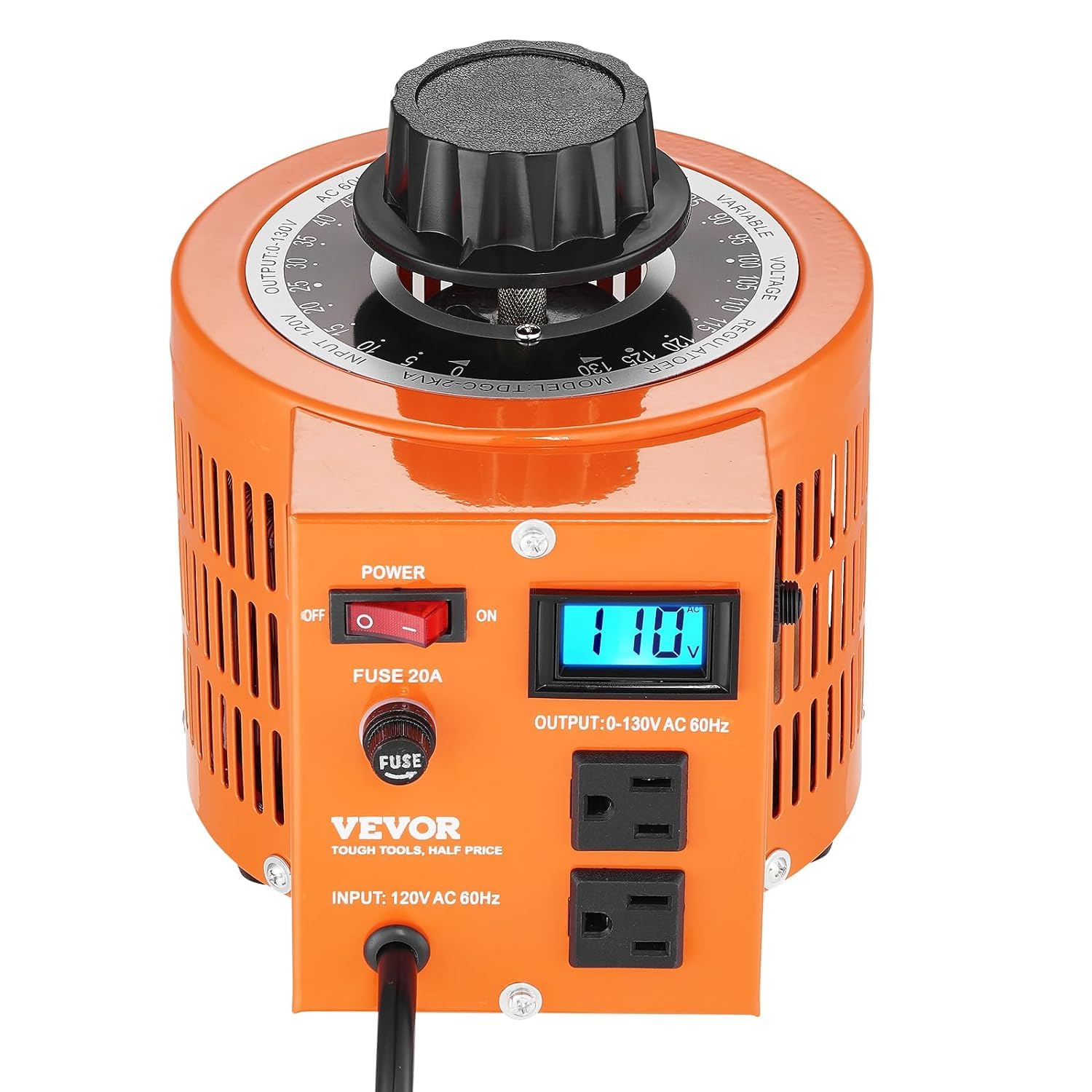
Type: Auto variable voltage transformer
Capacity: 2000VA
Current: 15.3 Amp
Input: 110V
Output: 0–130V AC, variable
Extras: LCD display, four spare fuses, thermal control switch
This is a bench-style variable transformer rather than a plug-and-forget stabiliser: the output is set by hand across a 0–130V range, so the user decides the voltage rather than a control circuit. The LCD display makes the setting readable at a glance, and the thermal control switch gives the unit a way to back off when it runs warm. Four spare fuses in the box are a practical touch for a rural setting where a trip to the hardware shop is a long drive. The 2000VA ceiling keeps it in appliance-and-tool territory, not whole-house territory.
It suits the buyer who wants to dial in a supply deliberately — running a pump, a bench tool or a single sensitive appliance off a consistently set voltage. It is not for anyone who wants the correction to happen automatically while they are out of the room. The trade-off is that manual regulation demands attention: the output must be reset as the incoming supply moves, and an unattended load can be left over- or under-volted.
Check the current price on Amazon
SEVENSTAR AR 5000W Heavy Duty Voltage Reglator/Stabilizer

Type: Automatic voltage regulator/stabiliser
Capacity: 5000W
Build: Heavy duty
Transformer: Built-in step up/down
Best use: Whole-house or workshop backup
The 5000W rating puts this unit in the range where a household can run a fridge, lighting and a few small appliances together, or a workshop can run a single larger tool. The built-in step up/down transformer means the same box can serve equipment expecting a different mains voltage, which is useful where the supply is unreliable in both directions. "Heavy duty" in the name points to a chassis and winding sized for sustained load rather than intermittent bench use.
It fits the rural household that wants one automatic unit covering the main circuits, or a small workshop with mixed-voltage gear. It is not for a buyer with only one small appliance to protect — the capacity would be wasted. The trade-off is bulk and heat: a heavy-duty transformer of this rating is a substantial, warm-running box that needs ventilation and a firm surface, not a shelf corner.
Check the current price on Amazon
Automatic Voltage Regulator 220V 15000VA Ultra Low Voltage Stabilizer

Type: Automatic voltage regulator/stabiliser
Input: 220V
Capacity: 15000VA
Design: Ultra low voltage stabiliser
Best use: Large homes and heavy motor loads
At 15000VA this is the largest unit in the roundup, and the "ultra low voltage" wording signals it is built to keep correcting when the incoming supply sags well below nominal — the exact condition rural feeders produce at the end of a long line. Automatic operation means no dial to watch. That capacity covers a whole large home, or motor loads like pumps and compressors that draw a heavy surge on start-up.
It is the pick for a property where the lights dim every time a pump kicks in, and where a smaller stabiliser would simply trip out. It is not for a single-room setup or a buyer on a tight budget — the capacity is paid for whether it is used or not. The trade-off is installation: a unit of this size is a fixed, wired-in piece of equipment rather than a plug-in box, so it needs a proper mounting point and enough ventilation around it.
Check the current price on Amazon
Simran AR-2000 Voltage Regulator Stabilizer

Type: Automatic voltage regulator/stabiliser
Capacity: 2000 Watt
Conversion: 110v–240V step up and down
Transformer: Built-in
Best use: Mixed-voltage appliances and travel
This unit pairs automatic stabilisation with a 110v–240V step up/down converter in one chassis, so it does two jobs: holding the supply steady and matching it to equipment built for a different mains voltage. The 2000W ceiling is enough for a single large appliance or a small cluster of electronics. Simran is a small-business brand, and the form factor is the familiar portable box rather than a wired-in installation.
It suits the rural buyer running imported 110V equipment — a pump, a tool, a piece of audio gear — off a 220V supply that also wanders. It is not for a whole-house load; 2000W will not carry a household. The trade-off is that combining conversion and stabilisation in one compact box leaves less thermal headroom than a dedicated heavy-duty unit, so sustained loads near the ceiling will run it hot.
Check the current price on Amazon
2000VA Max Variable Transformer

Type: Variable transformer / auto AC voltage regulator
Capacity: 2000VA max
Output: 0–130 Volt, variable
Current: 20Amp
Best use: Budget variable regulation
This is the value option for manual regulation: a 2000VA variable transformer with a 0–130V output range and a 20Amp rating. The 20Amp figure is the more generous of the two budget variable units here, which matters for tools that pull a heavy current on start-up. It is a plain power supply box — no display, no spare fuses — and the price reflects that.
It fits the buyer who wants dial-controlled voltage at the lowest outlay, for a workshop bench or a single stubborn appliance. It is not for anyone who needs automatic correction, and it is not for a load that has to be left running unattended. The trade-off is the bare-bones package: fewer protections and no readout mean the user has to supply their own metering and their own discipline about resetting the dial.
Check the current price on Amazon
Before You Buy
- Capacity: Add up the running wattage of everything the unit will carry, then leave headroom for motor start-up surges — pumps and compressors draw several times their running current for a moment.
- Automatic vs variable: Automatic units correct the voltage themselves and suit unattended household loads; variable transformers need the output set by hand and suit bench work.
- Input voltage: Match the unit to the actual supply. A 220V unit on a 110V feed, or the reverse, will not do the job regardless of capacity.
- Low-voltage behaviour: Rural supplies sag rather than spike, so check that the unit is described as handling low input, not just surges.
- Ventilation: Transformers of any size run warm. Plan a firm, open mounting point with airflow rather than a closed cupboard.
- Wiring and mounting: Large units are wired-in installations; portable boxes plug in. Decide which the property can accommodate before ordering.
- Spares: Fuses and thermal cutouts are the parts that fail first. A unit that ships with spares saves a long trip when one blows.
Frequently Asked Questions
-
What size stabiliser does a rural house need?
Add the running wattage of the appliances that must stay on together, then add headroom for motor start-up. A few lights and a fridge sit in the low-kilowatt range; a whole house with a pump needs considerably more. -
Is a variable transformer the same as an automatic stabiliser?
No. A variable transformer holds whatever output the user dials in; an automatic stabiliser senses the incoming voltage and corrects it continuously without input. -
Can a stabiliser fix a supply that drops very low?
A unit described as handling ultra-low voltage is built to keep correcting during deep sags. A standard unit may simply cut out to protect itself, which is why the low-voltage rating matters on a rural line. -
Will a stabiliser protect a pump or compressor?
It can, provided the capacity allows for the start-up surge, which is far higher than the running load. Undersizing is the usual reason a stabiliser trips when a motor starts. -
Does a step up/down transformer replace a stabiliser?
Not on its own. Conversion matches voltage to the appliance; stabilisation holds it steady. A unit with both does the two jobs together. -
Where should a stabiliser be installed?
On a firm, dry surface with open space for airflow, close enough to the load for the wiring run to stay practical. Large units are fixed installations and should be wired in properly.
Bottom Line
For most rural households the Automatic Voltage Regulator 220V 15000VA is the pick that earns its price: enough capacity for a whole home and heavy motor loads, automatic correction, and a design aimed squarely at the deep sags a long rural feeder produces. Buyers with a smaller load and a smaller budget should look at the SEVENSTAR 5000W, while bench users who want dial control get the best value from the VEVOR 2000VA.