Why there are Amazon links here: Brave Review is paid a commission for qualifying Amazon purchases made through the links below. Your price does not change, and using our links is entirely optional. How this works
Anker SOLIX C300 vs Jackery Solar Generator 300: Which Compact Power Station Fits the Trip
The Anker SOLIX C300 and the Jackery Solar Generator 300 are two compact power stations that sit in the same weight class but solve slightly different problems. The Anker is the faster-charging, more flexible unit for buyers who already own a solar panel; the Jackery ships as a bundled solar generator kit with a panel in the box. This comparison reads both on capacity, charging, output, portability and price tier, then names the buyer each one suits.
The Picks at a Glance
| Product | Key Spec | Best Use | Price Tier |
|---|---|---|---|
| Anker SOLIX C300 | 288Wh, 300W (600W surge), 140W two-way charging | Fast top-ups, panel-optional camping, blackout backup | Mid |
| Jackery Solar Generator 300 | 292Wh, 300W AC, 40W solar panel included | First-time solar buyers, RV and outdoor kits | Mid |
Both units land in the same capacity band, so the decision is not about watt-hours. It comes down to whether the buyer wants a panel in the box and a pure sine wave AC outlet, or faster charging and a two-way USB-C style power flow.
Anker SOLIX C300 Portable Power Station

Battery Chemistry: LiFePO4
Capacity: 288Wh
AC Output: 300W continuous, 600W surge
Charging: 140W two-way fast charging
Solar: Panel optional, sold separately
Intended Use: Hunting, travel, blackout backup, camping
The C300 is built around a LiFePO4 battery, the chemistry that has become the default for power stations expected to sit unused for long stretches and then be called on during an outage. LiFePO4 tolerates being stored at partial charge better than older lithium blends, which matters for a unit that lives in a closet between trips.
The headline feature is the 140W two-way charging. That figure describes a single port that can both take power in and push power out at high speed, so the station doubles as a fast-charging power bank for laptops and phones when it is not plugged into a wall. Buyers who carry a lot of USB-C gear will feel that flexibility more than they will feel the raw capacity.
The 300W AC output with a 600W surge covers the small-appliance tier: a laptop, a camera battery charger, a fan, a small cooler, a CPAP machine. It will not run a microwave or a space heater, and buyers should not expect it to. The surge rating buys headroom for motors and compressors starting up, not for continuous high-draw loads.
Solar is optional here, which is the split that defines this comparison. A buyer who already owns a folding panel or who charges mainly from the wall or a car will not pay for a panel they do not need. A buyer who wants a turnkey solar kit will have to source one separately.
Trade-off: The panel-optional packaging means first-time solar buyers face a second purchase and a compatibility check before the station is truly off-grid ready.
Check the current price on Amazon
Jackery Solar Generator 300 and 40W Solar Panel
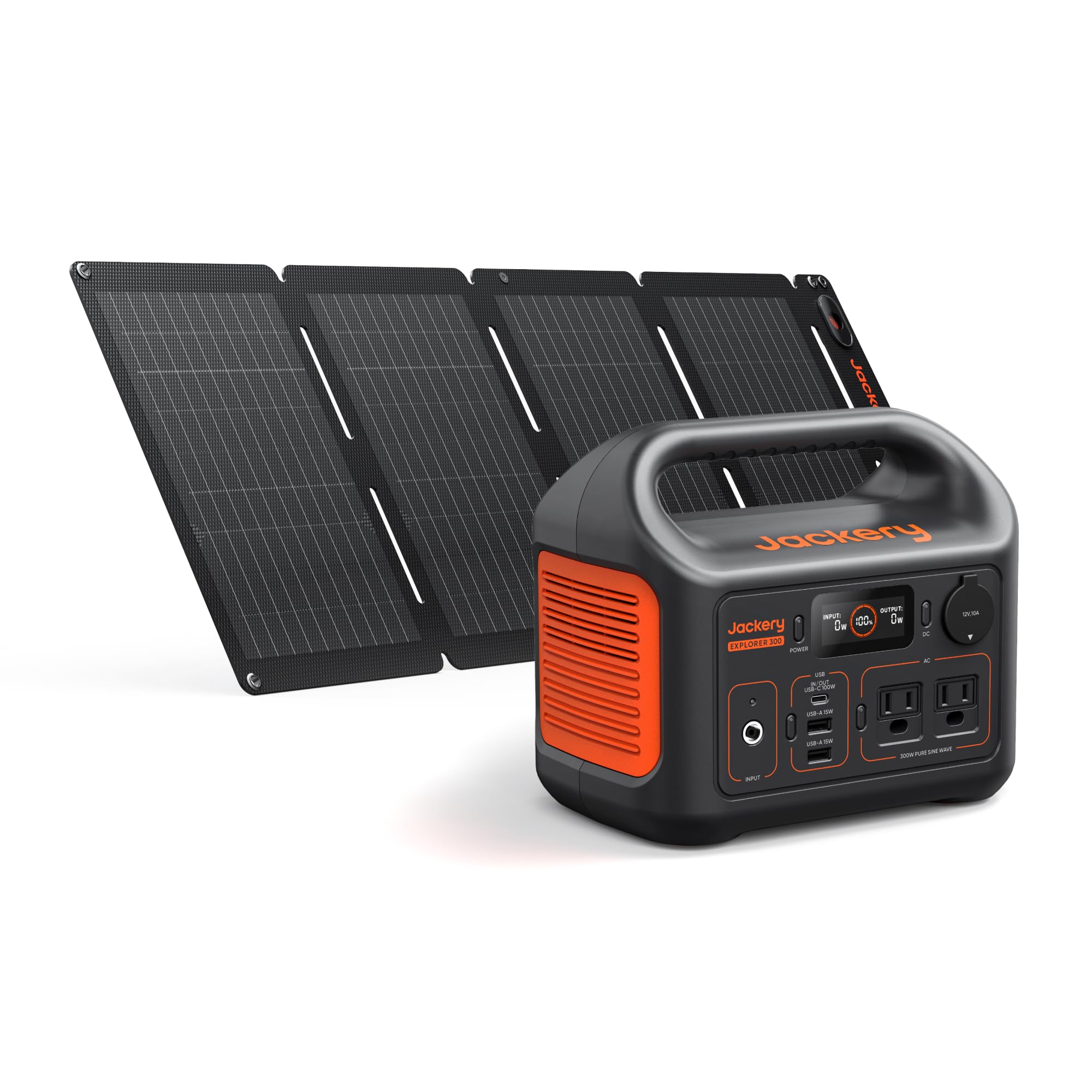
Battery Capacity: 292Wh
AC Output: 300W
AC Waveform: Pure sine wave
Solar Panel: 40W panel included
Intended Use: RV, outdoors, camping, travel, blackout
Packaging: Solar generator kit
The Jackery bundle pairs a 292Wh station with a 40W folding solar panel, which is the reason the product is sold as a "solar generator" rather than a plain power station. Buyers unbox a working off-grid setup in one order, with no compatibility question to answer and no second shipment to wait on.
The pure sine wave AC outlet is the spec worth slowing down on. Pure sine wave output is the cleaner waveform, and it is the one sensitive electronics prefer: laptops, TVs, medical devices and anything with a motor or a switching power supply. Modified sine wave inverters can cause hums, heat or erratic behavior in those loads. For a station this size, a pure sine wave inverter is a genuine quality marker rather than marketing filler.
The 292Wh capacity and 300W AC output put the Jackery in the same practical bracket as the Anker: phones, laptops, lights, cameras, small fans, a portable fridge for a while. Neither unit is a whole-home backup solution, and neither is meant to run high-draw kitchen appliances.
The 40W panel is modest, and that is the honest limit of the bundle. A 40W panel will recharge the station slowly in real sunlight, so buyers planning multi-day off-grid trips should treat the included panel as a maintainer rather than a fast refill. It keeps the station topped up between uses and covers light draw, but it will not race a wall outlet.
Trade-off: The included 40W panel is small for the battery it serves, so buyers who plan to live off solar for days at a time will likely want a larger panel anyway.
Check the current price on Amazon
Side-by-Side Comparison
| Dimension | Anker SOLIX C300 | Jackery Solar Generator 300 |
|---|---|---|
| Battery chemistry | LiFePO4 | Not the focus of the name; kit-first design |
| Capacity | 288Wh | 292Wh |
| AC output | 300W continuous, 600W surge | 300W |
| AC waveform | Not stated in the name | Pure sine wave |
| Fast charging | 140W two-way | Not stated in the name |
| Solar panel | Optional, sold separately | 40W panel included |
| Packaging | Station only | Station plus panel kit |
| Best fit | Buyers with their own panel or wall-first charging | First-time solar buyers and RV/outdoor kits |
Reading the Differences
Capacity is a wash. The 288Wh and 292Wh figures are close enough that no real-world trip will separate them on watt-hours alone. Buyers should not choose on capacity here; the four-watt gap is noise.
Charging speed and flexibility favor the Anker. The 140W two-way charging is the spec that changes daily behavior, because it lets the station act as a high-output power bank and refill quickly from a compatible source. The Jackery name does not foreground a comparable fast-charge figure, so the Anker is the clearer pick for buyers who treat the station as a hub for USB-C devices.
The AC waveform question favors the Jackery on paper. Pure sine wave output is the safer match for sensitive electronics, and the Jackery name states it directly. The Anker name does not make that claim, so a buyer with a device that is picky about power quality has a reason to lean Jackery.
Solar packaging is the real fork. The Jackery ships with a 40W panel, which makes it the simpler first purchase for someone who wants to unbox and go off-grid. The Anker assumes the buyer already has a panel or does not want one, which keeps the box leaner and the buyer’s options open.
Price tier is close enough that the bundle math decides it. The Jackery lists at a mid-tier price that includes a panel; the Anker sits in the same tier without one. Buyers comparing totals should price the Anker plus a panel against the Jackery kit, because that is the honest apples-to-apples figure.
Which Should You Buy?
Choose the Anker SOLIX C300 if the buyer already owns a solar panel or charges mainly from the wall and car, wants LiFePO4 chemistry for long storage life, and values a 140W two-way port for fast laptop and phone charging. It is the leaner, more flexible unit for gear-heavy travelers who do not need a bundled panel.
Choose the Jackery Solar Generator 300 if the buyer wants a complete solar generator kit in one order, plans to use it for RV and outdoor trips, and prefers pure sine wave AC output for sensitive electronics. The included 40W panel makes it the easier first step into off-grid power, even if a larger panel is a likely later upgrade.
FAQ
-
Is the Anker SOLIX C300 or the Jackery Solar Generator 300 bigger?
They are effectively the same size on paper. The Anker is rated at 288Wh and the Jackery at 292Wh, a difference too small to matter in real use. -
Does the Anker SOLIX C300 come with a solar panel?
No. The Anker is sold as a power station with solar listed as optional, so a panel is a separate purchase. -
Does the Jackery Solar Generator 300 include a solar panel?
Yes. The Jackery bundle includes a 40W solar panel alongside the 292Wh station. -
Which one has pure sine wave AC output?
The Jackery name states a pure sine wave AC outlet. The Anker name does not make that claim, so buyers with sensitive electronics should weigh that difference. -
Can either unit run a microwave or space heater?
No. Both are rated at 300W AC output, which is the small-appliance tier: laptops, lights, fans, cameras and similar loads. -
Which is better for fast charging a laptop?
The Anker, on the strength of its 140W two-way fast charging. The Jackery name does not foreground a comparable fast-charge figure. -
Which is the better first solar generator for a beginner?
The Jackery, because the panel is in the box and the buyer does not have to match a panel to the station.
Bottom Line
The Anker SOLIX C300 is the better pick for buyers who already own a panel or charge from the wall and want faster, more flexible power flow from a LiFePO4 station. The Jackery Solar Generator 300 wins for first-time solar buyers who want a complete kit with pure sine wave output in a single order. Buyers who want the leaner, faster-charging unit should start with the Anker SOLIX C300, while kit-first buyers should go straight to the Jackery Solar Generator 300.
