Why there are Amazon links here: Brave Review is paid a commission for qualifying Amazon purchases made through the links below. Your price does not change, and using our links is entirely optional. How this works
Pecron F3000LFP Portable Power Station: Home Backup Without the Generator
The Pecron F3000LFP is a large-capacity portable power station built for households that want backup power without a gas generator, and for RV and camping users who need serious runtime. This review covers what the unit is, how its battery and output specs translate into real use, and where it falls short. Readers deciding between a whole-home battery and a smaller camping unit will find the key numbers below, followed by a direct link to the current Amazon listing.
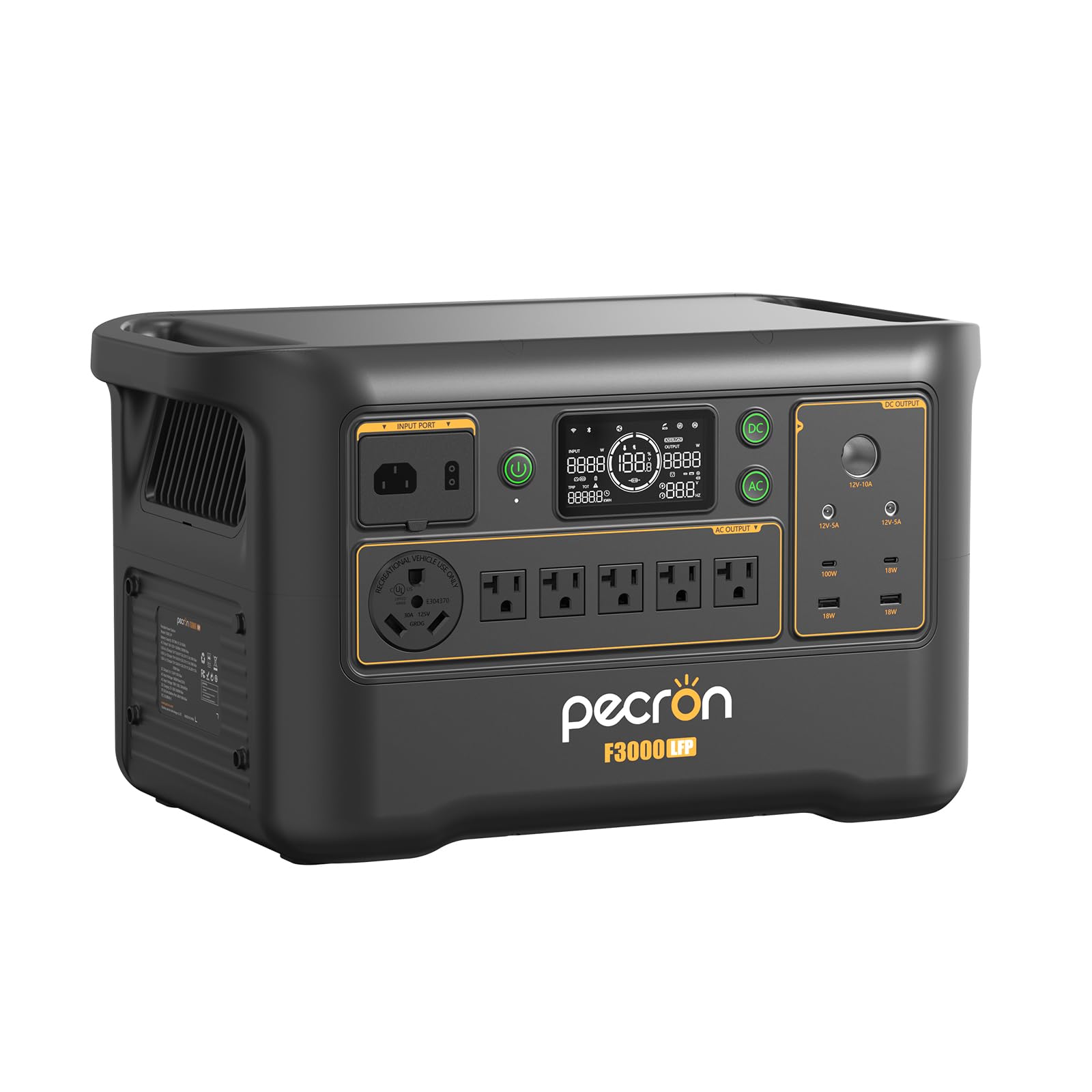
Features and Specifications
Battery Capacity: 3072Wh
Battery Chemistry: LiFePO4
AC Output: 3600W
Expandable Capacity: Up to 10752Wh
Charging: Fast charging
Intended Use: Home backup, camping, RV
Solar Input: Solar generator compatible
The headline figure is the 3072Wh battery, which is the number that decides how long the unit runs a load before it needs a recharge. That capacity puts the F3000LFP in the home-backup class rather than the weekend-camping class.
The 3600W AC output is the second number that matters. It sets the ceiling on what can be plugged in at once, and it is high enough that the unit is aimed at appliances rather than just phones and laptops.
Build and Battery Chemistry
LiFePO4 is the chemistry behind the name, and it is the reason this unit is positioned as a long-term purchase. Lithium iron phosphate cells are the more stable, longer-lived branch of the lithium family, and they are what most serious home-backup stations use.
The practical effect for a buyer is that the battery is treated as a fixed asset rather than a consumable. A unit at this capacity and chemistry is bought to sit in a garage or utility room for years and be called on during outages.
The trade-off is weight and bulk. A 3072Wh LiFePO4 pack is heavy, and this is not a station that gets carried up a trail on a whim. Buyers should plan on wheels, a cart, or a permanent spot near the breaker panel.
Capacity and Expandability
The 3072Wh base capacity is the starting point, not the ceiling. The unit expands to 10752Wh with additional battery modules, which is the feature that separates it from a sealed all-in-one station.
That expansion matters for households that want to cover a multi-day outage rather than a few hours. Buyers can start with the base unit and add capacity later, which spreads the cost and lets the system grow with the actual outage history of the home.
The caution here is that expansion is a commitment to an ecosystem. Extra capacity means buying into Pecron’s battery modules rather than mixing brands, so the long-term cost is set by that platform.
Power Output and What It Runs
At 3600W, the AC side is sized for real household loads rather than small electronics. That is the range where a refrigerator, a furnace blower, a sump pump, or a window AC unit becomes a realistic target.
Buyers should still think in terms of what runs at once. Output is a simultaneous-load limit, and a household that starts a fridge, a microwave and a space heater together is asking more of the unit than one that staggers them.
The 3600W figure also signals that this is not a gadget charger. It is a power source for the circuits a home actually depends on during an outage, and it should be planned around those circuits.
Charging and Solar Input
The unit is built as a solar generator, so it accepts solar panels as a charging source alongside wall power. That makes it viable for off-grid use and for extended outages where the grid is down for days.
Fast charging is the other side of the equation. A large battery is only useful if it can be refilled quickly between outages or during a sunny window, and the charging spec is what determines how practical the unit is as a rotating backup source.
Buyers who plan to rely on solar should size the panel array to the battery, not the other way around. A 3072Wh pack needs a meaningful solar input to recharge in a useful timeframe.
Maintenance and Ownership
LiFePO4 chemistry is the low-maintenance choice in this category. There is no fuel to store, no oil to change, and no carburetor to clean, which is the core reason buyers move from gas generators to battery stations.
Ownership is mostly about storage and readiness. The unit should be kept charged, kept dry, and kept within its operating temperature range so it is ready when an outage hits.
The trade-off is that a battery station has a finite service life in a way a fuel generator does not. Buyers are paying upfront for a sealed system, and that system degrades over years regardless of how carefully it is stored.
Trade-off: The F3000LFP is heavy and expensive for what it is, and buyers who only need to run a laptop and a lamp during a short outage are paying for capacity and chemistry they will never use.
Check the current price on Amazon
Who the Pecron F3000LFP Is For
This station suits homeowners in outage-prone areas who want a plug-and-play backup that does not involve fuel, exhaust, or a pull cord. It also fits RV owners and campers who want household-level power at a basecamp rather than a small travel unit.
It is a poor fit for ultralight campers, apartment dwellers with no place to store a heavy unit, and anyone whose backup needs are limited to charging phones. Those buyers are better served by a much smaller and cheaper station.
FAQ
-
How long will the Pecron F3000LFP run a refrigerator?
Runtime depends on the refrigerator’s draw and duty cycle, but the 3072Wh capacity is sized to carry a fridge through a multi-hour or multi-day outage when paired with sensible load management. -
Can the Pecron F3000LFP power a whole house?
It can power selected circuits and appliances up to its 3600W output, but it is not a whole-home solution on its own. Buyers with critical-circuit panels get the most from it. -
What does LiFePO4 mean in a power station?
LiFePO4 is lithium iron phosphate, a battery chemistry chosen for stability and long service life. It is the standard chemistry for home-backup stations at this capacity. -
Can the Pecron F3000LFP be expanded later?
Yes. The unit expands to 10752Wh with additional battery modules, so buyers can add capacity after the initial purchase. -
Does the Pecron F3000LFP work with solar panels?
It is built as a solar generator and accepts solar charging, which makes it usable off-grid and during extended grid outages. -
How heavy is a 3072Wh power station?
A LiFePO4 pack at this capacity is heavy by nature. Buyers should plan on a cart, wheels, or a fixed location rather than regular carrying. -
Is the Pecron F3000LFP safe to use indoors?
Battery stations produce no exhaust, which is the main reason buyers choose them over gas generators for indoor-adjacent use. Normal ventilation and dry storage still apply. -
What can 3600W run at once?
3600W covers major household appliances, but not all of them simultaneously. Buyers should stagger high-draw loads like heaters, microwaves, and compressors. -
Is the Pecron F3000LFP good for RV use?
Yes. The capacity and output suit RV boondocking and basecamp power, though the weight means it is better treated as a semi-permanent install than a portable carry. -
How fast does the Pecron F3000LFP charge?
The unit is specified for fast charging, which matters at this capacity because refill speed determines how usable the battery is between outages.
Bottom Line
The Pecron F3000LFP is the right buy for a household that wants serious, fuel-free backup power and is willing to pay for LiFePO4 capacity and expandability. Buyers who need a light camping unit or only occasional phone charging should look smaller and cheaper. For everyone else, the 3072Wh base and 10752Wh ceiling make it a system worth building around — check the current price on Amazon.
