Why there are Amazon links here: Brave Review is paid a commission for qualifying Amazon purchases made through the links below. Your price does not change, and using our links is entirely optional. How this works
Best Power Cut Alert for an Empty House to Catch Outages Before Damage Starts
A power cut alert for an empty house is a small alarm that tells someone far away the moment the mains power fails, so a freezer, sump pump, aquarium or server does not sit dead for days unnoticed. The five picks below cover three kinds of buyer: the budget homeowner who just wants a loud local siren, the Wi-Fi household that wants phone notifications, and the vacation or rental owner who cannot rely on home internet at all. The overview table sorts them by what each one actually does, and the reviews that follow explain who should skip which model.
Overview of the Picks
| Product | Key Spec | Best Use | Price Tier |
|---|---|---|---|
| 2X Power Failure Alarm Automatic Detector 120db | 120 dB local siren, 9V battery | Simple loud alarm, no app | Budget |
| Remote Silence, Dual 15A Outlets Wi-Fi Alarm | Dual 15A outlets, 110 dB, app alerts | Freezer and GFCI monitoring | Mid-range |
| 110dB Power Outage Alert with LED Indicator | 110 dB, Wi-Fi app notifications | Sump pump and greenhouse | Mid-range |
| Power Outage Alarm Monitor with Voltage Detection | 110 dB, voltage detection, app alerts | Aquarium and GFCI trips | Mid-range |
| 4G Cellular Temperature & Humidity Monitor | 4G cellular, no Wi-Fi needed | Vacation homes and RVs | Premium |
1. 2X Power Failure Alarm Automatic Detector 120db
Type: Plug-in power failure detector
Alert: 120 dB local siren
Power source: 110V/120V outlet, 9V battery backup (not included)
Connectivity: None
Best for: Loud in-home warning without an app

2X Power Failure Alarm Automatic Detector 120db is the simplest thing in this roundup: it plugs into a standard outlet and screams at 120 dB when the power drops. The 9V battery is what lets it keep screaming after the mains dies, so the alarm is genuinely audible in a house where everything else has gone quiet. Two units ship together, which lets one cover the kitchen circuit and one cover a basement or garage outlet.
This is the pick for a household that is often home and simply wants to know instantly that the power failed — not for someone who needs a message on a phone in another state. The trade-off is that it has no connectivity at all, so an empty house with nobody nearby produces a siren nobody hears.
2. Remote Silence, Dual 15A Outlets Wi-Fi Power Failure Alarm
Type: Wi-Fi outlet alarm with dual relays
Outlets: Two 15A outlets
Alert: 110 dB siren, 3 volume levels, 3 tones
Connectivity: 2.4GHz Wi-Fi only
App features: Remote silence, custom alarm settings, app alerts
Best for: Freezers and GFCI outlets on home Wi-Fi
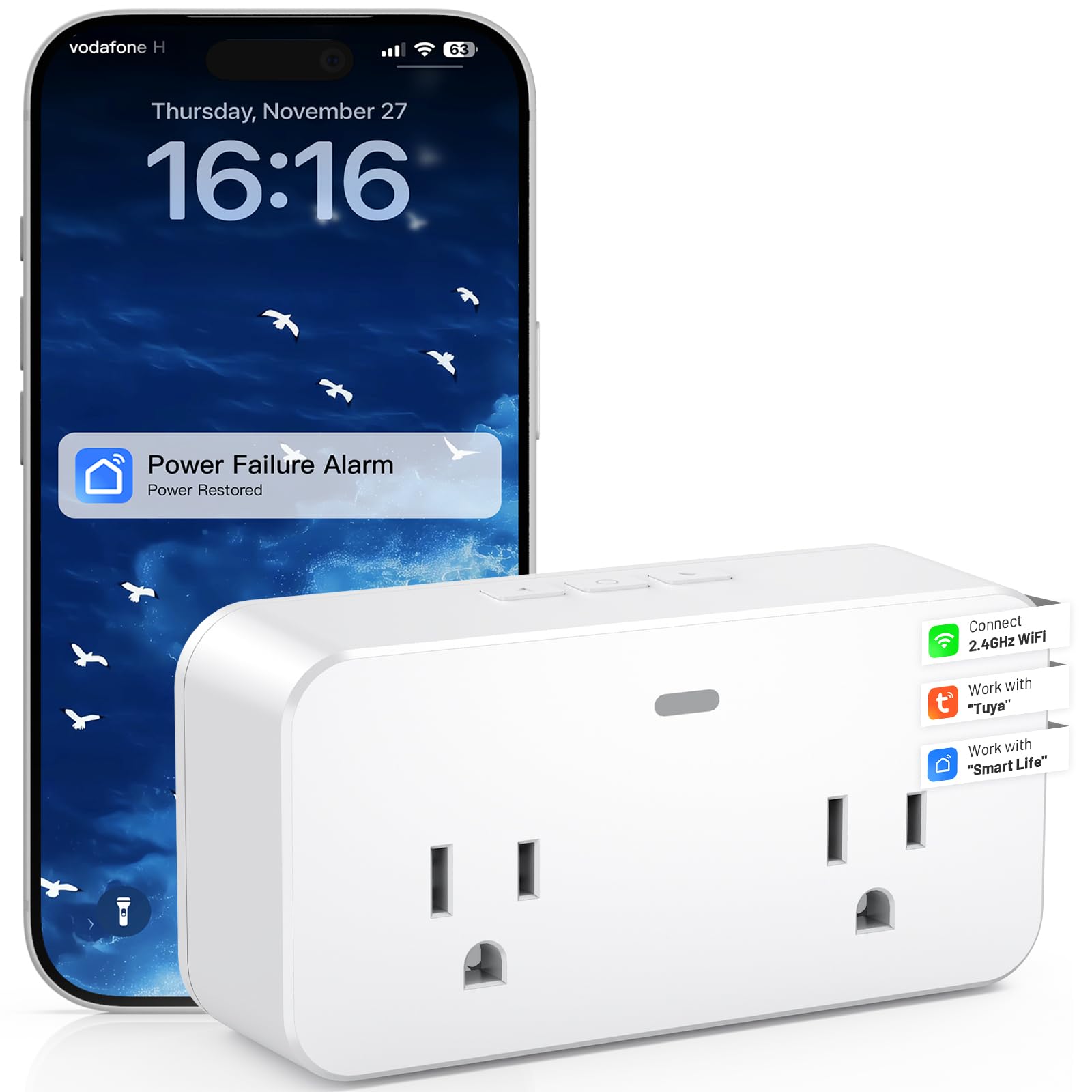
Remote Silence, Dual 15A Outlets, Loud 110dB, Custom Alarm Settings, 3 Volume Levels, 3 Alarm Tones, 2.4GHz Wi-Fi Only WiFi Power Failure Alarm for Outlet, Freezer & GFCI Trip with APP Alerts is the most configurable unit here. Two 15A outlets mean a freezer and a second appliance can share one device, and the app lets the owner silence the siren remotely instead of driving home to a screaming box. Three volume levels and three tones matter more than they sound — a 110 dB alarm in a small apartment is punishing, and a lower setting keeps neighbors calm during a short outage.
It suits a homeowner with solid 2.4GHz coverage who wants push alerts on a phone and the ability to mute a false alarm from anywhere. The trade-off is the 2.4GHz-only radio: a router running a single combined 5GHz band will need splitting before this pairs reliably.
3. 110dB Power Outage Alert with LED Indicator
Type: Wi-Fi power outage alert
Alert: 110 dB siren with LED indicator
Connectivity: Wi-Fi with app notifications
Intended use: Home power monitoring, freezer, GFCI outlet, sump pump, greenhouse
Best for: Sump pumps and outbuildings on home Wi-Fi

110dB Power Outage Alert with LED Indicator for Home Power Monitor, Freezer, GFCI Outlet, Sump Pump, and Greenhouse Power Failure Alarm with WiFi App Notifications, Smart Power Outage Alarm is built around one job: watch a single critical circuit and report a failure to a phone. The LED indicator is the useful part in person — a glance at the panel shows whether the outlet is live, without opening the app. The listed use cases (sump pump, greenhouse, freezer, GFCI) point at a device meant to sit on one dedicated outlet rather than roam.
It fits a homeowner whose sump pump or greenhouse heater is the thing that cannot be allowed to stop quietly, and who already has Wi-Fi reaching that corner of the property. The trade-off is single-outlet coverage: a buyer with two critical circuits needs two units, which pushes the cost past the dual-outlet pick above.
4. Power Outage Alarm Monitor with Voltage Detection
Type: Wi-Fi power monitor with voltage detection
Alert: 110 dB siren with LED indicator
Connectivity: Wi-Fi with free app notifications
Intended use: GFCI trips, aquarium, sump pump, freezer
Best for: Aquariums and circuits that trip rather than fail
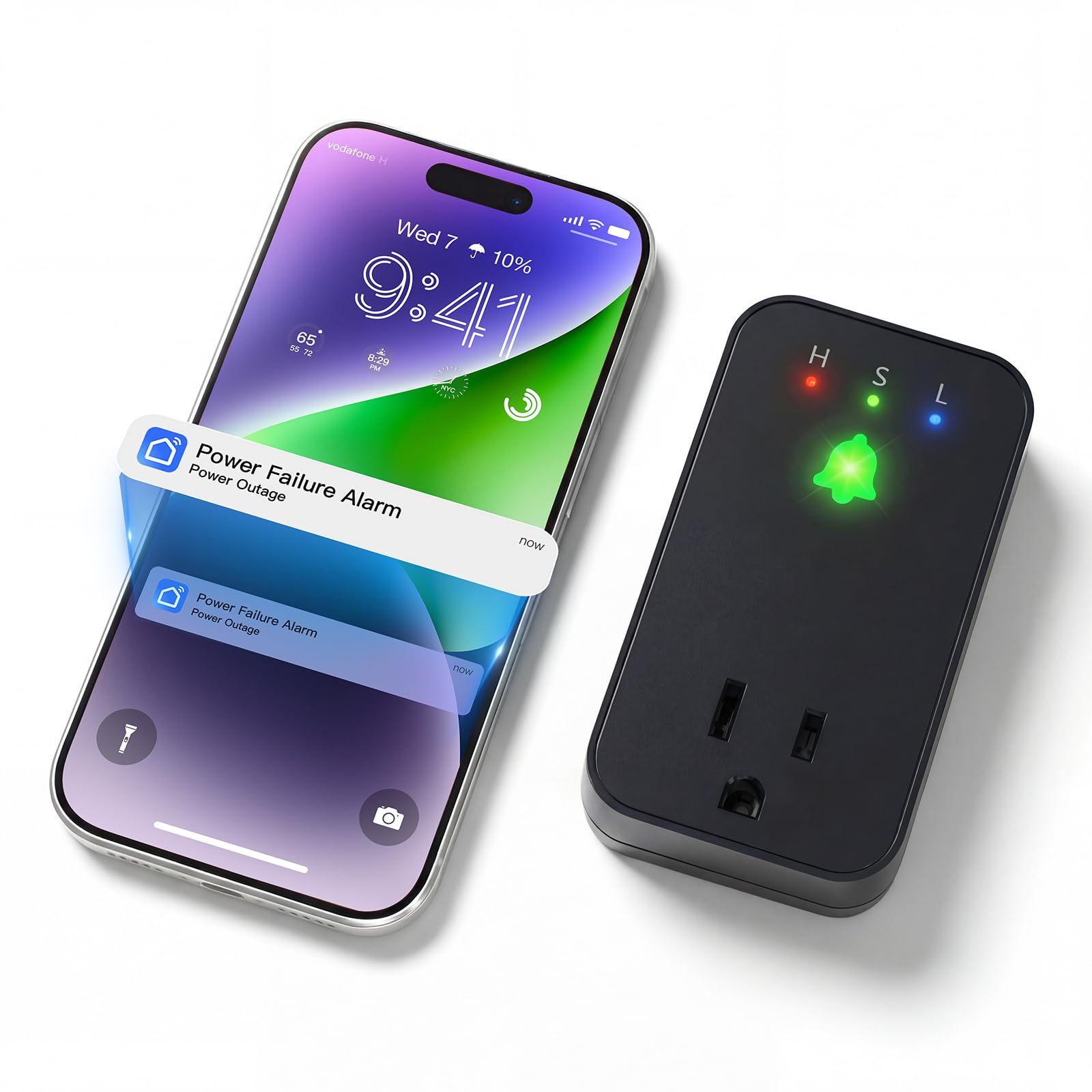
Power Outage Alarm Monitor, Loud 110dB Alert, LED Indicator, Voltage Detection, For GFCI Trips, Aquarium, Sump Pump Power Failure Alarm WiFi, Smart Freezer Alarm, Free App Notification adds voltage detection to the usual outage siren, which makes it the pick for circuits that trip rather than go fully dark. A GFCI that pops or a voltage sag is a different failure from a neighborhood blackout, and a monitor that reads voltage can flag both. The free app notifications keep the alert off a subscription, and the LED indicator covers the in-person check.
It suits aquarium owners and anyone with a GFCI-protected pump, where a silent trip is the realistic risk. The trade-off is that voltage detection invites fiddling: buyers who want a set-and-forget alarm will find the extra readings more to configure than they need.
5. 4G Cellular Temperature & Humidity Monitor
Type: Cellular power and climate monitor
Connectivity: 4G cellular, no Wi-Fi required (Wi-Fi optional)
Monitoring: Temperature and humidity alongside power status
Alerts: Email and app notifications
Best for: Vacation homes, RVs and rentals with no reliable internet

No WiFi Required(WiFi Optional), 24/7 Remote Power Outage Alarm Sensor, for RV Pets Safety Vacation Server Home Frigga 4G Cellular Temperature & Humidity Monitor with Email App Alerts is the only pick here that does not depend on the home router, which is exactly the point for an empty house. When the power fails, home internet usually fails with it; a 4G radio keeps reporting over the cell network and emails the owner. Temperature and humidity tracking turn it into a freezer and pet-safety monitor as well as an outage alarm, and the RV and vacation-home use cases fit that design.
It suits the owner of a property that sits empty for weeks, or anyone who has been burned by a Wi-Fi alarm that went silent the moment it was needed. The trade-off is the premium tier and the cellular plan behind it — this is the most expensive way to answer the question, and it only makes sense where remote reporting genuinely matters.
Before You Buy
- Connectivity: Wi-Fi alarms die with the router during an outage; a 4G model keeps reporting. Match the radio to how often the house is empty.
- Battery backup: A siren needs its own battery to sound after the mains drops. Check whether a 9V or similar cell is included or sold separately.
- Outlet rating: Dual-outlet models list a 15A rating — confirm the freezer or pump draw stays within it before sharing a circuit.
- Coverage: Single-outlet units protect one appliance. Count the critical circuits first, then buy the number of alarms that matches.
- Alert type: Local siren only, app push, or email. An empty house needs a remote alert; an occupied one can live with a loud box.
- Placement: Wi-Fi signal has to reach the basement, garage or greenhouse where the alarm sits. Weak coverage means missed alerts.
- Extras: Temperature and humidity tracking matter for freezers and pets; voltage detection matters for GFCI circuits that trip.
Frequently Asked Questions
-
Will a Wi-Fi power cut alert still work when the power is out?
Usually not on its own. Most home routers lose power in an outage, so a Wi-Fi alarm cannot send a notification unless the router and modem are on battery backup. A 4G cellular model avoids the problem entirely. -
What is the loudest alert in this roundup?
The 2X Power Failure Alarm lists 120 dB, the highest figure here. The other models sit at 110 dB, which is still loud enough to be heard across a house. -
Can one alarm watch a freezer and a sump pump at once?
Only the dual-outlet model covers two appliances from one device. The single-outlet picks need one unit per circuit. -
Does a power cut alert need a subscription?
The Wi-Fi models list free app notifications, so no subscription is implied. A 4G cellular monitor needs a data plan to report remotely, which is a recurring cost. -
Is a power outage alarm useful in an empty house without internet?
Only if it reports over cellular. A local siren in an empty house alerts nobody, so the 4G model is the one that fits that scenario. -
Where should the alarm be plugged in?
On the same circuit as the appliance being protected — the freezer outlet, the sump pump circuit or the GFCI outlet. A different circuit can stay live while the critical one fails.
Bottom Line
For most empty-house owners the safest answer is the 4G Cellular Temperature & Humidity Monitor, because it keeps reporting when the router does not. Households that are usually home and want a loud, cheap local warning should take the 120 dB two-pack instead.
