Why there are Amazon links here: Brave Review is paid a commission for qualifying Amazon purchases made through the links below. Your price does not change, and using our links is entirely optional. How this works
Reolink RLK8-800B4: 4K PoE Security Without the Subscription
The Reolink RLK8-800B4 is a four-camera 4K wired security bundle built around an eight-channel NVR and a 2TB hard drive. It suits homeowners who want continuous recording and person/vehicle alerts without paying a cloud plan every month. This review breaks down what the kit includes, how the hardware is likely to behave in daily use, and which households should look elsewhere.
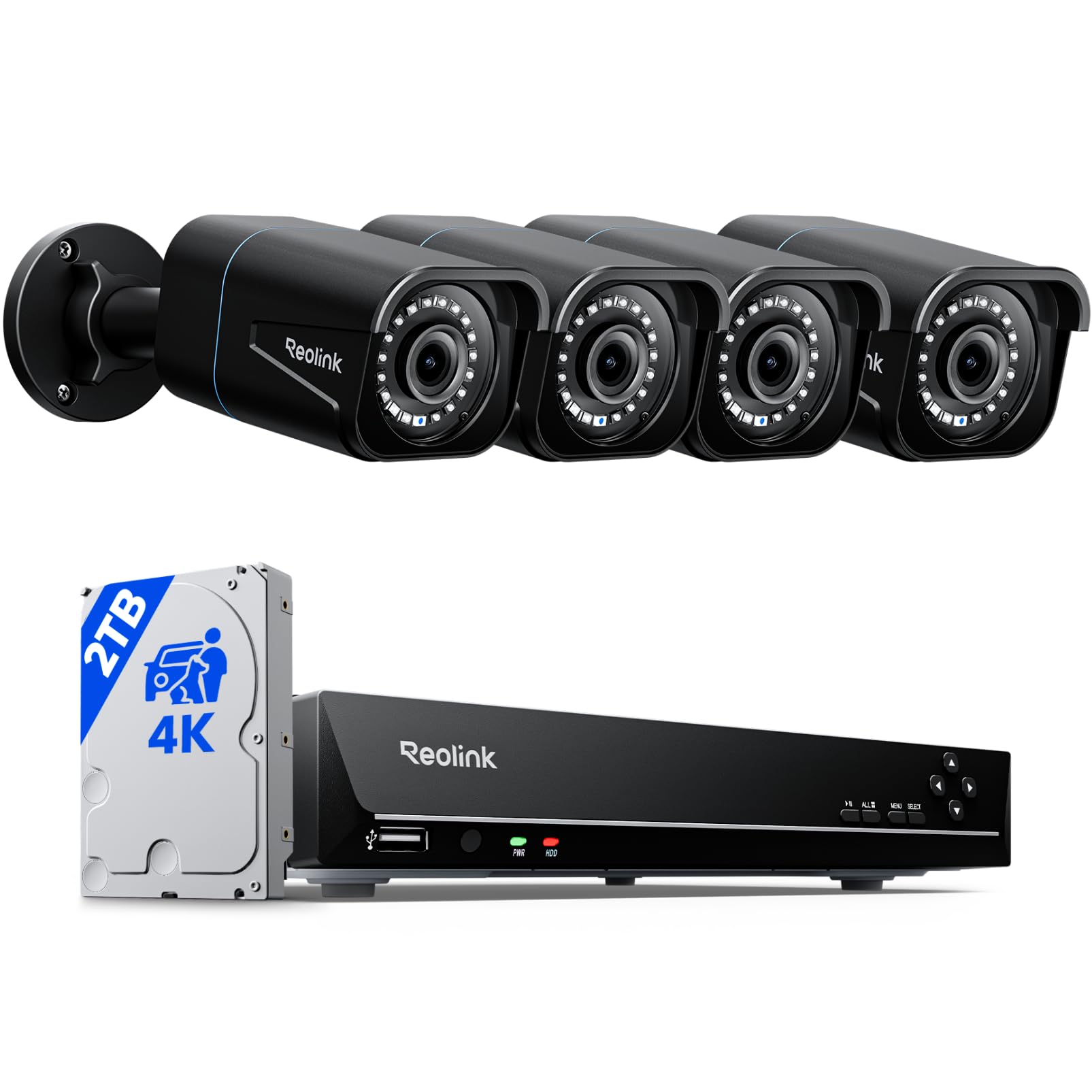
Features and Specifications
Type: Wired PoE security camera system with NVR
Cameras Included: 4
Resolution: 8MP / 4K
NVR Channels: 8
Storage: 2TB HDD, pre-installed
Recording: 24-7 continuous
Video Compression: H.265
Smart Detection: Person and vehicle detection
Power: Power over Ethernet (single cable per camera)
Color: Black
The headline figure is the resolution. Four 8MP cameras recording at 4K capture enough detail to identify a face at the door or read a plate on the driveway, which is the whole point of moving up from a 1080p kit. The H.265 compression matters just as much: it shrinks file sizes compared with older H.264 encoding, so the 2TB drive holds noticeably more footage before it starts overwriting. Buyers should treat the 2TB figure as a starting point rather than a fixed number of days, since retention depends on how many cameras run and how much motion the scene sees.
The NVR is the other half of the value. Eight channels against four included cameras leaves room to add four more later without replacing the recorder, and the pre-installed drive means the system is usable the day it arrives rather than after a separate purchase and install. That combination is what separates a bundle like this from buying cameras and a recorder piecemeal.
Build and Installation
Power over Ethernet is the defining practical feature here. Each camera runs from a single Ethernet cable that carries both data and power, so there is no separate power adapter at the camera end and no need for an electrician to run mains wiring to each corner of the house. The trade-off is that every camera must be reachable by cable, which rules out the quick stick-anywhere placement that battery cameras allow. A buyer needs either an existing cable run, an attic or soffit route, or a willingness to drill and fish cable.
The kit is wired, so installation is a weekend project rather than a ten-minute one. The NVR needs a spot near a router or network switch, and each camera needs a home under an eave or on a wall with a clear view. The four cameras are PoE, which means they draw power from the NVR or a PoE switch rather than a wall outlet, keeping the installation tidy once the cable is in place.
Capacity and Coverage
Four cameras cover the standard residential layout: front door, driveway, back door and one side or yard. An 8MP sensor at 4K gives a wide enough field to watch a driveway and still resolve detail at the far end, though buyers should expect the edges of the frame to be softer than the center, as with any wide lens. The eight-channel NVR is the growth path — four spare ports mean a buyer can add cameras to a garage, shed or side gate later without buying a second recorder or a second app to manage.
The 2TB drive is generous for a four-camera 4K setup on H.265, but it is not unlimited. Adding cameras or recording at maximum quality shortens retention, and a buyer who wants weeks of history rather than days should plan on a larger drive eventually. The NVR’s drive bay is the natural upgrade point.
Power and Network
Because the cameras are PoE, the NVR is effectively the power source as well as the recorder. That simplifies the cable run but concentrates the load: the recorder needs a stable outlet and, ideally, a small UPS so a brief power cut does not take the whole system offline. The NVR also needs a wired connection to the router for remote viewing, and buyers should confirm the router has a free Ethernet port or plan on a switch.
The wired design is a genuine reliability advantage. There is no battery to recharge, no Wi-Fi drop-out at the far end of the garden, and no camera that quietly stops recording because the signal faded. The cost is that the system is fixed in place — relocating a camera means re-running cable.
Detection and Alerts
Person and vehicle detection is the feature that makes a 24-7 system usable rather than exhausting. Instead of alerting on every passing cat or shifting branch, the cameras classify what triggered the motion and push an alert only for the categories that matter. That reduces notification fatigue, which is the usual reason people stop checking their security app.
Buyers should set expectations honestly: on-camera detection is good at filtering obvious false triggers but not perfect in heavy weather or at long range, and the quality of the alert depends on placement and lighting. Aiming cameras so the approach path is lit and within a sensible distance does more for accuracy than any setting.
Trade-Off
Trade-off: The wired PoE design buys reliability and no battery maintenance, but it demands cable runs to every camera location — a real obstacle for renters or anyone unwilling to drill through exterior walls.
Who It Suits and Who It Does Not
This system fits a homeowner with a house to wire and a preference for owning the footage outright. The 2TB drive, the eight-channel recorder and the absence of a required cloud plan mean the cost is largely upfront. A buyer who wants to check in from a phone without a monthly fee gets exactly that, and the four spare channels leave room to grow.
It does not suit renters, apartment dwellers, or anyone who needs a camera running by the end of an afternoon. Battery and Wi-Fi cameras exist for that buyer. Nor is it the right pick for someone who wants the simplest possible app experience above all else — a wired NVR system rewards a buyer who is comfortable with a bit of network setup.
Check the current price on Amazon
FAQ
-
Does the Reolink RLK8-800B4 require a monthly subscription?
No. The system records to the local 2TB drive inside the NVR, so continuous 24-7 recording and playback work without a cloud plan. Optional cloud storage may exist, but it is not needed for the core function. -
How many cameras can the NVR handle?
The recorder has eight channels and the kit includes four cameras, leaving four free ports for adding more PoE cameras later. -
Are the cameras wireless?
No. They are wired PoE cameras, powered and connected over a single Ethernet cable each. There is no Wi-Fi link between camera and recorder. -
What resolution do the cameras record at?
8MP, which is 4K. That is a significant step up from 1080p for identifying faces and reading details at distance. -
How long will the 2TB drive hold footage?
It depends on how many cameras run and how much motion the scenes see. H.265 compression stretches retention considerably, but buyers who want weeks of history should expect to upgrade the drive. -
Can the system be viewed remotely?
Yes. The NVR connects to the home network and the cameras can be viewed through the manufacturer’s app, which is one reason a stable wired network connection to the recorder matters. -
Is person and vehicle detection included?
Yes. The cameras classify people and vehicles so alerts focus on those events rather than every passing shadow. -
Can the cameras be used outdoors?
The kit is designed for exterior home surveillance, with cameras mounted under eaves or on walls. Buyers should check the stated weather rating for each camera before exposing it to direct rain. -
What happens if the power goes out?
Recording stops unless the NVR is on a battery backup. A small UPS on the recorder is a sensible addition for anyone who wants coverage through short outages. -
Can more storage be added?
Yes. The NVR has a drive bay, so a larger hard drive can replace or supplement the included 2TB unit when retention needs grow.
Bottom Line
The Reolink RLK8-800B4 is the right buy for a homeowner who wants 4K coverage, continuous local recording and no subscription, and who is prepared to run cable to four camera positions. The eight-channel NVR and pre-installed 2TB drive make it a complete system on day one with room to expand. Renters and anyone needing same-day installation should look at battery or Wi-Fi cameras instead.
