Why there are Amazon links here: Brave Review is paid a commission for qualifying Amazon purchases made through the links below. Your price does not change, and using our links is entirely optional. How this works
BLUETTI Elite 300 Portable Power Station: 3kWh of Backup for RV and Home
The BLUETTI Elite 300 is a large-capacity portable power station aimed at two kinds of buyers: RV owners who want to run appliances off-grid without a generator, and homeowners who want a battery ready when the grid goes down. This review covers what the unit is built to do, where its 2400W output and 3kWh battery make sense, and where the size and price start to work against it. Buyers who need a serious reserve rather than a camping gadget should read on; those wanting something light to carry to a picnic will find it is more machine than they need.
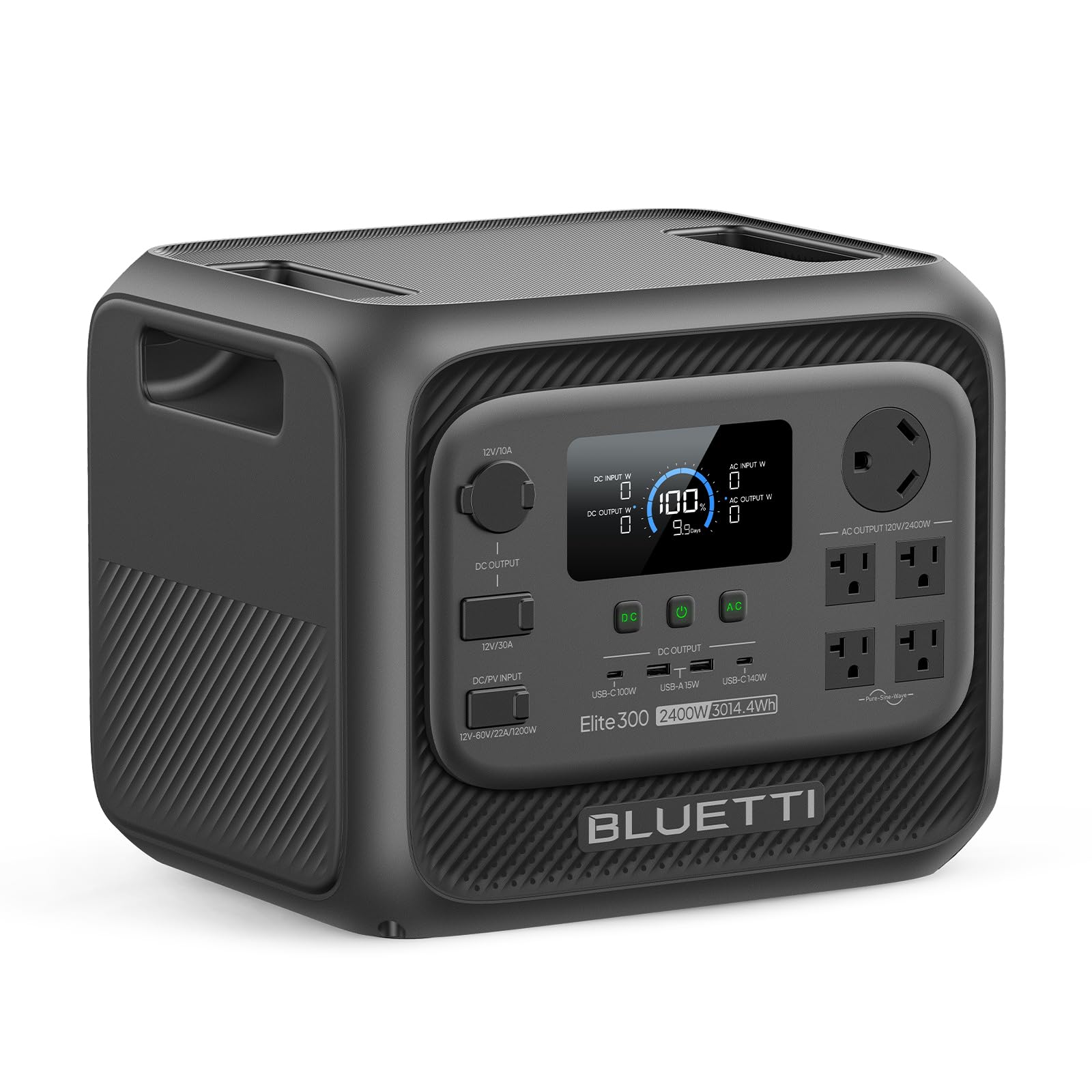
Features and Specifications
Type: Portable power station / solar generator
Battery Chemistry: LiFePO4 (lithium iron phosphate)
Battery Capacity: 3014.4Wh (roughly 3kWh)
AC Output: 2400W continuous, 4800W surge
RV Port: TT-30
DC Output: 12V/30A
Intended Use: Emergency home backup, RV power
The headline figure here is the battery. At just over 3kWh, the Elite 300 sits in the class of power stations that can carry a household through a short outage or keep an RV running for days rather than hours. The 2400W continuous output with a 4800W surge ceiling is what lets it start motor-driven appliances that briefly pull far more than their running wattage.
The LiFePO4 chemistry is the other specification worth pausing on. It is the battery type that has become standard for units meant to be cycled often and stored for long stretches, because it holds up better to repeated charge and discharge than older lithium formulations. For a buyer spending this much on a backup unit, that is the spec that decides whether the purchase still makes sense several years down the line.
The TT-30 port is a deliberate choice for the RV market. It is the standard plug format for larger travel trailers and motorhomes, so the unit can feed an RV’s distribution panel directly rather than through a bundle of adapters. The 12V/30A DC output covers the other half of RV life — running a DC fridge, lights, or charging a house battery.
Build, Capacity, and Power in Practice
What the 3kWh Capacity Actually Covers
Capacity is the number buyers should weigh hardest, because it sets the ceiling on everything else. A 3kWh reserve is enough to run a refrigerator through a multi-day outage, keep phones and laptops charged, run lights and a router, and still have headroom for a fan or a small heater. It is not enough to run central air conditioning or an electric water heater for long.
The practical framing is that this is an outage unit, not an off-grid whole-home system. Buyers who want to keep a normal household running indefinitely need a permanently installed system with far more capacity. Buyers who want to keep the essentials alive until the power returns are exactly who this size is built for.
The 2400W Output and 4800W Surge
Continuous output determines which appliances can run at once; surge output determines which ones can start at all. Many appliances with motors — refrigerators, pumps, compressors — draw a brief spike several times their running wattage when they kick on. The 4800W surge ceiling is what makes the Elite 300 able to handle those starts without tripping.
For RV owners, this matters most with air conditioners and microwave ovens, both of which are demanding loads. The unit can support them, but the battery drains quickly under that kind of draw. The realistic pattern is running heavy appliances in short bursts and leaning on the 12V output for the steady background loads.
The RV Port and DC Output
The TT-30 port is the feature that separates this unit from generic power stations. It lets an RV connect the way it would to a campground pedestal, which means the trailer’s own outlets and breakers work normally. That is a meaningful convenience for anyone who uses the rig regularly rather than occasionally.
The 12V/30A DC output serves the other side of RV power. It can run a DC refrigerator directly, which is far more efficient than converting battery power to AC and back again. Together the two outputs cover both the AC and DC sides of a typical trailer setup.
Size, Weight, and Placement
A 3kWh LiFePO4 battery is heavy, and the Elite 300 is described as the smallest unit in its capacity class — a claim about footprint, not weight. Buyers should expect a unit that needs a permanent or semi-permanent home: a garage shelf, an RV bay, or a corner near the breaker panel. It is not a unit to carry up stairs casually.
That shapes who the product suits. Buyers planning to move it between a house and a vehicle will find the weight a chore. Buyers who park it in one place and plug in when needed get the full benefit of the capacity without the handling penalty.
Trade-off: The capacity and output that make this unit useful for whole-home outages also make it heavy and bulky, so it rewards buyers with a fixed place to keep it and frustrates anyone hoping for grab-and-go portability.
Check the current price and availability on Amazon
Strengths and Weaknesses
The strongest argument for the Elite 300 is the combination of a 3kWh LiFePO4 battery with a 2400W inverter and a native TT-30 RV port. That is a coherent package for a specific buyer: someone who wants one box that can back up a house’s essentials and also feed a travel trailer without adapters. The 4800W surge ceiling adds real headroom for motor-driven appliances.
The LiFePO4 chemistry is the second real strength. It is the battery type that makes a long-term purchase sensible, because it tolerates frequent cycling and long storage better than the alternatives. For a unit at this price, that longevity is central to whether the money is well spent.
The weaknesses follow from the same design. The unit is heavy and takes up space, so it is a poor fit for anyone who wants portability as a primary feature. The capacity, while substantial, still has clear limits: heavy loads like air conditioning will drain it quickly, and it cannot carry a whole house through an extended outage on its own.
Charging speed is the other area buyers should think through. A battery this large takes time to refill from solar or a wall outlet, so a buyer planning to rely on it during a multi-day outage needs a charging plan — panels sized appropriately, or a generator to top it up — rather than assuming it will recharge itself quickly.
FAQ
-
What can the BLUETTI Elite 300 power?
It can run refrigerators, lights, routers, fans, laptops, and similar household essentials, plus RV appliances through the TT-30 port. Its 2400W continuous output covers most everyday devices; heavy loads like air conditioning will drain the battery quickly. -
How long does a 3kWh battery last during an outage?
That depends entirely on the load. Running a refrigerator and a few small devices, the reserve can stretch across multiple days. Running a space heater or air conditioner, it may last only a few hours. -
Is the BLUETTI Elite 300 good for RV use?
Yes — the TT-30 port is designed for RV connection, and the 12V/30A DC output handles DC appliances like fridges. The unit’s weight means it is best treated as a fixed installation in the rig rather than something moved in and out. -
What is LiFePO4 and why does it matter?
LiFePO4 is lithium iron phosphate, a battery chemistry known for tolerating frequent cycling and long storage better than older lithium types. For a backup unit meant to last years, it is the specification that most affects long-term value. -
Can the Elite 300 run a whole house?
No. It can carry essential circuits during an outage, but it is not sized for whole-home backup. Buyers wanting to run central air, electric heat, or an entire panel need a permanently installed system. -
How is the unit recharged?
It can be charged from a wall outlet, from solar panels, or from a generator. Because the battery is large, refilling it takes time, so buyers planning for extended outages should size their solar or generator accordingly. -
Is the 4800W surge rating important?
Yes, for appliances with motors. Refrigerators, pumps, and compressors briefly draw several times their running wattage at startup, and the surge ceiling is what allows those appliances to start without overloading the unit. -
Who is the BLUETTI Elite 300 not for?
It is a poor fit for campers who want a light, portable unit to carry to a campsite, and for buyers who need whole-home backup. It suits buyers with a fixed place to keep it and a clear list of essential loads. -
Does it work with a transfer switch?
The unit can feed a home’s circuits through a transfer switch installed by a qualified electrician, which is the safe way to connect a power station to household wiring. Buyers should not backfeed a panel without proper equipment. -
What should buyers check before ordering?
The weight and footprint relative to where the unit will live, the list of appliances it needs to run, and the charging plan for extended outages. Matching those three to the unit’s capacity is the whole decision.
Bottom Line
The BLUETTI Elite 300 is the right buy for a specific shopper: an RV owner or homeowner who wants a large LiFePO4 reserve, a 2400W inverter with real surge headroom, and a native TT-30 port in one unit, and who has a fixed place to keep it. Buyers who need grab-and-go portability or whole-home coverage should look elsewhere. For everyone in between, the capacity and chemistry make it a sensible long-term purchase — check the current price on Amazon before deciding.
