Why there are Amazon links here: Brave Review is paid a commission for qualifying Amazon purchases made through the links below. Your price does not change, and using our links is entirely optional. How this works
Best Bandwidth Planning for Video Devices for Clean, Glitch-Free Streams
Bandwidth planning for video devices is the part of streaming that bites hardest after everything else works: the camera is fine, the encoder is fine, and the picture still stutters because the network was never sized for it. The five books here cover that gap from different angles, from a beginner’s OBS walkthrough to the SMPTE standards that govern professional IP production. They suit three kinds of reader: the home streamer sizing a first setup, the production operator moving a studio onto IP, and the engineer who wants the underlying math rather than a checklist. The overview below ranks all five by what each one actually solves.
The Five Picks at a Glance
| Product | Key Spec | Best Use | Price Tier |
|---|---|---|---|
| OBS Studio User Guide for Beginners | Step-by-step software walkthrough | First-time streamers learning where bitrate fits | Budget |
| Video Demystified, 5th Edition | Digital video engineering handbook | Understanding compression and signal fundamentals | Premium |
| The Unofficial Guide to NDI | IP video over existing networks | Studio setups moving to NDI workflows | Budget |
| The Unofficial Guide to vMix | Live production software overview | Operators building a software production desk | Budget |
| SMPTE ST 2110: The Broadcast IP Revolution | Professional media-over-IP standard | Broadcast engineers planning standards-based IP | Budget |
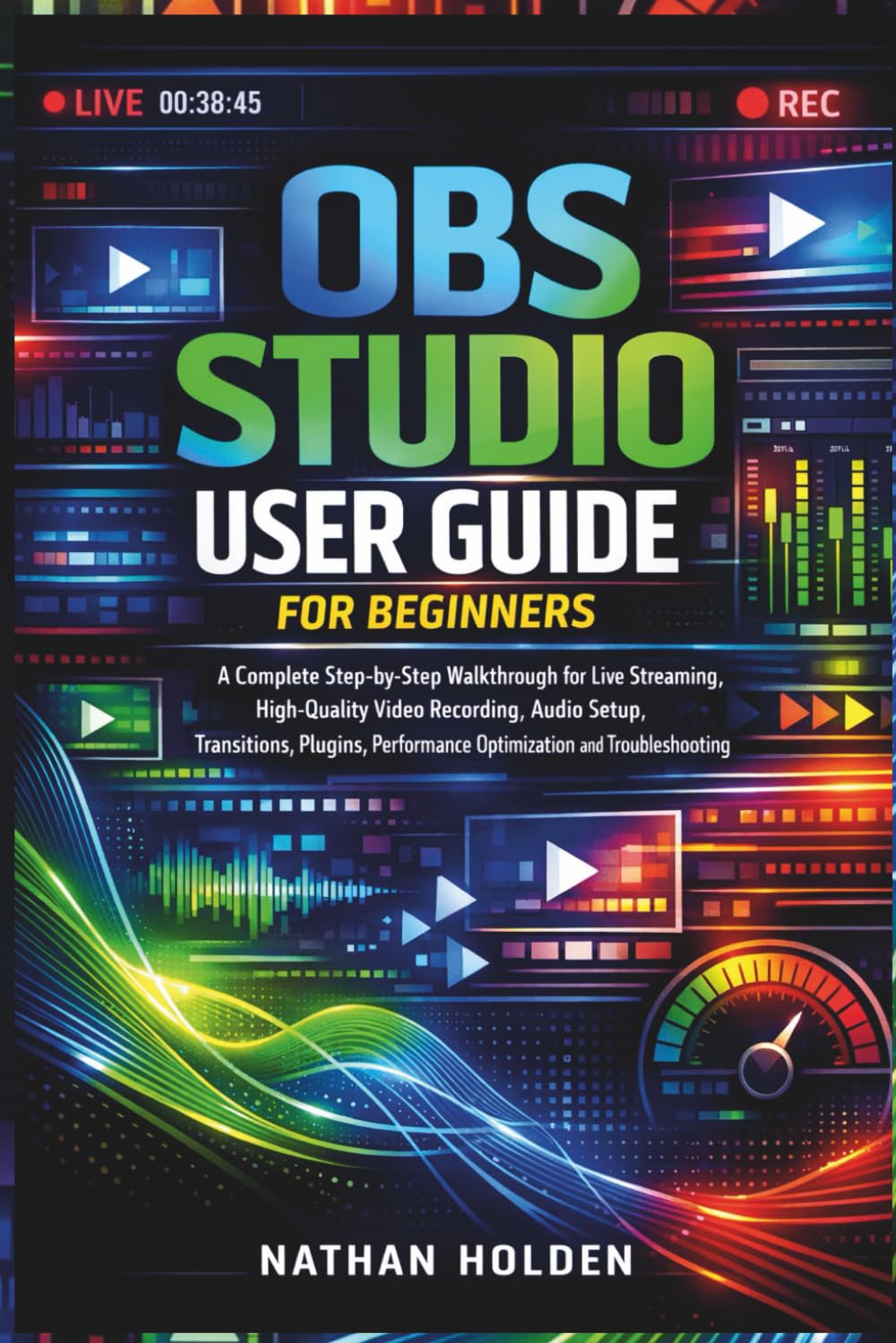
1. OBS Studio User Guide for Beginners
Format: Paperback software guide
Subject: OBS Studio streaming and recording
Level: Beginner
Coverage: Setup, audio, transitions, plugins, performance, troubleshooting
Best For: Home streamers sizing a first encode
Check the current price on Amazon
This is the entry point for anyone whose first encounter with bandwidth planning comes from watching OBS warn about dropped frames. The book walks through the software in order, and the performance and troubleshooting sections are where the network conversation actually lives, since encoder settings and upload headroom are two halves of the same problem. It is written for readers who have never configured a stream before, so the explanations assume no prior video engineering background. The step-by-step format means it works as a desk reference during a first setup rather than as a cover-to-cover read.
The pick earns its place because most home streaming bandwidth trouble is really an OBS configuration problem wearing a network costume. A reader who understands what the encoder is asking of the connection can size the connection correctly instead of guessing.
Trade-off: It teaches the software, not the network, so anyone hoping for router, switch or ISP-side guidance will need a second source.
2. Video Demystified: A Handbook for the Digital Engineer, 5th Edition
Format: Engineering handbook
Subject: Digital video fundamentals
Level: Technical
Coverage: Compression, formats, signal processing, transmission
Best For: Readers who want the math behind the bitrate

Video Demystified: A Handbook for the Digital Engineer, 5th Edition
Check the current price on Amazon
This is the reference the other four books quietly assume the reader has already absorbed. It covers how digital video is sampled, compressed and carried, which is exactly the layer underneath any bandwidth calculation — bitrate only means something once the codec and the chroma handling are understood. The fifth edition carries the weight of a long-standing engineering handbook, and it reads like one: dense, precise and not designed for a weekend. It suits the reader who wants to reason about a network from first principles rather than follow someone else’s recommended settings.
It sits at the top of the price range here, and the gap is justified by depth rather than presentation. This is the pick for someone who will keep coming back to it across projects.
Trade-off: The density and the price both put it out of reach for casual readers, and it offers no practical setup guidance at all.
3. The Unofficial Guide to NDI
Format: Paperback workflow guide
Subject: NDI IP video
Level: Intermediate
Coverage: NDI with OBS, vMix and Wirecast
Best For: Studios moving video onto an existing LAN

Check the current price on Amazon
NDI is where bandwidth planning stops being theoretical, because NDI moves full video streams across a network that someone else may already be using for everything else. This guide covers the protocol across the three software tools most small productions actually run, and it is written for operators rather than network architects. The practical value is in understanding what a given NDI source demands of a link and where congestion shows up first. It assumes the reader can already get a stream running and now needs several of them to coexist.
The book belongs in this list because it addresses the middle ground most productions occupy: better than a single webcam, nowhere near a broadcast facility.
Trade-off: It is a workflow guide rather than a network design manual, so switch configuration and QoS planning fall outside its scope.
4. The Unofficial Guide to vMix
Format: Paperback software guide
Subject: vMix live production
Level: Beginner to intermediate
Coverage: Software production overview, inputs, outputs, workflow
Best For: Operators building a software production desk

Check the current price on Amazon
vMix turns a PC into a production switcher, and that means every input, output and recording stream competes for the same machine and the same network link. This overview explains how the software is structured, which is the prerequisite for planning capacity around it — a producer cannot budget bandwidth for outputs without knowing how many the software is running and where each one goes. The writing targets newcomers to the software rather than newcomers to production generally. It pairs naturally with the NDI guide, since the two tools frequently appear in the same workflow.
The pick suits someone assembling a small production desk who needs to understand the software’s footprint before committing hardware and connectivity to it.
Trade-off: It is an overview rather than a deep reference, and it says little about the network layer itself.
5. SMPTE ST 2110: The Broadcast IP Revolution
Format: Paperback standards explainer
Subject: SMPTE ST 2110 media over IP
Level: Professional
Coverage: The IP standard for professional media production
Best For: Broadcast engineers planning standards-based IP

SMPTE ST 2110: The Broadcast IP Revolution: The IP Standard for Professional Media Production
Check the current price on Amazon
ST 2110 is the standard that separates professional broadcast IP from everything else, because it carries audio, video and metadata as separate streams with precise timing requirements. This book explains what that architecture means in practice and why it changes how capacity has to be planned — the assumptions that hold for a compressed NDI workflow do not transfer to uncompressed essence streams. It is written for readers already working in or moving toward broadcast infrastructure. The subject matter is narrow by design, and that is the point.
For anyone planning bandwidth at a facility rather than a desk, this is the book that defines the rules the plan has to satisfy.
Trade-off: It is a standards explainer for professionals, and readers without broadcast background will find the terminology heavy going.
Before You Buy
- Level: Match the book to the reader’s actual starting point — the OBS guide and the vMix guide assume no video engineering background, while Video Demystified and the ST 2110 title do not.
- Scope: Software guides teach configuration, protocol guides teach workflow, and the engineering handbook teaches fundamentals. Bandwidth planning sits between all three, so pick the layer that is actually missing.
- Format: All five are print-oriented references. Buyers who want to search a text or copy formulas should check whether an e-book edition exists before ordering.
- Currency: Video standards and software versions move quickly. Check the edition and publication date on the listing rather than assuming the newest printing.
- Compatibility: The NDI and vMix guides are written around specific software families. Confirm the tools in use match before buying.
- Depth versus price: The premium engineering handbook costs several times the budget picks, and that premium buys reference depth rather than readability.
Frequently Asked Questions
-
Which book is best for someone new to bandwidth planning for video devices?
The OBS Studio guide, because it starts from zero and covers the encoder settings where network demand originates. The NDI guide is the natural second step once multiple sources enter the picture. -
Do these books cover network hardware like routers and switches?
Not directly. They explain what video traffic demands of a network; the equipment selection is a separate discipline. -
Is Video Demystified worth the higher price?
For readers who want to understand compression and signal fundamentals rather than follow a checklist, yes. For casual streamers, the budget picks cover the practical ground. -
What is the difference between NDI and SMPTE ST 2110?
NDI is a practical IP video workflow built for software production over ordinary networks. ST 2110 is a broadcast standard built around separate, precisely timed essence streams. -
Can these books be read in any order?
Yes. Each stands alone, though reading the OBS or vMix guide before the NDI guide makes the workflow chapters easier to follow. -
Are e-book versions available?
Availability varies by title, so check the format options on each Amazon listing before ordering.
Bottom Line
For most readers, bandwidth planning for video devices starts with OBS Studio User Guide for Beginners, which explains the encoder settings that create network demand in the first place and costs little enough to sit alongside a second title. Pair it with the NDI guide once multiple sources are in play, and reach for Video Demystified when the numbers themselves need to make sense.
