Why there are Amazon links here: Brave Review is paid a commission for qualifying Amazon purchases made through the links below. Your price does not change, and using our links is entirely optional. How this works
Best Cable Set for Solar Charging for RVs, Power Stations and Panels
The best cable set for solar charging depends on where the panel sits and what the panel plugs into. This roundup covers five options: two long 10AWG extension runs for roof and ground panels, a shorter 10AWG pair for tight installs, a multi-adapter kit for portable power stations and RC packs, and an XT60-specific cable for RV setups. Buyers who already know their connector type can jump to the overview and pick in under a minute; everyone else should read the two paragraphs under each pick.
Overview of the Picks
| Product | Key Spec | Best Use | Price Tier |
|---|---|---|---|
| 10AWG 30FT Solar Panel Extension Cable (B0CX5JBZNY) | 10AWG, 30 ft, IP68 MC4 connectors | Long panel-to-controller runs | Mid |
| 7-in-1 Solar Panel Adapter Connectors (B0FGJBGT9Q) | 12AWG, 3.6 ft, 7 adapters | Portable power stations, RC batteries | Budget |
| Solar Panel Cable 10AWG 30FT Red + Black (B0D2H1DTWL) | 10AWG, 30 ft, separate red/black | Custom runs needing split leads | Mid |
| Solar Panel Cable 10AWG 20FT Red + Black (B0D2GVRNRL) | 10AWG, 20 ft, separate red/black | Shorter runs, tighter routing | Budget |
| Vansdon Solar to XT60 Cable (B0DSKJZBX6) | 10AWG, 30 ft, XT60 adapter | RV and portable power station charging | Premium |
1. 10AWG 30FT Solar Panel Extension Cable with IP68 Connectors

Gauge: 10AWG
Length: 30 ft
Connectors: IP68 female and male waterproof
Build: Flame retardant protective sleeving, twin wire
Extras: Dust caps
Intended use: Home, RV
This is the pick for buyers running a panel a long way from the charge controller. The 10AWG twin wire keeps voltage drop low over the full 30 ft, and the flame retardant sleeving adds a layer of abrasion protection that bare twin cable lacks. The IP68 male and female connectors are pre-terminated, so the run is plug-and-play between a panel and a controller or combiner. Dust caps are included, which matters for anyone leaving the cable connected outdoors between trips.
It suits roof-mounted panels on homes and RVs, ground-mount arrays, and any install where the panel and controller sit far apart. Buyers with a very short run pay for length they do not need, and anyone using a non-MC4 connector on the controller end needs an adapter. The pre-terminated ends also mean the cable cannot be cut to length without losing the waterproof rating.
Trade-off: The fixed 30 ft length and sealed connectors leave no room to shorten the run, so buyers with a compact setup end up coiling excess cable.
2. 7-in-1 Solar Panel Adapter Connectors Kit
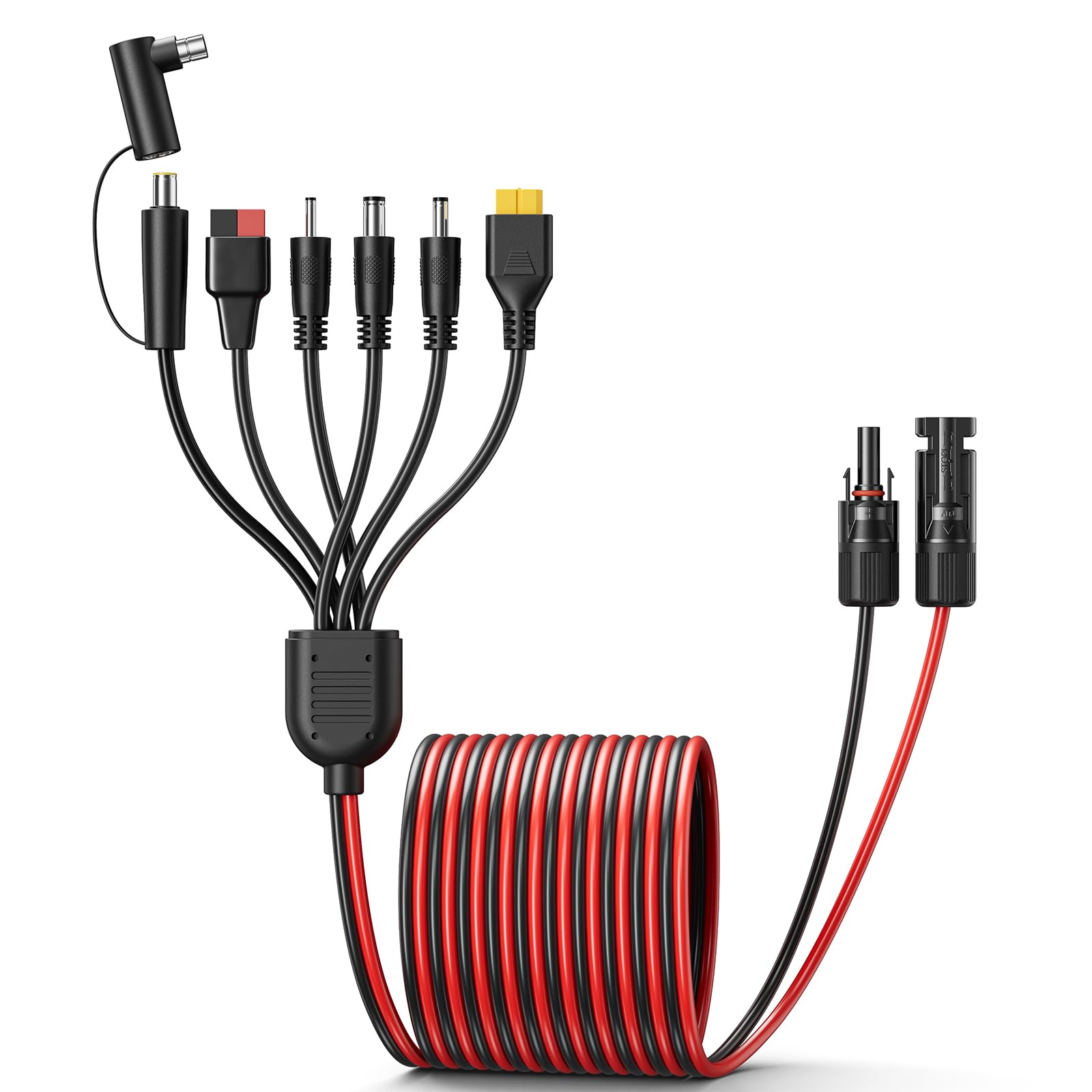
Gauge: 12AWG
Length: 3.6 ft
Connector type: Universal MC4 to DC 8mm, XT60, Anderson
Adapter count: 7-in-1 kit
Intended use: RC battery, portable power stations, solar generators
This kit solves the connector-matching problem rather than the distance problem. The 12AWG cable is short at 3.6 ft, but the seven adapters cover the plugs most portable power stations, solar generators and RC chargers use — MC4, DC 8mm, XT60 and Anderson among them. For a buyer with a folding panel and a power station whose input port does not match the panel’s lead, this is the fastest route to a working charge.
It suits campers, overlanders and anyone charging a portable power station from a suitcase panel. Hobbyists topping up RC battery packs from a small solar panel are the other natural fit. The 12AWG gauge and short length mean it is not built for long panel runs, and buyers with a single known connector type pay for adapters they will never use.
Trade-off: The 3.6 ft length and 12AWG gauge rule it out for permanent or long-distance panel runs, so the kit is a connector solution rather than an extension solution.
3. Solar Panel Cable 10AWG 30FT Red + Black with Connectors
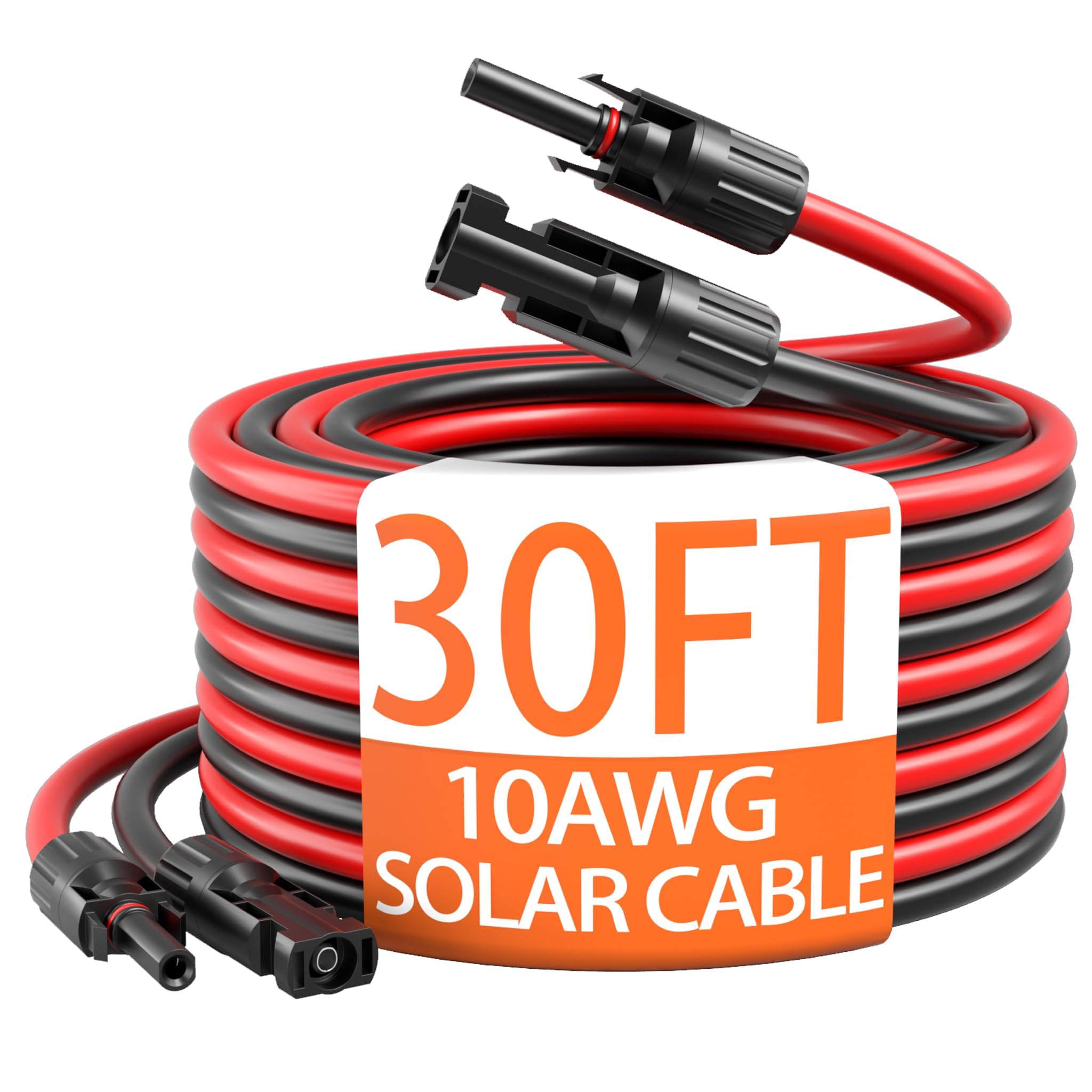
Gauge: 10AWG
Length: 30 ft red + 30 ft black
Connectors: Female and male, one pair included
Configuration: Separate red and black leads
Intended use: Solar extension runs
Kit type: Solar panel adaptor kit
This is the twin-lead alternative to the first pick: two separate 30 ft lengths of 10AWG, one red and one black, with a pair of connectors included. Separate leads give more routing freedom than bonded twin cable, which helps when the positive and negative paths have to take different routes around a frame or through a bulkhead. The 10AWG gauge carries the same low-loss benefit over the full run.
It suits DIY installers who want to route each lead independently, and anyone building a run where a bonded twin cable would be awkward to pull. Buyers who want a single tidy cable to manage will find two loose leads more fiddly, and the included connector pair covers one termination point rather than a full set of spares.
Trade-off: Two separate leads take more clips and more attention to keep polarity straight than a bonded twin cable, and the kit ships with only one connector pair.
4. Solar Panel Cable 10AWG 20FT Red + Black with Connectors
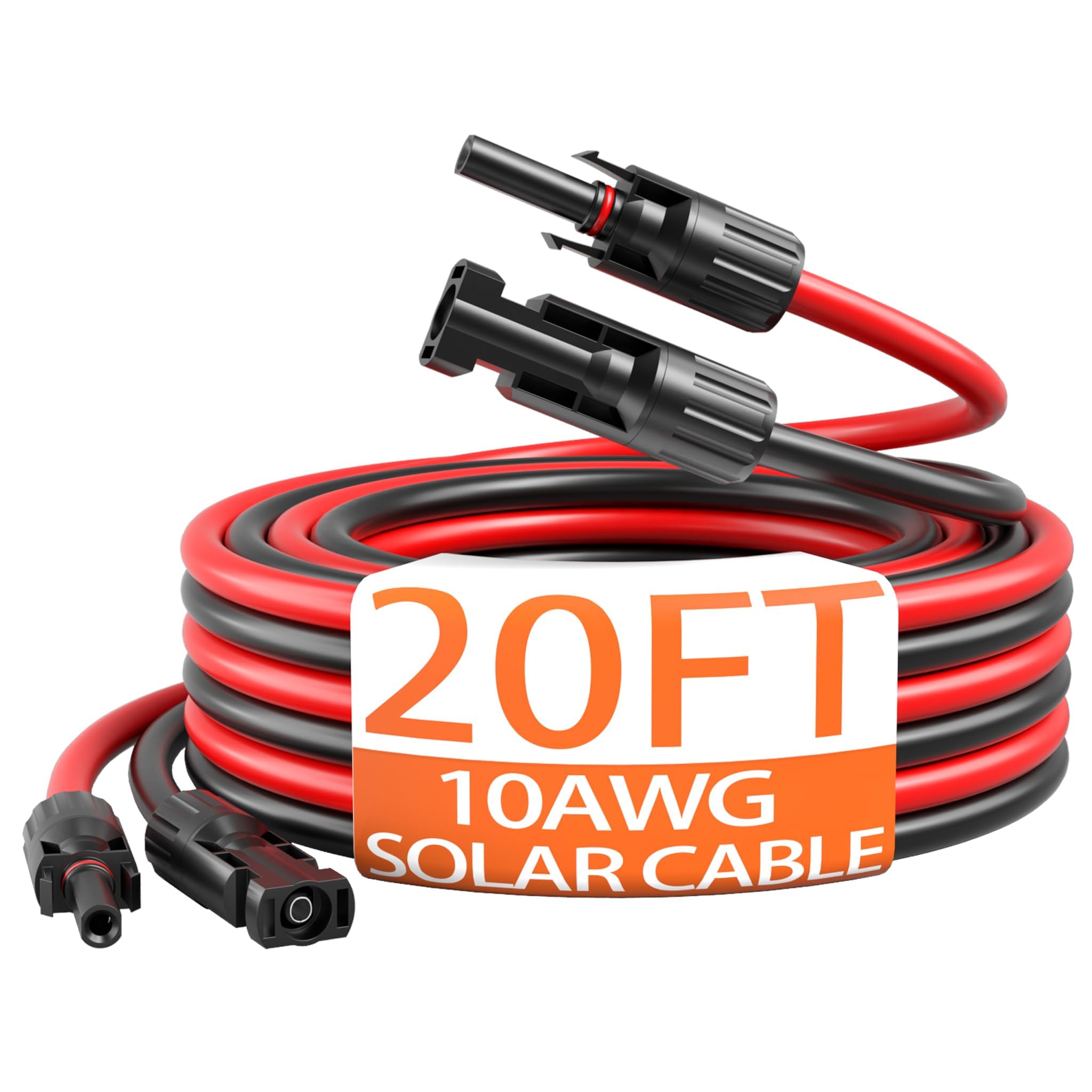
Gauge: 10AWG
Length: 20 ft red + 20 ft black
Connectors: Female and male, one pair included
Configuration: Separate red and black leads
Intended use: Solar extension runs
Kit type: Solar panel adaptor kit
The 20 ft version of the pick above keeps the same 10AWG gauge and separate red and black leads but trims the length. For a panel mounted close to the controller — a short ground mount, a shed roof, a van roof with the controller inside — 20 ft is often enough and leaves less slack to coil and secure. The connector pair and adaptor kit contents match the longer version.
It suits buyers who have measured their run and know 20 ft covers it, and anyone who wants 10AWG without paying for length that becomes a tripping hazard. Buyers who are unsure of their final distance should size up; a run that falls a few feet short cannot be stretched, and adding a second cable introduces another connection point.
Trade-off: The 20 ft length leaves little margin for error, so a buyer who mismeasures ends up buying a second cable to bridge the gap.
5. Vansdon Solar to XT60 Cable, 10AWG 30FT
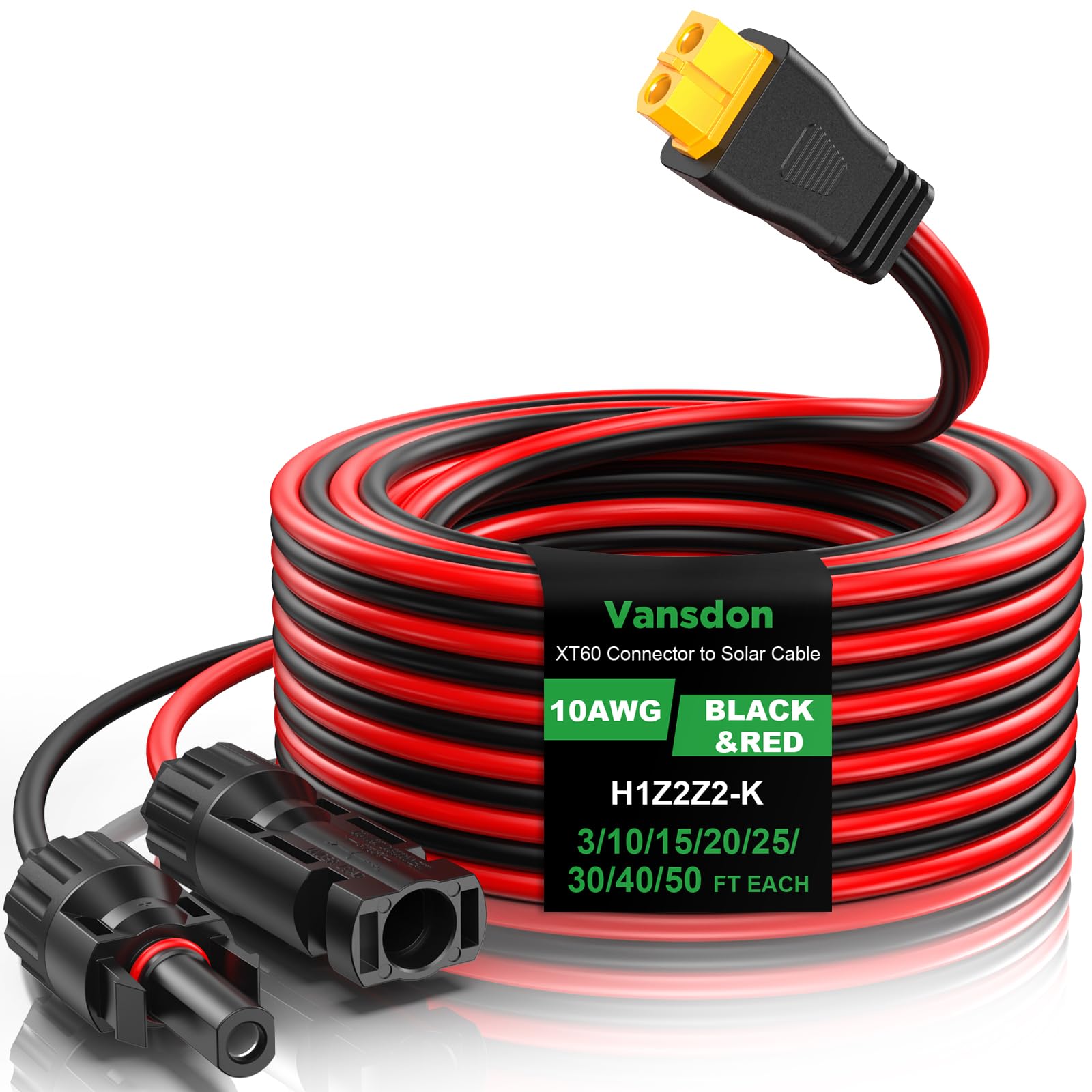
Gauge: 10AWG
Length: 30 ft
Connector type: Solar to XT60
Cable type: Charging extension cable adapter
Intended use: RV, portable power station
This cable is built for one job: getting panel power into an XT60 input on a portable power station or RV system. The 10AWG conductor holds up over the full 30 ft, and the solar-to-XT60 adapter removes the need for a separate dongle at the station end. For a buyer whose power station takes XT60 and whose panel uses a standard solar connector, this is the cleanest single-cable answer in the roundup.
It suits RV owners and portable power station users who have confirmed an XT60 input and want a long run without adapters. It is the most expensive pick here, and buyers whose equipment uses MC4, Anderson or DC 8mm get no benefit from the XT60 end — they should look at the multi-adapter kit instead.
Trade-off: The XT60 termination is fixed, so the cable is only worth the premium for buyers whose power station or RV system actually takes an XT60 input.
Before You Buy
- Gauge: 10AWG suits longer panel runs and higher-current setups; 12AWG is fine for short adapter runs and small panels.
- Length: Measure the actual route, including slack, before ordering — a cable that falls short cannot be stretched, and extra length has to be coiled and secured.
- Compatibility: Match the connector on both ends — MC4, XT60, Anderson or DC 8mm — before buying; adapters add cost and another failure point.
- Configuration: Bonded twin cable is tidier to route; separate red and black leads give more freedom around frames and bulkheads.
- Weatherproofing: IP68 connectors and dust caps matter for any cable left outdoors between uses.
- Included accessories: Check whether a connector pair, adapter set or dust caps are in the box, since replacing them separately adds to the total.
- Routing and care: Keep runs out of standing water and away from sharp edges, and check connector seals at the start of each season.
Frequently Asked Questions
-
What gauge cable is best for solar charging?
10AWG is the safer choice for longer runs and higher-current panels because it loses less voltage over distance. 12AWG works for short adapter runs and small panels where the cable stays under a few feet. -
Can a 30 ft solar cable be used with a portable power station?
Yes, provided the connector on the station end matches. An XT60-specific cable or a multi-adapter kit covers most portable power stations; a plain MC4 extension needs an adapter at the station end. -
Do longer solar cables reduce charging power?
Longer runs lose more voltage, which is why gauge matters. A 10AWG cable over 30 ft keeps losses modest, while a thinner cable over the same distance loses more. -
What does IP68 mean on a solar connector?
It indicates the connector is sealed against dust and against water immersion under the conditions the rating specifies. For cables left outdoors, that sealing plus the dust caps is what keeps the connection reliable. -
Is a twin cable or separate red and black leads better?
Twin cable is neater and easier to clip along a single route. Separate leads are easier to route around obstructions and through tight bulkheads, but they need more clips and more care with polarity. -
Can solar cables be cut to length?
Only if the buyer can re-terminate the ends to the same waterproof standard. Pre-terminated cables like the ones here lose their sealed connectors if cut, so it is better to buy the right length up front.
Bottom Line
For most buyers running a panel any real distance from the controller, the 10AWG 30FT Solar Panel Extension Cable with IP68 connectors is the safest single purchase: the right gauge, a useful length and sealed connectors out of the box. Buyers charging a portable power station from a folding panel should take the multi-adapter kit instead, and XT60 users should go straight to the Vansdon cable.
