Why there are Amazon links here: Brave Review is paid a commission for qualifying Amazon purchases made through the links below. Your price does not change, and using our links is entirely optional. How this works
ScreenBeam ECB6200K02 vs BVP 5100D Powerline Adapter: Coax or Outlet
This comparison covers two ways to get a wired internet connection to a room where Wi-Fi struggles. The ScreenBeam ECB6200K02 rides the coaxial cable already in the walls, while the BVP-5100D powerline adapter pushes data through the electrical wiring. The choice comes down to what cabling a home already has and how much speed the far room needs.
The ScreenBeam kit is the stronger pick for streaming and work-from-home setups where coax outlets exist. The BVP-5100D is the simpler, cheaper option when only power outlets are available. A few details settle it, and they follow below.
ScreenBeam ECB6200K02 vs BVP 5100D Powerline Adapter at a Glance
| Product | Key Spec | Best Use | Price Tier |
|---|---|---|---|
| ScreenBeam ECB6200K02 | Bonded MoCA 2.0 coax adapter starter kit | Whole-home wired internet over existing coax | Premium |
| BVP-5100D Powerline Adapter | Powerline adapter with cable, white | Simple wired link over electrical wiring | Budget |
ScreenBeam ECB6200K02 Ethernet Over Coax Starter Kit
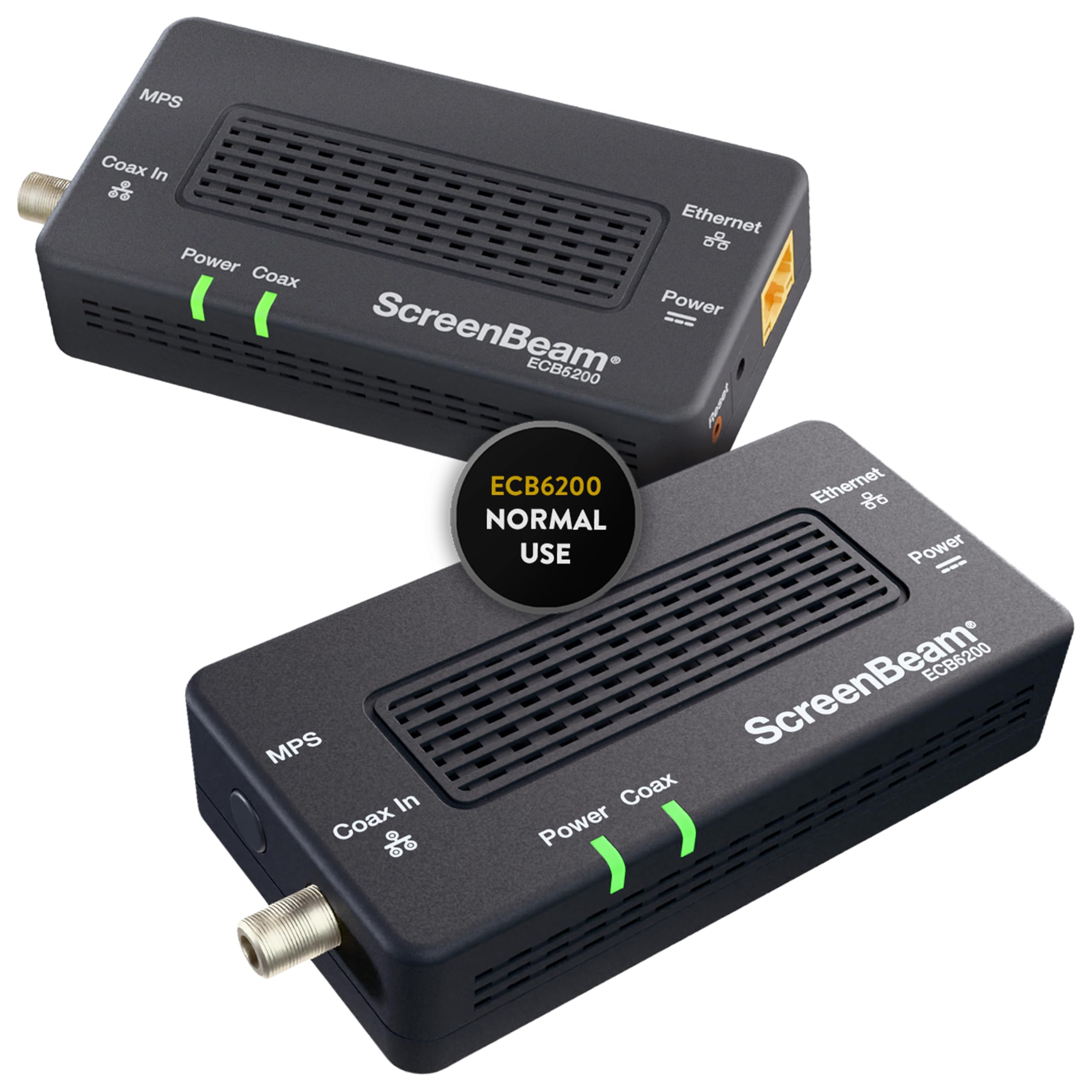
Type: Ethernet over coax network adapter starter kit
Standard: Bonded MoCA 2.0
Connection: Coaxial cable to Ethernet
Intended Use: Streaming and work-from-home networking
Kit Format: Starter kit
Color: Not applicable
The ScreenBeam ECB6200K02 turns existing coaxial cable into a network backbone. A home with cable TV or satellite wiring already running through the walls has a ready-made high-speed path, and this kit puts an Ethernet port at each end of it. Bonded MoCA 2.0 is the part that matters: it uses more than one coax channel at once, which is what separates a coax adapter from a plain powerline link in throughput terms.
The kit format suits a single run between two rooms. One adapter typically connects at the router end and the other sits at the far room, giving a device there a wired connection without new cable. For streaming boxes, desktop PCs and video calls, that wired stability is the whole point.
Trade-off: The kit only works where coaxial outlets exist and are wired back to a common point, so a home without coax has nothing for it to use.
Check the ScreenBeam ECB6200K02 on Amazon
BVP-5100D Powerline Adapter

Type: Powerline network adapter
Connection: Electrical wiring to Ethernet
Included: Power cable
Color: White
Intended Use: Wired networking through household power outlets
The BVP-5100D takes the other route entirely. It sends network data over the electrical wiring in the home, so any room with a power outlet becomes a candidate for a wired connection. That is its great strength: almost every room has power, and almost none have coax. Setup is a matter of plugging in and pairing, with no configuration of the home’s cable infrastructure.
The white housing and included power cable keep the install tidy against a wall or skirting board. At its price tier, this is the budget entry into wired networking, and it shows in the spec sheet. Powerline throughput depends heavily on the age and quality of the home’s wiring, and this model sits at the modest end of the category rather than the fast end.
Trade-off: Powerline speed is at the mercy of household wiring and can fall well short of what the label suggests, especially across circuits or in older homes.
Side-by-Side: What Separates Them
| Dimension | ScreenBeam ECB6200K02 | BVP-5100D |
|---|---|---|
| Medium | Coaxial cable | Electrical wiring |
| Standard | Bonded MoCA 2.0 | Powerline |
| Kit contents | Starter kit (two adapters) | Adapter with power cable |
| Home requirement | Coax outlets wired to a common point | Power outlets on the same electrical system |
| Speed ceiling | Higher, thanks to bonded MoCA 2.0 | Lower, capped by wiring quality |
| Install effort | Moderate, needs coax access | Low, plug and pair |
| Price tier | Premium | Budget |
The medium is the first fork in the road. Coax is a shielded cable designed from the start to carry high-frequency signals, and bonded MoCA 2.0 exploits that with multiple channels. Electrical wiring was never designed for data, and powerline adapters fight noise from every appliance on the circuit. That is why the ScreenBeam kit carries the higher speed ceiling and the higher price.
The second fork is what the home already has. A house with coax in the target rooms can put the ScreenBeam kit to work immediately. A house without it is looking at a powerline adapter or a mesh system instead, and the BVP-5100D becomes the practical answer.
The third fork is budget and simplicity. The BVP-5100D asks for less money and less thought: plug it in, pair it, connect a device. The ScreenBeam kit asks for more of both but rewards a coax-wired home with a faster, more stable link. Neither is universally better; each is better for a specific house.
Which Should You Buy?
Choose the ScreenBeam ECB6200K02 if the home has coaxial outlets in the rooms that need internet, and the goal is streaming, video calls or a desktop that needs a solid wired connection. The bonded MoCA 2.0 standard makes it the faster of the two, and the starter kit covers a router-to-room run out of the box.
Choose the BVP-5100D if there is no coax to work with, the budget is tight, or the far room only needs a basic wired link for a smart TV or a light-duty device. It is the lower-effort, lower-cost path, and it works wherever there is a power outlet.
FAQ
-
Does the ScreenBeam ECB6200K02 work without cable TV service?
Yes. The coax cable in the walls carries the network signal between the two adapters; an active cable TV subscription is not required for the link itself. -
Can the BVP-5100D and the ScreenBeam kit be used together?
No. They use different mediums and different standards, so a powerline adapter and a coax adapter cannot pair with each other. Pick one technology for the whole link. -
Which one is faster for streaming?
The ScreenBeam ECB6200K02 has the higher ceiling because bonded MoCA 2.0 uses multiple coax channels. The BVP-5100D is limited by the quality of the home’s electrical wiring. -
Do powerline adapters work across different circuits?
They can, but performance drops when the two adapters sit on different circuits. Best results come from outlets on the same circuit, ideally in the same part of the home. -
Is the ScreenBeam kit hard to install?
It is a plug-in affair at both ends, but it does require access to coax outlets at the router and in the target room. Homes without coax in those spots cannot use it. -
Does the BVP-5100D need any software?
Powerline adapters of this type pair at the hardware level. The included power cable and a pair of outlets are the main requirements. -
Which is better for a work-from-home office?
The ScreenBeam ECB6200K02, provided the office has a coax outlet. Video calls and large file transfers benefit from the higher, more consistent throughput of a coax link.
Bottom Line
The ScreenBeam ECB6200K02 is the better buy for any home with coaxial wiring, because bonded MoCA 2.0 delivers more speed and stability than powerline can match. The BVP-5100D remains the right call for homes without coax or for buyers who want the cheapest possible wired link. Check the current price on the ScreenBeam ECB6200K02 before deciding.