Why there are Amazon links here: Brave Review is paid a commission for qualifying Amazon purchases made through the links below. Your price does not change, and using our links is entirely optional. How this works
Westinghouse 12500 Watt Dual Fuel vs EF ECOFLOW Delta Pro Portable Power Station: Generator or Battery Backup?
The Westinghouse 12500 Watt Dual Fuel and the EF ECOFLOW Delta Pro solve the same problem — keeping a home powered when the grid fails — with two completely different technologies. One burns gasoline or propane in a conventional generator; the other stores energy in a large lithium battery and can be recharged from solar, wall power, or a generator. This comparison breaks down the dimensions that actually separate them so a buyer can pick the right one fast.
The short version: buyers who want raw output, long runtimes, and whole-home transfer-switch capability lean toward the Westinghouse. Buyers who want quiet, fume-free indoor-capable power and expandability lean toward the Delta Pro. The table below puts the key specs side by side.
The Picks at a Glance
| Product | Key Spec | Best Use | Price Tier |
|---|---|---|---|
| Westinghouse 12500 Watt Dual Fuel | 12,500 peak watts, dual fuel, remote electric start | Whole-home backup and heavy loads | Mid-range |
| EF ECOFLOW Delta Pro | 3600Wh expandable to 25kWh, 3600W AC output | Quiet indoor backup and solar recharge | Premium |
Westinghouse 12500 Watt Dual Fuel Home Backup Portable Generator

Type: Portable fuel generator
Power source: Gasoline and propane (dual fuel)
Peak output: 12,500 watts
Starting method: Remote electric start
Installation: Transfer switch ready
Safety feature: CO sensor
The Westinghouse is a fuel-burning generator built for heavy loads. Its 12,500 peak watts put it in the class that can carry a well pump, a furnace, refrigerators, and lights at the same time — the kind of load a whole-home transfer switch is designed to feed. The dual-fuel design means it can run on gasoline or propane, which matters when one fuel is easier to source during an outage.
The remote electric start and transfer-switch readiness reduce the manual work of getting backup power online. The CO sensor is a meaningful safety addition for a gasoline-powered machine that must be run outdoors. This is a machine for buyers who need serious wattage and can store and maintain fuel.
Trade-off: A fuel generator of this size is loud, needs outdoor placement, and requires ongoing fuel and maintenance, so it is not a fit for apartment dwellers or anyone wanting silent indoor backup.
Check the current price on Amazon
EF ECOFLOW Delta Pro Portable Power Station
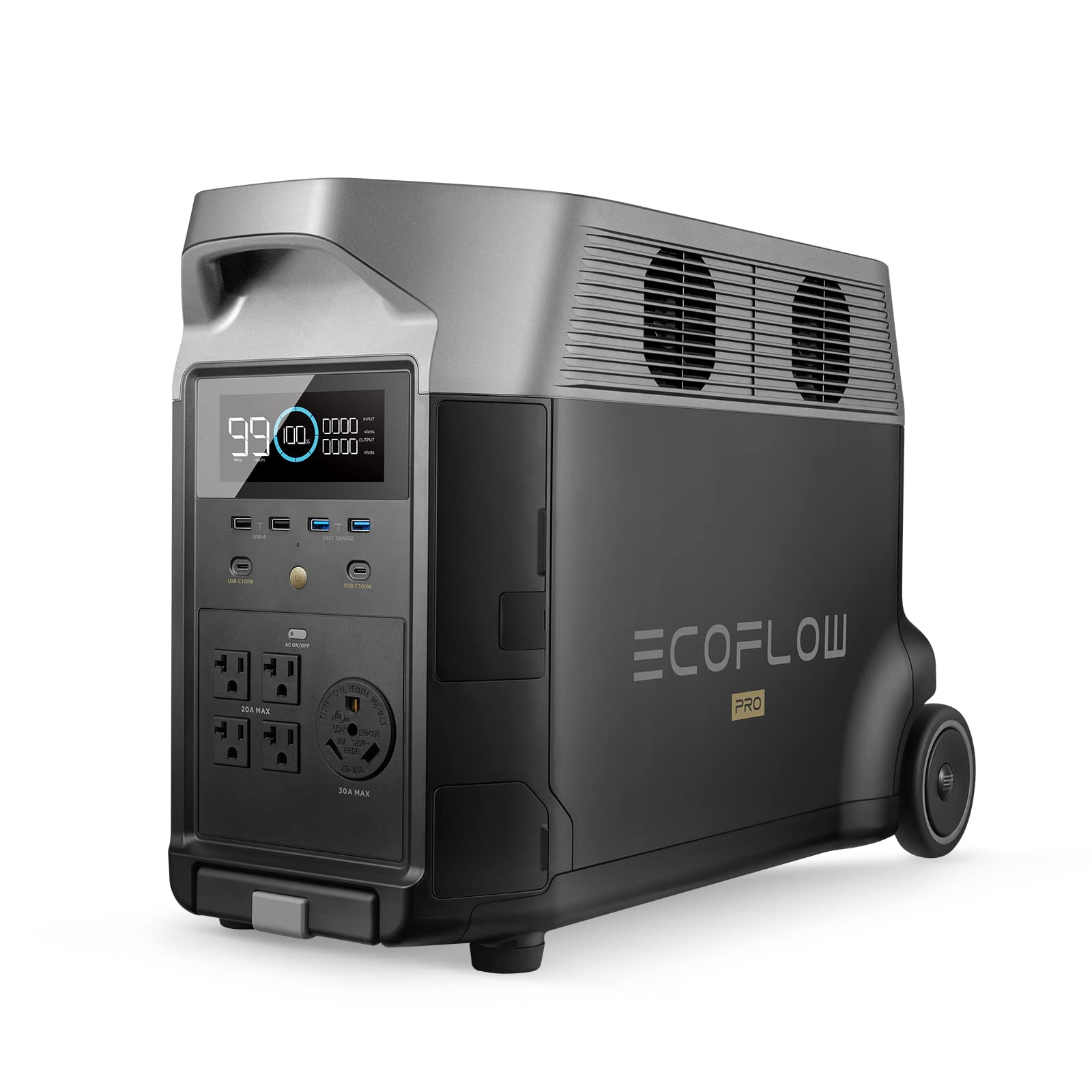
Type: Portable battery power station
Power source: Battery, rechargeable from solar or wall
Capacity: 3600Wh, expandable up to 25kWh
AC output: 3600W at 120V
Charge time: Fast charge
Intended use: Home backup, camping, RV, emergencies
The Delta Pro is a battery-based power station that stores energy rather than generating it. Its 3600Wh base capacity and 3600W AC output handle most household essentials and many appliances, and the expandable design lets buyers grow capacity up to 25kWh by adding batteries. That expandability is the standout feature — it lets a system scale from a single unit to something approaching whole-home coverage.
Because it runs on stored energy, the Delta Pro produces no exhaust and no engine noise, so it can run indoors and in shared spaces where a generator cannot. Fast charging and solar compatibility make it practical to refill between outages or during a long one.
Trade-off: The Delta Pro stores energy rather than making it, so a long outage eventually drains it unless solar or another source refills it — and the premium price tier reflects the battery cost.
Check the current price on Amazon
Side-by-Side Spec Comparison
| Attribute | Westinghouse 12500 Watt Dual Fuel | EF ECOFLOW Delta Pro |
|---|---|---|
| Type | Portable fuel generator | Battery power station |
| Power source | Gasoline and propane | Battery, solar or wall recharge |
| Peak output | 12,500 watts | 3600W AC output |
| Capacity | Not a stored-energy device | 3600Wh, expandable to 25kWh |
| Starting method | Remote electric start | Standard power-on |
| Installation | Transfer switch ready | Plug-and-play |
| Safety feature | CO sensor | No exhaust, indoor-capable |
| Intended use | Whole-home backup | Home backup, camping, RV |
How the Two Compare
Power and load handling. The Westinghouse wins on raw wattage. Its 12,500 peak watts dwarf the Delta Pro’s 3600W AC output, so it can start and run heavy motor loads — well pumps, furnaces, large appliances — that the Delta Pro cannot carry alone. Buyers whose priority is starting big loads should weight this heavily toward the generator.
Runtime and refueling. The two differ in how they sustain a load. The Westinghouse runs as long as fuel is supplied, and dual-fuel capability gives a backup option if gasoline runs short. The Delta Pro runs until its battery drains, then needs recharging from solar or wall power. For a multi-day outage, the generator’s ability to refuel is a real advantage; for a short outage, the battery’s silence and simplicity win.
Noise and placement. The Delta Pro runs silently and produces no exhaust, so it can sit indoors and in shared living spaces. The Westinghouse must run outdoors and is loud. Buyers in apartments, condos, or shared walls will find the battery far more livable.
Installation and effort. The Westinghouse is transfer-switch ready and uses remote electric start, but it still needs fuel, oil, and maintenance. The Delta Pro is plug-and-play and needs no fuel handling, though its capacity must be managed carefully during an outage.
Scalability and cost. The Delta Pro’s expandability to 25kWh lets a buyer grow the system over time, but at a premium price tier. The Westinghouse delivers high output at a mid-range price but commits the buyer to fuel and upkeep.
Trade-off summary: The Westinghouse trades quiet, clean indoor operation for raw power and refuelable runtime; the Delta Pro trades raw output and unlimited runtime for silence, indoor use, and expandable capacity.
Which Should You Buy?
Choose the Westinghouse 12500 Watt Dual Fuel if the priority is maximum wattage, whole-home transfer-switch backup, and the ability to refuel during a long outage. It suits homeowners with heavy loads — well pumps, furnaces, large appliances — who can run a generator outdoors and maintain it.
Choose the EF ECOFLOW Delta Pro if the priority is quiet, fume-free power that can run indoors, plus the option to expand capacity and recharge from solar. It suits apartment and condo dwellers, RV and camping users, and buyers who want plug-and-play backup without fuel handling.
FAQ
- Can the Westinghouse run indoors? No. It is a fuel-burning generator that produces exhaust, so it must run outdoors. The CO sensor adds a safety layer but does not make indoor use safe.
- Can the Delta Pro run a whole house? Its base 3600W output handles essentials and many appliances, and expandability up to 25kWh lets a system grow, but whole-home coverage depends on how the system is configured and how long the outage lasts.
- Which is better for a long outage? The Westinghouse, because it can be refueled and run indefinitely as long as fuel lasts. The Delta Pro needs solar or another recharge source once its battery drains.
- Which is quieter? The Delta Pro runs silently; the Westinghouse is a loud fuel generator.
- Do both need special installation? The Delta Pro is plug-and-play. The Westinghouse is transfer-switch ready but still needs fuel, maintenance, and outdoor placement.
- Which costs more upfront? The Delta Pro sits in a premium price tier, while the Westinghouse is mid-range — but the generator carries ongoing fuel and maintenance costs.
Bottom Line
The decision comes down to what the outage demands. For raw wattage, refuelable runtime, and whole-home transfer-switch backup, the Westinghouse 12500 Watt Dual Fuel is the stronger pick. For silent, fume-free indoor power with expandable capacity and solar recharge, the EF ECOFLOW Delta Pro is the better fit.