Why there are Amazon links here: Brave Review is paid a commission for qualifying Amazon purchases made through the links below. Your price does not change, and using our links is entirely optional. How this works
Best Cold Alarm for a Garage Workshop: 5 Reliable Picks
A garage workshop sits away from the house, so a cold snap can go unnoticed until pipes freeze or finishes and adhesives are ruined. The best cold alarm for a garage workshop watches temperature and warns when it drops too low, whether that means a fridge-style monitor, a high-decibel siren or a heat detector for fire risk. This roundup covers five picks for different priorities: budget monitoring, loud local alerts, remote visibility and fire safety. The overview below sorts them by spec and use so a choice can be made in a minute.
The Picks at a Glance
| Product | Key Spec | Best Use | Price Tier |
|---|---|---|---|
| AcuRite Digital Wireless Fridge and Freezer Thermometer (00515M) | Wireless display with max/min memory and alarm | Budget temperature monitoring | Budget |
| Freezer Alarm Monitor 120V | 105dB sound and light alert, 120V | Loud local cold alert | Budget |
| Briidea Battery Powered Temperature Warning Light | -4℉ to 248℉ range, 1000ft LED, magnetic base | High-visibility garage alert | Mid-range |
| Freezer & Fridge Thermometer, 110dB Built-in Alarm, Hub for Remote | External probe to -40F, 110dB alarm | Remote probe for deep cold | Mid-range |
| Kidde Heat Detector | Hardwired with battery backup, interconnect | Fire and heat safety | Mid-range |
1. AcuRite Digital Wireless Fridge and Freezer Thermometer (00515M)

Type: Wireless digital thermometer with alarm
Display: 4.25" x 3.75" indoor unit
Key Feature: Max/min temperature memory
Intended Use: Home and restaurants, adaptable to a garage
Power Source: Battery-powered wireless sensor
AcuRite Digital Wireless Fridge and Freezer Thermometer (00515M)
The AcuRite 00515M is the familiar fridge-and-freezer monitor adapted to workshop duty. A wireless sensor sends readings to a display unit that keeps max/min records, so a temperature excursion overnight is still visible in the morning. The alarm sounds when the reading crosses a set threshold. For a garage workshop it works best as a simple cold watch on a cabinet, paint locker or small fridge. It is a budget pick from a well-known name, and the 2K+ monthly purchases suggest it is a common first stop.
This pick suits buyers who want a cheap, set-and-forget monitor with a display they can check at a glance. It is not for anyone who needs a siren loud enough to hear across a yard or a probe that reads deep sub-zero. The wireless sensor’s range and battery are the weak points; a detached garage at the far end of a property may push the link.
Trade-off: The compact wireless sensor trades range and battery life for its low price, so a distant outbuilding may lose contact.
2. Freezer Alarm Monitor 120V
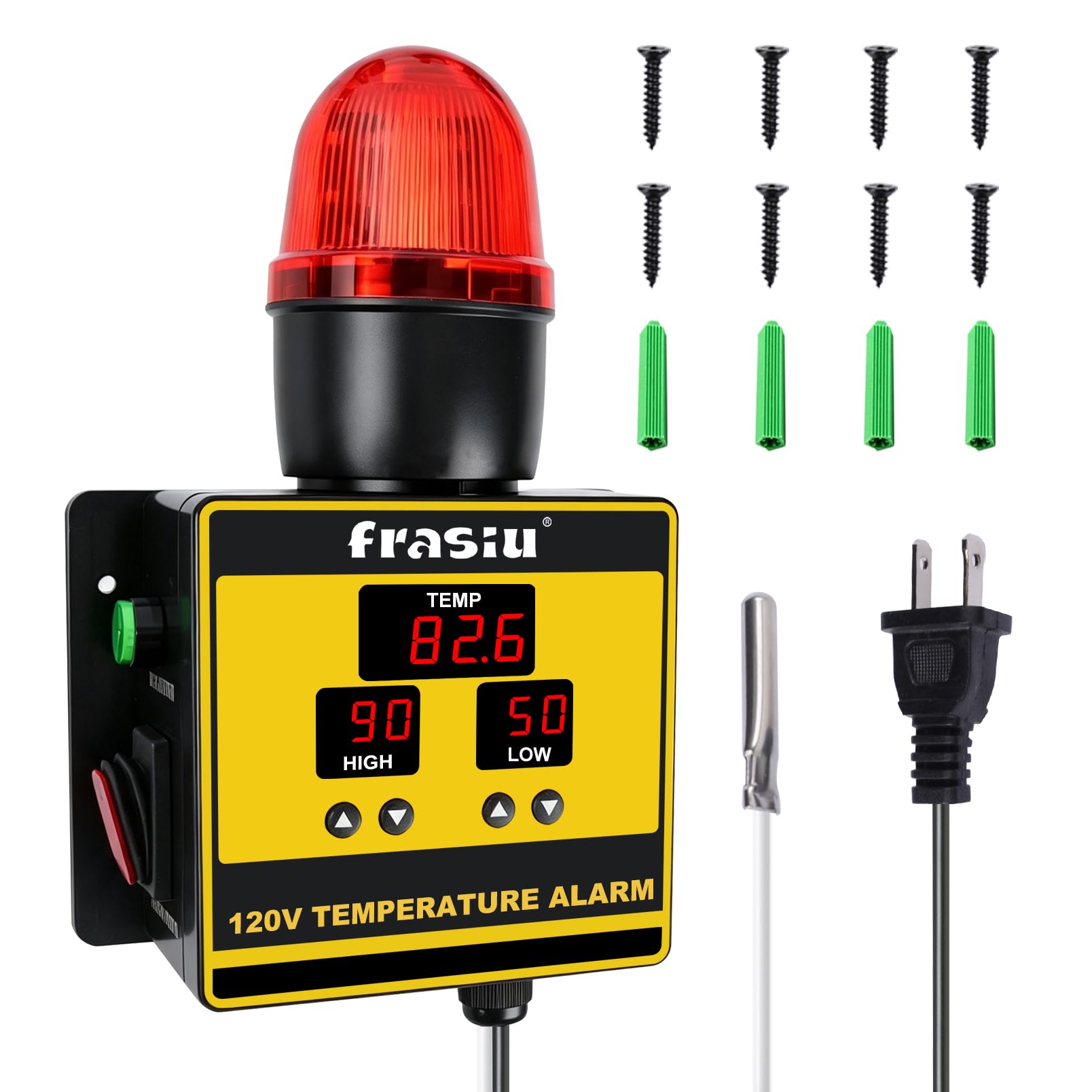
Type: Plug-in high/low temperature alarm
Alert: 105dB sound plus light
Power Source: 120V
Intended Use: Freezer, fridge, walk-in cooler, garage, greenhouse
Output: Alarm only, no relay output
This 120V unit is a dedicated alarm rather than a display-first monitor. It plugs into a wall outlet and sounds a 105dB siren with a light when temperature crosses high or low limits. That combination of sound and light is useful in a workshop where a machine may be running and a display would go unseen. The name lists garage among its intended uses, alongside freezers and greenhouses, so the cold side is covered. It is a straightforward, single-purpose device.
This pick suits buyers who want a loud, local warning and do not need remote monitoring or data logging. It is not for anyone who wants to check trends or receive alerts away from the building, since it has no relay output and no app. The 120V cord also means placement depends on an outlet, which limits where it can sit.
Trade-off: With no relay output and no remote link, the alarm only helps someone within earshot of the building.
3. Briidea Battery Powered Temperature Warning Light
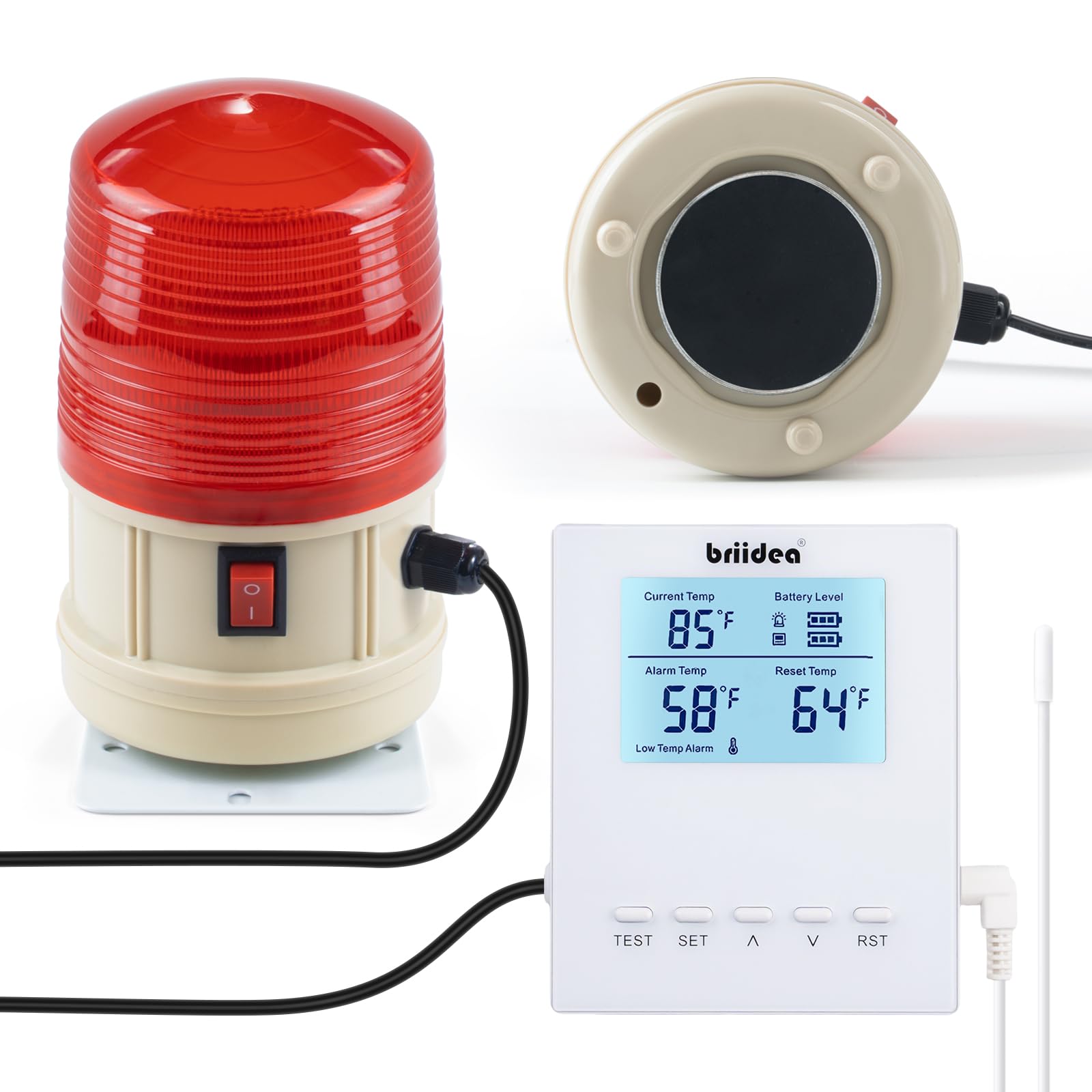
Type: Battery-powered temperature warning light
Range: -4℉ to 248℉
Visibility: 1000ft high-visibility LED
Mounting: Magnetic base and mounting bracket
Display: LCD
Intended Use: Home, garage, farms
Briidea Battery Powered Temperature Warning Light
The Briidea is built around visibility. A high-visibility LED is rated to be seen at 1000ft, and the LCD shows the current reading, so a glance from the workshop door or the house window confirms the status. The -4℉ to 248℉ range covers winter cold and summer heat in an uninsulated garage. A magnetic base and mounting bracket give two ways to fix it to a steel cabinet, wall or shelf. Battery power removes the outlet constraint that limits plug-in alarms.
This pick suits buyers with a detached or hard-to-see workshop who want a warning that reads across a distance. It is not for anyone who needs phone alerts or a recorded history of temperature swings. Battery power is a convenience but also a maintenance item, and the light-based warning depends on someone actually looking in its direction.
Trade-off: The warning is visual and local, so it only works if a person is present to see the LED or LCD.
4. Freezer & Fridge Thermometer, 110dB Built-in Alarm, Hub for Remote
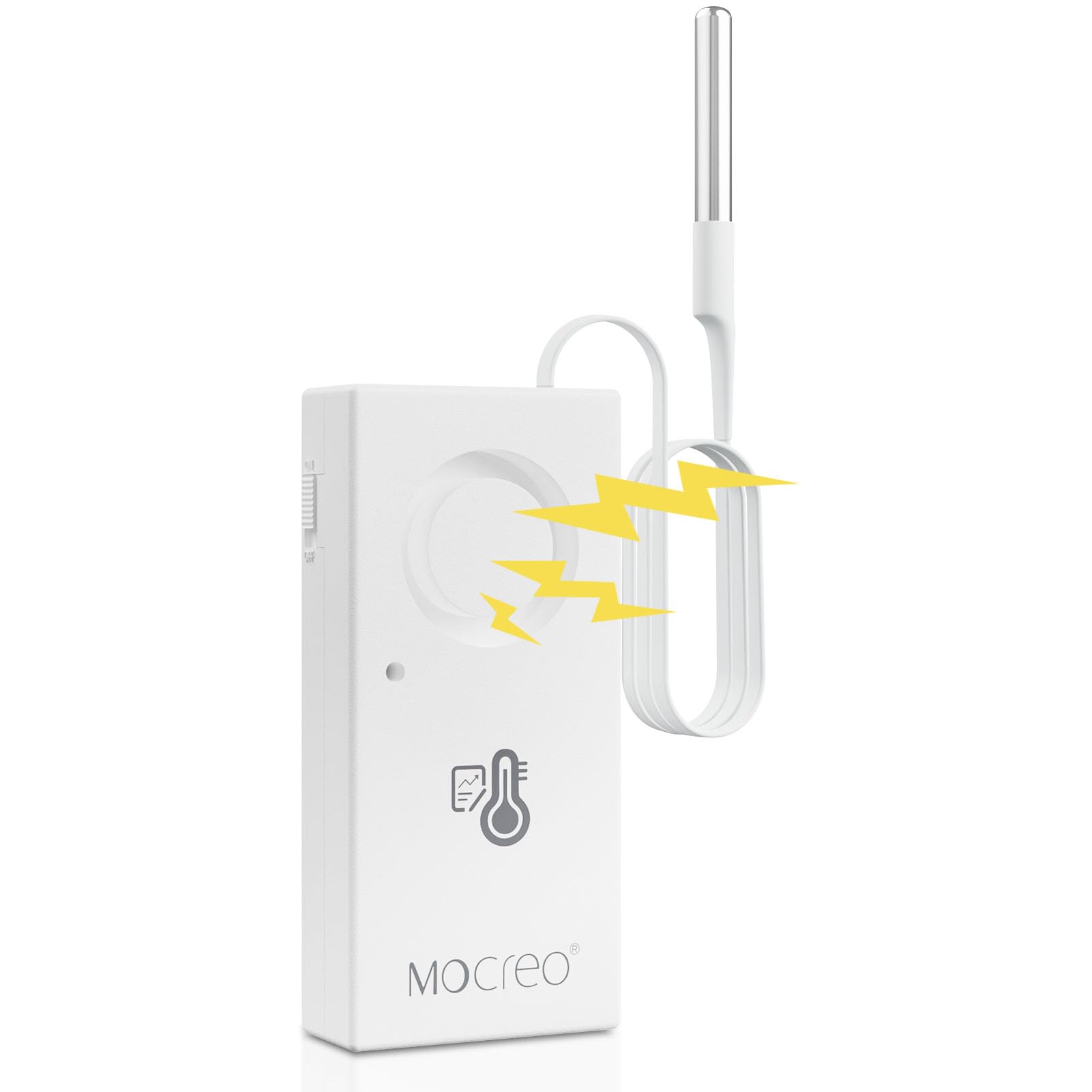
Type: Thermometer hub with external probe
Low Range: Reads down to -40F
Alarm: 110dB built-in
Power Source: 9V
Intended Use: Deep freezers, garage and basement units, walk-in coolers, RVs
Design: Add-on sensor with external probe
Freezer & Fridge Thermometer, 110dB Built-in Alarm, Hub for Remote
This unit is the specialist of the group for serious cold. An external probe reads down to -40F, which covers deep freezers and the worst a garage can throw at it, while the hub carries a 110dB built-in alarm. It is described as an add-on sensor for garage and basement units, walk-in coolers and RVs, so it fits a workshop that already runs a monitoring setup or wants a probe-based reading rather than an ambient one. The 9V power source keeps it independent of wall outlets.
This pick suits buyers who need a probe in a freezer, chest unit or cold corner and want a loud local siren. It is not for anyone who wants a simple standalone display, since this is part of a hub system and its value depends on that ecosystem. The probe design also means installation takes a little more care than setting a box on a shelf.
Trade-off: As a hub add-on, the unit is only as useful as the system it joins, so a buyer without that hub gains little.
5. Kidde Heat Detector

Type: Hardwired heat detector
Backup: Battery backup
Indicators: 2 LEDs
Feature: Interconnect capability
Intended Use: Garages and similar spaces
The Kidde Heat Detector covers the other cold-weather garage risk: a heater, charger or tool battery starting a fire in a space nobody is watching. It is hardwired with battery backup and two LEDs, and it can interconnect with other alarms so a garage event triggers the whole system. The name specifically calls out garages as the ideal location, where dust and fumes make a heat detector a better fit than a standard smoke alarm. It is a safety layer rather than a thermometer.
This pick suits buyers who run a heater or charge batteries in the workshop and want fire coverage that reaches the house. It is not for anyone looking for a temperature readout or a cold warning, because it does neither. Installation is a wiring job rather than a plug-in, which puts it out of reach for some renters.
Trade-off: This is fire protection, not a cold alarm, and hardwiring makes it a permanent installation rather than a quick add-on.
Before You Buy
- Alert type: Decide whether a local siren, a visible LED or a display matters most, since each pick leads with a different one.
- Temperature range: A garage can swing well below freezing, so check the low limit against the coldest nights in the area.
- Power source: Battery units go anywhere; 120V and hardwired units need an outlet or wiring at the mounting spot.
- Probe vs ambient: A probe reads inside a freezer or cold cabinet, while an ambient sensor reads the room; match the sensor to what needs watching.
- Connectivity: A standalone alarm stays local, while a hub or interconnect system can warn elsewhere in the building.
- Mounting: Magnetic bases and brackets suit steel cabinets and walls; check the surface before buying.
Frequently Asked Questions
-
What temperature should a garage workshop alarm be set to?
Set the low limit above the point where stored paint, glue, pipes or batteries are at risk, leaving a margin so the alarm sounds before damage begins. -
Is a fridge thermometer good enough for a garage?
A fridge-style monitor works for a basic cold watch, but its sensor range and battery life may fall short in a distant, unheated outbuilding. -
Do these alarms need Wi-Fi?
None of the picks here depend on Wi-Fi; they warn locally with sound, light or a display, and the hub unit works within its own system. -
Can a heat detector replace a cold alarm?
No. A heat detector watches for fire, not low temperature, so a workshop with both risks needs both devices. -
How loud should a garage alarm be?
A workshop with running tools benefits from a high-decibel siren, while a light-based unit suits a space that is checked visually from a distance. -
Where should the alarm be mounted?
Place it at the height where cold air settles and near the items at risk, and keep a probe-based unit’s sensor inside the cabinet or freezer it monitors.
Bottom Line
For most garage workshops, the Briidea Battery Powered Temperature Warning Light is the best cold alarm for a garage workshop: its wide range, long-visibility LED and magnetic mounting cover an unheated outbuilding without an outlet. Buyers who need a loud local siren should look at the 120V Freezer Alarm Monitor, and anyone heating or charging in the shop should add the Kidde Heat Detector as fire cover.
