Why there are Amazon links here: Brave Review is paid a commission for qualifying Amazon purchases made through the links below. Your price does not change, and using our links is entirely optional. How this works
Best Heat Alarm for a Utility Room with a Tumble Dryer
A utility room with a tumble dryer is one of the trickier spots in a house to protect: lint, warm exhaust air and a running appliance make a standard smoke alarm a nuisance-trip waiting to happen. That is why a heat alarm, which responds to a rapid rise in temperature rather than smoke, is the usual answer. The five picks below cover the three buyer types this room attracts: the hardwired installer matching existing alarm wiring, the budget-focused owner who wants a simple battery-backup unit, and the owner who wants live temperature monitoring rather than a one-off trip. The overview table below compares all five at a glance before the individual reviews.
The Picks at a Glance
| Product | Key Spec | Best Use | Price Tier |
|---|---|---|---|
| First Alert BRK HD6135FB | Hardwired with 9V battery backup | Standard hardwired heat alarm | Budget |
| Kidde Heat Detector | Hardwired, battery backup, interconnect | Linking into an existing alarm circuit | Mid-range |
| First Alert Hard Wired Heat Alarm | Thermistor sensor, 50 ft detection, 85 dB | Large utility rooms | Mid-range |
| Heat Safety Monitor (Made in USA) | Temperature and heat index monitoring | Premises needing live temperature data | Premium |
| 120V Temperature Alarm Controller | One-key mute, 105 dB sound and light | Equipment rooms with nuisance alarms | Mid-range |
1. First Alert BRK HD6135FB Hardwired Heat Alarm

Type: Hardwired heat alarm
Power Source: 120 V hardwired with 9V battery backup
Sensor: Heat detection (fixed temperature and rate-of-rise type)
Mounting: Ceiling
Audible Output: 85 dB alarm horn
Interconnect: Single-station
This is the workhorse pick. It is a hardwired heat alarm that draws its main power from the household circuit and keeps a 9V battery on standby, so a tripped breaker or a power cut does not leave the utility room unprotected. The heat sensor responds to a fast temperature rise rather than smoke, which is exactly what a dryer exhaust and a pocket of warm lint-filled air would otherwise trigger on a smoke alarm. It is the right unit for a homeowner replacing an old hardwired alarm in the same ceiling box.
It suits the buyer who already has mains wiring in the ceiling and wants a straight swap without pulling new cable. The trade-off is that it works as a standalone unit, so it will not set off the other alarms in the house, and anyone who wants whole-home linking should look at the Kidde below instead.
2. Kidde Heat Detector, Hardwired with Battery Backup

Type: Hardwired heat detector
Power Source: 120 V hardwired with battery backup
Indicator: Two LEDs
Interconnect: Yes, links with compatible alarms
Intended Use: Garages, utility rooms
Mounting: Ceiling
The Kidde unit is the pick for anyone who wants the utility room alarm to be part of the wider system. Its interconnect capability means it can be wired to trigger compatible alarms elsewhere in the house, so a heat event above the dryer sounds throughout the property rather than only in the room nobody is standing in. The two LEDs give a quick visual status check from floor level, and the battery backup keeps it live when mains power drops.
It is the best fit for a household that already runs Kidde alarms and wants the utility room brought onto the same circuit. The trade-off is price: it costs more than the First Alert for a similar hardwired heat function, and that premium only pays off if the buyer actually uses the interconnect wiring.
3. First Alert Hard Wired Heat Alarm, 120 V
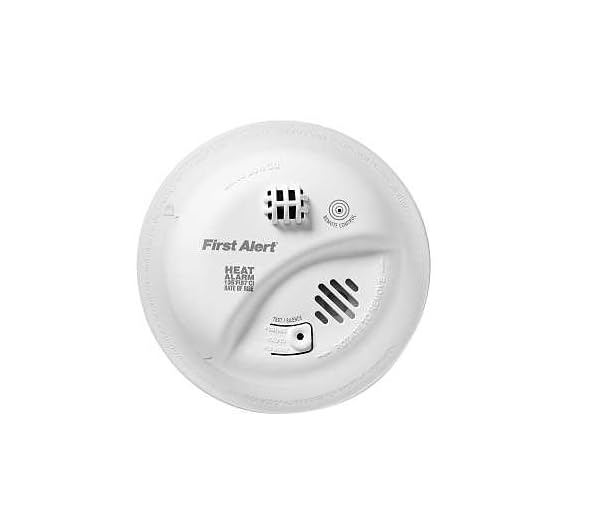
Type: Hardwired heat alarm
Sensor: Thermistor
Detection Range: 50 ft
Audible Output: 85 dB
Power Source: 120 V hardwired with battery backup
This First Alert model is built around a thermistor sensor and lists a 50 ft detection range, which makes it the sensible choice for a long utility room or a converted garage where the dryer sits at one end and the ceiling space runs deep. The 85 dB horn is in line with the rest of the hardwired field, and the battery backup keeps it working through a power interruption. The thermistor design is a solid-state approach that avoids the mechanical parts some older heat sensors rely on.
It suits the buyer with a larger room or an awkward ceiling footprint who needs coverage rather than a compact unit. The trade-off is that the extra detection range is wasted in a small box room, where a cheaper hardwired alarm covers the same space for less money.
4. Heat Safety Monitor, Made in USA

Type: Temperature and heat index monitor
Origin: Made in USA
Function: Heat safety monitoring with instant alerts
Measurement: Temperature and heat index
Use Case: Premises monitoring
This is a different class of device from the alarms above. Rather than waiting for a fixed trip point, it monitors temperature and heat index and issues instant alerts, which makes it useful for a utility room where the concern is gradual heat build-up from a dryer running back-to-back cycles rather than a single flash fire. It is made in the USA and aimed at buyers who want data and early warning rather than a bare siren.
It earns its place for the owner of a commercial-style laundry room, a workshop or a rental property who wants to know the room is overheating before it becomes an incident. The trade-off is cost: it sits in the premium tier and is far more expensive than a standard heat alarm, so it makes sense only where temperature monitoring is the actual goal rather than basic code compliance.
5. 120V Temperature Alarm Controller

Type: Temperature alarm controller
Power Source: 120 V
Audible Output: 105 dB
Alert Type: Sound and light
Special Feature: One-key mute
Intended Use: Greenhouses, farms, warehouses, equipment rooms
This controller is the loudest unit here at 105 dB and pairs the sound alert with a light, which helps in a utility room where a dryer or boiler can drown out a standard horn. The one-key mute is the feature that earns it a spot: in a room that runs hot by design, being able to silence a nuisance alarm without dismantling the unit is a real convenience. It is a 120 V controller aimed at equipment rooms and outbuildings as much as domestic utility spaces.
It suits the buyer whose utility room doubles as an equipment room and who expects occasional high-temperature events that should not trigger a full panic. The trade-off is that it is a temperature controller rather than a certified residential heat alarm, so anyone needing a code-compliant alarm for a home sale should choose one of the hardwired alarms above.
Before You Buy
- Power source: Match the unit to the wiring already in the ceiling. A hardwired alarm needs a 120 V supply; a controller or monitor may run on mains or its own supply.
- Interconnect: Decide whether the utility room alarm must trigger the rest of the house. Only interconnected models do that.
- Sensor type: Thermistor and rate-of-rise heat sensors suit dryer rooms; a temperature monitor suits buyers who want readings, not just a siren.
- Coverage: A listed detection range matters in a long or open-plan utility room and is wasted in a small cupboard-sized space.
- Audible output: A dryer and a boiler raise background noise, so a louder horn or a sound-and-light alert is worth the extra.
- Mute function: A one-key mute is valuable in a room designed to run warm, where nuisance trips are likely.
- Certification and use case: Confirm the unit is sold as a residential heat alarm rather than a general-purpose temperature controller if it needs to satisfy a home inspection.
Frequently Asked Questions
-
Why use a heat alarm instead of a smoke alarm in a utility room?
A tumble dryer throws off lint and warm, moist exhaust air that can trip a smoke alarm repeatedly. A heat alarm ignores that and responds to a genuine temperature rise instead. -
Does a heat alarm need to be hardwired?
Not always, but hardwired models with battery backup are the common choice where ceiling wiring already exists, and they keep working through a power cut. -
Can a utility room heat alarm be linked to the rest of the house?
Only if the model lists interconnect capability. The Kidde unit here supports it; single-station alarms do not. -
Is a temperature monitor the same as a heat alarm?
No. A monitor tracks temperature and heat index and sends alerts, while a heat alarm sounds a siren when it detects a rapid temperature rise. The monitor suits data-driven buyers; the alarm suits code compliance. -
Where should the alarm be mounted in a room with a dryer?
On the ceiling, clear of the dryer exhaust path, so warm damp air does not sit directly on the sensor and cause nuisance trips. -
How loud should a utility room alarm be?
Look for a high-decibel horn, since a running dryer and boiler raise background noise. The controller here lists 105 dB, the loudest of the group.
Bottom Line
For most homes, the First Alert BRK HD6135FB is the best heat alarm for a utility room with a tumble dryer: it is hardwired, keeps a battery backup, and costs the least of the dedicated alarms here. Buyers who need the utility room tied into a whole-house alarm circuit should step up to the Kidde Heat Detector, and anyone who wants live temperature data rather than a siren should look at the Heat Safety Monitor instead.
