Why there are Amazon links here: Brave Review is paid a commission for qualifying Amazon purchases made through the links below. Your price does not change, and using our links is entirely optional. How this works
GoveeLife WiFi Hygrometer Thermometer with Gateway, Mini Sensor 3-Pack: Three Rooms, One App
The GoveeLife WiFi hygrometer thermometer is a three-room monitoring kit: one gateway that talks to the home network and three mini sensors that report temperature and humidity back through it. It suits a household that wants to watch a wine cellar, a bedroom and a basement at the same time without buying three separate standalone units. This review covers what the kit includes, how the gateway-and-sensor arrangement actually works, where the 2.4 GHz limitation bites, and who should look elsewhere. The short answer sits in the Bottom Line.
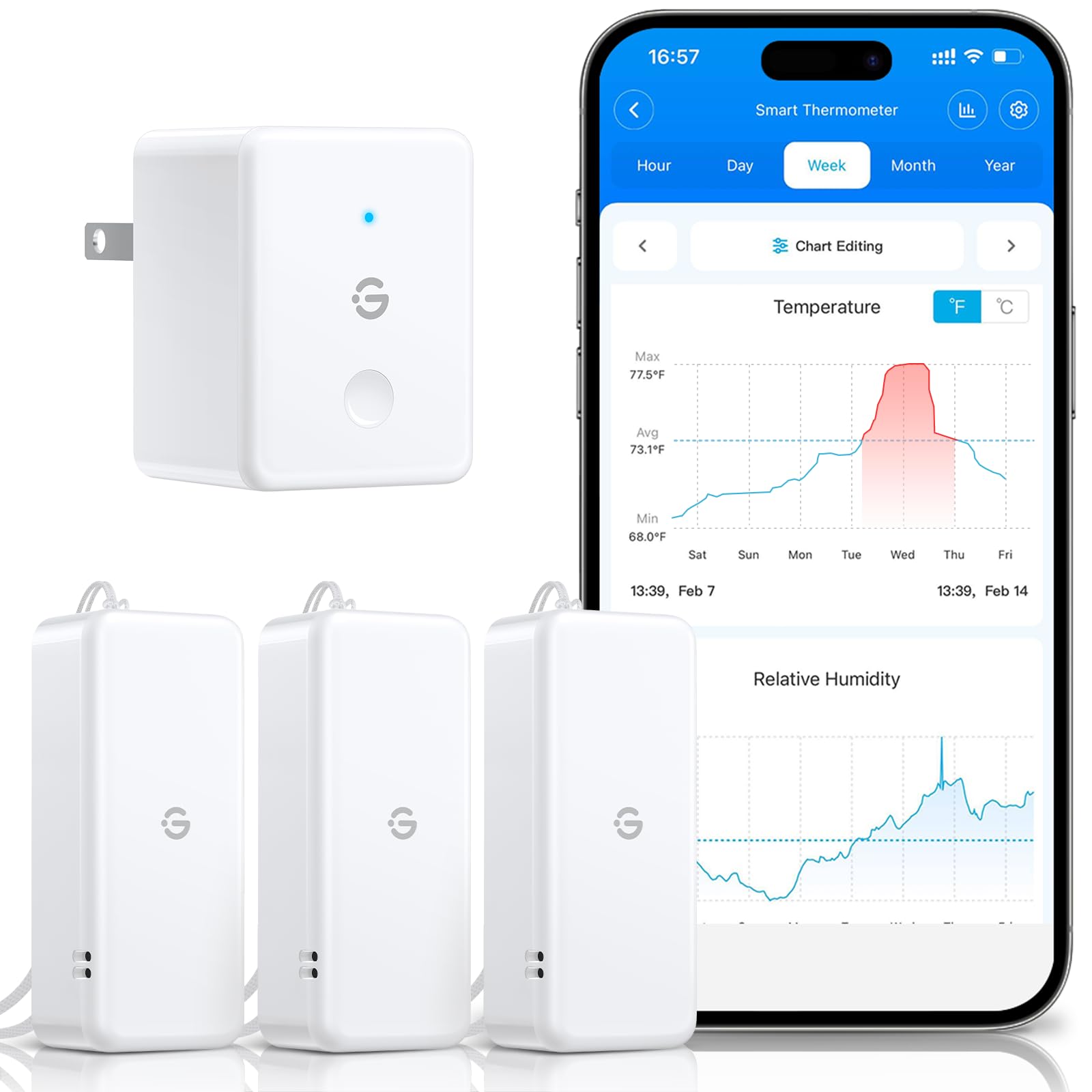
Features and Specifications
Type: Wi-Fi hygrometer and thermometer kit with separate gateway
Sensors Included: Three mini sensors
Connectivity: 2.4 GHz Wi-Fi only
Reported Data: Temperature and humidity, with app alerts
Data Retention: Two years of history
Power Source: Battery
Intended Rooms: Wine cellar, bedroom, basement
The kit splits the job in two. The gateway is the part that joins the home Wi-Fi network and pushes readings to the cloud; the three mini sensors are the parts that sit in the rooms and measure. That split is why the sensors can be small — they carry no Wi-Fi radio of their own, so they sip battery instead of draining it.
The two-year data figure is the number that separates this kit from a bare bones display unit. A cheap hygrometer shows the current reading and forgets it. This one keeps a running record, which matters in a wine cellar or a basement where the question is rarely "what is the humidity now" but "when did it drift, and for how long".
Build, Capacity and Placement
The mini sensor form factor is the whole point of the kit. A sensor that fits in the palm can be tucked onto a wine rack, set on a nightstand or dropped on a basement shelf without becoming furniture. Three of them cover the three rooms named in the product title, and the gateway needs only one spot near the router.
Capacity here is measured in rooms, not in litres. Three sensors is a deliberate middle ground: enough to cover a cellar, a sleeping room and a below-grade space, not so many that the app becomes a wall of tiles. A buyer with a fourth room to watch would need a second kit or an add-on sensor.
Placement is the one thing that decides whether the readings mean anything. A sensor pressed against an exterior wall reads the wall, not the room. A sensor above a radiator reads the heat plume. The gateway, meanwhile, wants a central position — sensors at the far end of a basement can drop off if the gateway sits in a upstairs corner.
Trade-off: The mini sensors are small enough to disappear into a room, which also means they are easy to forget — batteries go flat quietly and a sensor that has stopped reporting looks identical in the app to a room that is simply stable.
Power and Connectivity
The 2.4 GHz limitation is the single most important line in the product name, and it is the one buyers skim past. The gateway connects only to a 2.4 GHz Wi-Fi band. A router that broadcasts a single merged network, or one locked to 5 GHz, will refuse the connection, and the fix is a router setting rather than a product fault. Buyers who have never opened their router admin page should expect to do so once.
Once the gateway is on the network, the arrangement is genuinely convenient. The sensors do not need Wi-Fi credentials, do not need re-pairing when the router password changes, and do not compete with phones and televisions for bandwidth. They talk to the gateway, and the gateway does the networked work.
Battery power is the correct choice for room sensors — nobody wants a cable running to a wine rack — but it sets the maintenance rhythm. A kit like this is a set-and-forget purchase only in the sense that the app does the watching. The batteries still need replacing, and the app alerts are what turn a dead sensor from a silent failure into a notification.
The two-year history and the alert function work together. An alert fires when a reading crosses a threshold; the history shows whether that crossing was a one-off or a pattern. For a wine cellar, that pairing is the difference between reacting to a problem and understanding it.
App and Alerts
The app is the interface for the whole kit — there is no separate display to glance at. That is a trade: a wall-mounted hygrometer can be read by anyone walking past, while this kit requires a phone and a login. A guest or a house-sitter will not see the readings unless they are given access.
Alerts are the feature that justifies the gateway. A standalone sensor can beep, but a beep in an empty basement is useless. A push notification reaches a phone wherever it is, which is the only kind of alert that matters for a cellar or a holiday property.
Remote checking is the other half of that value. The kit lets a buyer confirm a basement is dry or a bedroom is comfortable without walking down the stairs. For anyone who travels, or who maintains a second property, that remote view is the reason to pay for a gateway at all.
Trade-off: The kit’s usefulness is tied to the app and the cloud service behind it — a buyer who wants a display on the wall, or who dislikes accounts and notifications, is paying for a capability they will not use.
Who It Suits and Who It Does Not
The kit fits a household with three specific rooms to watch and a phone always within reach. Wine collectors, basement owners and people who care about bedroom humidity are the obvious buyers, and the three-sensor count maps neatly onto that combination.
It does not fit a buyer who wants one room monitored on a budget — a single standalone hygrometer costs less and does the job. It does not fit anyone on a 5 GHz-only network who cannot change router settings. And it does not fit a buyer who wants a wall display rather than an app.
FAQ
-
Does the GoveeLife WiFi hygrometer need a hub?
Yes. The kit includes a gateway, and the mini sensors report through it. The sensors do not connect to Wi-Fi directly, which is why they are small and battery-friendly. -
Will it work with 5 GHz Wi-Fi?
No. The product is specified as 2.4 GHz only. Most routers broadcast both bands, but a merged or 5 GHz-locked network needs a settings change before the gateway will connect. -
How many rooms can one kit cover?
Three, one per mini sensor. Covering more rooms means a second kit or additional sensors rather than stretching this one. -
Does it keep a history of readings?
Yes, two years of data are retained, which allows a buyer to look back at a drift or a spike rather than only seeing the current reading. -
Can it send alerts to a phone?
Yes. App alerts fire when readings cross thresholds, which is the main reason to choose a gateway kit over a standalone sensor. -
Is it suitable for a wine cellar?
It is explicitly intended for one. Temperature and humidity history plus remote alerts are the two things a cellar owner needs, and the kit provides both. -
Can it be used in a basement?
Yes, a basement is one of the named intended rooms. Signal range between sensor and gateway is the thing to check, so the gateway should sit centrally. -
Does it need to be plugged in?
The sensors run on batteries. The gateway is the networked part of the kit, and it is the piece that needs to stay in contact with the router. -
Is a subscription required?
The product name makes no mention of one, and the two-year data retention is presented as part of the kit rather than a paid tier. -
Who should not buy it?
A buyer who wants one room monitored cheaply, wants a visible wall display, or cannot adjust router band settings should choose a simpler standalone hygrometer instead.
Bottom Line
The GoveeLife WiFi hygrometer thermometer with gateway and mini sensor 3-pack is the right buy for a household that already knows which three rooms it wants to watch and wants the record and the alerts, not just a number on a screen. The 2.4 GHz requirement is the one hurdle to clear before ordering. Buyers who clear it get a tidy three-room monitoring setup with two years of history behind it.
