Why there are Amazon links here: Brave Review is paid a commission for qualifying Amazon purchases made through the links below. Your price does not change, and using our links is entirely optional. How this works
Best Carbon Monoxide Alarm for a Room With a Gas Fire
A gas fire is a comfort feature, but it is also a combustion appliance — and that means carbon monoxide is a real risk if the flue, vent, or burner ever misbehaves. The right alarm gives fast warning without fuss. This roundup covers five alarms that suit three buyer types: renters who want a plug-in they can take with them, homeowners who want a permanent fixture with backup power, and anyone who wants smoke and CO coverage from one device. The overview table below sorts all five by key spec and best use so a decision can be made in under a minute.
Overview of the Picks
| Product | Key Spec | Best Use | Price Tier |
|---|---|---|---|
| Kidde Carbon Monoxide + Explosive Gas Alarm | Plug-in, 9V backup, digital display | Gas fire rooms with natural gas or propane lines | Mid |
| Kidde Carbon Monoxide Detector | Plug-in, AA backup, LED status | Simple CO-only coverage near a gas fire | Budget |
| CO400 First Alert Battery Carbon Monoxide Alarm | Battery-only, compact | Rooms without a free outlet | Budget |
| CO606 First Alert Plug-In Carbon Monoxide Alarm | Plug-in, 9V backup | Set-and-forget coverage in one room | Budget |
| X-Sense SC07 Combo | 10-year sealed battery, smoke + CO | Whole-room protection with one device | Mid |
1. Kidde Carbon Monoxide + Explosive Gas Alarm

Type: Plug-in with 9V battery backup
Detection: Carbon monoxide, explosive gas, natural gas, propane
Alarm: 85 dB
Display: Digital
Status: LED indicators
Edition: 3rd Edition
This is the most complete pick for a gas fire room because it watches for two problems at once. It detects carbon monoxide plus explosive gas, natural gas, and propane, so a slow leak at a connection or a CO problem from a poorly venting fire both trigger an alert. The digital display shows readings at a glance, and the LED status indicators confirm the unit is powered and working. The 9V battery backup keeps it live through a power cut, which matters because a gas fire can still run when the mains drop.
It suits homeowners with a fixed gas fire and anyone who wants one device to cover both fuel-gas leaks and combustion byproducts. The 85 dB alarm is loud enough to carry through a doorway into an adjacent hallway. It earned its place as the top pick because it covers the widest range of gas-fire failure modes.
Trade-off: The plug-in body is bulkier than a battery-only puck and occupies an outlet near the fire, so placement depends on where sockets sit.
2. Kidde Carbon Monoxide Detector
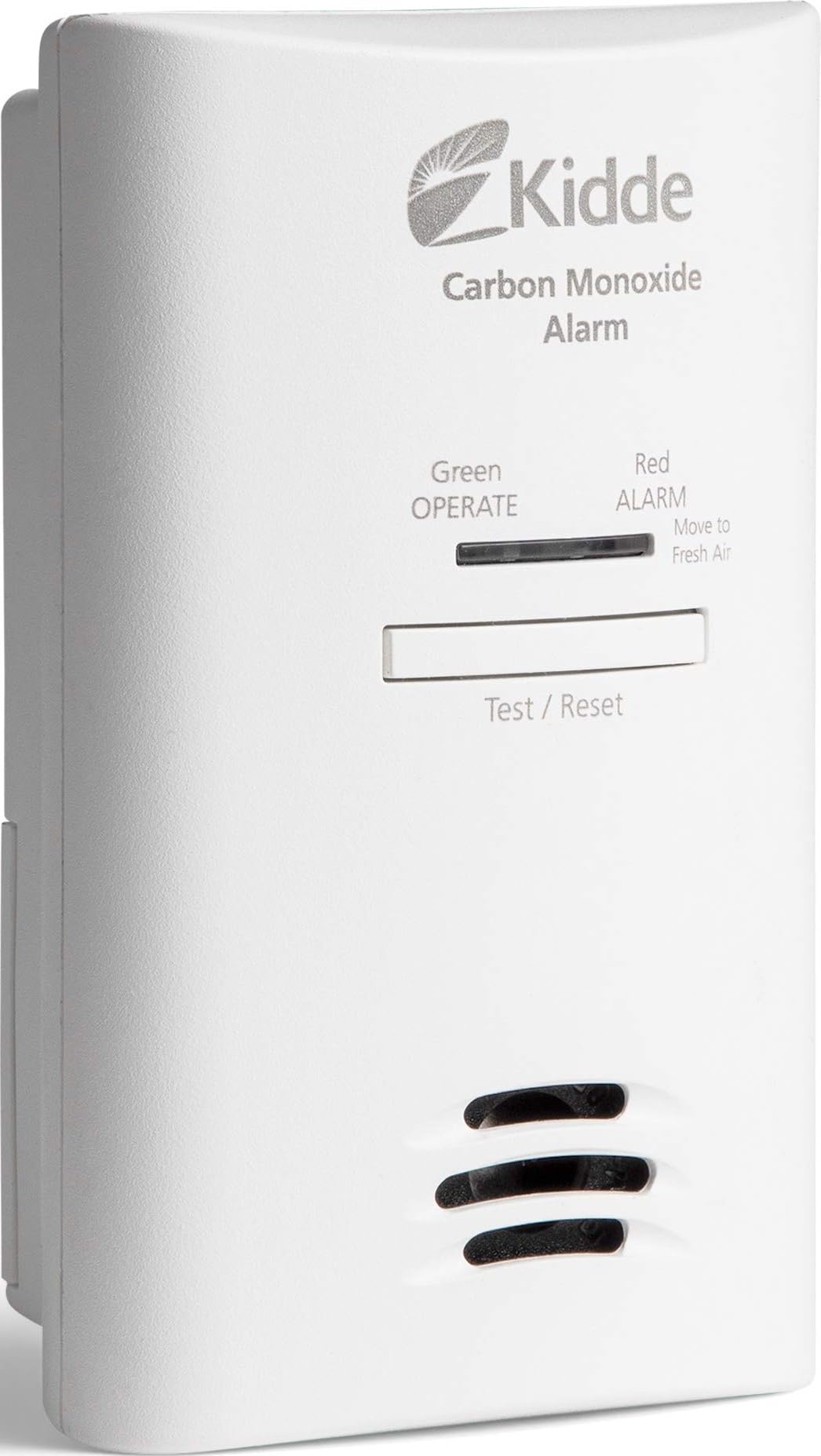
Type: Plug-in with AA battery backup
Detection: Carbon monoxide
Alarm: 85 dB
Status: LED status light indicators
Edition: 3rd Edition
A straightforward CO-only alarm that keeps things simple. It plugs into a wall outlet and runs on AA batteries as backup, so it stays active during an outage without any wiring. The 85 dB alarm is the same loudness as the top pick, and the LED status lights give a quick visual check that the unit is receiving power and monitoring. There is no digital readout, which keeps the faceplate clean and the operation obvious.
It suits renters and budget-conscious buyers who want reliable CO coverage near a gas fire without paying for gas-leak detection. The AA backup is easy to replace and widely available. It earned its place as the value pick for pure carbon monoxide protection.
Trade-off: It does not detect explosive gas or propane, so a fuel leak at the fire’s supply line will not set it off.
3. CO400 First Alert Battery Carbon Monoxide Alarm

Type: Battery-powered
Detection: Carbon monoxide
Model: CO400
Brand: First Alert
The CO400 is a battery-only alarm, which makes it the most flexible unit to place in a gas fire room. There is no cord and no outlet requirement, so it can sit on a shelf, mount on a wall, or move with the reader between rooms. It runs entirely on battery power, so a mains failure does not affect it at all. The compact body is unobtrusive next to a fireplace surround.
It suits anyone whose gas fire sits far from a socket, and renters who cannot add wiring. It also works as a secondary alarm in a bedroom near the fire. It earned its place as the placement-flexible option.
Trade-off: Battery-only operation means the alarm is only as good as the cell inside it, so a replacement schedule has to be kept.
4. CO606 First Alert Plug-In Carbon Monoxide Alarm
Type: Plug-in with 9V battery backup
Detection: Carbon monoxide
Model: CO606
Brand: First Alert
A plug-in CO alarm with a 9V backup, built for set-and-forget use. It draws power from the outlet during normal operation and switches to the 9V cell if the power fails, so coverage continues through an outage. The plug-in format means no battery swaps in day-to-day use, and the unit is always charged and monitoring. It is a simple, single-purpose device with no display to interpret.
It suits homeowners who want a permanent alarm in a fixed spot near the gas fire and who prefer not to think about batteries. It also works well in a hallway outside the fire room. It earned its place as the low-maintenance plug-in choice.
Trade-off: It must stay in its outlet to run on mains, so a room with no free socket near the fire will need an extension or a different pick.
5. X-Sense SC07 Smoke & CO Combo

Type: 2-in-1 smoke and CO detector
Power: 10-year sealed battery, not hardwired
Display: LCD
Certification: UL 217 and UL 2034
Model: SC07
Pack: 1-Pack
This unit covers both smoke and carbon monoxide in one housing, which is useful in a room where a gas fire sits alongside other fire risks. The 10-year sealed battery means no annual cell swaps and no hardwiring, so it installs anywhere on a ceiling or wall. The LCD display shows status at a glance, and the unit carries UL 217 and UL 2034 certification for both detection types. It is the only pick here that watches for smoke as well as CO.
It suits homeowners who want one device to handle the whole room and anyone replacing an old smoke alarm at the same time. It earned its place as the two-in-one option for whole-room coverage.
Trade-off: The sealed battery cannot be replaced, so the entire unit is retired at the end of its service life rather than refreshed with a new cell.
Before You Buy
- Placement: Mount the alarm at breathing height or on the ceiling near the gas fire, following the manufacturer’s distance guidance for combustion appliances.
- Power source: A plug-in unit needs a free outlet; a battery unit needs a replacement schedule; a sealed-battery combo needs nothing until end of life.
- Detection scope: CO-only alarms watch for carbon monoxide; a combo or explosive-gas model covers additional risks in the same room.
- Backup power: A gas fire can run during an outage, so a backup battery keeps coverage live when the mains fail.
- Alarm loudness: An 85 dB alarm is the baseline for waking occupants; check that the sound carries to bedrooms.
- Certification: Look for a unit certified to the relevant UL standard for the detection type it claims.
Frequently Asked Questions
-
Where should a CO alarm go in a room with a gas fire?
Place it near the appliance but follow the manufacturer’s clearance guidance, and keep it away from dead-air corners and direct drafts. -
Is a plug-in or battery alarm better for a gas fire room?
A plug-in with backup suits a fixed spot with a free outlet; a battery-only unit suits rooms without sockets or renters who need portability. -
Does a CO alarm detect a gas leak?
Only models that explicitly list explosive gas, natural gas, or propane detection will alert to a fuel leak; a CO-only alarm will not. -
How long do these alarms last?
Sealed-battery combos are designed for a fixed service life, while plug-in and battery models depend on the sensor’s rated life and the backup cell. -
Can one alarm cover both smoke and CO?
Yes — a 2-in-1 combo unit watches for both in a single housing, which suits a room with a gas fire and other fire risks. -
Do these alarms need wiring?
None of the picks here require hardwiring; they run on plug-in power, batteries, or a sealed battery.
Bottom Line
For a room with a gas fire, the Kidde Carbon Monoxide + Explosive Gas Alarm is the strongest single choice because it catches both carbon monoxide and fuel-gas problems while staying live through a power cut. Buyers who only want CO coverage can save with the Kidde CO-only plug-in, and anyone who wants smoke and CO from one device should look at the X-Sense SC07 combo.
