Why there are Amazon links here: Brave Review is paid a commission for qualifying Amazon purchases made through the links below. Your price does not change, and using our links is entirely optional. How this works
Govee H5179 vs GoveeLife WiFi Hygrometer: Which Monitor Setup Fits the Room
The Govee H5179 and the GoveeLife WiFi hygrometer both log temperature and humidity and both push app alerts when conditions drift, so the decision comes down to how many rooms need watching and whether a gateway hub is welcome in the setup. The H5179 ships as a two-pack of standalone WiFi sensors. The GoveeLife kit ships as a three-pack of mini sensors that depend on an included gateway. Readers who want the short answer can scan the overview table, then jump to the full comparison.
Overview of the Picks
| Product | Key Spec | Best Use | Price Tier |
|---|---|---|---|
| GoveeHumidity temperature sensor, portable. Wireless remote monitor greenhouse, incubator, wine cellar with 2-yr data WiFi Thermometer Hygrometer H5179 with App Notification Alert 2 Pack | 2-pack, WiFi, 2-yr data history | Spread-out rooms, no hub wanted | Mid |
| GoveeLifeTemperature and humidity monitor with APP alert, 2yr data & battery, indoor for wine cellar/bedroom/basement, 2.4G Wi-Fi only 2.0 WiFi Hygrometer Thermometer with Gateway, Mini Sensor 3-Pack | 3-pack mini sensors, gateway included, 2.4G WiFi | Whole-home coverage, small spots | Mid |
Govee H5179: The Two-Sensor Standalone Kit

Type: WiFi thermometer hygrometer, two-pack
Connectivity: WiFi, no gateway listed
Data history: 2 years
Alerts: App notification alert
Intended use: Greenhouse, incubator, wine cellar, remote monitoring
Form factor: Portable, wireless
The H5179 is the simpler architecture of the two. Each sensor talks to the network on its own, so the pair can be split between a wine cellar and a greenhouse without a hub sitting between them and the router. Two years of stored data gives buyers a long baseline for spotting slow drifts in a room’s climate rather than one-off spikes.
The trade-off is coverage arithmetic. A two-pack covers two locations and no more, so a buyer watching three or four rooms ends up buying a second kit and managing two separate sets of devices in the app. The portable, wireless build also means each unit lives on its own battery, and battery swaps happen per sensor rather than once at a hub.
Trade-off: Two sensors is a hard ceiling on coverage, and the standalone design means every extra room is another device to pair, name and maintain in the app.
Check the current price on Amazon
GoveeLife WiFi Hygrometer: The Three-Sensor Gateway Kit
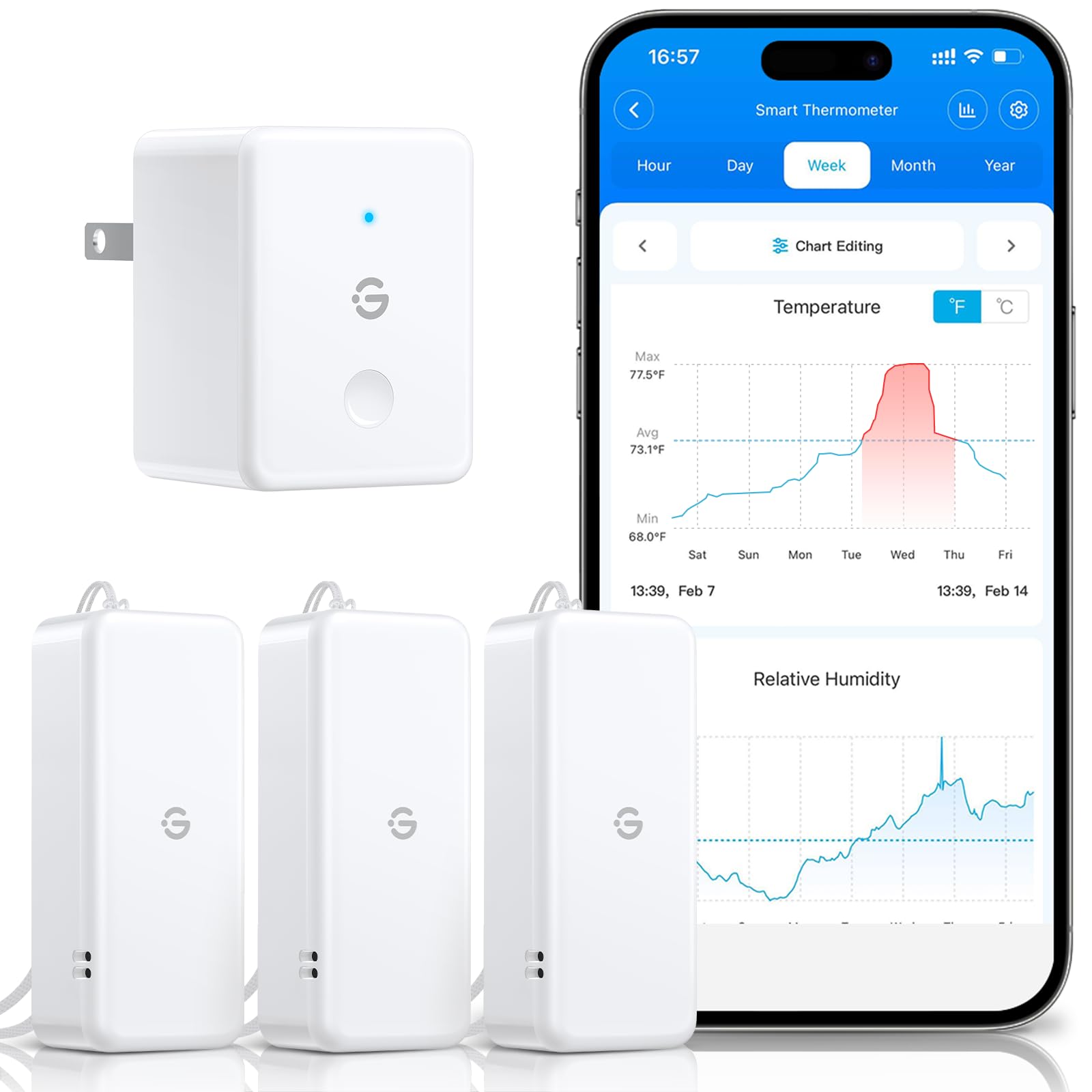
Type: WiFi thermometer hygrometer with gateway
Sensor count: Three mini sensors
Connectivity: 2.4G WiFi only
Data history: 2 years
Alerts: App alert
Intended use: Wine cellar, bedroom, basement, indoor monitoring
Power: Battery
The GoveeLife kit puts a gateway at the center of the setup and hangs three mini sensors off it. That is the more efficient arrangement for a house: one device holds the network connection, and the small sensors can be tucked into a bedroom, a basement and a cellar without each one needing a strong signal to the router. The mini form factor is the point here — these are meant to disappear onto a shelf or behind a door.
The catch is the gateway itself. It needs a free outlet and a spot with solid 2.4G WiFi, and the whole kit goes quiet if that one link drops. The 2.4G-only radio is also worth flagging for anyone on a mesh network that splits bands, since the gateway has to land on the 2.4G side. Buyers who want zero extra hardware should look at the standalone option instead.
Trade-off: The gateway is a single point of failure and one more device to power and place, and the 2.4G-only radio can be fussy on mixed-band home networks.
Check the current price on Amazon
Side-by-Side Specifications
| Attribute | Govee H5179 | GoveeLife WiFi Hygrometer |
|---|---|---|
| Pack size | 2 sensors | 3 mini sensors + gateway |
| Hub required | No | Yes, included |
| Connectivity | WiFi | 2.4G WiFi only |
| Data history | 2 years | 2 years |
| App alerts | Yes | Yes |
| Power | Battery | Battery |
| Intended use | Greenhouse, incubator, wine cellar | Wine cellar, bedroom, basement |
| Form factor | Portable | Mini sensor |
Where the Two Setups Diverge
The first difference is architecture. The H5179 treats every sensor as its own network device, which is more resilient per room but heavier on setup and on router connections. The GoveeLife kit concentrates the network link in one gateway and keeps the sensors small and simple. Neither approach is better in the abstract; the right one depends on whether the buyer is covering two far-apart spots or three close-together ones.
The second is coverage versus compactness. Three mini sensors beat two portables on raw count, and the mini size suits tight spots like a shelf in a wine cellar or a corner of a basement. The H5179’s portable body is easier to move around and to place where a mini sensor’s placement options are limited, which matters in a greenhouse or an incubator where the sensor may need to sit near equipment rather than on a wall.
The third is network compatibility. The GoveeLife gateway is explicit about 2.4G WiFi, and that is the band most smart-home gear prefers anyway, but it does mean a buyer on a single-SSID mesh network should confirm the gateway can join the 2.4G side before committing. The H5179’s WiFi connection is the more forgiving of the two for buyers who do not want to think about bands at all.
A fourth, quieter difference is expansion. Adding a room to the H5179 setup means buying another standalone sensor. Adding a room to the GoveeLife setup means checking whether the gateway supports another mini sensor. Buyers who expect to grow the system should weigh which path is cheaper and simpler for them over a couple of years.
Which Should You Buy?
Choose the Govee H5179 if the monitoring points are far apart, the buyer does not want a hub on the network, or the job is a greenhouse, incubator or wine cellar where a portable sensor is easier to position. Two rooms, two sensors, done.
Choose the GoveeLife WiFi Hygrometer if the goal is whole-home coverage with small sensors in a bedroom, basement and cellar, and one gateway on an outlet is an acceptable trade for three tidy mini units. The three-pack plus gateway is the more efficient buy for a house-wide setup.
FAQ
-
Does the Govee H5179 need a hub?
No. The H5179 sensors connect over WiFi on their own, so the two-pack works without any additional gateway hardware. -
Does the GoveeLife kit work without its gateway?
No. The mini sensors rely on the included gateway for the network connection, so the gateway has to be powered and online for the kit to report. -
Can both setups store two years of data?
Yes. Both product names list a two-year data history, which is long enough to compare seasons and spot slow climate drift. -
Which is better for a wine cellar?
Both list wine cellar as an intended use. The H5179 suits a cellar that is far from the router; the GoveeLife mini sensor suits a cellar where a small unit needs to tuck onto a shelf. -
Do both send app alerts?
Yes. Both names list app notification alerts, so either kit can warn when temperature or humidity leaves the range the buyer sets. -
Is the GoveeLife gateway limited to 2.4G WiFi?
Yes, the name specifies 2.4G WiFi only, so buyers on mixed-band mesh networks should confirm the gateway can join the 2.4G side. -
How many locations does each kit cover out of the box?
The H5179 covers two and the GoveeLife kit covers three, before any expansion. -
Which kit is better for a greenhouse?
The H5179, because its portable sensors are easier to move near equipment and it does not depend on a gateway placed indoors.
Bottom Line
For most buyers covering a whole house, the GoveeLife WiFi Hygrometer’s three mini sensors and included gateway make it the more efficient pick — one network link, three rooms watched. Buyers with two far-apart spots and no appetite for a hub should take the Govee H5179 instead.
