Why there are Amazon links here: Brave Review is paid a commission for qualifying Amazon purchases made through the links below. Your price does not change, and using our links is entirely optional. How this works
Best Mesh System for a House with a Loft Conversion
A loft conversion adds a floor, and a floor is exactly where a single router gives up. The best mesh system for a house with a loft conversion puts a node on that top level, so the new bedroom or office is not living off a weak signal leaking through a ceiling. This roundup covers five systems for three buyer types: households on a budget, families with a busy gigabit connection, and owners who want the newest WiFi standard before the loft is finished. The overview table below ranks all five by coverage and price tier.
The Picks at a Glance
| Product | Key Spec | Best Use | Price Tier |
|---|---|---|---|
| TP-Link Deco X55 (3-Pack) | AX3000, up to 6,500 sq ft | Budget whole-house coverage | Budget |
| Amazon eero 6+ (3-Pack) | Up to a Gigabit, 4,500 sq ft | Simple setup, mainstream plans | Mid-range |
| NETGEAR Orbi 370 (3-Pack) | Up to 6,000 sq ft, 2.5 Gig port | WiFi 7 on a mid budget | Mid-range |
| Deco 7 Pro BE63 (3-Pack) | Tri-band WiFi 7, up to 7,600 sq ft | Large homes with heavy traffic | Upper mid-range |
| NETGEAR Orbi 770 (3-Pack) | Up to 8,000 sq ft, 11 Gbps | Biggest homes, fastest plans | Premium |
The Deco X55 sits at the bottom on price and still covers more square footage than two systems that cost twice as much. The eero 6+ trades raw coverage for the simplest app-driven setup in the group. The Orbi 370 is the cheapest route into WiFi 7, while the BE63 and Orbi 770 push coverage, device counts and multi-gig ports higher for households that need them. For a loft conversion, the deciding factor is usually whether the third unit can sit on the top floor and still reach the rest of the house — every pick here includes three units for that reason.
TP-Link Deco X55 AX3000 WiFi 6 Mesh System, Deco X55 (3-Pack)

Coverage: Up to 6,500 sq ft
Standard: WiFi 6 (AX3000)
Ports: 3 Gigabit ports per unit
Backhaul: Supports Ethernet backhaul
Units: 3-pack
Price Tier: Budget
Label: Coverage — up to 6,500 sq ft
Label: Standard — WiFi 6 (AX3000)
Label: Ports — 3 Gigabit ports per unit
Label: Backhaul — Ethernet backhaul supported
Label: Units — 3-pack
Label: Price Tier — Budget
The Deco X55 is the value play here, and it is the most popular system in this group for a reason. Each unit carries three Gigabit ports, which is unusually generous at this price and makes a wired backhaul between the ground floor and the loft genuinely practical. Setup runs through the Deco app, and the three units are enough for a typical three-bedroom house with a conversion on top.
Buyers on a sub-gigabit or entry gigabit plan get the best return from this system, and anyone wiring the loft during the build should shortlist it. The catch is that AX3000 is a dual-band WiFi 6 design, so a house full of simultaneous 4K streams and game downloads will feel the ceiling sooner than a tri-band system would.
Trade-off: The low price buys WiFi 6 rather than WiFi 7 and no multi-gig port, so it will not keep pace with a fast fibre plan or a dense device load.
Amazon eero 6+ Mesh WiFi System (3-Pack)
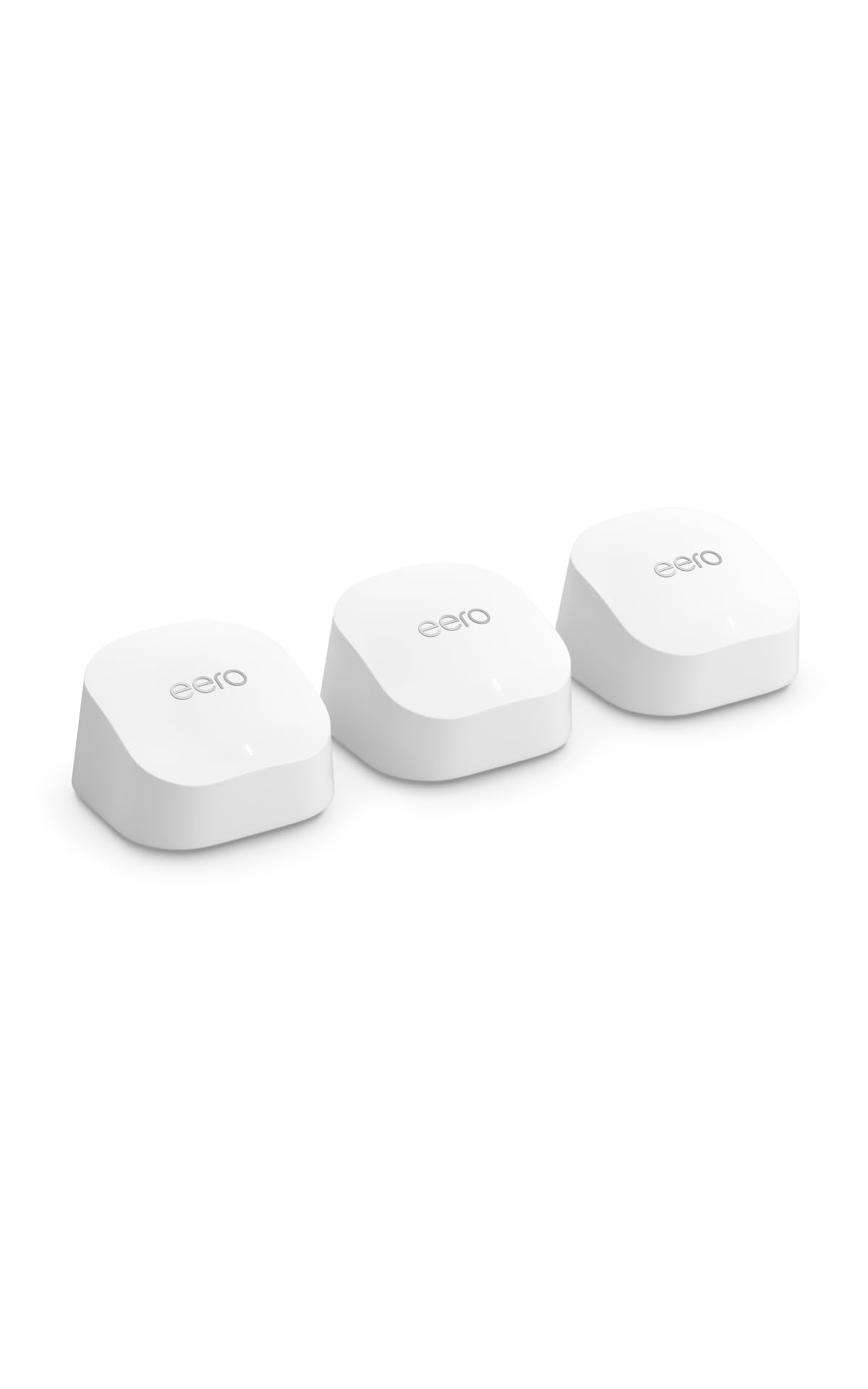
Coverage: Up to 4,500 sq ft
Plan Support: Internet plans up to a Gigabit
Devices: 75+ devices
Standard: WiFi 6
Units: 3-pack
Price Tier: Mid-range
Label: Coverage — up to 4,500 sq ft
Label: Plan Support — Internet plans up to a Gigabit
Label: Devices — 75+ devices
Label: Standard — WiFi 6
Label: Units — 3-pack
Label: Price Tier — Mid-range
The eero 6+ is the least fiddly system in this roundup. It is built around a guided app setup, automatic updates and a compact design that does not need to sit on a shelf looking like networking gear. It supports plans up to a Gigabit and is rated for 75+ connected devices, which covers a family with phones, laptops, a TV and smart home kit.
It suits buyers who want the loft online with minimal configuration and no interest in tweaking channels or bands. The trade-off is coverage: at 4,500 sq ft it is the smallest footprint here, so a large or unusually thick-walled house may need a fourth unit, and the feature set is deliberately simpler than the competition’s.
Trade-off: The smallest coverage figure in the group and a closed, simplicity-first feature set make it a poor fit for very large homes or tinkerers.
NETGEAR Orbi 370 Series WiFi 7 Mesh System, 3 Pack

Coverage: Up to 6,000 sq ft
Speed: Up to 5 Gbps
Devices: 70 devices
Standard: Dual-band WiFi 7
Ports: 2.5 Gig port
Units: Router + 2 satellite extenders
Label: Coverage — up to 6,000 sq ft
Label: Speed — up to 5 Gbps
Label: Devices — 70 devices
Label: Standard — Dual-band WiFi 7
Label: Ports — 2.5 Gig port
Label: Units — Router + 2 satellite extenders
The Orbi 370 is the entry point into WiFi 7 in this roundup, and it is the pick for a household that wants the newer standard without paying premium money. It is a dual-band design rated to 5 Gbps with a 2.5 Gig port, so it can actually use a faster-than-gigabit plan rather than bottlenecking it. The router-plus-two-satellite layout maps neatly onto a house where one satellite goes in the loft.
It fits buyers who have just signed a multi-gig contract and want hardware that will not need replacing in two years. The caution is that dual-band WiFi 7 delivers less of the standard’s benefit than tri-band, and the 70-device rating is the lowest here.
Trade-off: Dual-band rather than tri-band and a 70-device ceiling mean it is the wrong pick for a packed smart home or a very dense household.
Deco 7 Pro Tri-Band WiFi 7 BE10000 Whole Home Mesh System (BE63 3-Pack)
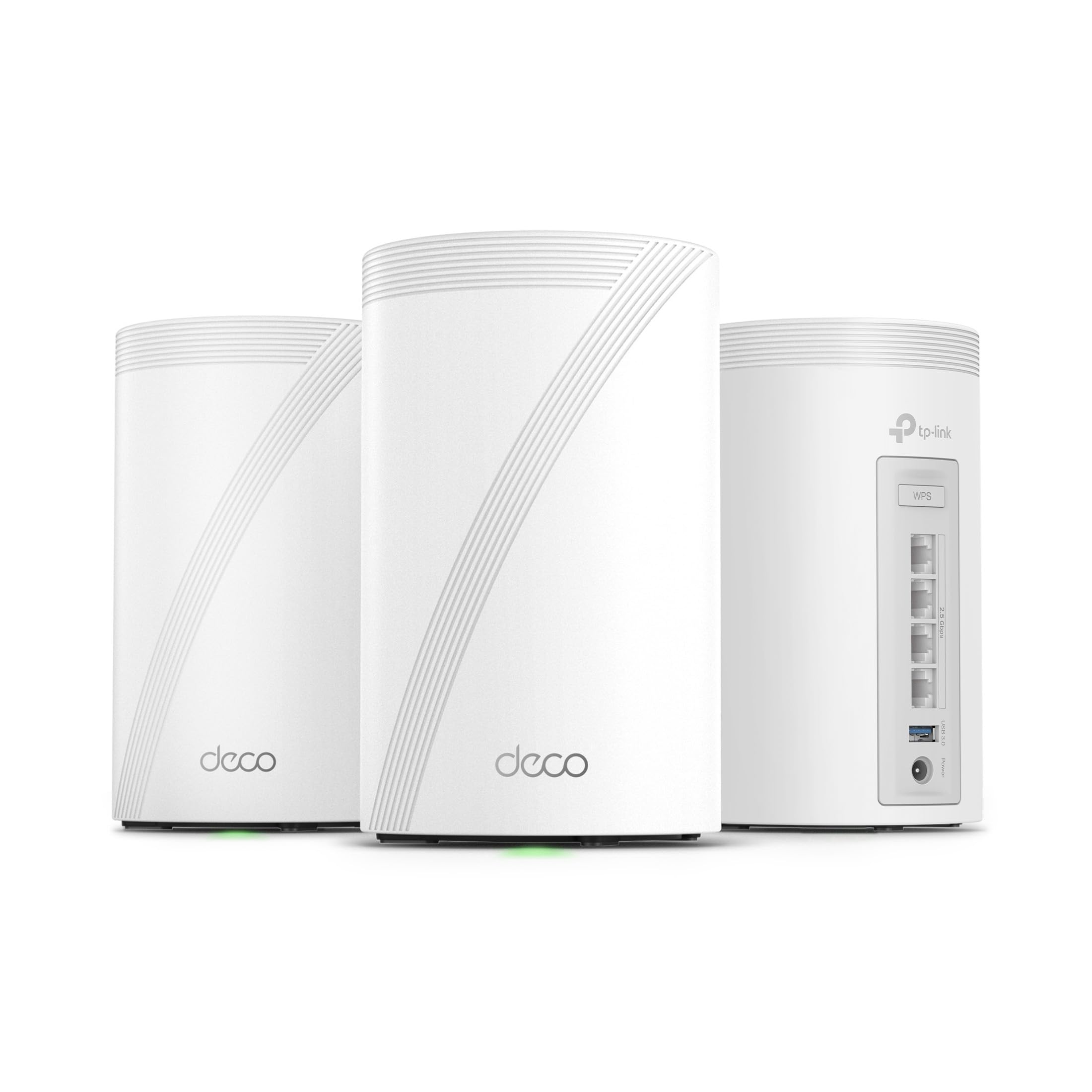
Coverage: Up to 7,600 sq ft
Standard: Tri-band WiFi 7 (BE10000)
Streams: 6-stream
Ports: 4 x 2.5G ports, wired backhaul
Antennas: 4 x smart internal antennas
Features: VPN, HomeShield, AI-Roaming
Units: 3-pack
Label: Coverage — up to 7,600 sq ft
Label: Standard — Tri-band WiFi 7 (BE10000)
Label: Streams — 6-stream
Label: Ports — 4 x 2.5G ports, wired backhaul
Label: Features — VPN, HomeShield, AI-Roaming
Label: Units — 3-pack
The BE63 is the sweet spot for a large converted house. Tri-band WiFi 7 with a dedicated backhaul band keeps the loft node fast even when the signal has to travel through the rest of the house, and four 2.5G ports per unit mean a wired loft office is straightforward. AI-Roaming and HomeShield add client steering and network security without extra hardware.
It is aimed at buyers with a big footprint, a fast plan and a lot of devices — the household where the loft is a permanent office rather than a spare room. The trade-off is that this is a lot of system for a small home, and the top-tier price only pays off if the connection and the device count can use it.
Trade-off: The price is high for what a modest house needs, and the feature set is overkill unless the plan and device load are genuinely heavy.
NETGEAR Orbi 770 Series WiFi 7 Mesh System, 3 Pack

Coverage: Up to 8,000 sq ft
Speed: Up to 11 Gbps
Devices: 100 devices
Standard: Tri-band WiFi 7
Ports: 2.5 Gig port
Units: Router + 2 satellite extenders
Label: Coverage — up to 8,000 sq ft
Label: Speed — up to 11 Gbps
Label: Devices — 100 devices
Label: Standard — Tri-band WiFi 7
Label: Ports — 2.5 Gig port
Label: Units — Router + 2 satellite extenders
The Orbi 770 is the biggest and fastest system in this roundup, rated for 8,000 sq ft, 100 devices and up to 11 Gbps. Tri-band WiFi 7 gives it a separate backhaul path, which matters most when one satellite has to cover a loft and the floors below at the same time. It is the pick for a large house where the conversion is one part of a bigger coverage problem.
Buyers with the fastest available plans and a house that has struggled with dead spots everywhere, not just upstairs, get the most from it. The drawback is straightforward: this is premium money for capacity most homes will not saturate, and a mid-size house is better served by the BE63.
Trade-off: The highest price here buys headroom that only a very large home on a very fast plan will actually use.
Before You Buy
- Coverage: Match the square footage rating to the whole house, not just the loft — the top floor is where the signal has to reach last.
- Node placement: A three-pack only helps if one unit can sit on the converted level; a unit left in the box does nothing for the loft.
- Backhaul: Ethernet backhaul between floors is the single biggest upgrade for a loft conversion, so favour systems with wired ports.
- Plan speed: A multi-gig plan needs a 2.5G port to be worth paying for; a standard plan does not.
- Standard: WiFi 7 costs more today, but a house mid-renovation is the right time to buy hardware that will last.
- Device count: Count phones, laptops, TVs, consoles and smart kit before choosing — the ratings here range from 70 to 100 devices.
- App and features: Parental controls, VPN and security tools vary widely between brands and are worth checking before purchase.
Frequently Asked Questions
- Does a loft conversion need its own mesh node? In most houses, yes. A ceiling and a floor of structure between the router and the loft will weaken the signal, and a dedicated unit on that level solves it directly.
- Is WiFi 7 worth it for a loft conversion? It is worth it if the house is being renovated anyway and the plan is fast. On a basic connection, a WiFi 6 system like the Deco X55 delivers more value.
- How many units are needed for a three-bedroom house with a loft? A three-pack is the usual starting point: one unit downstairs, one mid-house and one in the loft.
- Can mesh units be wired together? Most systems here support Ethernet backhaul, and the Deco X55 and BE63 both make it easy with multiple ports per unit.
- Will a mesh system work through old loft walls? It depends on construction, but placing a node inside the converted room rather than below it is the reliable fix.
- Does a bigger coverage rating always mean better performance? No. Coverage figures assume open space, so real-world results depend on walls, floors and node placement.
Bottom Line
For most houses with a loft conversion, the Deco 7 Pro BE63 3-Pack is the best mesh system for the job: tri-band WiFi 7, 7,600 sq ft of coverage and four 2.5G ports per unit give the loft a fast, wired-capable node without overbuying. Households on a tighter budget should take the Deco X55, which covers more ground than its price suggests.
