Why there are Amazon links here: Brave Review is paid a commission for qualifying Amazon purchases made through the links below. Your price does not change, and using our links is entirely optional. How this works
Philips Hue Smart LED A19 Bulb 7.2W, E26, 1-Pack: The Starter Bulb That Does More
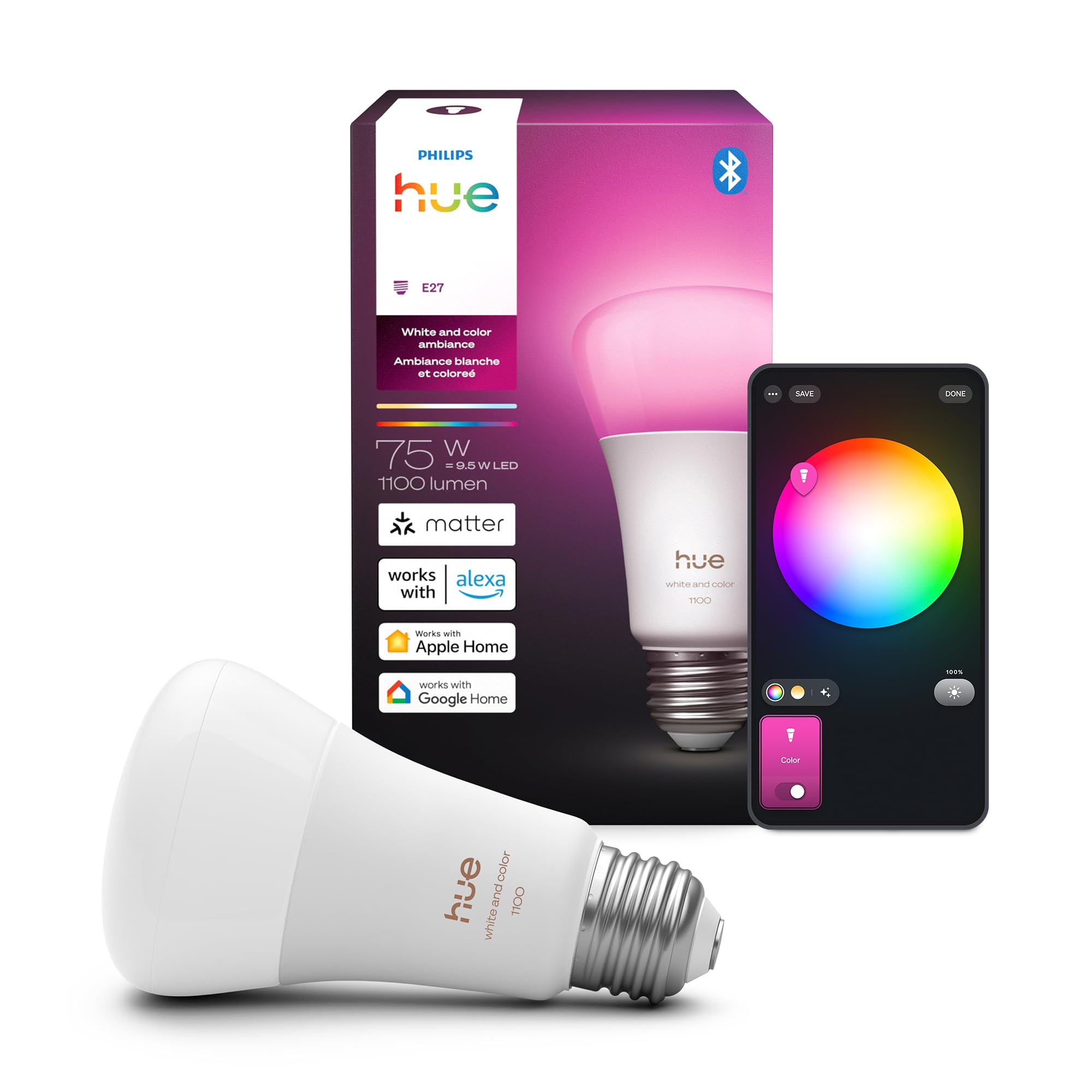
The Philips Hue Smart LED A19 bulb is the entry point into the Hue ecosystem — a single E26 bulb that turns an ordinary lamp into a phone-controlled, color-capable light. It suits renters, first-time smart-home buyers, and anyone who wants app control without rewiring a thing. This review covers what the bulb actually does, how it fits into a Hue setup, and the trade-offs that come with buying one at a time.
Check the current price on Amazon
Features and Specifications
Type: Smart LED bulb
Base: E26 (standard US screw-in)
Wattage: 7.2W
Pack Size: 1-Pack
Control: App and voice control via the Hue system
Compatibility: Fits standard E26 fixtures
The A19 shape is the bulb most US homes already use, so this drops straight into table lamps, ceiling fans, and open fixtures without an adapter. At 7.2W it draws a fraction of what an incandescent equivalent pulls, which matters if the lamp stays on for hours.
The E26 base is the deciding spec here. Buyers with candelabra or pin-base fixtures need a different Hue model entirely, and this bulb will not fit those sockets.
Build and Design
The bulb is a standard A19 silhouette — the same pear shape as a conventional lamp bulb — with the Hue electronics packed into the base and neck. It is not a bulb that draws attention to itself when off, which helps in visible fixtures.
The plastic diffuser over the LED array spreads light rather than throwing a hard spot, so it behaves well in a lampshade or a bare socket alike. Buyers should expect a bulb that feels solid but not heavy; the Hue line is built for everyday household duty, not industrial use.
One design reality: this is a smart bulb, and smart bulbs carry electronics that a plain LED does not. That means slightly more heat at the base and a bulb that should not be enclosed in a fully sealed fixture with no airflow.
Power and Light Output
The 7.2W rating puts this in the energy-sipping category — the kind of draw that barely registers on a power bill even with several bulbs running. It is designed as a replacement for a standard household lamp bulb, not as a high-output fixture light.
Because it is a Hue bulb, the light is adjustable through the app rather than fixed at the factory. Brightness, color, and scheduling all run through the Hue system, which is where the value sits.
Buyers shopping on raw lumens per dollar will find cheaper dumb LEDs. The premium here pays for control, not for maximum brightness.
Control and Ecosystem
The bulb is built to work inside the Philips Hue system, which means app control, scheduling, scenes, and voice assistant integration once the bulb is paired with a Hue Bridge or a compatible setup. That ecosystem is the reason to choose Hue over a generic smart bulb.
The catch is that the full feature set depends on the Hue Bridge, which is sold separately. A buyer who picks up this single bulb expecting every app feature to work out of the box may be disappointed — some functions need the bridge in place.
Buyers already inside the Hue ecosystem get the most from this bulb. Buyers starting from zero should plan for the bridge as part of the total cost.
Maintenance and Daily Use
Day to day, the bulb needs nothing — no pairing rituals after setup, no battery changes, no cleaning beyond what any lamp bulb gets. It is a screw-in-and-forget product once it is configured.
Firmware updates arrive through the Hue app, which keeps the bulb current with the rest of the system. That is a plus for buyers who want a smart home that stays supported rather than orphaned.
The one maintenance-adjacent caution: smart bulbs should stay powered at the switch so the app can reach them. Buyers who habitually flip the wall switch off will find the bulb unresponsive until the switch is back on.
Trade-off: A single bulb at this price tier is an expensive way to light one lamp, and the full Hue feature set leans on a separately sold bridge — buyers who only want remote on/off should weigh a cheaper smart plug instead.
Who It Suits and Who It Does Not
This bulb suits renters and first-time smart-home buyers who want to test the Hue system with minimal commitment. It also suits existing Hue owners who need one more bulb for a lamp, a hallway, or a bedside light.
It does not suit buyers who want whole-room lighting on a budget — one bulb covers one fixture, and scaling up means buying more. It also does not suit anyone unwilling to add a Hue Bridge, since that is where most of the smart features live.
Buyers with non-E26 fixtures should look elsewhere in the Hue range before ordering.
FAQ
-
What is the Philips Hue A19 bulb used for?
It replaces a standard E26 lamp bulb and adds app-based control, scheduling, and color adjustment through the Hue system. -
Does the Philips Hue A19 bulb need a bridge?
Basic control works through Bluetooth on compatible models, but the full feature set — automation, remote access, and deeper integrations — relies on the Hue Bridge, sold separately. -
Is the Philips Hue A19 bulb dimmable?
Yes. Dimming runs through the Hue app and compatible switches rather than a traditional wall dimmer. -
What does 7.2W mean on this bulb?
It is the power draw — a low figure typical of LED bulbs, designed to replace a standard household lamp bulb while using far less energy. -
Will this bulb fit a normal lamp?
It fits any fixture with an E26 screw base, which is the standard socket in most US lamps and ceiling fixtures. -
Can one bulb be used without the rest of the Hue system?
Yes, as a standalone smart bulb with app control. The ecosystem features only matter once more Hue devices and a bridge are added. -
Is the Philips Hue A19 bulb worth it for a single lamp?
It is worth it for buyers who want Hue control in one spot or who plan to expand later. Buyers who only want a remote switch can spend less. -
Does the bulb work with voice assistants?
It integrates with major voice assistants through the Hue system, so voice control is available once the bulb is set up. -
What happens if the wall switch is turned off?
The bulb loses power and drops off the app until the switch is turned back on, so it should stay powered for smart control to work.
Bottom Line
The Philips Hue Smart LED A19 Bulb 7.2W, E26, 1-Pack is the right buy for anyone testing the Hue ecosystem or topping up an existing setup with one more bulb. It is not the cheapest way to light a lamp, and the bridge cost sits in the background — but for buyers who want app control in a standard socket, it is the straightforward pick.