Why there are Amazon links here: Brave Review is paid a commission for qualifying Amazon purchases made through the links below. Your price does not change, and using our links is entirely optional. How this works
Philips Hue A19 vs Philips Hue BR30: Which Bulb Fits Your Fixture
The Philips Hue A19 vs Philips Hue BR30 decision comes down to the fixture, not the brand. The A19 multi-pack suits table lamps, floor lamps, and open fixtures where a standard bulb shape works, while the BR30 two-pack is built for recessed ceiling cans and wide, downward floodlighting. The quick answer: pick A19 for lamps and everyday sockets, pick BR30 for ceiling downlights, then confirm the base and can size before buying.
Philips Hue A19 (4-Pack)
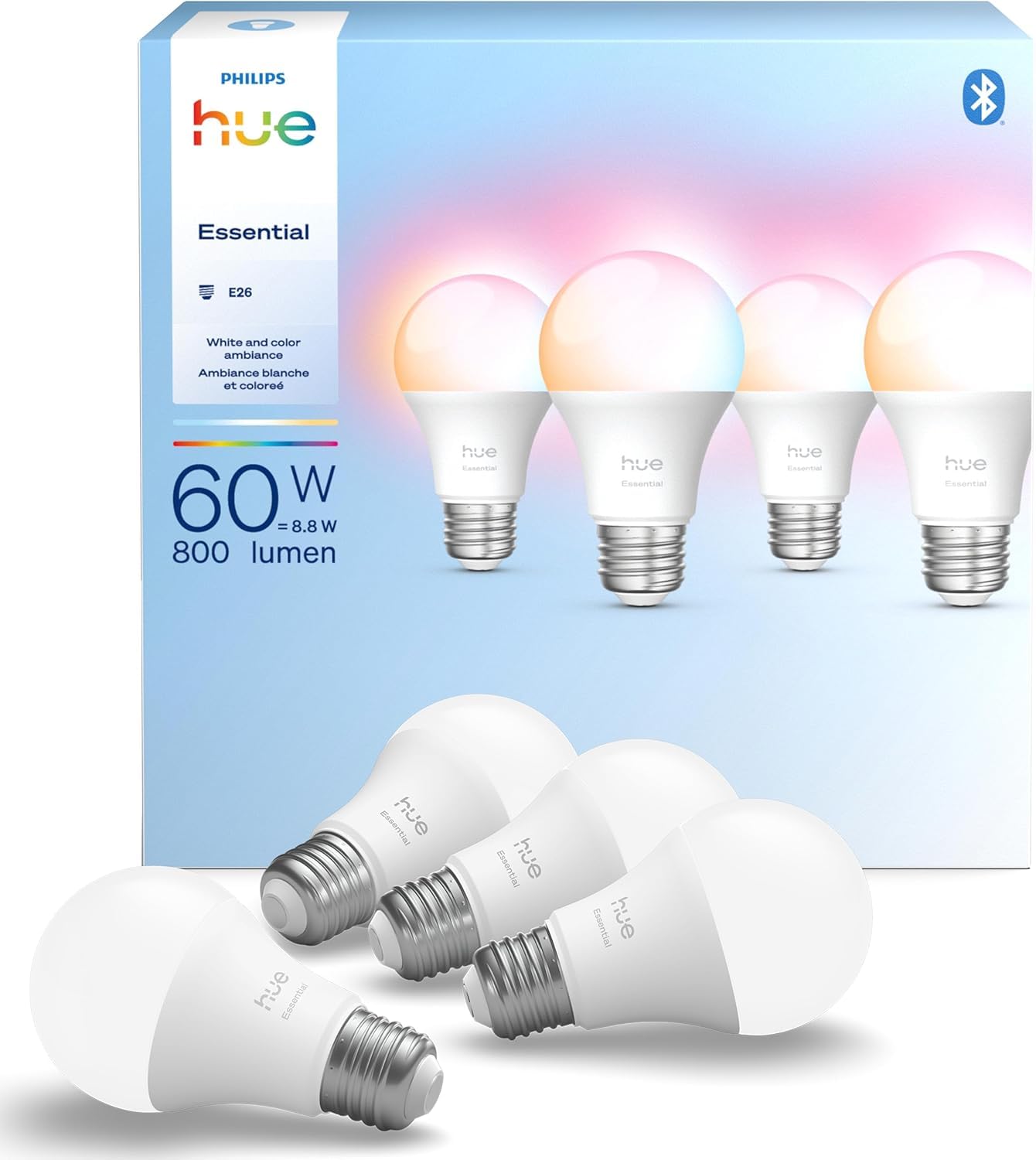
Type: Smart LED, A19 standard shape
Base: E26
Wattage: 7.2W
Brightness: 800 lumens
Color Range: White and color ambiance, 2200K–6500K
Dimming: Dimmable
Pack Size: 4 bulbs
Voice Platforms: Alexa, Google Assistant, Apple Home
The A19 is the general-purpose shape most households already know. It fits standard table lamps, floor lamps, open ceiling fixtures, and many enclosed fixtures where a rounded bulb has room. The 7.2W draw and 800-lumen output put it in the everyday-brightness range for a single socket.
The 2200K–6500K range covers warm evening light through cool daylight, and the color ambiance side adds full-color scenes for living rooms and bedrooms. Dimming works through the Hue system, so a dimmer switch or app control shapes the output. The four-pack matters for buyers lighting a whole room rather than a single socket.
Trade-off: The A19 is a standard-shape bulb, so it spreads light in every direction and will look dim and washed out inside a deep recessed can that expects a directional flood.
Check the Philips Hue A19 4-Pack on Amazon
Philips Hue BR30 (2-Pack)

Type: Smart LED, BR30 flood shape
Base: E26
Shape Class: BR30 reflector flood
Feature: Flicker-free
Pack Size: 2 bulbs
Voice Platforms: Alexa, Google Assistant, Apple HomeKit
Connectivity: Bluetooth compatible
The BR30 is a reflector flood bulb, wider and squatter than the A19, shaped to throw light forward and down. That makes it the natural fit for recessed ceiling cans and track-style downlights in kitchens, hallways, and living rooms. The E26 base is the same standard screw base as the A19, so the difference is the bulb body and beam, not the socket.
The flicker-free claim targets buyers who notice strobing on camera or in low dim settings, which matters for home offices and video calls. Bluetooth compatibility means a phone can control the bulbs directly before a bridge is added, and the voice-platform list covers the major assistants. The two-pack suits a pair of downlights rather than a full room.
Trade-off: Two bulbs rarely cover a whole ceiling of recessed cans, so a room-wide BR30 install usually means buying multiple packs, and the flood shape is the wrong pick for a table lamp where the wide beam spills and glares.
Check the Philips Hue BR30 2-Pack on Amazon
Philips Hue A19 vs Philips Hue BR30: Side-by-Side Specs
| Spec | Philips Hue A19 | Philips Hue BR30 |
|---|---|---|
| Type | Smart LED, A19 standard shape | Smart LED, BR30 flood shape |
| Base | E26 | E26 |
| Wattage | 7.2W | 85W equivalent listed in name |
| Brightness | 800 lumens | Not stated in name |
| Color | White and color ambiance, 2200K–6500K | Not stated in name |
| Dimming | Dimmable | Not stated in name |
| Notable Feature | Color ambiance, multi-platform | Flicker-free, Bluetooth compatible |
| Pack Size | 4 bulbs | 2 bulbs |
| Voice Platforms | Alexa, Google Assistant, Apple Home | Alexa, Google Assistant, Apple HomeKit |
Where the Two Bulbs Diverge
Shape and fixture fit. This is the dimension that settles most purchases. The A19 is a rounded standard bulb that fits lamps, open fixtures, and general sockets. The BR30 is a wide reflector flood built to sit flush in a recessed can and aim light downward. A buyer who ignores this ends up with a bulb that either will not seat properly or lights the room badly.
Beam behavior. The A19 spreads light in all directions, which suits ambient room lighting and lampshades. The BR30 concentrates output into a forward flood, which is why it belongs in ceiling downlights over counters, hallways, and seating areas. The two are not interchangeable in practice even though both use an E26 base.
Color and dimming. The A19 name states white and color ambiance across 2200K–6500K and confirms dimming, making it the more explicitly full-featured bulb on paper. The BR30 name emphasizes flicker-free performance and Bluetooth compatibility instead. Buyers who want full color scenes have a clearer case for the A19; buyers who want smooth, stable light in downlights lean BR30.
Pack size and coverage. Four A19 bulbs cover a room’s worth of lamps and sockets in one purchase. Two BR30 bulbs cover a pair of cans, so a full ceiling install usually needs more packs. Buyers lighting a whole kitchen ceiling should budget for multiple BR30 packs; buyers refreshing a living room’s lamps get further with one A19 pack.
Control and setup. Both list the major voice assistants. The BR30 explicitly names Bluetooth compatibility, which lets a phone control it before a bridge is added. The A19 leans on the Hue ecosystem and the multi-platform list. Neither is harder to live with, but a buyer starting from zero may find the BR30’s Bluetooth path a simpler first step.
Which Should You Buy?
Choose the Philips Hue A19 4-Pack if the plan is table lamps, floor lamps, open ceiling fixtures, or general sockets, and full color ambiance across a room matters. The four-pack covers more sockets per purchase and the standard shape drops into the most common household fixtures.
Choose the Philips Hue BR30 2-Pack if the target is recessed ceiling cans and downlights, and the priority is a clean, flicker-free flood of light rather than full color scenes. The flood shape is the correct fit for cans, and Bluetooth compatibility eases a first setup.
FAQ
-
What is the main difference between the Philips Hue A19 and BR30?
The shape and beam. The A19 is a standard rounded bulb that spreads light in all directions, while the BR30 is a wide reflector flood that aims light forward and down. Both use an E26 base, so the fixture type decides which one fits. -
Can a Philips Hue BR30 go in a table lamp?
It physically fits an E26 socket, but the flood shape throws a wide, glaring beam that is a poor match for a lampshade. The A19 is the better choice for lamps. -
Can a Philips Hue A19 go in a recessed ceiling can?
It can seat in the socket, but a standard-shape bulb spreads light sideways and can look dim and uneven in a deep can. The BR30 is designed for that fixture. -
Do both bulbs work with Alexa, Google Assistant, and Apple Home?
Yes. Both list the major voice platforms, and the BR30 also names Bluetooth compatibility for direct phone control before a bridge is added. -
Which pack is better for lighting a whole room?
The A19 four-pack covers more sockets in one purchase, which suits a room full of lamps. The BR30 two-pack covers a pair of cans, so a full ceiling install usually needs several packs. -
Does the A19 support color?
Yes. The name states white and color ambiance with a 2200K–6500K range, so it covers warm white through daylight plus full color scenes. -
Is the BR30 dimmable?
The BR30 name does not state dimming, while the A19 name explicitly does. Buyers who need confirmed dimming should lean toward the A19 or verify the BR30’s dimming support on the product page.
Bottom Line
The fixture decides this one: the Philips Hue A19 4-Pack is the top pick for lamps, open fixtures, and buyers who want full color ambiance across a room, while the Philips Hue BR30 2-Pack is the right call for recessed ceiling cans that need a clean, flicker-free flood. Most households lighting lamps and living spaces should start with the A19 four-pack, and anyone working on downlights should go straight to the BR30.
