Why there are Amazon links here: Brave Review is paid a commission for qualifying Amazon purchases made through the links below. Your price does not change, and using our links is entirely optional. How this works
Best Solar Panel Kit for a Balcony With No Direct Sun: 5 Picks That Still Deliver
A shaded balcony is not a dead end for solar. The best solar panel kit for a balcony with no direct sun is the one that matches how the space is actually used — full plug-in grid-tie systems for owners who want to trim a power bill, compact starter kits for tinkerers, and tracking or portable setups for anyone who can chase the light. This roundup covers five verified options and names the buyer each one fits. The overview table below is the fastest way to pick a lane before reading the full reviews.
Overview of the Picks
| Product | Key Spec | Best Use | Price Tier |
|---|---|---|---|
| 1600W Plug-in Balcony Solar Kit (8-Panel) | 8 panels, APsystems microinverter, WiFi monitoring | Maximum output from a large balcony or roof edge | Premium |
| 800W Plug-in Balcony Solar Kit (4-Panel) | 4 panels, APsystems microinverter, WiFi monitoring | Small balconies and first-time plug-in buyers | Mid-range |
| 1200W Plug-in Balcony Solar Kit (6-Panel) | 6 panels, APsystems microinverter, WiFi monitoring | The middle ground between size and output | Upper mid-range |
| Renogy 100W 12V Solar Panel Starter Kit | 100W monocrystalline panel, 30A PWM controller | Off-grid charging and learning the basics | Budget |
| REDIGOO 160W Portable Solar Panel with Dual-Axis Solar Tracker | 160W panel, dual-axis tracking | Camping, RVs, and balconies with movable light | Premium portable |
1. 1600W Plug-in Balcony Solar Kit (8-Panel)
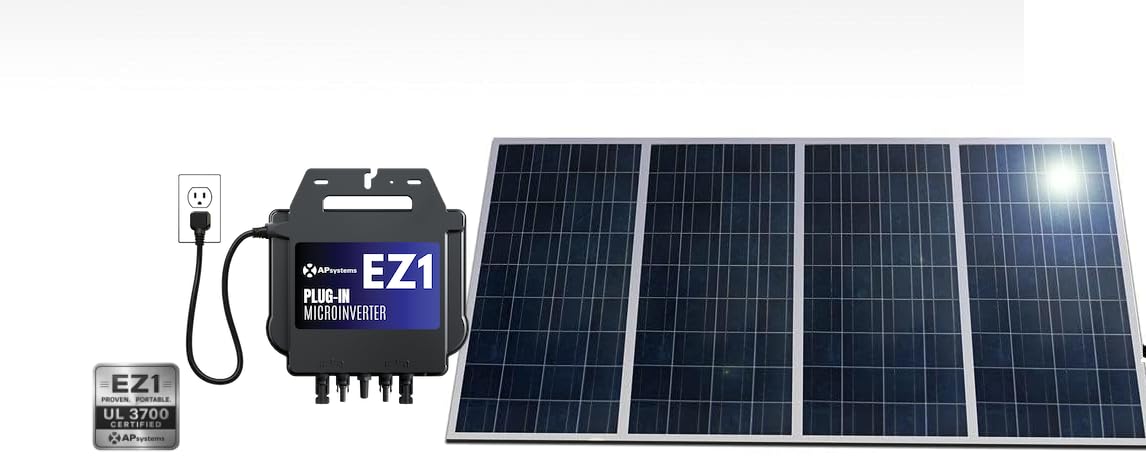
Panels: 8
System Type: Grid-tie plug and play
Inverter: APsystems microinverter
Monitoring: WiFi
Certification: UL 3700
Best For: Large balconies with the most usable panel area
Check the current price on Amazon
This is the biggest system in the roundup, built around eight panels and an APsystems microinverter that converts power at the panel rather than in a central box. The grid-tie, plug-and-play design means the kit is meant to feed a home circuit through a standard outlet setup rather than charge a battery bank. WiFi monitoring lets the owner watch production per panel, which matters on a shaded balcony where one panel can lag the rest. It suits a buyer with a long railing or a roof edge and a real appetite for offsetting household draw.
The eight-panel footprint is the reason to buy it and also the reason to think twice. A balcony without direct sun still needs diffuse light across a wide area for a system this size to justify itself, and the mounting surface has to carry all eight panels securely. Buyers with a narrow balcony will spend more time on brackets than on savings.
Trade-off: The large panel count demands serious mounting space and a sturdy railing, so it is a poor fit for compact or rented balconies where permanent fixtures are restricted.
2. 800W Plug-in Balcony Solar Kit (4-Panel)
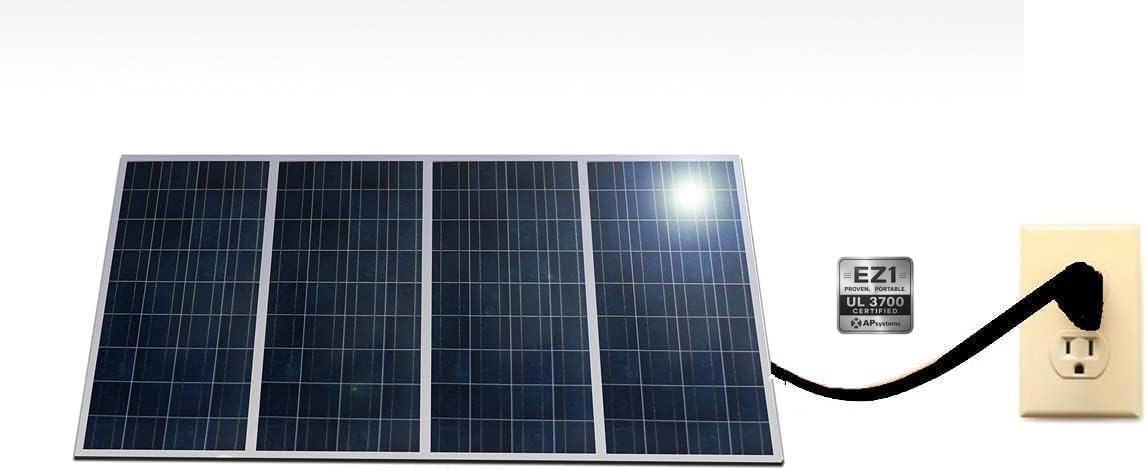
Panels: 4
System Type: Grid-tie plug and play
Inverter: APsystems microinverter
Monitoring: WiFi
Certification: UL 3700
Best For: First-time plug-in buyers with limited railing space
Check the current price on Amazon
The four-panel version is the sensible entry point into plug-in balcony solar. It uses the same APsystems microinverter architecture and WiFi monitoring as its larger siblings, so the owner gets per-panel visibility without committing a whole railing to panels. Four panels are easier to angle toward whatever diffuse light reaches the balcony, and the smaller array is less punishing when one section sits in deep shade.
This is the pick for a renter or a first-time solar buyer who wants to test the waters before scaling up. The catch is headroom: a shaded balcony already limits output, and four panels leave little room to compensate by adding capacity later without buying a second system.
Trade-off: The modest panel count caps total production, so a buyer with a genuinely large, light-starved balcony may outgrow it quickly.
3. 1200W Plug-in Balcony Solar Kit (6-Panel)
Panels: 6
System Type: Grid-tie plug and play
Inverter: APsystems microinverter
Monitoring: WiFi
Certification: UL 3700
Best For: Balconies that can host six panels but not eight
Check the current price on Amazon
The six-panel kit sits between the two extremes and will be the right answer for a lot of buyers. It shares the APsystems microinverter, WiFi monitoring and UL 3700 certification of the rest of the family, so nothing is sacrificed on the electronics side. Six panels give enough array area to make a meaningful dent in household consumption while still fitting a medium-length balcony.
Choosing between this and the four-panel kit comes down to railing length and budget rather than technology. The buyer who can physically mount six panels and wants more production per square foot of railing should start here. The buyer who cannot should not force it — panels crammed into a bad angle underperform regardless of count.
Trade-off: The middle position means paying more than the four-panel kit for capacity that a heavily shaded balcony may never fully use.
4. Renogy 100W 12V Solar Panel Starter Kit with 30A PWM Controller

Panel Type: Monocrystalline
Output: 100W, 12V
Controller: 30A PWM
Included: Cables and Z-brackets
Intended Use: RVs, campers, off-grid
Best For: Budget off-grid charging and learning solar basics
Check the current price on Amazon
This Renogy kit is a different animal from the plug-in systems: a single 100W monocrystalline panel paired with a 30A PWM charge controller, cables and Z-brackets for mounting. It is an off-grid kit, so it charges a battery rather than feeding a home circuit, which makes it a natural fit for a shed, a camper or a balcony battery project. The included brackets mean it can be fixed to a railing without hunting for extra hardware.
For a shaded balcony, the realistic job is trickle-charging a battery for lights or a small device, not offsetting a power bill. The 30A PWM controller is a budget-tier component, and PWM controllers are less efficient than MPPT types when panel voltage and battery voltage differ. It remains the cheapest way into solar here and the easiest to understand.
Trade-off: A single 100W panel and a PWM controller keep costs low but limit both output and charging efficiency compared with the plug-in systems.
5. REDIGOO 160W Portable Solar Panel with Dual-Axis Solar Tracker
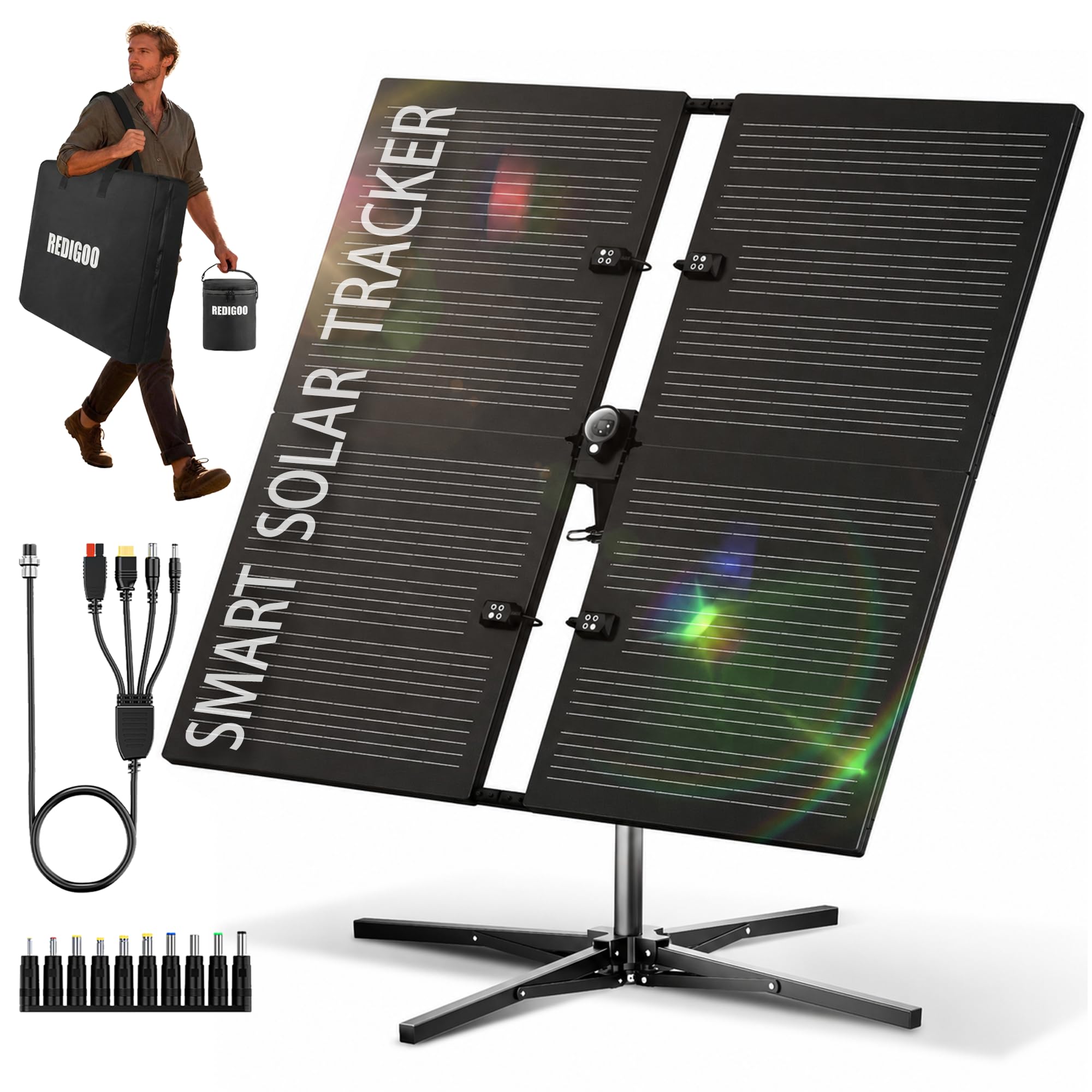
Panel Output: 160W
Tracking: Dual-axis
System Type: Portable solar tracker kit
Intended Use: Camping, RV, off-grid
Claimed Equivalent: 300W
Best For: Balconies where the panel can be repositioned through the day
Check the current price on Amazon
The REDIGOO kit takes a different approach to shade: instead of adding panels, it adds movement. A dual-axis tracker follows the sun across the sky so the 160W panel stays square to whatever light is available, and the manufacturer positions it as equivalent to a fixed 300W setup. It is portable and aimed at camping, RV and off-grid use, which makes it the only pick here that can move between a balcony and a campsite.
For a balcony with no direct sun, tracking helps most during the hours when light grazes the space at an angle. The trade-off is that a tracker needs clearance to rotate and a stable base, and a 160W panel will not match the output of a multi-panel plug-in array. It is a specialist tool rather than a bill-offset system.
Trade-off: The moving mechanism and single panel suit portable use, but the tracker needs free space to swing and cannot match a fixed multi-panel array for raw production.
Before You Buy
- Sun exposure: A balcony with no direct sun still needs bright, open sky. Panels in deep shadow behind a wall or under an overhang will underperform no matter which kit is chosen.
- Mounting surface: Count the railing length and check what it can carry. Eight panels need far more structure than four, and renters should confirm what fixtures are permitted.
- System type: Plug-in grid-tie kits feed a home circuit; off-grid kits charge a battery. Mixing the two up is the most common buying mistake.
- Included accessories: The Renogy kit ships with a controller, cables and Z-brackets. Plug-in kits include the microinverter and monitoring but may still need mounting hardware.
- Monitoring: WiFi monitoring on the APsystems kits shows per-panel output, which is genuinely useful on a shaded balcony where one panel can drag the array down.
- Portability: Only the REDIGOO tracker is designed to move. Buyers who want to take solar camping should weight that heavily.
- Scalability: Starting with four panels leaves room to add later; starting with eight leaves none.
Frequently Asked Questions
-
Will a solar panel kit work on a balcony that never gets direct sun?
It can, but at reduced output. Panels generate power from diffuse and reflected light too, so a bright but shaded balcony still produces something — just less than a sun-facing one. Matching the kit size to the available light matters more than buying the biggest system. -
What is the difference between a plug-in balcony kit and an off-grid kit?
A plug-in kit uses a microinverter to feed power into a home circuit through an outlet. An off-grid kit like the Renogy charges a battery instead. The plug-in systems here carry UL 3700 certification; the off-grid kit is built for battery charging. -
Do the plug-in kits include mounting hardware?
The product listings center on the panels, microinverter and monitoring. Buyers should plan on sourcing railing brackets separately and confirm the mounting method suits the balcony. -
Is a solar tracker worth it on a shaded balcony?
It helps when light reaches the balcony at a low angle for part of the day, since the panel can face the light directly. It needs clearance to rotate and a stable base, so it suits open balconies better than cramped ones. -
How many panels are realistic for a typical balcony?
Four panels is the common starting point and the easiest to mount. Six suits a longer railing, and eight requires a genuinely large, sturdy mounting area. -
Can these kits be expanded later?
The plug-in kits are sized as complete systems, so expansion usually means adding a second kit rather than extending the first. Buyers who expect to grow should start with the four-panel version.
Bottom Line
For most shaded balconies, the 800W Plug-in Balcony Solar Kit (4-Panel) is the best solar panel kit for a balcony with no direct sun: it brings the APsystems microinverter, WiFi monitoring and UL 3700 certification of the larger systems without demanding eight panels of railing space. Buyers with a long, sturdy balcony and real appetite for production should step up to the six- or eight-panel versions, while anyone charging a battery or camping is better served by the Renogy starter kit or the REDIGOO tracker.
