Why there are Amazon links here: Brave Review is paid a commission for qualifying Amazon purchases made through the links below. Your price does not change, and using our links is entirely optional. How this works
Best Heat Alarm for a Loft Conversion with Sloped Ceilings
A loft conversion creates a kitchen problem in the roof: cooking fumes, steam and dust rise straight up into the new room, and a smoke alarm placed near a sloped ceiling can nuisance-trip on them. A heat alarm solves that by reacting to temperature rather than smoke, which is why it is the usual choice for the kitchen end of an open-plan loft.
This roundup covers five hardwired heat alarms and one battery smoke alarm, each matched to a different buyer: the DIY installer replacing an old unit, the owner wiring a full interconnected system, the renovator on a tight budget, and the household that just needs a cheap backup alarm. The overview below compares all five in one place before the full reviews.
The Picks at a Glance
| Product | Key Spec | Best Use | Price Tier |
|---|---|---|---|
| Kidde Heat Detector, Hardwired with Battery Backup | Hardwired, 2 LEDs, interconnect capable | Garages and utility spaces | Mid |
| First Alert BRK HD6135FB | 9V battery backup, hardwired | Straight swap for an existing unit | Budget |
| Kidde HD135F | 135-degree fixed threshold, interconnectable | Full interconnected loft system | Premium |
| First Alert Heat Alarm, Thermistor Sensor | 120V hardwired, 85 dB, 50 ft detection | Large or awkward loft rooms | Mid |
| First Alert SMI100 2-Pack | Battery smoke alarm, two units | Cheap secondary coverage | Budget |
1. Kidde Heat Detector, Hardwired with Battery Backup
Type: Hardwired heat detector
Power: Mains with battery backup
Indicators: Two LEDs
Interconnect: Capable
Best For: Garages, lofts and utility rooms

This Kidde unit is built around a hardwired base with a battery backup that keeps it live during a power cut, a sensible setup for a loft where the consumer unit may be several floors away. The two LEDs give a visible status readout at ceiling height, so a quick glance up tells the household whether the unit is powered and whether it has latched into alarm. Interconnect capability means it can join a circuit with compatible alarms elsewhere in the house, which matters when the loft stairwell opens onto a landing.
The housing is the familiar round ceiling-mount format, so it sits flat against a sloped ceiling without the angled bracket gymnastics a smoke alarm sometimes needs. It suits the buyer replacing a single aging unit or adding one heat alarm to an existing hardwired circuit. Buyers fitting a whole new system from scratch will find the interconnect wiring needs planning around the other alarms’ brand compatibility.
Trade-off: The unit is sold as a single alarm with no mounting hardware beyond the standard base, so buyers fitting a fresh circuit should budget for cable, back boxes and connectors separately.
2. First Alert BRK HD6135FB Hardwired Heat Alarm
Type: Hardwired heat alarm
Power: 9V battery backup
Model: HD6135FB
Best For: Replacing an existing hardwired alarm

HD6135FB, 9V Battery Backup First Alert BRK Hardwired Heat Alarm with Battery Backup, HD6135FB
The HD6135FB is the budget route into a hardwired heat alarm, and it is the pick for a straight swap rather than a new installation. A 9V battery carries it through outages, and the hardwired base is the standard ceiling format that most existing heat alarm circuits already use. The First Alert BRK name is one of the most common in residential alarm panels, so it is a logical replacement for a tired unit on the same circuit.
It is a plain, functional alarm: no frills, no elaborate indicators, just heat detection on mains power with a battery fallback. That simplicity is the point for a loft where the alarm is high up and awkward to reach — fewer features means less to go wrong between annual tests. The lower price tier also makes it easy to fit one per level of the conversion.
Trade-off: The 9V backup battery is a consumable that needs replacing on schedule, and a budget unit like this rewards buyers who actually climb up and test it rather than assuming the backup is healthy.
3. Kidde HD135F Interconnectable 135-Degree Heat Alarm
Type: Hardwired heat alarm
Threshold: 135-degree fixed temperature
Power: Mains hardwired
Interconnect: Yes
Best For: Full interconnected loft systems

Kidde Hardwire Interconnectable 135-Degree Heat Alarm HD135F
The HD135F is the premium pick and the one to choose when the loft is part of a whole-house alarm plan. Its 135-degree fixed threshold means it triggers at a defined temperature rather than a rate of rise, which gives predictable behaviour in a room that heats up slowly through the afternoon sun. Interconnectable design lets it link with matching Kidde alarms so an alarm in the loft sounds through the rest of the house.
That interconnect feature is the real reason to pay more. In a loft conversion the sleeping area is often furthest from the exit, so an alarm that only rings locally is a weak safety plan. The hardwired supply removes battery-only failure from the equation, and the fixed threshold keeps nuisance alarms down in a room that sees cooking smells drift upward.
Trade-off: The interconnect only works within the matching family, so buyers with an existing brand of alarm elsewhere in the house need to check compatibility before committing to a Kidde circuit.
4. First Alert Heat Alarm, Thermistor Sensor, 120V Hardwired
Type: Hardwired heat alarm
Sensor: Thermistor
Coverage: 50 ft detection
Sound: 85 dB
Power: 120V with battery backup
Best For: Large or awkwardly shaped loft rooms
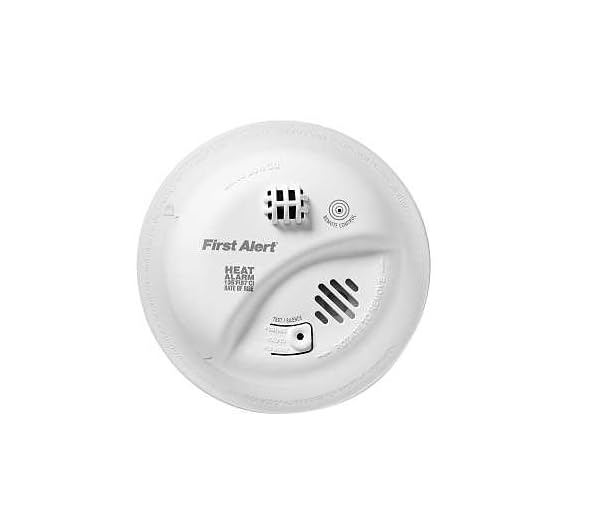
This First Alert model is the one to look at when the loft is big or oddly shaped. A thermistor sensor reads temperature electronically rather than relying on a mechanical element, and the stated 50 ft detection range means a single unit can cover a long open-plan room that would leave a smaller alarm struggling. The 85 dB sounder is loud enough to carry through a closed loft door.
The 120V hardwiring with battery backup is the standard arrangement for a permanently installed alarm, and it suits a renovation where the electrician is already running cable into the roof space. Buyers converting a large loft into a bedroom-plus-bathroom layout will appreciate that one unit covers more floor than a compact heat alarm typically manages.
Trade-off: The wider detection range comes with a bulkier unit and a higher price than the basic First Alert, so a small box room may not justify the extra coverage.
5. First Alert SMI100 2-Pack Battery Smoke Alarm
Type: Battery smoke alarm
Pack: Two units
Power: Battery
Best For: Cheap secondary coverage on the landing

SMI100, 2-Pack First Alert Battery Smoke Alarm
The SMI100 two-pack is not a heat alarm and will not replace one in a kitchen-adjacent loft, but it earns a place here as the cheap secondary layer. Two battery-powered smoke alarms for roughly the price of one hardwired heat alarm make it easy to protect the landing and the foot of the loft stairs without touching the wiring. It is the pick for a household that wants basic coverage fast and is not ready to open up ceilings.
Battery power means no electrician and no cable runs, which suits a rental or a quick safety top-up. The trade-off is that these units protect against smoke, not heat, so they belong in circulation spaces rather than directly over a cooking area. Used alongside a hardwired heat alarm in the loft itself, they close the gap on the escape route.
Trade-off: Battery-only alarms depend entirely on the household remembering to test and replace cells, and a smoke alarm in a loft kitchen zone will nuisance-trip on cooking fumes where a heat alarm would not.
Before You Buy
- Power source: A loft conversion usually needs a hardwired alarm with battery backup; battery-only units are a stopgap, not a permanent installation.
- Interconnect compatibility: Check the brand of any existing alarms before buying, because interconnect only works within a matching family.
- Sensor type: Heat alarms suit kitchens and loft rooms that see fumes; smoke alarms belong on landings and escape routes.
- Coverage: Match the stated detection range to the floor area — a long open-plan loft needs a wider-coverage unit than a box room.
- Mounting: Round ceiling-mount bases sit flat on a sloped ceiling; avoid anything that needs a vertical wall fix where the pitch is steep.
- Backup battery: Treat the backup cell as a scheduled consumable and factor replacement into the annual test routine.
- Extras: Cable, back boxes and connectors are rarely included with a single alarm, so budget for them on a fresh circuit.
Frequently Asked Questions
- Why use a heat alarm instead of a smoke alarm in a loft conversion? Heat alarms respond to temperature rather than smoke, so cooking fumes, steam and dust rising into the loft are less likely to trigger a false alarm.
- Can a heat alarm be mounted on a sloped ceiling? Yes — the round ceiling-mount base used by these units sits flat against a pitched surface, which is one reason they suit loft rooms.
- Does a hardwired heat alarm need a battery? Most hardwired models include a battery backup so the alarm stays live during a power cut; the backup cell still needs periodic replacement.
- Can different brands be interconnected? Generally no — interconnect works within a matching family, so buyers should check existing alarms before adding a new one.
- How many heat alarms does a loft conversion need? It depends on the floor area and layout; a large open-plan room may need one wide-coverage unit, while a divided layout may need more.
- Is a battery smoke alarm a substitute for a heat alarm? No — it adds coverage on landings and escape routes but will nuisance-trip near cooking areas where a heat alarm is the correct choice.
Bottom Line
For most loft conversions with sloped ceilings, the Kidde HD135F is the top pick: its 135-degree fixed threshold keeps nuisance alarms down in a room that collects rising cooking fumes, and its interconnect capability means an alarm in the loft is heard through the rest of the house. Buyers on a tighter budget who are simply swapping an existing unit should look at the First Alert BRK HD6135FB instead, while anyone covering a large open-plan loft should weigh the wider detection range of the First Alert thermistor model.
