Why there are Amazon links here: Brave Review is paid a commission for qualifying Amazon purchases made through the links below. Your price does not change, and using our links is entirely optional. How this works
Linkind Matter GU10 vs Matter Smart Light Bulbs: Which Bulb Fits the Fixture
This comparison settles one decision: does the buyer need a narrow spot bulb for a recessed GU10 fixture, or an everyday A19 bulb for lamps and standard sockets? The Linkind Matter GU10 four-pack suits track heads, downlights and display spots, while the Linkind Matter A19 six-pack suits table lamps, ceiling fixtures and general room lighting. Both speak Matter, both change color, and both pair directly with Apple Home, Alexa and Google Home without a proprietary bridge. The short answer sits in the two product blocks below; the long answer is in the table that follows.
Linkind Matter GU10 Smart Bulbs (4-Pack)

Base: GU10
Bulb Shape: MR16 reflector
Light Output: 470 lumens
Color Range: 1800K–6500K plus color changing
Connectivity: Matter, works with Alexa, Apple Home and Google
Extras: Music sync and light shows
Pack Size: 4 bulbs
The GU10 is the specialist of the pair. Its MR16 reflector body throws a tighter, more directed beam than a standard bulb, which is exactly what recessed cans, track heads and display spots want. The 470-lumen output is modest by room-lighting standards, and that is deliberate: these are accent and task bulbs, not the light source for a whole living room. The 1800K-to-6500K range covers candle-warm evenings through crisp daylight, and the music sync and light show modes give the set a party trick beyond plain dimming.
Matter is the headline feature. Pairing happens directly through Apple Home, Alexa or Google Home, so there is no Linkind bridge to buy and no second app to keep alive. Voice control arrives through whichever assistant already runs the house. The four-pack format makes sense for the way GU10 fixtures are installed — kitchens, hallways and retail-style downlights rarely come in singles.
Trade-off: The narrow reflector beam and 470-lumen ceiling mean these bulbs flatter a wall or a countertop but will not carry a room on their own, and the four-pack leaves anyone with five or more cans short.
Check the current price on Amazon
Linkind Matter Smart Light Bulbs (6-Pack, A19 E26)
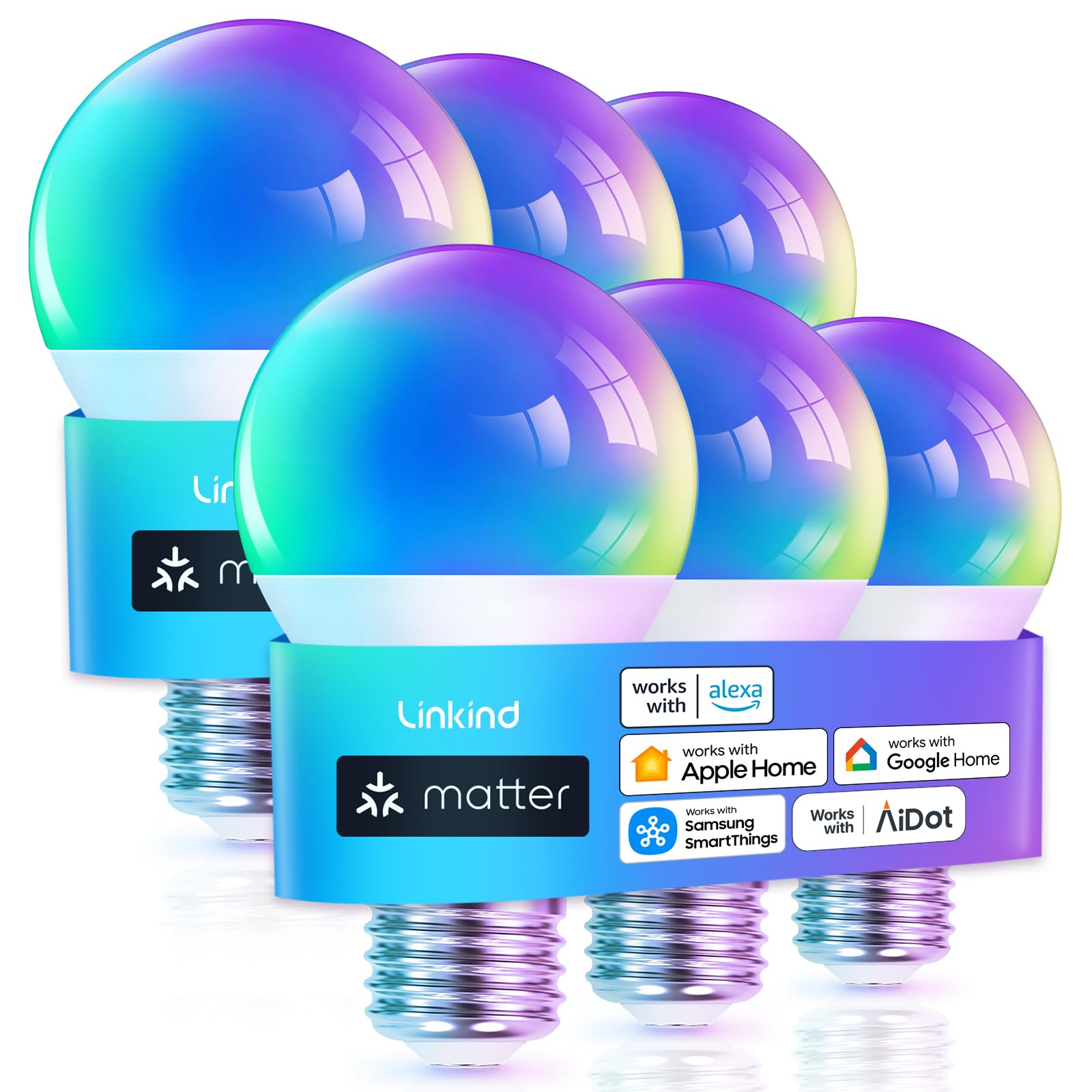
Base: E26 (standard screw)
Bulb Shape: A19
Light Output: 800 lumens
Equivalent: 60W
Connectivity: Matter over 2.4G WiFi, works with Apple Home, Alexa and Google Home
Intended Use: Color changing and mood lighting
Pack Size: 6 bulbs
The A19 is the generalist. An E26 screw base fits the overwhelming majority of lamps, ceiling fans and open fixtures in a US home, so this six-pack can be spread across a whole apartment in one order. At 800 lumens and a 60W-equivalent rating, each bulb is bright enough to be the primary light in a bedroom or a reading corner rather than just an accent. Color changing plus mood lighting is the stated purpose, and that framing is honest about what the set does best.
Matter over 2.4G WiFi means direct connection to the home network and native pairing with Apple Home, Alexa and Google Home. No hub, no vendor cloud dependency for basic control. The 2.4G band is the right call for smart bulbs — it reaches further through walls than 5GHz and keeps the bulbs off the crowded high-band channel that phones and laptops use. Six bulbs for a household’s worth of lamps is the practical unit here.
Trade-off: The 2.4GHz-only radio is a real constraint in mesh networks that broadcast a single combined SSID, and six identical bulbs in one order is more commitment than a first-time smart-home buyer may want before testing one room.
Check the current price on Amazon
Linkind Matter GU10 vs Matter Smart Light Bulbs: Side-by-Side
| Feature | Linkind Matter GU10 (4-Pack) | Linkind Matter A19 (6-Pack) |
|---|---|---|
| Base Type | GU10 | E26 standard screw |
| Bulb Shape | MR16 reflector | A19 |
| Light Output | 470 lumens | 800 lumens |
| Wattage Equivalent | Not the room-lighting class | 60W |
| Color Range | 1800K–6500K plus color | Color changing, mood lighting |
| Connectivity | Matter, Alexa/Apple Home/Google | Matter over 2.4G WiFi |
| Signature Feature | Music sync and light shows | Direct connect, no hub |
| Pack Size | 4 bulbs | 6 bulbs |
| Price Tier | Mid | Mid |
The Differences That Actually Matter
Fixture Fit Decides the Purchase Before Anything Else
A GU10 bulb physically will not go into an E26 socket, and an A19 will not clip into a GU10 can. This is the first filter, and it eliminates one product entirely for most buyers. Homes with recessed downlights, track lighting or cabinet spots are GU10 territory. Homes with lamps, ceiling fans and standard ceiling fixtures are A19 territory. Mixed homes exist, and the honest answer there is to buy both — but the budget decision usually lands on whichever fixture type dominates.
Beam Character: Spot Against Flood
The MR16 reflector in the GU10 set produces a directed pool of light. That makes it excellent for highlighting a countertop, a piece of art or a stairwell, and poor for washing a whole room. The A19 spreads light broadly in every direction, which is what a lamp shade or a bare ceiling fixture expects. Buyers who want drama and definition go GU10; buyers who want even, comfortable general light go A19.
Brightness and the Job Each Bulb Can Do
At 470 lumens the GU10 is an accent bulb and should be planned as one. At 800 lumens and a 60W-equivalent rating, the A19 can serve as primary lighting in a small room. A kitchen with six GU10 cans will read brighter than the per-bulb number suggests because the beams overlap, but a single GU10 in a floor lamp would disappoint. Matching bulb to job matters more here than raw output.
Pack Size and Rollout Cost
Four bulbs against six changes how a buyer phases a smart-home rollout. The A19 six-pack covers a full apartment in one purchase and leaves no orphan fixtures; the GU10 four-pack suits a single room’s worth of cans and may need a second order to finish a larger ceiling. Neither pack is wasteful, but the A19 set is the friendlier starting point for someone testing Matter for the first time.
The Matter Experience Is the Same on Both
Both bulbs pair directly with Apple Home, Alexa and Google Home through Matter, with no proprietary hub in the chain. Voice control, scenes and automations behave the same way on each. The GU10 adds music sync and light show modes, which leans entertainment; the A19 leans whole-home convenience. Buyers already committed to one ecosystem lose nothing by choosing either.
Which Should You Buy?
Choose the Linkind Matter GU10 four-pack if: the fixtures are recessed cans, track heads or display spots with GU10 sockets, the goal is accent and task lighting with a bit of party-mode fun, and four bulbs cover the space.
Choose the Linkind Matter A19 six-pack if: the sockets are standard E26, the goal is everyday room lighting with color and mood control, and a single order should cover most of the home.
FAQ
-
Do both bulbs need a hub?
No. Both are Matter-enabled and pair directly with Apple Home, Alexa and Google Home. Neither requires a Linkind bridge. -
Can a GU10 bulb go in a normal lamp?
No. GU10 is a twist-and-lock base used in recessed and track fixtures. Standard lamps take E26, which is what the A19 set uses. -
Which set is brighter per bulb?
The A19 set, at 800 lumens and a 60W-equivalent rating. The GU10 set outputs 470 lumens per bulb, which suits accent and directed lighting. -
Does the GU10 set really do music sync?
Yes — music sync and light show modes are part of the GU10 four-pack’s feature set, which makes it the more entertainment-oriented of the two. -
Why does the A19 set specify 2.4G WiFi?
Matter over 2.4GHz reaches further through walls and keeps bulbs off the busier high-band channel. The caveat is mesh networks that merge both bands under one network name. -
Which is the better first smart bulb purchase?
For most homes, the A19 six-pack — standard sockets are far more common, and six bulbs cover more fixtures for a first rollout. -
Can both sets be used in the same home?
Yes. Both run on Matter and can sit in the same Apple Home, Alexa or Google Home setup, controlled together in shared scenes.
Bottom Line
Fixture fit settles this before features do, and for the majority of US homes the standard E26 socket wins on volume alone. The Linkind Matter A19 six-pack is the broader, more useful purchase: brighter per bulb, six to a pack, and Matter-direct with no hub. The GU10 four-pack remains the right call for anyone whose ceiling is already cut for recessed cans — just plan the beam as accent lighting, not room lighting.
