Why there are Amazon links here: Brave Review is paid a commission for qualifying Amazon purchases made through the links below. Your price does not change, and using our links is entirely optional. How this works
Best Mesh System for a House With a Long Narrow Layout
A long narrow house is a coverage problem, not a speed problem. The signal has to travel down a hallway and through several rooms in a line, and a single router at one end usually fades out before the far end. A mesh system solves that by placing nodes along the length of the house, so each one hands off to the next.
This guide covers five mesh kits that suit different budgets and layouts. It serves buyers in a modest ranch-style home, buyers in a long townhouse or row house, and buyers who want future-proof WiFi 7 hardware. The overview table below puts all five side by side so a decision is possible in under a minute.
The Picks at a Glance
| Product | Key Spec | Best Use | Price Tier |
|---|---|---|---|
| TP-Link Deco S4 (3-Pack) | AC1900 dual-band, up to 5,500 sq ft | Budget pick for a long single-story house | Budget |
| TP-Link Deco X55 AX3000 (3-Pack) | WiFi 6, up to 6,500 sq ft, 3 Gigabit ports per unit | Best overall for most long layouts | Mid-range |
| NETGEAR Orbi 370 Series (3-Pack) | WiFi 7, up to 6,000 sq ft, 2.5 Gig port | Small footprint with newer wireless standard | Mid-range |
| TP-Link Deco 7 Pro BE10000 (3-Pack) | WiFi 7 tri-band, up to 7,600 sq ft, 4 x 2.5G ports | Heavy device loads and wired backhaul | Upper mid-range |
| NETGEAR Orbi 770 Series (3-Pack) | WiFi 7 tri-band, up to 8,000 sq ft, up to 11 Gbps | Largest homes and top-end throughput | Premium |
TP-Link Deco S4 Mesh AC1900 WiFi System, Deco S4(3-Pack)

Wireless Standard: AC1900 dual-band
Coverage: Up to 5,500 sq ft
Units: 3-pack
Ports: Gigabit ports
Voice Control: Works with Alexa
Function: Replaces WiFi router and extender
The Deco S4 is the value entry in this group. It is a dual-band AC1900 kit with three identical units, each with Gigabit ports, and it replaces both a router and any extenders already in the house. The three nodes are meant to be spaced down the length of a property, which is exactly the arrangement a narrow floor plan needs.
This is the pick for a buyer on a tight budget who mainly streams, browses and works from home on a handful of devices. It earns its place because three nodes for a budget outlay covers a long house better than one expensive router ever could.
Trade-off: Dual-band AC hardware has less headroom than WiFi 6 or 7, so a household with many simultaneous 4K streams or large local file transfers will feel the ceiling sooner.
TP-Link Deco X55 AX3000 WiFi 6 Mesh System, Deco X55(3-Pack)

Wireless Standard: WiFi 6, AX3000
Coverage: Up to 6,500 sq ft
Units: 3-pack
Ports: 3 Gigabit ports per unit
Backhaul: Supports Ethernet backhaul
Function: Replaces wireless router and extender
The Deco X55 is the sensible middle of this list. Each of the three units carries three Gigabit ports, which is unusually generous for a mid-range mesh kit and matters in a long house where a wired backhaul run down the hallway can carry the traffic instead of the radio. WiFi 6 and AX3000 throughput handle a normal family load comfortably.
It suits the buyer who wants a set-and-forget system with enough wired flexibility to fix a stubborn far room. It earns its place as the best all-rounder because it balances coverage, port count and price better than anything else here.
Trade-off: Three Gigabit ports per unit are wasted if the house has no way to run Ethernet between nodes, and the kit still tops out at Gigabit wired speeds.
NETGEAR Orbi 370 Series WiFi 7 Mesh System, 3 Pack

Wireless Standard: WiFi 7, dual-band
Coverage: Up to 6,000 sq ft
Throughput: Up to 5 Gbps
Device Load: 70 devices
Ports: 2.5 Gig port
Configuration: Router plus 2 satellite extenders
The Orbi 370 is a router-plus-two-satellites kit built on WiFi 7 with a 2.5 Gig port and support for up to 70 devices. The Orbi format uses a dedicated design language where satellites are clearly separate from the router, which makes placement down a long hallway easy to plan. Security features and easy setup round out the package.
This is for the buyer who wants the newer wireless standard without paying tri-band money. It fits a long house where the priority is a clean handoff between three well-spaced nodes and a wired port fast enough for modern internet plans.
Trade-off: Dual-band WiFi 7 gives up the extra radio lane of tri-band kits, so a very dense device household gets less separation between backhaul and client traffic.
TP-Link Deco 7 Pro Tri-Band WiFi 7 BE10000 Whole Home Mesh System (BE63 3-Pack)
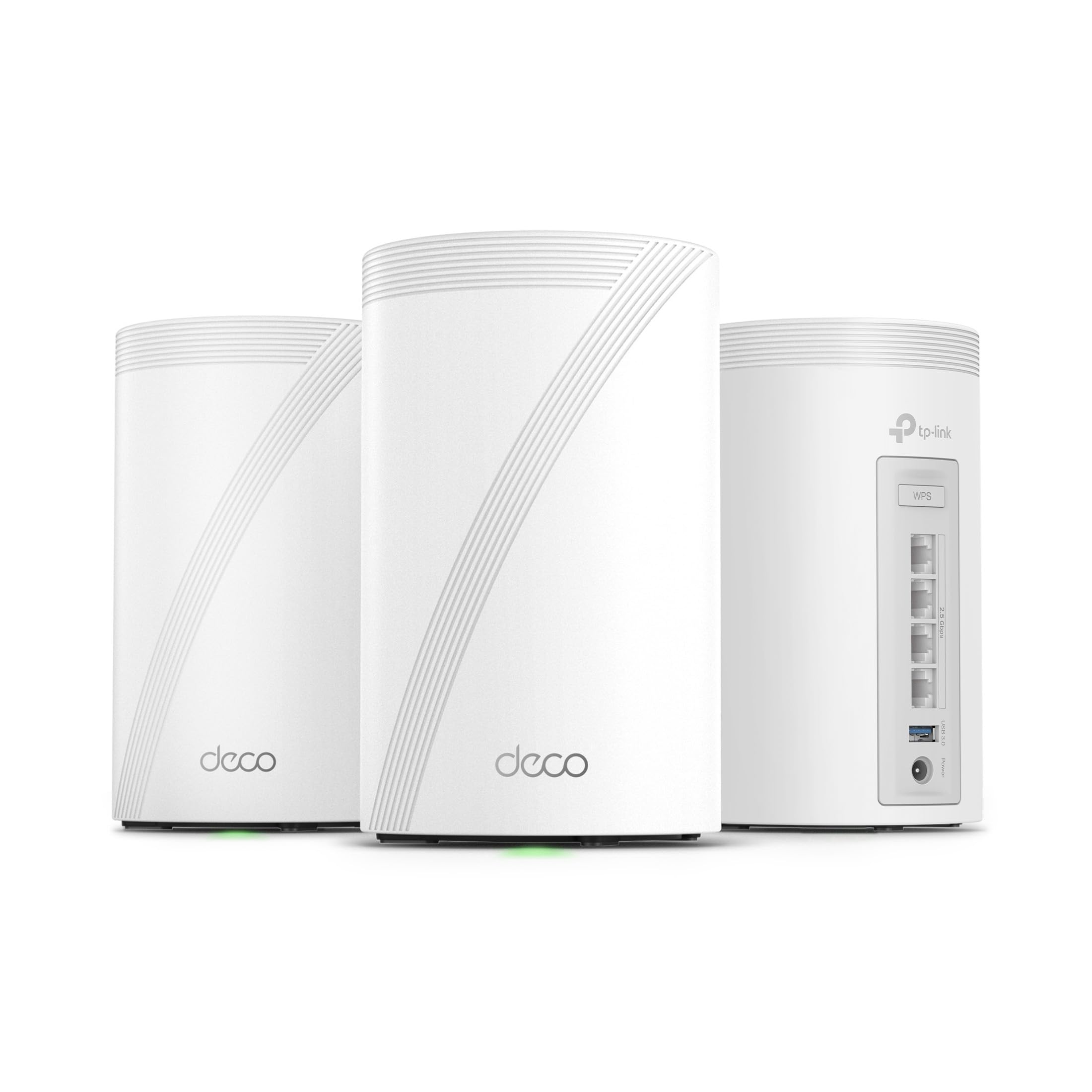
Wireless Standard: WiFi 7, tri-band, BE10000
Coverage: Up to 7,600 sq ft
Streams: 6-stream, 10 Gbps
Ports: 4 x 2.5G ports, wired backhaul
Antennas: 4 x smart internal antennas
Features: VPN, HomeShield, AI-Roaming
The Deco 7 Pro is the wired-backhaul specialist of the group. Four 2.5G ports per unit and explicit wired backhaul support mean the three nodes can be linked by cable down the length of a narrow house, leaving the wireless bands free for devices. Tri-band BE10000 throughput, six streams and AI-Roaming handle a busy household, and HomeShield and VPN support add network-level controls.
It suits a buyer with a long house and the ability to pull cable, or one with a very high device count. It earns its place because the port array is the most flexible here for anyone who wants the mesh to last through several internet upgrades.
Trade-off: The price sits well above the entry kits, and the 2.5G ports only pay off with a matching internet plan and wired backhaul.
NETGEAR Orbi 770 Series WiFi 7 Mesh System, 3 Pack

Wireless Standard: WiFi 7, tri-band
Coverage: Up to 8,000 sq ft
Throughput: Up to 11 Gbps
Device Load: 100 devices
Ports: 2.5 Gig port
Configuration: Router plus 2 satellite extenders
The Orbi 770 is the top of this list. Tri-band WiFi 7 with up to 11 Gbps, coverage rated to 8,000 sq ft and support for 100 devices makes it the kit for a large, long property with a heavy load. A 2.5 Gig port, security features and simple setup keep it practical rather than purely spec-sheet hardware.
This is for the buyer who wants the widest coverage and the most throughput available here and is willing to pay for it. It earns its place as the premium pick because nothing else in the group matches its rated coverage or device ceiling.
Trade-off: This is the most expensive kit here by a wide margin, and a long narrow house with a modest internet plan will not use most of that capacity.
Before You Buy
- Coverage rating: Match the rated square footage to the house, then add margin, because a long narrow layout has more walls between nodes than an open plan of the same size.
- Node count: Three units suit most long houses; a very long property may need a fourth node, so check whether the system can be expanded.
- Wired backhaul: A long hallway is the ideal place for an Ethernet run. Kits that support wired backhaul make far more of their hardware.
- Ports: Count the wired devices that need a connection — TVs, consoles, desktops — and check the port count and speed per unit.
- Wireless standard: WiFi 6 is ample for most households; WiFi 7 is worth the premium only with a fast internet plan and many devices.
- Placement: Nodes need to be spaced along the length of the house with a clear line of sight where possible, not clustered at one end.
- Security features: Parental controls and network-level protection vary by brand, so check what the kit includes before buying.
Frequently Asked Questions
-
How many mesh nodes does a long narrow house need?
Three is the usual starting point, spaced from one end of the house to the other. A very long property may need a fourth node, so a system that supports expansion is the safer choice. -
Is WiFi 7 worth it for a long house?
Only with a fast internet plan and a high device count. WiFi 6 hardware like the Deco X55 covers a long layout perfectly well for most households at a lower price. -
Does wired backhaul help in a narrow layout?
Yes. A cable run down the length of the house frees the wireless bands for devices and gives the most stable handoff between nodes. The Deco 7 Pro is built around this. -
Can a mesh system replace an existing router and extender?
Yes. Every kit here is designed to replace both, which also removes the weak link an old extender usually creates in a long hallway. -
Where should the nodes be placed?
Space them along the length of the house rather than stacking them in one room, and keep each node out in the open rather than inside a cabinet or closet. -
Will a mesh system work with smart home devices?
Yes. Kits with higher device ceilings, like the Orbi 770, handle a large number of smart home gadgets more comfortably than budget hardware.
Bottom Line
For most long narrow houses, the TP-Link Deco X55 AX3000 three-pack is the pick: WiFi 6 coverage rated to 6,500 sq ft, three Gigabit ports per unit and Ethernet backhaul support at a mid-range price. Buyers who can run cable and want the most flexible port array should step up to the Deco 7 Pro BE63, while a tight budget still gets a workable three-node layout from the Deco S4.
