Why there are Amazon links here: Brave Review is paid a commission for qualifying Amazon purchases made through the links below. Your price does not change, and using our links is entirely optional. How this works
Reolink 4K Solar Security Cameras vs Aosu 2K QHD Solar Security Cameras: One Camera or Four?
The Reolink 4K solar security cameras and the Aosu 2K QHD solar security cameras solve the same problem from opposite directions. Reolink sells one high-resolution, pan-and-tilt camera for buyers who want detail on a single critical view. Aosu sells a four-camera kit for buyers who want broad coverage of a whole property on a modest budget.
The decision comes down to resolution and flexibility against camera count and simplicity. The comparison below works through each dimension, and the "Which Should You Buy?" section settles it for the two most common households.
Reolink 4K Solar Security Cameras: Single-Camera Detail
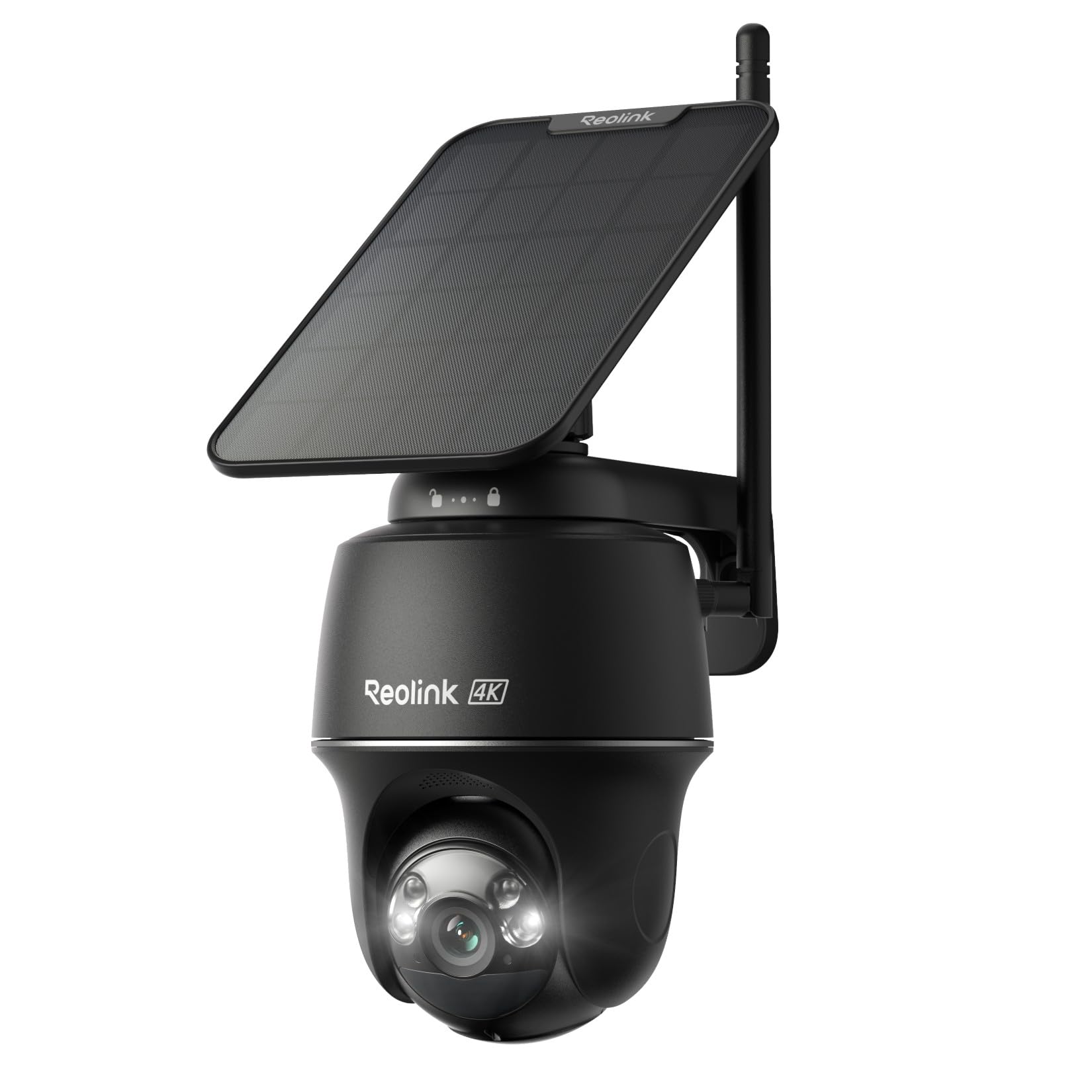
Resolution: 4K (8MP)
Night Vision: Color
Field of View: 360° pan and tilt
Connectivity: 2.4/5 GHz Wi-Fi 6
Power Source: Solar
Subscription: No monthly fee
Smart Home: Home Hub compatible
Color: Black
The Reolink unit is built around image quality and movement. The 4K sensor and color night vision mean faces, plates and package labels stay readable after dark, and the pan-and-tilt head lets one camera sweep a yard, driveway or storefront instead of staring at a fixed slice of it.
Wi-Fi 6 on both bands helps in crowded neighborhoods where older 2.4 GHz gear stutters. The solar panel keeps the battery topped up in most climates, and the no-monthly-fee stance matters for buyers who refuse another subscription. Home Hub compatibility adds local storage options for those already in the Reolink ecosystem.
Trade-off: One camera covers one area at a time, so a large property still needs additional units, and the pan-and-tilt mechanism is the part most likely to need attention over years of outdoor use.
Check the current price on Amazon
Aosu 2K QHD Solar Security Cameras: Four-Camera Coverage

Resolution: 2K QHD
Night Vision: Color
Power Source: Solar
Installation: 2-minute DIY
Alarms: Siren and light
Subscription: Not required
Kit Size: 4 cameras
The Aosu kit takes the opposite approach: four 2K QHD cameras instead of one 4K unit. Each camera covers its own fixed view, so front door, back door, driveway and side yard all get watched at once without any moving parts to aim or maintain.
The 2-minute DIY installation claim reflects a genuinely simple design — mount, angle, done — with solar panels handling power and no wiring to run. Siren and light alarms give each camera an active deterrent beyond passive recording, and the no-subscription model keeps ongoing costs at zero.
Trade-off: 2K QHD captures less fine detail than 4K, so identifying a face or plate at the far edge of a frame is harder, and fixed cameras cannot be redirected to follow activity the way a pan-and-tilt unit can.
Check the current price on Amazon
Side-by-Side Specifications
| Feature | Reolink Argus PT Ultra | Aosu 2K QHD 4-Cam-Kit |
|---|---|---|
| Resolution | 4K (8MP) | 2K QHD |
| Cameras Included | 1 | 4 |
| Field of View | 360° pan and tilt | Fixed per camera |
| Night Vision | Color | Color |
| Connectivity | 2.4/5 GHz Wi-Fi 6 | Wireless |
| Power Source | Solar | Solar |
| Installation | Standard mount | 2-minute DIY |
| Alarms | Not stated in name | Siren and light |
| Subscription | None required | None required |
| Smart Home | Home Hub compatible | Not stated in name |
| Color | Black | Not stated in name |
How the Two Compare
Resolution and image detail. The Reolink’s 4K sensor wins outright on raw detail. That matters most for identification — reading a license plate across a driveway or recognizing a face at the edge of frame. Aosu’s 2K QHD is sharp enough for recognizing people and vehicles at close and mid range, but it gives up fine detail at distance. Buyers who need courtroom-grade clarity from a single viewpoint should favor Reolink.
Coverage and camera count. The Aosu kit wins on breadth. Four cameras watch four areas simultaneously, which suits a typical house with multiple entry points. The Reolink covers one zone at a time, though its pan-and-tilt head can sweep a wide arc. A large property needs more Reolink units to match the Aosu kit’s simultaneous coverage, and that changes the cost math considerably.
Flexibility versus simplicity. Reolink’s pan-and-tilt is the more flexible design — one camera can be redirected when the property layout changes. Aosu’s fixed cameras are simpler and more reliable by construction, with no motors to fail and nothing to re-aim. Buyers who want set-and-forget coverage lean Aosu; buyers who want to actively monitor a single zone lean Reolink.
Installation and setup. Aosu’s 2-minute DIY claim reflects a design built for quick mounting with no wiring. Reolink’s install is still straightforward but more involved, especially when aiming the pan-and-tilt head for the best arc. Neither requires professional installation.
Ongoing cost. Both products advertise no monthly fee, which puts them in the same camp for buyers tired of subscription-based cameras. Local storage options differ, so buyers should check which storage method each supports before committing.
Which Should You Buy?
Choose the Reolink 4K solar security cameras if the priority is sharp image detail on one important view — a driveway, a gate, a storefront entrance — and the buyer wants color night vision, a sweeping pan-and-tilt head and Wi-Fi 6 connectivity. This is the pick for detail over breadth.
Choose the Aosu 2K QHD solar security cameras if the goal is covering a whole house with four cameras at once, without wiring, subscriptions or complex setup. This is the pick for broad, simple, budget-friendly coverage.
FAQ
-
Which system has better image quality? The Reolink 4K camera captures more detail than the Aosu 2K QHD cameras. That advantage matters most at distance and in low light.
-
Do either of these require a subscription? Neither. Both the Reolink and Aosu products advertise no monthly fee, so recording and alerts work without an ongoing payment.
-
Can one Reolink camera cover a whole yard? Its 360° pan and tilt lets it sweep a wide area, but it watches one direction at a time. A large property with several entry points needs multiple units or the Aosu kit.
-
Is the Aosu kit hard to install? The product name advertises 2-minute DIY installation, reflecting a design built for quick mounting with no wiring.
-
Which is better for renters? The Aosu kit’s simple, solar-powered, no-wiring design is the easier fit for a rental where permanent installation is not practical.
-
Do both work at night? Yes. Both advertise color night vision, so footage stays in color after dark rather than switching to black and white.
-
Which is the better value? The Aosu kit delivers four cameras for broad coverage, while the Reolink delivers one higher-resolution camera. Value depends on whether the buyer needs camera count or image detail.
Bottom Line
For most households wanting to cover a whole property without wiring or subscriptions, the Aosu 2K QHD solar security cameras are the practical pick — four cameras, simple install, no ongoing cost. Buyers who need maximum detail on a single critical view should choose the Reolink 4K solar security cameras instead.
