Why there are Amazon links here: Brave Review is paid a commission for qualifying Amazon purchases made through the links below. Your price does not change, and using our links is entirely optional. How this works
Best Programmable Thermostat for Someone Who Works Nights
A night-shift schedule breaks the standard 9-to-5 thermostat routine. The best programmable thermostat for someone who works nights needs schedules that can bend around sleep at 8 a.m., wake-ups at 5 p.m., and an empty house from midnight to dawn. This roundup covers five thermostats at different price points: a budget 5-2 day model, two smart Wi-Fi units, a seven-day touchscreen, and a simple non-programmable backup option. The overview table below shows each pick’s key spec and best use so a decision can happen fast.
Overview of the Picks
| Product | Key Spec | Best Use | Price Tier |
|---|---|---|---|
| Vine Smart Thermostat with Nightlight | 4.3-inch display, 7-day x 8-period programming | Night-shift schedules with a bedside-friendly glow | Mid-range |
| Honeywell Home X2P (RTH20B) | 5-2 day schedule, 1 heat/1 cool | Simple weekday/weekend splits on a tight budget | Budget |
| Sensi Smart Thermostat ST55 | Wi-Fi, Alexa, Energy Star certified | Remote schedule changes from a phone | Mid-range |
| Honeywell Home RTH8560D | 7-day touchscreen programming | Full seven-day control without an app | Mid-range |
| Suuwer Non-Programmable Thermostat | 1 heat/1 cool, blue backlight | A basic manual replacement | Budget |
1. Vine Smart Thermostat for House with Nightlight

Display: 4.3 inches
Connectivity: Wi-Fi, Alexa and Google Assistant
Programming: 7-day x 8-period
Wiring: C-wire required
Type: Smart thermostat with nightlight
The Vine unit is built around its 4.3-inch screen, which is larger than what most smart thermostats in this tier offer. The integrated nightlight is the standout feature for night workers: a dim glow in a hallway at 3 a.m. is genuinely useful when the rest of the house is dark. Seven-day programming with eight periods per day means a separate schedule for every day of the week, which suits rotating or irregular shifts. Alexa and Google Assistant support adds voice control for people who are half-asleep.
This pick earns its place for anyone whose sleep window shifts week to week. It requires a C-wire, so older homes without one will need an adapter or a different model.
Trade-off: The large display and nightlight draw more power than a plain thermostat, and the C-wire requirement rules out some older wiring setups.
2. Honeywell Home X2P Programmable Thermostat (RTH20B)
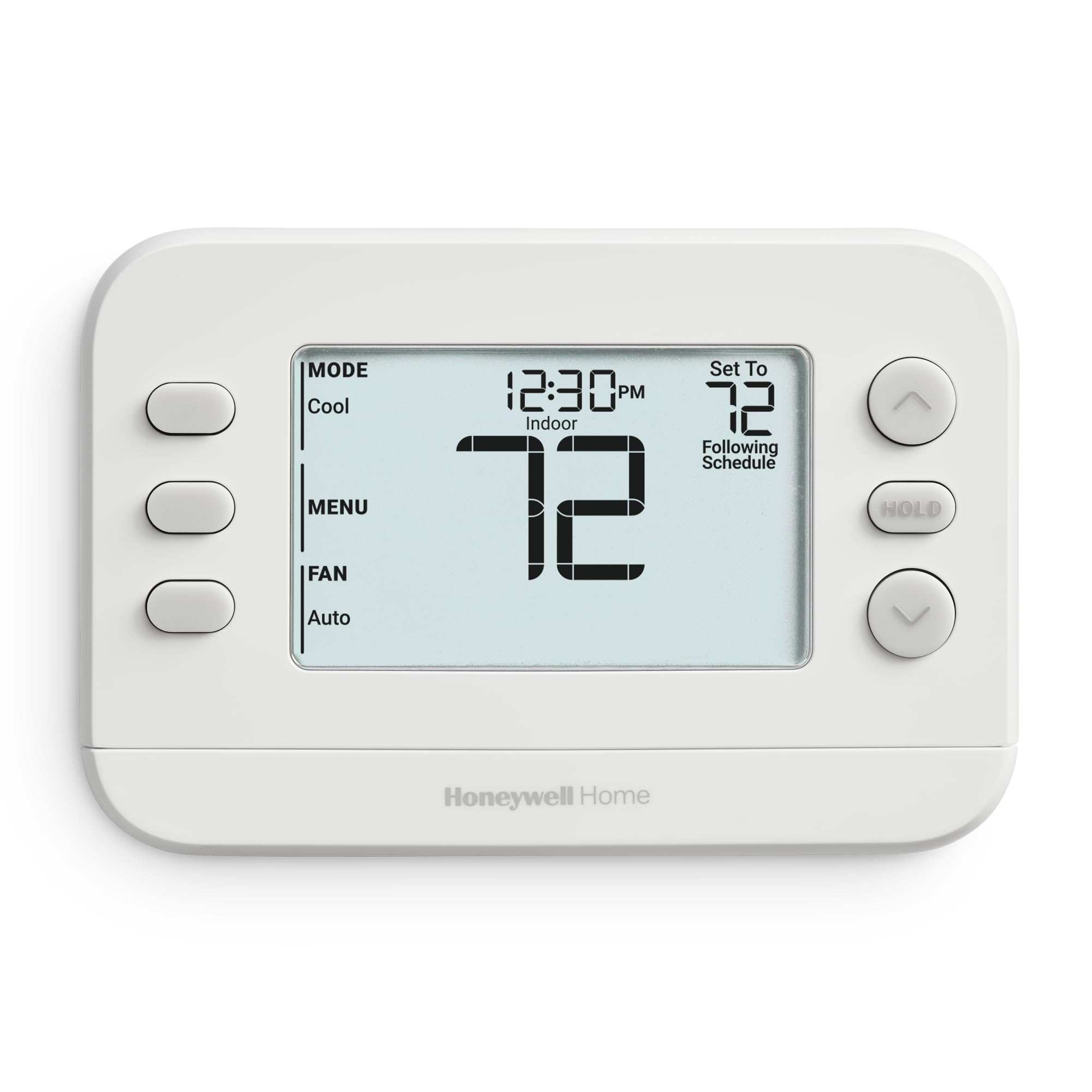
Schedule: 5-2 day programming
Compatibility: 1 heat/1 cool, single-stage
Color: White
Type: Programmable thermostat
Connectivity: None (no Wi-Fi)
The X2P is the budget option and the most popular pick in this lineup by purchase volume. Its 5-2 day format sets one schedule for weekdays and another for weekends, which is a reasonable fit for a fixed night-shift routine that repeats Monday through Friday. Single-stage 1 heat/1 cool compatibility covers the majority of standard residential systems. There is no app and no Wi-Fi, so everything happens at the wall unit.
This is the pick for a night worker who wants a cheap, no-fuss replacement and has the same shift pattern every week. It is not for anyone with a rotating schedule or a heat pump.
Trade-off: The 5-2 day format cannot give each day its own schedule, so a rotating shift pattern will need constant manual overrides.
3. Sensi Smart Thermostat ST55
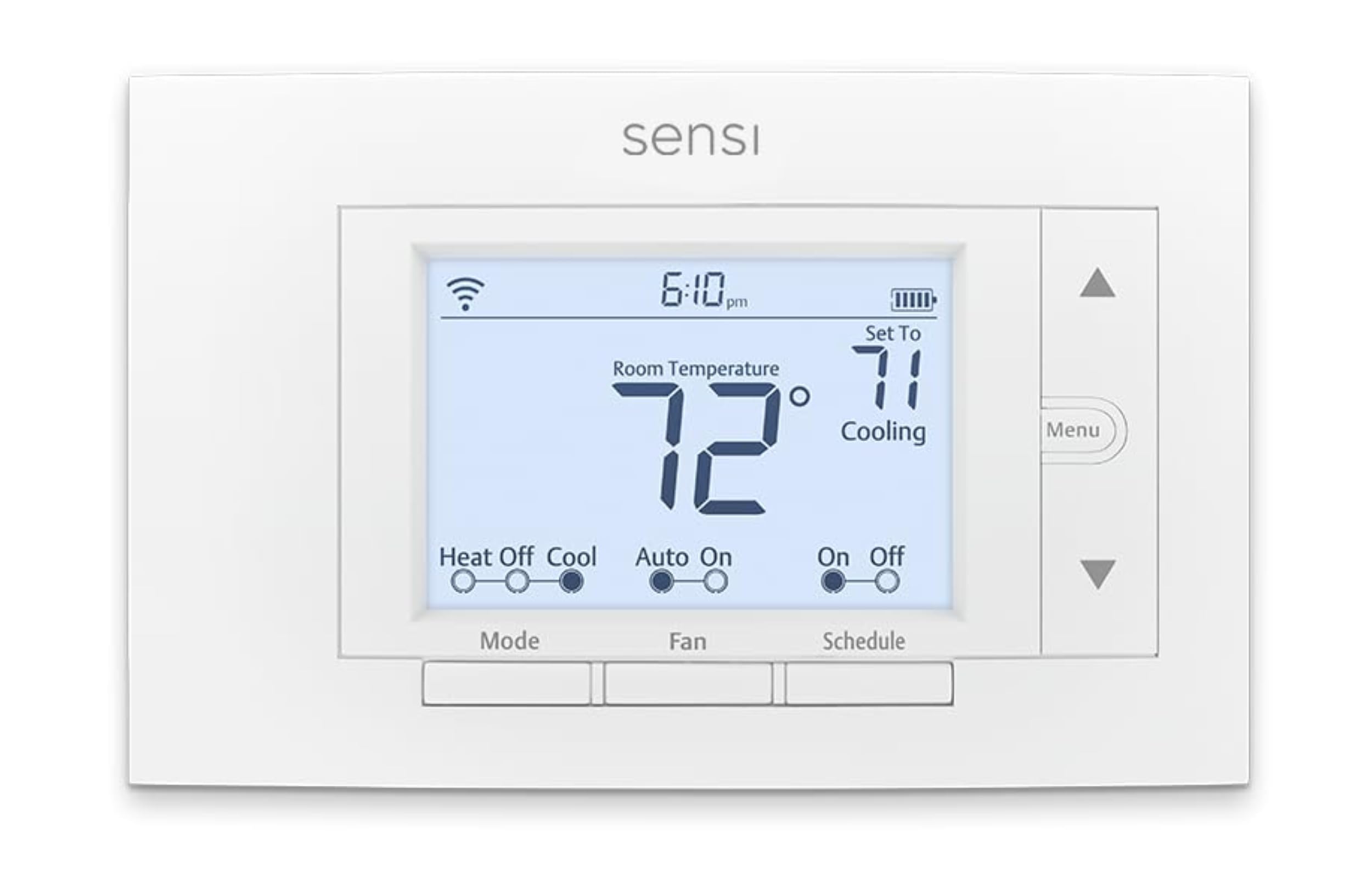
Connectivity: Wi-Fi
Voice Control: Alexa
Certification: Energy Star certified
Installation: DIY
Type: Smart thermostat
The Sensi ST55 is a Wi-Fi thermostat aimed at DIY installers, and the app-based control is the reason it belongs on this list. A night worker can adjust the schedule from a phone in bed rather than walking to the hallway. Energy Star certification signals efficient operation, and Alexa support covers voice changes. The DIY positioning means the install is designed to be handled without a technician.
This pick suits someone who wants smart features without paying premium smart-thermostat prices. It is less appealing for a household that wants a rich on-device display or extensive automation routines.
Trade-off: The feature set is deliberately basic for a smart thermostat, so buyers wanting advanced automation or multi-sensor room balancing will find it limited.
4. Honeywell Home RTH8560D 7-Day Programmable Touchscreen Thermostat

Programming: 7-day
Display: Touchscreen
Color: White
Type: Programmable thermostat
Connectivity: None (no Wi-Fi)
The RTH8560D gives full seven-day programming on a touchscreen, with no app and no account required. That independence is the appeal: every day of the week gets its own schedule, set directly on the device, and nothing breaks when the Wi-Fi goes down. The touchscreen interface is easier to read and operate than button-based models, particularly at odd hours.
This pick suits night workers who want per-day control but prefer to keep their thermostat off the network. It is a weaker fit for anyone who wants remote adjustments from a phone.
Trade-off: Without Wi-Fi, schedule changes have to be made at the wall, which is inconvenient for anyone used to adjusting settings remotely.
5. Suuwer Non-Programmable Thermostat

Compatibility: 1 heat/1 cool, conventional single-stage
Programming: None (non-programmable)
Backlight: Blue
Type: Manual thermostat
The Suuwer is included as the honest baseline: a non-programmable thermostat with a blue backlight and single-stage 1 heat/1 cool compatibility. It does one thing — hold a temperature — and it does it cheaply. For a night worker in a mild climate with a stable routine, that may be enough. The backlight helps with late-night adjustments in a dark hallway.
This pick suits renters, guest rooms, or anyone replacing a failed thermostat on a minimal budget. It is not a real solution for someone trying to cut energy costs through scheduling.
Trade-off: With no programming at all, every temperature change is manual, which undercuts the entire point of scheduling around a night shift.
Before You Buy
- Scheduling format: A 7-day thermostat allows a different schedule for each day; a 5-2 day model locks weekdays together, which matters for rotating shifts.
- Wiring: The Vine model requires a C-wire, so the existing wiring should be checked before ordering.
- Compatibility: The Honeywell X2P and Suuwer units are single-stage 1 heat/1 cool; heat pump and multi-stage systems need a different model.
- Connectivity: Two picks here have no Wi-Fi, which means no phone control and no remote schedule changes.
- Display: A backlit or large screen helps with adjustments during night hours; a touchscreen is easier to operate than buttons in the dark.
- Budget: Non-programmable units cost the least but deliver the fewest savings; smart models cost more upfront and repay through scheduling.
Frequently Asked Questions
-
What is the best programmable thermostat for someone who works nights?
A 7-day model with per-day scheduling fits night shifts best, because sleep and wake times rarely match a standard weekday pattern. The Vine and RTH8560D both offer full seven-day control. -
Is a 5-2 day thermostat useless for night shift workers?
Not useless, but limited. It works for a fixed Monday-to-Friday night schedule and falls short the moment shifts rotate. -
Do night workers need a Wi-Fi thermostat?
Not strictly. Wi-Fi helps when schedules change often, since adjustments happen from a phone instead of the hallway wall. -
Why does the Vine thermostat need a C-wire?
The larger display and nightlight draw more power than a battery-only design supports, so a constant wire is required. -
Can a non-programmable thermostat still save money?
Only through manual discipline. It holds whatever temperature is set, with no automatic setback during sleep or away hours. -
Does a thermostat’s backlight matter for night shift use?
It does. Adjusting a thermostat in a dark hallway at 3 a.m. is far easier with a lit display than with a plain button panel.
Bottom Line
For most night-shift households, the Vine Smart Thermostat is the strongest fit: its 7-day, 8-period programming handles irregular schedules, and the nightlight is a small feature that makes a real difference at odd hours. Buyers who want per-day control without any network connection should look at the Honeywell RTH8560D instead, and anyone on the tightest budget can start with the Honeywell X2P.
