Why there are Amazon links here: Brave Review is paid a commission for qualifying Amazon purchases made through the links below. Your price does not change, and using our links is entirely optional. How this works
Best Smart Heating for a House With Underfloor Heating Upstairs
A house with underfloor heating upstairs and a different system downstairs needs a thermostat that understands zones. The five picks below cover the three buyer profiles that matter here: the homeowner running a wet underfloor loop upstairs, the renovator wiring an electric mat, and the tinkerer who wants everything on one automation platform. The overview table gives a 60-second answer, and each review explains where a pick fits and where it does not. Every link goes straight to the current Amazon listing, so prices and stock can be checked in one click.
Overview of the Picks
| Product | Key Spec | Best Use | Price Tier |
|---|---|---|---|
| 6iE Smart WiFi Thermostat for Underfloor Heating | SmartGeo, touchscreen, ultra-thin | Sleek single-zone floor control | Budget |
| ecobee Smart Thermostat Enhanced | Energy Star, Siri/Alexa/Google | Whole-house air and boiler control | Mid |
| Schluter Ditra-Heat-E-RS1 Smart Thermostat | Built-in GFCI, Control4 ready | Electric floor warming with safety built in | Premium |
| Electric Warmup 7iE Smart Thermostat | Matter, single zone, dual heating | Mixed underfloor and radiator setups | Mid |
| SunTouch SunStat ConnectPlus | 4.3" touchscreen, floor and air sensing | Large-display floor heating control | Mid |
1. 6iE Smart WiFi Thermostat for Underfloor Heating

Type: WiFi underfloor heating thermostat
Design: Ultra-thin
Display: Smartphone-style touchscreen
Control: App control, SmartGeo technology
Energy feature: Energy-saving scheduling
The 6iE is built specifically for underfloor loops, not adapted from a wall thermostat, and the ultra-thin body suits the shallow back boxes common in upstairs floor heating installs. The touchscreen behaves like a phone panel, so schedules and setpoints are adjusted with taps rather than a dial. SmartGeo adds location-based control, which lets the system react to whether the house is occupied instead of running a fixed timetable. The energy-saving app layer makes more sense for a floor that heats slowly and needs to be told to start early.
This is the pick for a homeowner with one upstairs floor zone who wants the thermostat to look like part of the wall. It earns its place on price and form factor rather than ecosystem depth. The caution is ecosystem breadth: a small-brand panel like this will not match the third-party integration list of a mass-market thermostat, so anyone planning to hang the whole house off one app should check the supported platforms first.
Trade-off: The slim, purpose-built panel is elegant for one floor zone but offers less smart-home integration than the big-name alternatives.
2. ecobee Smart Thermostat Enhanced

Type: Programmable WiFi thermostat
Voice platforms: Siri, Alexa, Google Assistant
Certification: Energy Star certified
Feature set: Smart home, energy-saving scheduling
The ecobee Enhanced is the mainstream pick, and its strength is the ecosystem rather than the floor. All three major voice assistants are supported, Energy Star certification backs the efficiency claims, and the programming logic is mature enough to handle a whole-house schedule. In a house where upstairs underfloor heating is one part of a larger HVAC picture, this is the thermostat that ties the rest together.
It suits the buyer who wants one familiar app and voice control across the property, and it has the sales volume of a mainstream product that most installers have seen before. The caution is the one that applies to every air-focused thermostat: it is designed around air temperature and a conventional HVAC call, so a buyer wanting dedicated floor-probe sensing for the upstairs loop should confirm compatibility with the specific heating setup before buying.
Trade-off: Excellent ecosystem and efficiency credentials, but it is an air-sensing thermostat first and an underfloor specialist second.
3. Schluter Ditra-Heat-E-RS1 Smart Thermostat

Type: Smart floor warming thermostat
Safety: Built-in GFCI
Platform: Control4 home automation compatible
Control: App and voice
Integration: Home Assist
The Ditra-Heat-E-RS1 is the premium pick and the only one here with a built-in GFCI, which matters for electric floor warming because ground-fault protection is a code concern in wet and tiled areas. It is part of a named floor warming system rather than a generic thermostat, so the wiring and sensor expectations are documented for this exact use. Control4 compatibility and Home Assist support put it in the custom-install bracket.
This is the right choice for a renovator installing electric mats under tile, or for a house already running Control4 where the thermostat needs to join the automation scene programming. The caution is cost and complexity: a system-specific, automation-platform thermostat sits at the top of the price range and rewards buyers who will actually use the integration, while a simple single-zone household pays for capability it never touches.
Trade-off: Built-in GFCI and Control4 support justify the premium for integrated installs, but the price is hard to defend for a basic one-room floor.
4. Electric Warmup 7iE Smart Thermostat
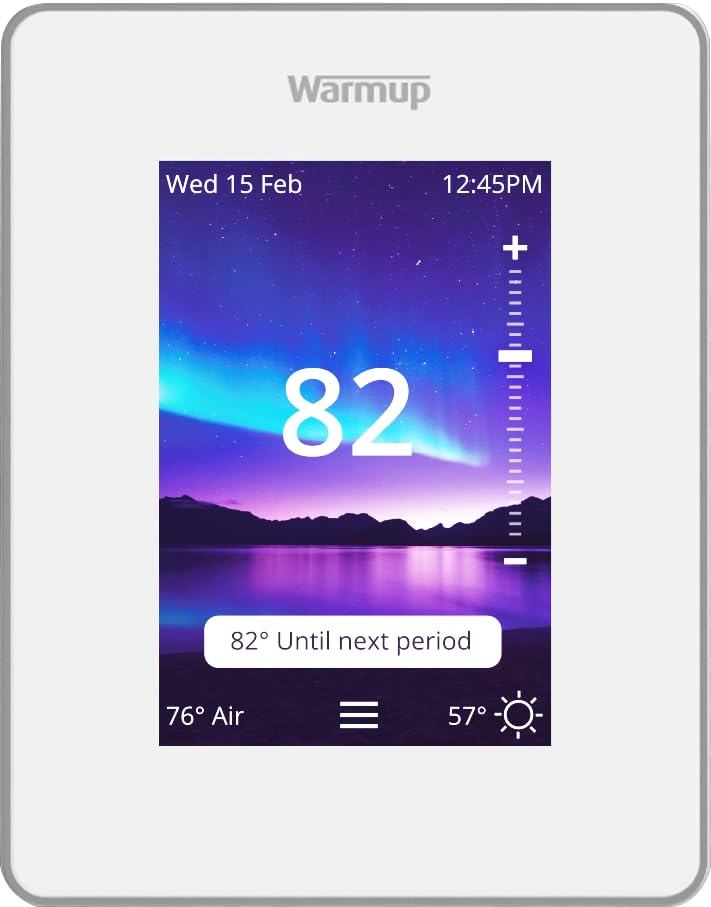
Type: Wired WiFi smart thermostat
Heating control: Underfloor and radiator
Installation: DIY
Zones: Single zone
Protocol: Matter technology
Colour: White
The 7iE is the most interesting pick for a mixed house, because it is named for both underfloor and radiator control in a single zone. Matter support is the headline: it lets the thermostat join a cross-brand smart home rather than locking control into one manufacturer’s app. Smartcare and DIY installation point at a product designed to be fitted and commissioned without a specialist visit.
It suits the practical renovator adding an upstairs floor loop while keeping radiators on the same zone, and the Matter protocol gives it more long-term relevance than a closed ecosystem panel. The caution is the single-zone limit and the DIY framing: one thermostat covers one zone, so a house with several separately controlled upstairs rooms needs multiple units, and DIY wiring of a mains heating circuit is only sensible for buyers genuinely comfortable with it.
Trade-off: Matter support and dual underfloor/radiator control are genuinely useful, but the single-zone design limits it to one heating area per unit.
5. SunTouch SunStat ConnectPlus Smart Wi-Fi Floor Heating Thermostat

Type: Smart WiFi floor heating thermostat
Display: 4.3 inch touchscreen
Voice platforms: Alexa and Google compatible
App: Watts Home app, remote access
Sensing: Floor and air
Feature: Energy monitoring
The ConnectPlus is the readability pick. A 4.3-inch touchscreen is large for a wall thermostat, and floor-plus-air sensing is exactly the combination an upstairs underfloor zone needs, since the floor probe reads slab temperature while the air sensor handles the room. Remote access through the Watts Home app and energy monitoring round out the feature list, and Alexa and Google compatibility keeps voice control in reach.
It suits households that want to see and adjust the floor heating at a glance rather than through a phone, and the dual sensing makes it a natural fit for tiled bathrooms and landings. The caution is app dependence for the smart features: remote access and monitoring live in the manufacturer’s app, so the value of the connected layer depends on staying within that ecosystem.
Trade-off: The big screen and dual sensing are excellent for floor heating, but smart features are tied to a single manufacturer app.
Before You Buy
- Sensing: Confirm the thermostat supports a floor probe, not just air temperature, for any underfloor zone.
- Zones: Count separately controlled upstairs areas first; most picks here cover one zone per unit.
- Compatibility: Check the heating type (electric mat, wet loop, radiator) against the thermostat’s stated control before ordering.
- Safety: Electric floor warming in wet areas benefits from ground-fault protection, so a built-in GFCI is worth prioritising.
- Ecosystem: Decide whether Matter, Control4, Alexa, Google or a manufacturer app is the intended control route.
- Installation: Match the DIY or professional framing to the buyer’s comfort with mains wiring.
- Display: A larger touchscreen helps where settings are changed on the wall rather than by phone.
Frequently Asked Questions
-
Can one smart thermostat run upstairs underfloor heating and downstairs radiators?
Only if it is rated for both loads on a single zone, as the Warmup 7iE is described. Otherwise each heating area needs its own thermostat. -
Is a floor sensor necessary for underfloor heating?
A floor probe lets the thermostat regulate slab temperature directly, which is why floor-and-air sensing models suit underfloor zones best. -
Does a smart thermostat work with electric underfloor mats?
Yes, provided the thermostat is rated for electric floor warming. Models with built-in GFCI add ground-fault protection for tiled and wet areas. -
What does Matter support add?
Matter lets a thermostat join a cross-brand smart home, so control is not locked to one manufacturer’s app. -
Is DIY installation realistic for a heating thermostat?
It depends on the buyer’s comfort with mains wiring. A wired thermostat connects to the heating circuit, so professional fitting is the safer route for most households. -
Why choose a large touchscreen model?
A bigger display makes setpoints and schedules readable at the wall, which helps in bathrooms and hallways where the phone is not to hand.
Bottom Line
For most houses with underfloor heating upstairs, the ecobee Smart Thermostat Enhanced is the safest all-round buy: broad voice support, Energy Star certification and a mature app make it easy to live with. Buyers installing electric floor warming under tile should step up to the Schluter Ditra-Heat-E-RS1 for its built-in GFCI, while a mixed underfloor-and-radiator zone points to the Matter-ready Warmup 7iE.
