Why there are Amazon links here: Brave Review is paid a commission for qualifying Amazon purchases made through the links below. Your price does not change, and using our links is entirely optional. How this works
Best Mesh System for a House with Solid Brick Internal Walls: 5 Picks That Punch Through
Solid brick internal walls block WiFi far more aggressively than drywall or timber stud partitions — masonry absorbs and reflects signal, so a single router often leaves whole rooms stranded. The five mesh systems below are the ones worth considering for that kind of house, and they are split by budget, house size, and how much speed the household actually needs. A family in a large multi-story brick home, a renter in a compact flat, and a budget-conscious buyer upgrading from a tired router will each find a fit. The overview table below narrows the field fast.
Overview of the Picks
| Product | Key Spec | Best Use | Price Tier |
|---|---|---|---|
| TP-Link Deco X55 (3-Pack) | AX3000 WiFi 6, up to 6,500 sq ft | Budget whole-home coverage | Budget |
| NETGEAR Orbi 370 Series (3 Pack) | WiFi 7, up to 6,000 sq ft | Mid-range WiFi 7 upgrade | Mid-range |
| NETGEAR Orbi Compact Wall-Plug (RBK20W) | AC2200, up to 3,500 sq ft | Small homes, wall-plug simplicity | Entry |
| TP-Link Deco 7 Pro BE63 (3-Pack) | Tri-Band WiFi 7 BE10000, up to 7,600 sq ft | Large homes, wired backhaul | Upper mid-range |
| NETGEAR Orbi 770 Series (3 Pack) | Tri-Band WiFi 7, up to 8,000 sq ft | Very large homes, heavy device loads | Premium |
TP-Link Deco X55 AX3000 WiFi 6 Mesh System (3-Pack)

Type: Whole-home mesh WiFi system
Standard: WiFi 6 (AX3000)
Coverage: Up to 6,500 sq ft
Ports: 3 Gigabit ports per unit
Backhaul: Supports Ethernet backhaul
Pack: 3-pack
Check the current price on Amazon
The Deco X55 is the value pick of the group and the system most buyers in a brick house should look at first. Each unit carries three Gigabit ports, which matters in masonry homes because a wired backhaul between nodes sidesteps the wall problem entirely rather than fighting it. The AX3000 WiFi 6 platform is a generation behind WiFi 7 but still comfortably outruns most home broadband connections. Setup runs through the Deco app, and the three-pack footprint covers a typical semi-detached or terraced brick home well.
This pick suits buyers who want maximum coverage per dollar and are willing to run a cable between nodes if the brick proves stubborn. It also suits anyone whose internet plan tops out well below Gigabit. The trade-off is that WiFi 6 and Gigabit ports leave little headroom for future multi-Gig broadband, so it is a poor fit for a household already on a faster plan or planning a heavy upgrade.
NETGEAR Orbi 370 Series WiFi 7 Mesh System (3 Pack)

Type: Whole-home mesh WiFi system
Standard: WiFi 7, dual-band
Coverage: Up to 6,000 sq ft
Speed: Up to 5 Gbps
Capacity: Up to 70 devices
Ports: 2.5 Gig port
Pack: Router + 2 satellite extenders
Check the current price on Amazon
The Orbi 370 is the sensible entry point into WiFi 7 for a brick house that does not need enormous coverage. The 2.5 Gig port gives it real headroom over the Deco X55 for faster broadband plans, and the dual-band design keeps the hardware simpler and cheaper than tri-band rivals. Orbi’s satellite extenders are designed to hand devices off cleanly as they move between rooms, which helps in a house where signal drops sharply at each masonry wall. Security features are built in and setup is app-driven.
This system suits buyers on a mid-tier broadband plan who want current-generation WiFi without paying tri-band prices. It also suits homes where 70 connected devices is a realistic ceiling. The trade-off is that dual-band WiFi 7 systems share their wireless backhaul with client traffic, so in a brick house with weak signal between nodes, throughput on the far satellites can sag compared with tri-band designs.
NETGEAR Orbi Compact Wall-Plug Whole Home Mesh WiFi System (RBK20W)

Type: Router plus wall-plug satellite mesh system
Standard: WiFi 5 (AC2200)
Coverage: Up to 3,500 sq ft
Format: Wall-plug satellite extender
Voice control: Works with Alexa
Check the current price on Amazon
The Orbi RBK20W is the compact, low-hassle option, and its wall-plug satellite is the reason it earns a place here. In a brick house, the biggest practical hurdle is often finding a spot for a second node near a power socket in a hallway or landing — a plug-in satellite solves that without a shelf or cable run. Coverage tops out around 3,500 sq ft, which is realistic for a smaller brick home or a flat with one or two problem rooms. Alexa voice control is supported for basic network management.
This pick suits renters, small-home owners, and anyone who wants to banish a dead zone without drilling or cabling. It also suits buyers who do not need the latest standard and just want reliable coverage. The trade-off is that WiFi 5 is now two generations old, so this system is a coverage fix rather than a speed upgrade and will feel dated sooner than the WiFi 7 options.
TP-Link Deco 7 Pro Tri-Band WiFi 7 BE10000 Whole Home Mesh System (BE63 3-Pack)
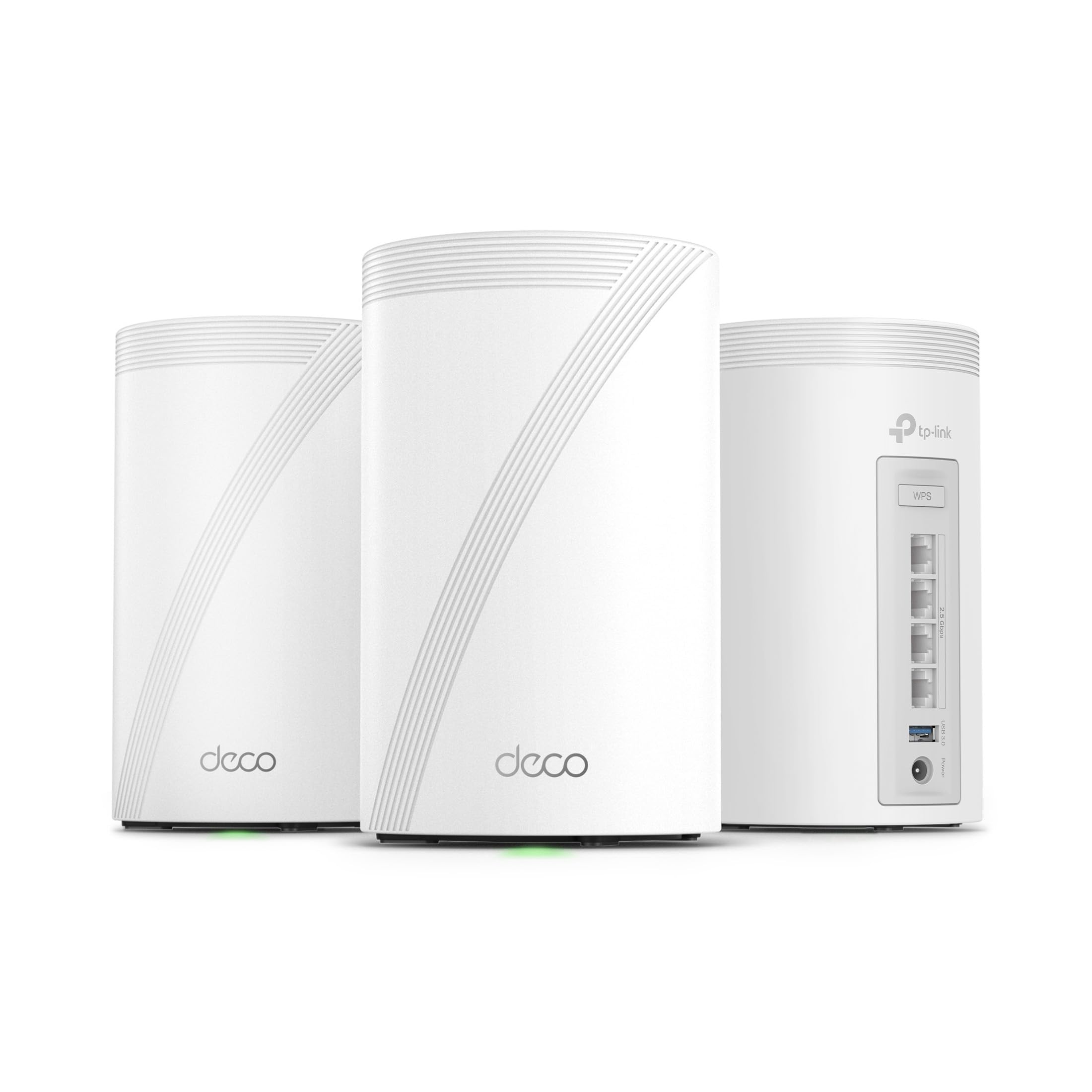
Type: Whole-home mesh WiFi system
Standard: Tri-band WiFi 7 (BE10000)
Coverage: Up to 7,600 sq ft
Ports: 4 x 2.5G ports, wired backhaul
Antennas: 4 x smart internal antennas
Features: VPN, HomeShield, AI-Roaming
Pack: 3-pack
Check the current price on Amazon
The Deco 7 Pro BE63 is the strongest all-rounder for a large brick house, largely because of its four 2.5G ports and explicit wired backhaul support. Running Ethernet between nodes is the single most effective answer to solid masonry walls, and this system is built to take advantage of it. Tri-band operation keeps the wireless backhaul separate from client traffic, so the far nodes hold their speed better than dual-band designs. AI-Roaming and HomeShield add sensible device-handoff and network-security features.
This pick suits large households with multi-Gig broadband and a willingness to cable at least one node. It also suits buyers who want WiFi 7 headroom without jumping to the most expensive tier. The trade-off is that the 7,600 sq ft figure assumes clean, open conditions — in a dense brick layout, buyers should expect real coverage to fall well short of the headline number and plan a wired backhaul accordingly.
NETGEAR Orbi 770 Series WiFi 7 Mesh System (3 Pack)

Type: Whole-home mesh WiFi system
Standard: Tri-band WiFi 7
Coverage: Up to 8,000 sq ft
Speed: Up to 11 Gbps
Capacity: Up to 100 devices
Ports: 2.5 Gig port
Pack: Router + 2 satellite extenders
Check the current price on Amazon
The Orbi 770 is the premium pick, aimed at the largest brick homes and the busiest networks. Tri-band WiFi 7 with an 11 Gbps rating and support for 100 devices puts it at the top of this group on raw capability, and the dedicated backhaul band helps satellites stay fast even when walls are working against them. The 2.5 Gig port keeps pace with fast broadband, and Orbi’s satellite design is well suited to spreading coverage across floors.
This system suits large families with many connected devices, heavy streaming, and a big brick property where one or two nodes will sit far from the router. It also suits buyers who want to buy once and not revisit the decision for years. The trade-off is price: the premium tier buys capability many households will never saturate, and a smaller home on an average broadband plan would be overpaying for headroom it cannot use.
Before You Buy
- Wall construction: Solid brick attenuates signal far more than drywall, so plan for more nodes than the headline coverage figure suggests, or budget for a wired backhaul.
- Wired backhaul: Ethernet between nodes is the most reliable fix for masonry walls. Check that the system’s ports support it before buying.
- House size: Match coverage to the real footprint, not the advertised maximum — brick layouts reduce effective range considerably.
- Broadband speed: A WiFi 7 system is wasted on a slow plan. Match the router’s port speed to what the ISP actually delivers.
- Device count: Count phones, laptops, TVs, speakers, and smart-home gear. The device capacity rating matters more in a busy household.
- Node placement: Nodes need power and, ideally, line of sight through doorways. Wall-plug satellites help where shelf space is short.
- Future-proofing: WiFi 6 is fine for most buyers today; WiFi 7 makes more sense for anyone planning a multi-Gig plan or a long ownership window.
Frequently Asked Questions
-
Will a mesh system work through solid brick walls?
Yes, but with caveats. Mesh nodes relay signal around obstacles rather than through them, so placing nodes in doorways and hallways — and wiring them together where possible — makes a large difference in a brick house. -
How many mesh nodes does a brick house need?
More than the advertised coverage suggests. A three-pack is a reasonable starting point for a typical brick home, with an extra node added if a far room still struggles. -
Is wired backhaul worth it with brick walls?
It is the single most effective upgrade. Ethernet between nodes removes the wall problem from the equation entirely and keeps speeds high on the far satellites. -
Is WiFi 7 necessary, or is WiFi 6 enough?
WiFi 6 is enough for most households on standard broadband. WiFi 7 makes sense for multi-Gig plans, very busy networks, or buyers who want the system to last many years. -
Can a wall-plug extender replace a full mesh node?
For a single dead zone in a smaller home, yes. For whole-home coverage across multiple brick-walled rooms, a full mesh system with several nodes performs better. -
Does a mesh system need to replace the existing router?
Most mesh systems, including the picks here, replace the router entirely rather than sitting behind it. That simplifies the network and avoids double NAT issues.
Bottom Line
For most brick-walled homes, the TP-Link Deco 7 Pro BE63 three-pack is the best mesh system for a house with solid brick internal walls: its four 2.5G ports and wired backhaul support give buyers the one tool that genuinely beats masonry, and tri-band WiFi 7 keeps the far nodes fast. Buyers on a tighter budget should look at the Deco X55, while the Orbi 770 is the choice for very large homes with heavy device loads. Check the Deco 7 Pro price on Amazon to see today’s deal.
