Why there are Amazon links here: Brave Review is paid a commission for qualifying Amazon purchases made through the links below. Your price does not change, and using our links is entirely optional. How this works
EnginStar Solar Generator vs EGO Power+ PAD5000: Power for the Campground or the Tailgate
The EnginStar Solar Generator and the EGO Power+ PAD5000 are two different answers to the same question: how to run a few small appliances away from a wall outlet. The EnginStar is a self-contained battery power station with its own cells and solar input; the EGO is an inverter that runs off the brand’s own battery packs, which are sold separately. This comparison sets the two side by side, shows which one fits which buyer, and points to the one detail that settles most decisions.
The overview below is the short version. Readers who want the reasoning can keep going.
EnginStar Solar Generator vs EGO Power+ PAD5000 at a Glance
| Product | Key Spec | Best Use | Price Tier |
|---|---|---|---|
| EnginStar Solar Generator | 300W output, 296Wh lithium battery, two 110V pure sine wave AC outlets | Camping, road trips, RV trips, blackout backup | Budget |
| EGO Power+ PAD5000 | 400W portable inverter, quiet, battery and charger not included | Anyone already invested in EGO’s battery platform | Budget to mid |
The EnginStar is the cheaper and more complete package in the sense that it arrives ready to use. The EGO costs more up front for a unit that cannot power anything until a battery is bought, but it runs on packs a buyer may already own. That single fact — whether EGO batteries are already in the garage — matters more than any spec below.
EnginStar Solar Generator
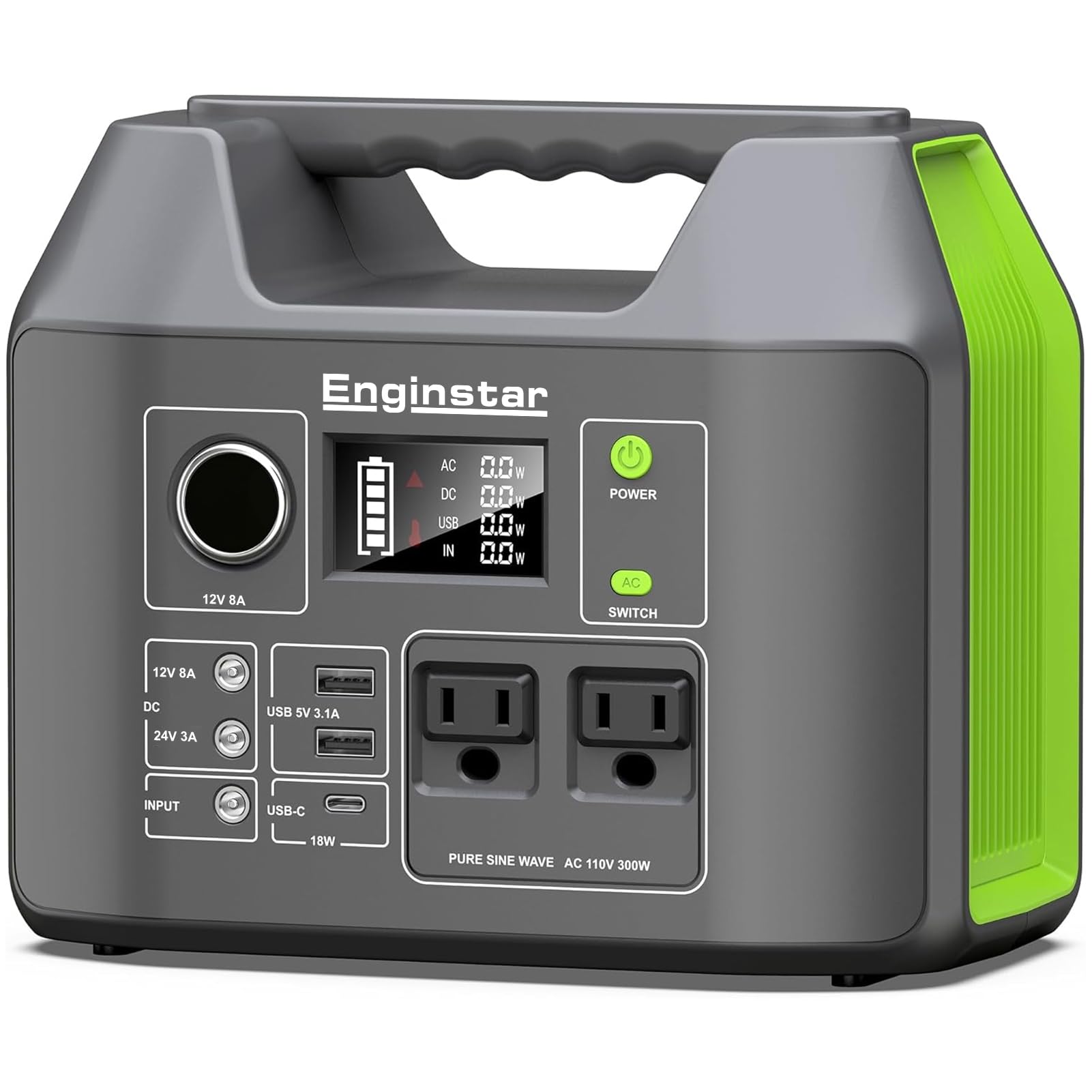
Output: 300W continuous
Battery Capacity: 296Wh lithium
Capacity in mAh: 80,000mAh
AC Outlets: Two 110V pure sine wave
Charging: Solar panel compatible
Intended Use: Camping, road trips, RV, blackout backup
The EnginStar is a sealed, self-contained power station. Its 296Wh lithium battery is built in, and the 300W inverter feeds two 110V pure sine wave AC outlets — the clean waveform that laptops, fans, lights and small electronics expect. Because the cells are internal, the unit works straight out of the box: charge it from a wall outlet or a solar panel, then carry it to wherever the power is needed. The 80,000mAh figure is the same capacity expressed the way phone-battery shoppers think about it, and it hints at the realistic use case: a weekend of small loads rather than a whole-house backup.
The 300W ceiling is the number that should drive the buying decision. It comfortably covers lights, a laptop, a phone, a fan, a small television or a portable fridge with a modest draw, but it will not start a full-size refrigerator, a space heater, a microwave or any tool with a heavy startup surge. Buyers planning to run those appliances need a much larger and more expensive class of power station. The EnginStar is the entry rung, and it is honest about that.
Solar charging is the headline feature, and it is the reason this unit suits campers and RV owners who spend days off-grid. A folding panel tops the battery back up during daylight, which stretches a weekend trip without a wall outlet. The trade-off is that solar input is slow relative to the wall, so a full recharge from the sun takes patience and good weather. Buyers who need power back in an hour should plan on the wall charger.
Trade-off: The 300W output cap rules out heating appliances and anything with a big startup surge, and the built-in battery cannot be swapped or upgraded when it ages.
Check the EnginStar Solar Generator on Amazon
EGO Power+ PAD5000

Output: 400W
Type: Portable inverter
Noise: Quiet operation
Battery: Not included
Charger: Not included
Platform: EGO Power+ battery system
Model: PAD5000
The EGO PAD5000 is a portable inverter, not a power station. It has no cells of its own: it takes an EGO Power+ battery pack and turns that pack’s DC current into usable AC power at up to 400W. That makes it the lighter, more modular option for anyone who already owns EGO yard tools and has packs sitting in the garage. A spare battery becomes a portable outlet, and the inverter itself is small enough to toss in a truck bed or a gear bag.
The 400W rating edges out the EnginStar on paper, and the quiet operation is a genuine advantage at a campsite or a tailgate where a gas generator would draw complaints. Inverter output is clean and stable, so sensitive electronics are safe. The device is also the more flexible long-term buy for a household already on the EGO platform, because adding runtime means adding batteries rather than replacing the whole unit — a spare pack is useful for the mower on Monday and the campsite on Saturday.
The catch is written into the product name, and it is the biggest difference between these two products. Battery and charger are not included, so the real cost of the EGO is the inverter plus at least one EGO battery and a charger if the buyer has neither. A reader starting from zero will spend meaningfully more than the sticker suggests and still need to manage a separate charging routine. Buyers with no EGO tools should price the whole kit before deciding, because the EnginStar’s all-in package is likely cheaper at that point.
Trade-off: With no battery in the box, the PAD5000 is useless until an EGO pack and charger are added, so the true cost depends entirely on what is already in the garage.
Check the EGO Power+ PAD5000 on Amazon
Side-by-Side: What Actually Separates Them
The table below lines up the differences that matter, with the verdict each one carries.
| Dimension | EnginStar Solar Generator | EGO Power+ PAD5000 | Edge |
|---|---|---|---|
| Power source | Built-in 296Wh lithium battery | EGO Power+ battery pack, sold separately | Depends on existing batteries |
| Output | 300W | 400W | EGO, narrowly |
| AC outlets | Two 110V pure sine wave | Inverter AC output | EnginStar, by count |
| Solar charging | Supported | Not a solar unit | EnginStar |
| Ready out of the box | Yes | No — battery and charger required | EnginStar |
| Runtime flexibility | Fixed internal battery | Swap packs to extend runtime | EGO |
| Noise | Quiet, no fuel | Quiet, no fuel | Tie |
| Best owner | Camper or RV user starting fresh | Household already on the EGO platform | — |
Read the table by column, not by row count. The EnginStar wins on completeness: it is a single purchase that works immediately, accepts solar, and offers two AC outlets for sharing a laptop and a lamp. That package is why it lands as the budget pick for a first-time power-station buyer.
The EGO wins on modularity and raw output. A 400W ceiling is not a huge step up, but it is a step, and the ability to carry three charged packs instead of one sealed battery is a real advantage for a tailgate that runs all afternoon. The unit is also the smarter buy for a household already deep in EGO’s cordless lineup, where batteries and chargers are a sunk cost rather than a new one.
Neither is a whole-home backup solution, and neither will run a heater, a microwave or a big fridge. Both are quiet, fuel-free ways to keep phones, lights, laptops and small appliances alive for a day or a weekend. The decision is less about watts than about what is already in the garage and whether the buyer wants one box or a system.
Which Should You Buy?
Choose the EnginStar Solar Generator if: the buyer wants one purchase that works immediately, plans to camp or RV off-grid and wants solar charging, needs two AC outlets for small devices, or is shopping on the tightest budget. It is the simpler, more self-contained answer.
Choose the EGO Power+ PAD5000 if: the household already owns EGO Power+ batteries and a charger, values the slightly higher 400W output, or wants the flexibility to swap packs and extend runtime without buying a new unit. It is the better system buy for an existing EGO owner.
Frequently Asked Questions
-
Can the EnginStar Solar Generator run a refrigerator?
No. The 300W output is sized for lights, laptops, fans, phones and small electronics. A full-size refrigerator draws far more, especially at startup, and needs a much larger power station. -
Does the EGO PAD5000 come with a battery?
No. The product is the inverter only — battery and charger are not included. It cannot power anything until an EGO Power+ pack is added. -
Which one is quieter?
Both are quiet. Neither burns fuel, so there is no engine noise; the EGO is explicitly marketed as quiet, and the EnginStar is a battery station with no moving parts to hear. -
Can the EGO PAD5000 be charged with a solar panel?
It is not a solar unit. It runs from EGO battery packs, so solar charging would depend on the separate EGO charging ecosystem rather than a panel plugged into the inverter. -
Which has more power, the EnginStar or the EGO?
The EGO is rated at 400W against the EnginStar’s 300W. The gap is modest and both remain small-load devices; neither is built for heating appliances. -
Is the EnginStar a good blackout backup?
It is a reasonable light-duty backup for phones, lights, a laptop and a fan during a short outage. It is not sized to keep a home’s major appliances running. -
Can two people share the EnginStar at a campsite?
Yes. It has two 110V pure sine wave AC outlets, so two small devices can run at once, within the 300W total. -
Which is the better first power station?
For a buyer starting from scratch, the EnginStar is the more complete first purchase because it includes the battery and works out of the box. The EGO makes more sense as an add-on for someone already on its battery platform.
Bottom Line
For most first-time buyers, the EnginStar Solar Generator is the pick: it arrives complete, accepts solar, and covers the small-load jobs a portable station is actually for at the lower price. The EGO Power+ PAD5000 is the smarter buy only for a household already stocked with EGO batteries — for that buyer, the modular runtime and slightly higher output justify the add-on cost.