Why there are Amazon links here: Brave Review is paid a commission for qualifying Amazon purchases made through the links below. Your price does not change, and using our links is entirely optional. How this works
Mifaso Outlet Extender vs Geeni Smart Surge Protector: One Decides It
The Mifaso outlet extender and the Geeni smart surge protector are both answers to a crowded wall socket, but they solve it in opposite ways. The Mifaso is a plug-in wall expander with a night light and a small shelf, built for one outlet and no app. The Geeni is a corded eight-outlet strip with six smart outlets controlled by Wi-Fi and voice, built for a desk or media corner.
The decision comes down to one question: does the buyer want a fixed wall unit that just works, or a networked strip that can be scheduled and switched by voice? The comparison below works through that difference dimension by dimension, then names a pick for each type of household.
Mifaso Wide Outlet Splitter
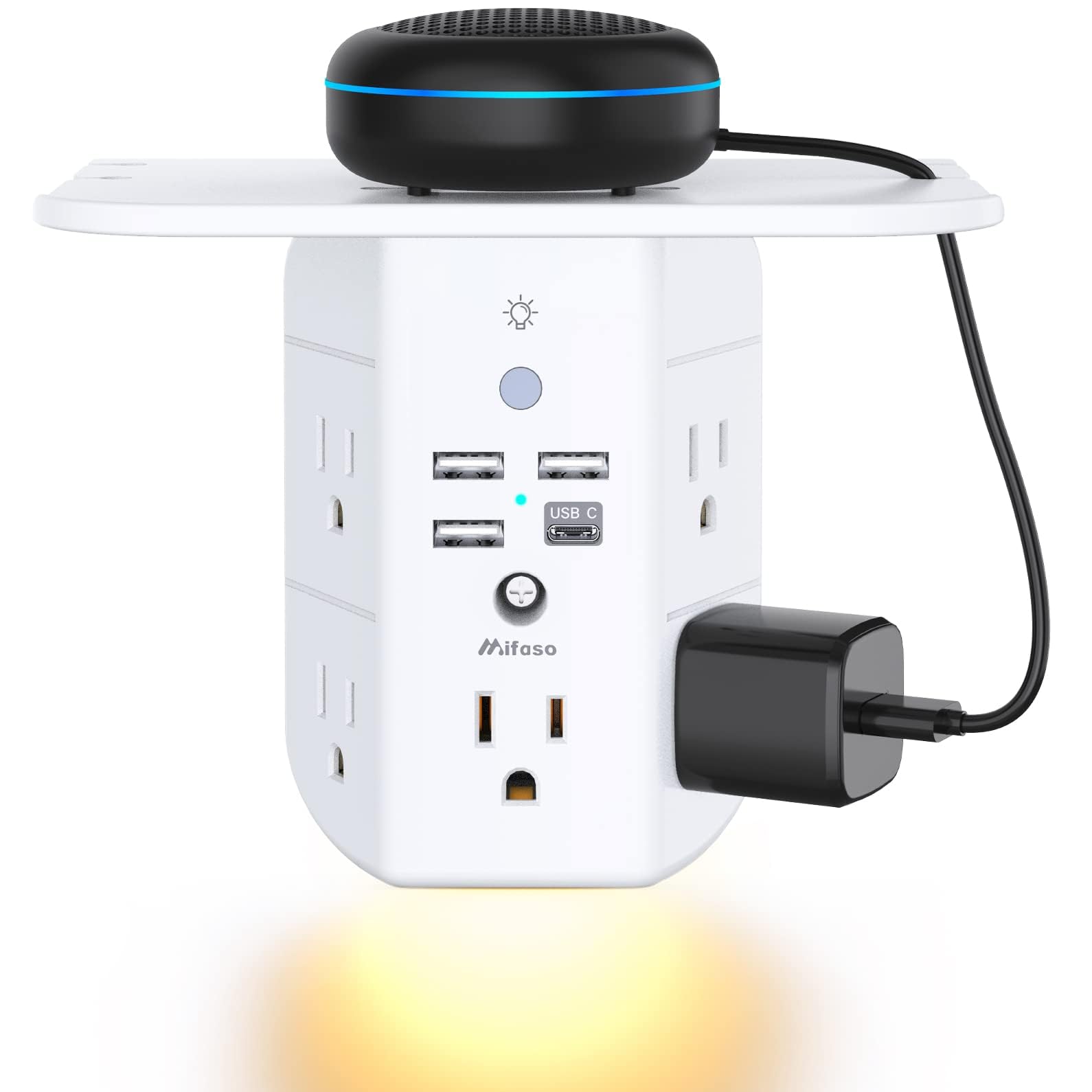
Type: Plug-in wall outlet expander
Outlets: Wide-spaced AC outlets plus 4 USB ports
Surge Protection: 1800 joules
Extras: Built-in shelf and night light
Mounting: Plugs directly into a wall receptacle
Best Suited To: Dorms, RVs, kitchens, and single-outlet rooms
The Mifaso takes the outlet that is already in the wall and multiplies it without adding a cord to trip over. Its wide spacing is the detail that matters most in practice: bulky power bricks and wall warts go in without covering the neighboring socket, which is the usual failure of cheap splitters. The four USB ports mean phones, tablets and earbuds charge without borrowing a brick at all.
The 1800-joule rating is the higher of the two products here, and for a plug-in unit that lives on one wall it is a sensible amount of headroom. The shelf and night light are the features that push it past a plain splitter — a phone can sit on the shelf overnight while it charges, and the light makes the unit findable in a dark hallway or hotel-style RV bedroom.
Trade-off: Because it plugs straight into the receptacle, the Mifaso hangs off the wall and carries no cord, so it cannot reach a desk across the room or serve equipment that sits on the floor.
Check the Mifaso outlet extender on Amazon
Geeni Smart Surge Protector

Type: Corded smart surge protector strip
Outlets: 8 total — 6 smart, 2 always-on
Smart Control: Wi-Fi with voice control, no hub required
Surge Protection: 1200 joules
Cord: 6 ft.
Color: Black
The Geeni is a different category of object. Six of its eight outlets are individually switchable over Wi-Fi, which means lamps, fans, a TV and a charger can each be turned on or off from a phone or by voice, and put on schedules. The two always-on outlets are the thoughtful part: a router or a smart speaker needs constant power, and those two sockets guarantee it stays on no matter what happens in the app.
The 6-foot cord is what separates it from a wall unit — the strip can sit on a desk, behind a TV stand, or under a workbench while the plug reaches the wall. At 1200 joules the protection is lower than the Mifaso’s, but still meaningful for consumer electronics on a strip. No hub is required, which keeps the setup to the app and the home Wi-Fi network.
Trade-off: The Geeni depends on a working Wi-Fi network and an app account to deliver its main feature, so a router outage or a changed password turns six smart outlets into ordinary ones until it is reconnected.
Check the Geeni smart surge protector on Amazon
Mifaso vs Geeni: Side-by-Side Comparison
| Feature | Mifaso Outlet Extender | Geeni Smart Surge Protector |
|---|---|---|
| Form Factor | Plug-in wall expander | Corded strip, 6 ft. cord |
| Total Outlets | Wide-spaced AC outlets + 4 USB | 8 AC outlets |
| Smart Outlets | None | 6 switchable, 2 always-on |
| Surge Rating | 1800 joules | 1200 joules |
| App / Voice Control | No | Yes, Wi-Fi, no hub |
| Extras | Shelf and night light | Always-on outlets for router |
| Best Room | Dorm, RV, kitchen, hallway | Desk, media center, home office |
| Price Tier | Budget | Mid-range |
How the Two Differ
Placement and Reach
The single biggest divider is where each unit can live. The Mifaso occupies the wall receptacle it plugs into, so it serves exactly one spot and serves it well — a nightstand, a kitchen counter, an RV wall. The Geeni brings its own 6 feet of cord, so the strip can sit where the devices are and only the plug needs a wall. Buyers who need power at the far end of a desk should stop reading the Mifaso column here.
Smart Control Against Zero Setup
The Geeni’s six smart outlets are its reason to exist. Scheduling a lamp, killing standby power to a TV at night, or switching a fan by voice are all things the Mifaso cannot do at any price. The counterweight is setup and dependence: an app, an account, a 2.4 GHz network and a working router. The Mifaso has no pairing step, no login and no failure mode beyond the wall switch.
Surge Protection
The Mifaso carries the higher joule rating at 1800 against the Geeni’s 1200. That does not make the Mifaso the safer strip overall — joule ratings describe how much energy a unit can absorb before it gives out, and both figures are in normal consumer territory. The point is that the wall unit does not give up protection to be small, which is not always true of plug-in splitters.
Physical Features and Daily Use
The Mifaso’s shelf and night light are small conveniences that get used every day: a phone rests on the shelf, the light guides a late-night trip to the bathroom. The Geeni’s equivalent daily feature is the pair of always-on outlets, which solve a real problem — smart strips that switch everything off are a nuisance when the router is plugged into one of them.
USB Charging Against Outlet Count
Four USB ports on the Mifaso cover phones, earbuds and tablets without occupying a single AC socket. The Geeni has no USB ports but offers eight AC outlets, six of them smart. A household with mostly USB-C devices will feel the Mifaso’s advantage; a household with lamps, monitors and appliances will feel the Geeni’s.
Which Should You Buy?
Choose the Mifaso outlet extender if the problem is one crowded wall socket and the fix needs to be invisible. It suits dorm rooms, RVs, kitchens, hallways and guest rooms, and it suits anyone who does not want another app. Buyers who charge mostly by USB and want a night light built in get the most from it.
Choose the Geeni smart surge protector if the devices need to be switched, scheduled or voice-controlled, or if the power needs to reach across a desk. It suits a media center, a home office or a bedroom lamp setup, and it suits a household already comfortable running smart-home apps.
Buyers who want both — a wall expander and app control — are looking at the wrong pair. These two products are alternatives, not upgrades of each other.
Frequently Asked Questions
-
Is the Mifaso outlet extender a surge protector?
Yes. The product name lists an 1800J surge protector rating, so it does double duty as a wall expander and a surge device for whatever is plugged into it. -
Does the Geeni smart surge protector need a hub?
No. The product name states no hub is required, so the strip connects to the home Wi-Fi network directly and is controlled through the app or by voice. -
Can the Geeni strip turn off every outlet at once?
No. Six outlets are smart and two are always-on, so devices that need constant power — a router, for example — can be plugged into the always-on pair and stay running. -
Which one has better surge protection?
The Mifaso carries the higher rating at 1800 joules against the Geeni’s 1200. Both are ordinary consumer ratings, but the wall unit has more headroom on paper. -
Can the Mifaso be controlled by a phone?
No. It is a passive plug-in unit with no Wi-Fi or app control, which is also why it needs no setup or account. -
Does the Geeni strip have USB ports?
The product name does not list USB ports, so a buyer charging by USB should plan on using the Mifaso or adding a separate charger. -
Which one is better for a dorm room?
The Mifaso fits a dorm better in most cases: it plugs into the wall, adds a shelf and a night light, and needs no network or account to work. -
Which one is better for a home office desk?
The Geeni, because the 6-foot cord reaches the desk and the smart outlets can switch a monitor lamp or fan on a schedule.
Bottom Line
The Mifaso outlet extender is the pick for the common case: one crowded wall outlet, a phone that needs charging, and no interest in another app. It is the simpler product, it carries the higher surge rating, and its shelf and night light earn their place every night. Buyers who need scheduling, voice control or reach across a room should take the Geeni instead — but for the reader who just wants the wall socket fixed, the Mifaso outlet extender is the one to check the price on.