Why there are Amazon links here: Brave Review is paid a commission for qualifying Amazon purchases made through the links below. Your price does not change, and using our links is entirely optional. How this works
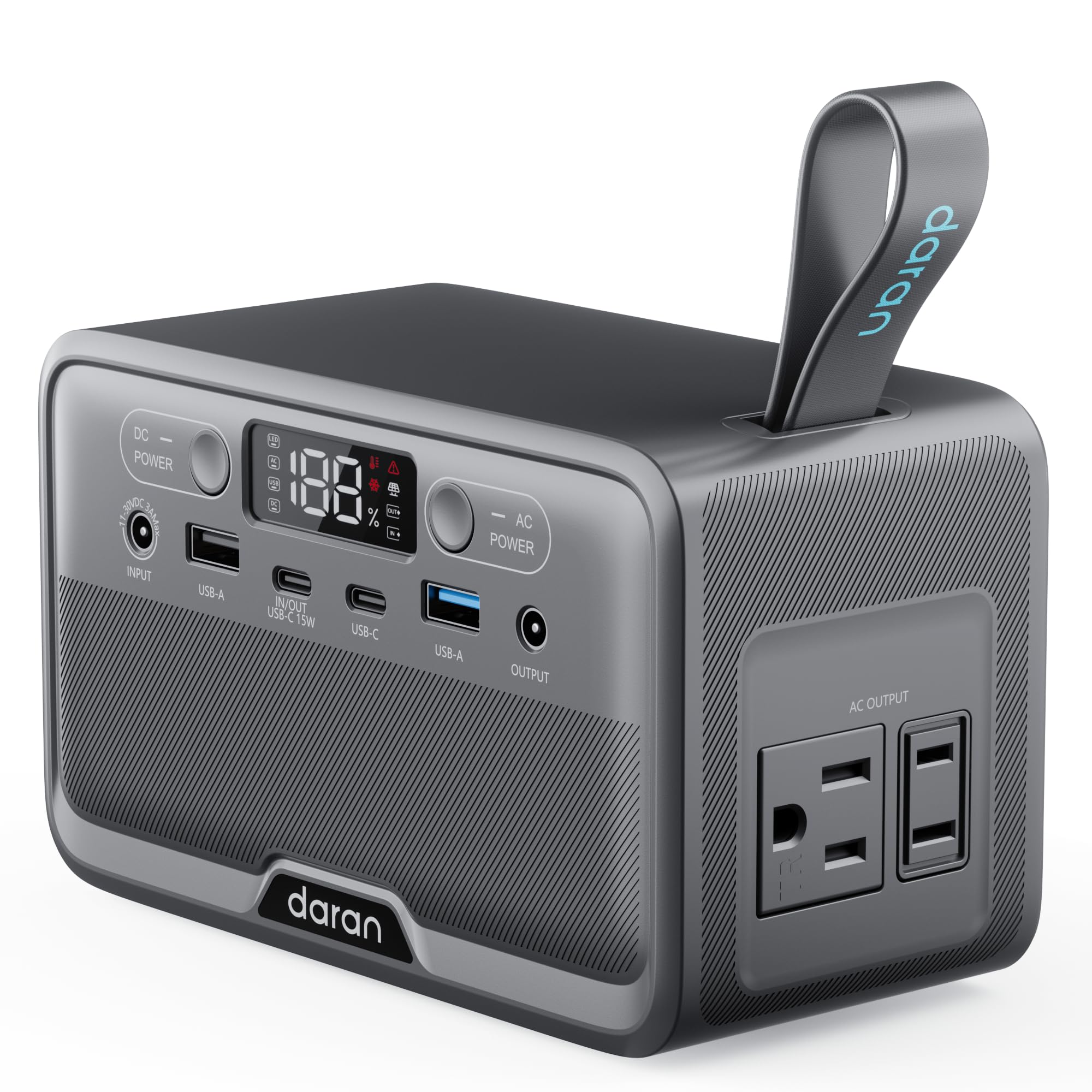
Daran Portable Power Station 89.6Wh LiFePO4 Battery: Pocket Power for Weekend Trips
The Daran portable power station 89.6Wh is a small, battery-bank-style power station built around a LiFePO4 battery and a single AC outlet. It suits campers, commuters and emergency-prep buyers who need to top up a laptop or phone away from a wall socket — not people planning to run appliances. This review covers what the unit is built to do, where its 100W ceiling bites, and who should spend more on a larger station instead.
Features and Specifications
The product name carries most of what matters here. The table below lists only what the listing actually states.
| Attribute | Value |
|---|---|
| Capacity | 89.6Wh |
| Battery chemistry | LiFePO4 |
| AC output | 100W continuous, 200W peak |
| Output types | AC outlets, PD fast charging |
| Form factor | Portable power bank / small generator |
| Solar input | Solar panel optional (sold separately) |
| Intended use | Home backup, laptop, camping |
| Charging | PD fast charging |
Capacity: 89.6Wh — roughly enough for a laptop charge or several phone top-ups.
Battery chemistry: LiFePO4, the longer-life lithium variant.
AC output: 100W continuous, 200W peak.
Charging: PD fast charging supported.
Solar: compatible with an optional solar panel, sold separately.
The headline figure is the capacity. At 89.6Wh, this unit sits in the same energy class as a large power bank rather than a camping generator, and that shapes everything else about it. The LiFePO4 chemistry is the more interesting detail: it is the battery type that has largely displaced older lithium-ion packs in this category because it degrades more slowly and holds up better to being cycled often.
The 100W AC output is the number that decides whether the unit is useful for a given task. It is enough for a laptop charger, a camera battery dock, a fan or a light. It is not enough for a kettle, a hot plate, a space heater or anything with a heating element or a compressor motor. The 200W peak rating covers brief startup surges from small devices, not sustained loads above the continuous figure.
Build and Design
This is a compact, carry-friendly unit — the kind of thing that lives in a backpack or a car glovebox rather than a garage shelf. The solar panel is sold separately, which is worth knowing before checkout: the station accepts solar input but does not ship with a panel, so anyone planning to recharge off-grid needs to budget for that as a second purchase.
The trade-off in a unit this size is always the same. Shrinking the enclosure to something pocketable means fewer ports, a smaller inverter and less thermal headroom than a full-size station. Buyers who want to run a laptop and charge two phones at once will find the port count tight; buyers who want a single device topped up on the move will not notice.
Trade-off: The small enclosure and single-outlet design keep it packable, but the port count and 100W ceiling mean it cannot serve as a household backup for anything beyond phones and laptops.
Capacity and Battery
LiFePO4 is the reason this unit is worth a look at its price tier. The chemistry is more tolerant of deep discharge and frequent cycling than standard lithium-ion, which matters for a device that may sit in a drawer for months and then get used hard on a camping weekend. Buyers who plan to cycle a station regularly — commuting, weekend trips, tailgates — get more usable life out of this chemistry than out of a cheaper pack.
What 89.6Wh actually buys depends entirely on the load. A phone charges several times over. A laptop gets roughly one full charge, sometimes less if it is a large model with a thirsty charger. A tablet or a camera gets a comfortable top-up. Anything that heats or cools is out of reach.
The honest framing is that this is a phone-and-laptop station, not a fridge station. Buyers comparing it against a 300Wh or 500Wh unit are not comparing like with like — they are comparing a packable day-trip accessory against a car-camping appliance.
Power Output and Charging
The 100W continuous / 200W peak AC output covers the small-device tier cleanly. Laptops, drones, camera gear, lights and fans all sit comfortably under the continuous rating. The peak figure handles the brief inrush current some chargers and small motors draw at startup, which is the difference between a station that trips and one that does not.
PD fast charging is the practical feature most buyers will use daily. It lets the station charge a compatible phone or laptop over USB-C at a useful rate rather than the slow trickle of older USB-A ports. For a commuter or a student, that is the main use case — the AC outlet is the backup, not the headline.
Recharging is where the solar-optional note matters. The unit can take solar input, but the panel is a separate purchase, and small folding panels charge a battery this size slowly. Buyers planning to rely on solar should expect to pair it with a panel sized for the job and treat solar as a top-up rather than a primary source.
Trade-off: The 100W ceiling rules out anything with a heating element or compressor, so the AC outlet is a laptop-and-gadget port rather than a true appliance outlet.
Maintenance and Longevity
LiFePO4 batteries reward good habits. Storing the unit partly charged rather than fully drained, keeping it out of extreme heat, and topping it up every few months all extend its working life. The chemistry is forgiving compared with older lithium packs, but it is not immune to being left flat for a year in a hot car.
The solar-optional design also means the station is only as good as the charging plan behind it. Buyers who charge from a wall before a trip get the most out of it. Buyers who expect to arrive at a campsite empty and recharge from a small panel will find the process slow.
For a unit at this price, the sensible expectation is a device that handles daily small-device charging for several years with reasonable care, rather than a whole-home backup that runs for a decade.
Who It Suits and Who It Doesn’t
This station suits commuters, students, weekend campers and emergency-prep buyers who want a compact, maintenance-light battery for phones, laptops and small gadgets. It also suits buyers who specifically want LiFePO4 chemistry at a budget-tier price and are willing to accept a small capacity to get it.
It does not suit anyone planning to run appliances, power a CPAP machine overnight, keep a fridge cold, or run a heater. It also does not suit buyers who want a station with several AC outlets and a high continuous wattage — those buyers need to step up to a larger class of unit. And it does not suit anyone who expects a solar panel in the box.
FAQ
-
What can a portable power station 89.6Wh actually run?
Phones, tablets, laptops, cameras, drones, lights and small fans. Anything with a heating element, a compressor or a motor above the continuous rating is out of scope. -
Is LiFePO4 better than lithium-ion in a power station?
For most buyers, yes. LiFePO4 degrades more slowly, tolerates frequent cycling better and is generally the safer long-term chemistry for a device that gets used often. -
How many times can this charge a laptop?
Roughly one full charge for a typical laptop, less for large models with high-wattage chargers. Phones charge several times over. -
Does it come with a solar panel?
No. The listing describes the solar panel as optional, so a panel is a separate purchase for anyone planning to recharge off-grid. -
Can it run a CPAP machine overnight?
Not reliably. A CPAP draws more over a full night than an 89.6Wh battery comfortably supplies, and the 100W ceiling limits headroom. -
Is 100W enough for a laptop charger?
For most laptops, yes. Large gaming laptops with high-wattage adapters may exceed the continuous rating and should be checked against the charger’s rated draw. -
How should the battery be stored?
Partly charged, in a cool dry place, topped up every few months. Leaving it fully drained or in a hot car shortens its life. -
Can it be charged while powering a device?
Pass-through charging is common in this category, but buyers should confirm the specific behavior for their use case rather than assume it. -
Is this a good emergency backup for a home?
For phones and a laptop during a short outage, yes. For fridges, heaters or medical devices, no — that needs a much larger station. -
Who should skip this and buy a bigger station?
Anyone who needs multiple AC outlets, sustained output above 100W, or enough capacity to run an appliance overnight.
Bottom Line
The Daran Portable Power Station 89.6Wh is the right buy for a narrow, well-defined job: keeping phones, laptops and small gadgets charged away from a wall socket, with LiFePO4 chemistry that should outlast a cheaper pack. Buyers who need appliance-level power should look at a larger station instead, but for a packable day-trip battery at a budget-tier price, this one covers the brief.
