Why there are Amazon links here: Brave Review is paid a commission for qualifying Amazon purchases made through the links below. Your price does not change, and using our links is entirely optional. How this works
Kidde Smoke Detector vs First Alert BRK 7020BSL: Hardwired or Strobe
The Kidde smoke detector vs First Alert BRK 7020BSL comparison comes down to one question: does the household need a multi-pack of interconnected alarms with sealed backup batteries, or a single alarm built to wake a hard-of-hearing sleeper with a strobe? The Kidde 20SA10 three-pack suits whole-home coverage on one circuit; the First Alert BRK 7020BSL suits a bedroom where sound alone is not enough. The sections below separate them dimension by dimension, and the bottom line names the pick for each case.
Kidde 20SA10 3-Pack
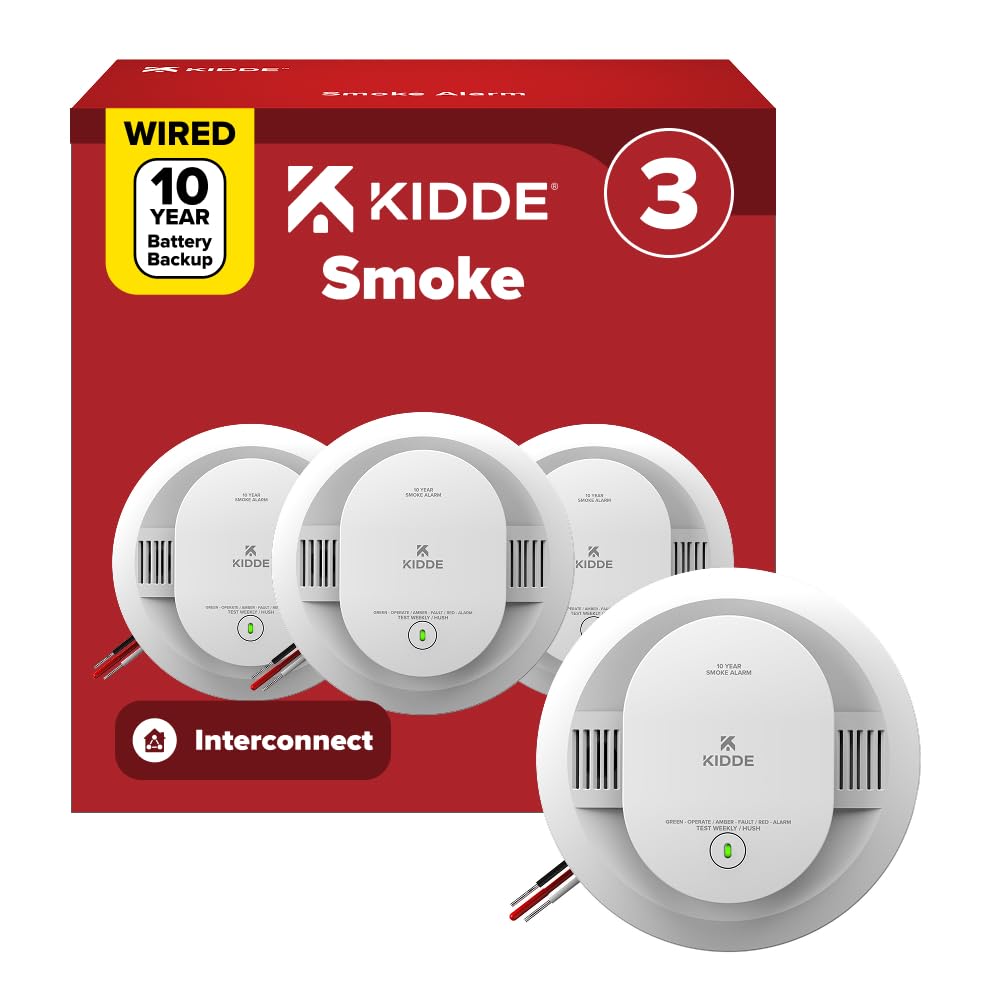
Type: Hardwired smoke detector
Power Source: Hardwired with 10-year battery backup
Interconnect: Wired interconnect capability
Battery Service: No battery replacement or low-battery chirps
Status Indicators: LED status lights
Pack Size: 3 pack
Intended Use: Homes and apartments
The Kidde 20SA10 is a hardwired alarm that draws its primary power from household wiring and keeps a sealed backup cell on board for outages. That sealed cell is the headline feature: it is rated to outlast the alarm’s service life, so the low-battery chirp that sends homeowners hunting for a nine-volt at 2 a.m. never arrives.
Wired interconnect means all three units sound together when one detects smoke, which matters on a multi-floor layout where a basement alarm is inaudible from an upstairs bedroom. LED status lights give a quick visual read on each unit without pressing a test button.
Trade-off: The three-pack only pays off if the home already has the wiring and the existing alarms are due for replacement — a buyer with one dead alarm and no interconnect circuit is paying for capacity that goes unused.
Check the current price on Amazon
First Alert BRK 7020BSL

Type: Hardwired smoke detector
Alerting: Audible alarm with LED strobe light
Intended Use: Hearing impaired households
Power Source: Hardwired
Color: White
Pack Size: Single unit
The BRK 7020BSL is a hardwired alarm that pairs its audible horn with a bright LED strobe, so a sleeping occupant who cannot hear the standard alarm still gets a visual signal. That combination is the reason this model exists; a standard alarm in the same hallway does not cover the same person.
It is sold as a single unit, which keeps the purchase simple for a one-alarm replacement in a bedroom or a hallway outside one. The white housing blends into most ceilings and wall mounts without drawing attention.
Trade-off: A single strobe alarm covers one room well but leaves the rest of the house on audible-only alerting, so a full hearing-impaired household needs several of these at a per-unit cost that adds up fast.
Check the current price on Amazon
Side-by-Side Comparison
| Feature | Kidde 20SA10 3-Pack | First Alert BRK 7020BSL |
|---|---|---|
| Type | Hardwired smoke detector | Hardwired smoke detector |
| Power source | Hardwired with 10-year battery backup | Hardwired |
| Interconnect | Wired interconnect capability | Not stated in the product name |
| Battery service | No battery replacement, no low-battery chirps | Not stated in the product name |
| Alerting | Audible alarm with LED status lights | Audible alarm with LED strobe light |
| Pack size | 3 pack | Single unit |
| Intended use | Homes and apartments | Hearing impaired households |
| Color | Not stated in the product name | White |
How the Two Alarms Differ
Coverage and Pack Size
The Kidde listing is a three-pack, and that changes the math more than any single feature. A buyer replacing alarms across a hallway, a landing and a bedroom gets all three in one order and one interconnect group.
The First Alert is one alarm. For a household that needs a single strobe unit in a bedroom, that is the right quantity; for a whole-home refresh it means buying several and paying the per-unit premium each time.
Verdict: Kidde for whole-home coverage, First Alert for a targeted single-room install.
Battery Maintenance
The sealed 10-year backup in the Kidde is the feature that separates the two most sharply in daily ownership. No replacement, and no low-battery chirp to chase — the unit either works or the LED status light tells the story.
The First Alert’s product name does not describe a backup battery arrangement, so a buyer should confirm the power details for their install before ordering. In a hardwired circuit that is usually fine; in an older home with unreliable wiring it is worth checking.
Verdict: Kidde is the lower-maintenance choice on paper.
Alerting for Hearing-Impaired Occupants
This is the dimension where the First Alert wins outright and the Kidde cannot compete. A strobe light reaches a sleeping person who cannot hear a horn, and no amount of interconnect or battery backup substitutes for that.
A household with a deaf or hard-of-hearing resident should treat the strobe as a requirement rather than a nice-to-have, and plan the alarm layout around it.
Verdict: First Alert, decisively, for any home with a hearing-impaired occupant.
Interconnect and Whole-Home Behavior
Wired interconnect means one alarm triggers all of them. In a two-story house with a basement, that is the difference between an alarm the whole family hears and one that only the nearest room hears.
The First Alert’s name does not describe interconnect capability, so a buyer planning a linked system should verify it against the specific model before committing to a mixed install.
Verdict: Kidde, for buyers who want a linked system out of the box.
Installation and Fit
Both are hardwired units, so both need an existing alarm circuit or an electrician. Neither is a battery-only swap-in for a home with no wiring in the ceiling.
The Kidde’s three-pack suits a planned replacement across several mount points at once; the First Alert suits matching an existing single mount, particularly where a strobe is needed at one specific location.
Verdict: A tie on installation effort; the difference is how many mounts the buyer is filling.
Which Should You Buy?
Choose the Kidde 20SA10 3-Pack if: the home has hardwired alarm positions that need refreshing, the goal is linked coverage across multiple rooms, and skipping battery swaps for the life of the alarm is worth paying for up front. It is also the better fit for rental properties and apartments where a landlord wants low-maintenance alarms across several units.
Choose the First Alert BRK 7020BSL if: someone in the household is deaf or hard of hearing, or sleeps too deeply for a horn to reliably wake them. The strobe is the reason to buy this model, and a buyer without that need is paying for a feature that does nothing for them.
A household that needs both — whole-home coverage and a strobe in one bedroom — can run the Kidde units across the house and put a single First Alert in the room that needs visual alerting, provided the wiring supports it.
FAQ
-
Is the Kidde 20SA10 a battery-only alarm?
No. It is a hardwired alarm with a 10-year battery backup, so it needs an existing alarm circuit but keeps working through a power outage. -
Does the First Alert BRK 7020BSL work without household wiring?
The product name describes it as hardwired, so it expects an alarm circuit rather than a battery-only mount. -
Which one is better for a deaf or hard-of-hearing resident?
The First Alert BRK 7020BSL, because of its LED strobe light. Audible alarms alone do not reliably wake someone who cannot hear them. -
Do the three Kidde alarms sound at the same time?
The units carry wired interconnect capability, which links them so one alarm triggers the others on the same circuit. -
Will the Kidde chirp when the battery runs low?
The product name states no battery replacement and no low-battery chirps, which is the point of the sealed backup cell. -
Can the two brands be mixed in one house?
Mixing is possible in principle, but interconnect compatibility between brands is not something to assume. A buyer planning a linked system should confirm compatibility before ordering. -
How many alarms does a typical home need?
Local codes set the minimum, usually one per bedroom, one outside each sleeping area and one per level. The Kidde three-pack covers a small home’s core positions; larger layouts need more units. -
Which one costs less per alarm?
The Kidde three-pack spreads its price across three units, so the per-alarm cost is lower. The First Alert is priced as a single specialized unit.
Bottom Line
For most households replacing hardwired alarms, the Kidde 20SA10 3-Pack is the pick: three interconnected units, a sealed 10-year backup and no chirping to chase. The First Alert BRK 7020BSL is the right buy only when a strobe is needed for a hearing-impaired occupant, and in that case it is not a compromise but the correct tool.
