Why there are Amazon links here: Brave Review is paid a commission for qualifying Amazon purchases made through the links below. Your price does not change, and using our links is entirely optional. How this works
EcoFlow River 2 vs AFERIY Portable Power Station 1024Wh: Capacity or Charging Speed
The EcoFlow River 2 Max 500 and the AFERIY 1024Wh sit close enough in price that the decision comes down to what a buyer actually needs to run. The EcoFlow trades battery capacity for a faster recharge and a lighter footprint, while the AFERIY doubles the stored energy and output ceiling for a modest step up in cost. This comparison breaks down the differences that matter so the choice takes a minute, not an afternoon.
EcoFlow River 2 Max 500

Battery Chemistry: LiFePO4
Battery Capacity: 499Wh
AC Output: Up to 1000W
Recharge Time: 1 hour
Solar Input: Solar panel optional
Intended Use: Outdoor camping, RVs, home use
The River 2 Max 500 is built around speed and portability. Its LiFePO4 cells are the same chemistry used across the River 2 line, chosen for a long service life and stable output over many charge cycles. The headline feature is the one-hour recharge from a wall outlet, which matters for anyone who needs the unit topped up between errands or before a trip rather than overnight.
At 499Wh, the unit covers light loads comfortably: phones, laptops, cameras, a fan, a small fridge for a stretch. The 1000W AC output handles most small appliances, though buyers running a microwave or space heater should check the draw against that ceiling before committing. The trade-off is capacity — this is a compact unit, and heavier or longer use will drain it faster than a larger station.
Trade-off: The 499Wh battery is the smallest part of this comparison, so buyers planning multi-day outages or heavy appliance use will run out of stored energy before they run out of outlets.
AFERIY Portable Power Station 1024Wh
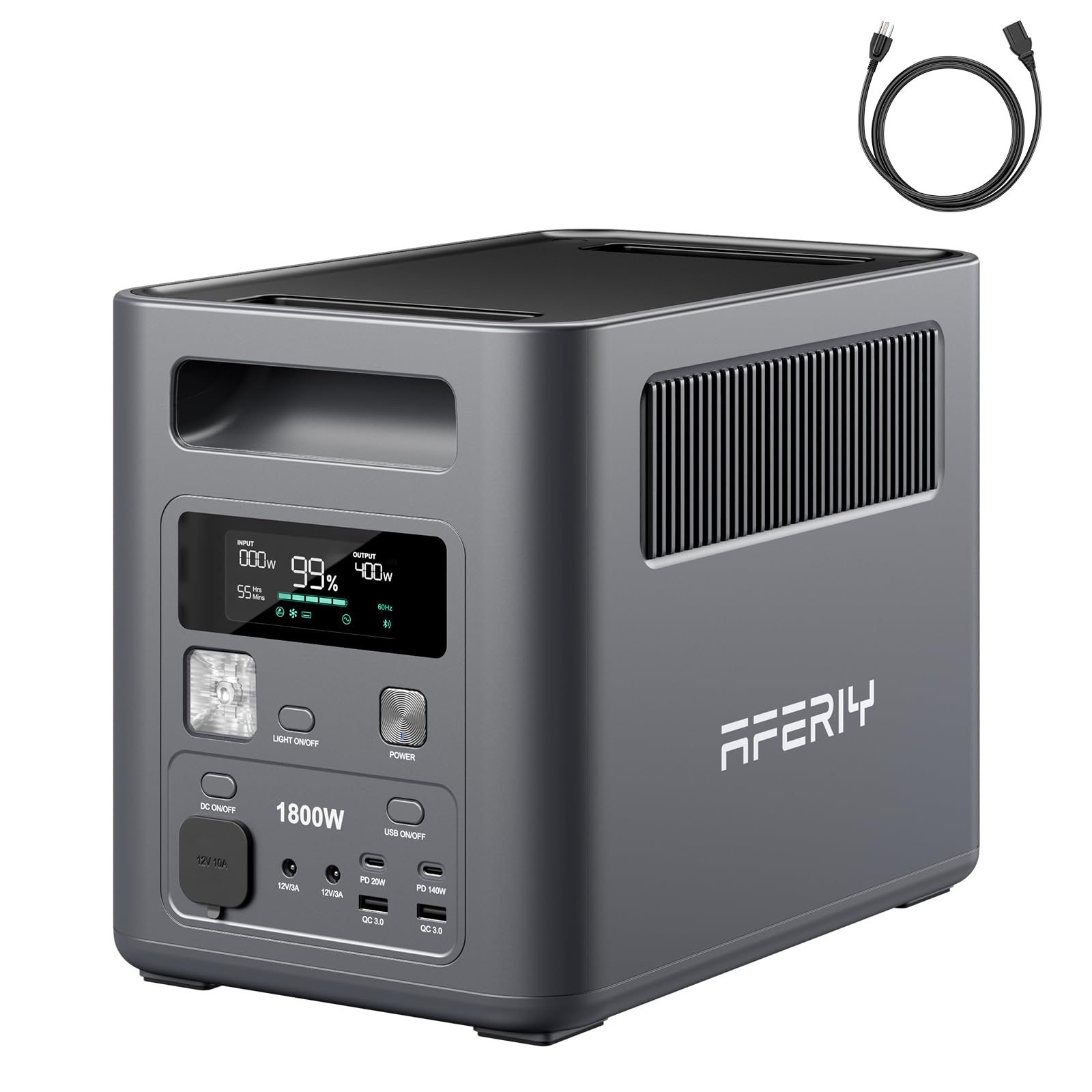
Battery Chemistry: LiFePO4
Battery Capacity: 1024Wh
AC Output: 1800W continuous, 3600W peak
Recharge: Fast recharge
Solar Input: Solar panel optional
Intended Use: Home, camping, outdoor emergencies
The AFERIY 1024Wh is the larger station of the pair, and its spec sheet reflects that. The 1024Wh LiFePO4 battery doubles the stored energy of the EcoFlow, and the 1800W continuous AC output with a 3600W peak gives it headroom for appliances the River 2 Max 500 cannot touch — a full-size fridge, a space heater, or power tools with a startup surge.
AFERIY markets the unit as compact and lightweight for its class, and the design leans toward home backup and emergency use as much as camping. Fast recharge is listed as a feature, though the brand does not publish a one-hour claim the way EcoFlow does. Buyers who want the most runtime per dollar will find the AFERIY the stronger value on paper.
Trade-off: The larger battery and higher output come with more weight and bulk than the EcoFlow, and the brand carries less market presence, which matters for anyone who wants a long track record before buying.
Side-by-Side Specifications
| Spec | EcoFlow River 2 Max 500 | AFERIY 1024Wh |
|---|---|---|
| Battery Chemistry | LiFePO4 | LiFePO4 |
| Battery Capacity | 499Wh | 1024Wh |
| AC Output | Up to 1000W | 1800W (3600W peak) |
| Recharge Time | 1 hour | Fast recharge |
| Solar Panel | Optional | Optional |
| Best For | Camping, RVs, light home use | Home backup, camping, emergencies |
| Price Tier | Budget | Mid-range |
How the Two Compare
Battery capacity. The AFERIY wins this dimension outright. At 1024Wh it stores roughly twice the energy of the EcoFlow’s 499Wh, which translates to longer runtime on every load. For a buyer planning to run a fridge overnight or keep a workspace powered through an outage, the extra capacity is the difference between finishing the job and shutting down early. The EcoFlow is the better fit only when the load is light and the trip is short.
AC output. The AFERIY again carries the higher ceiling, with 1800W continuous and a 3600W peak against the EcoFlow’s 1000W. Peak output matters for anything with a motor or compressor, since startup draw can spike well above running wattage. The EcoFlow’s 1000W handles laptops, fans, lights, and small kitchen appliances, but a buyer with a space heater or power tools will hit its limit.
Charging speed. This is where the EcoFlow earns its place. The one-hour recharge is the standout feature of the River 2 line, and for a buyer who moves the station between home and vehicle, that speed is a real convenience. The AFERIY offers fast recharge too, but without a published one-hour figure, the EcoFlow holds the edge on this dimension for anyone who values turnaround time over stored capacity.
Portability. The EcoFlow’s smaller battery makes it the lighter, more packable option. Buyers carrying a station to a campsite, a tailgate, or a job site will notice the difference. The AFERIY is described as compact for its class, but doubling the battery capacity has to add weight, and that shows up on longer carries.
Brand track record. EcoFlow is a well-established name in portable power, with a broad product line and a long public history. AFERIY is a smaller player, and while the specs are competitive, buyers who weigh brand history heavily will lean toward the EcoFlow. That is a judgement about market presence, not about the unit’s build.
Which Should You Buy?
Choose the EcoFlow River 2 Max 500 if the priority is a light, fast-recharging station for camping, RV trips, and light home use. It suits buyers who need to top up quickly between outings and who run phones, laptops, lights, and small fans rather than heavy appliances.
Choose the AFERIY 1024Wh if the priority is stored energy and output headroom. It suits homeowners building an emergency backup, campers running a fridge or heater, and anyone who needs to power tools or appliances the EcoFlow cannot carry.
FAQ
-
Which has the bigger battery, the EcoFlow River 2 or the AFERIY 1024Wh?
The AFERIY. Its 1024Wh battery stores roughly twice the energy of the EcoFlow River 2 Max 500’s 499Wh. -
Which one charges faster?
The EcoFlow carries a published one-hour recharge claim, which is the fastest figure in this comparison. The AFERIY lists fast recharge but does not publish a comparable time. -
Can the AFERIY run a refrigerator?
Its 1800W continuous output and 3600W peak give it the headroom for a full-size fridge, provided the startup surge stays within the peak rating. The EcoFlow’s 1000W ceiling makes it a better fit for a small fridge or cooler. -
Do both support solar panels?
Yes. Both units list solar panel input as optional, so either can be paired with a panel for off-grid charging. -
Which is better for camping?
The EcoFlow, on portability and recharge speed. The AFERIY is the better choice for basecamp setups where capacity matters more than weight. -
Are both batteries LiFePO4?
Yes. Both the EcoFlow River 2 Max 500 and the AFERIY 1024Wh use LiFePO4 chemistry. -
Which is the better value?
The AFERIY delivers more capacity and output for a modest price step up, which makes it the stronger value for buyers who need the power. The EcoFlow wins on speed and portability for lighter use.
Bottom Line
For most buyers weighing these two, the AFERIY Portable Power Station 1024Wh is the stronger pick: double the battery capacity and a much higher output ceiling for a small step up in price make it the more capable station for home backup and serious camping. The EcoFlow River 2 Max 500 remains the right call for buyers who prioritize a one-hour recharge and a lighter carry over stored energy.
