Why there are Amazon links here: Brave Review is paid a commission for qualifying Amazon purchases made through the links below. Your price does not change, and using our links is entirely optional. How this works
Best Mesh System for a House With a Shared Entrance
A house with a shared entrance — a duplex, a converted flat, a home split into two households, or a building where one front door leads to several living spaces — puts unusual demands on a Wi-Fi network. Coverage has to reach past the entryway into rooms that may sit behind thick shared walls, and the network has to stay manageable when more than one household depends on it. The five systems below cover that range, from a budget Wi-Fi 6 kit to a tri-band Wi-Fi 7 flagship. The overview table shows the differences at a glance; the reviews explain who each pick suits.
The Picks at a Glance
| Product | Key Spec | Best Use | Price Tier |
|---|---|---|---|
| TP-Link Deco X55 (3-Pack) | Wi-Fi 6, AX3000, 6,500 sq ft | Budget whole-home coverage | Budget |
| NETGEAR Orbi 360 Series (3-Pack) | Wi-Fi 7, dual-band, 6,000 sq ft | Entry-level Wi-Fi 7 | Mid-range |
| NETGEAR Orbi 370 Series (3-Pack) | Wi-Fi 7, up to 5 Gbps, 6,000 sq ft | Balanced speed and price | Mid-range |
| NETGEAR Orbi 770 Series (3-Pack) | Wi-Fi 7 tri-band, 8,000 sq ft | Large shared homes | Upper mid-range |
| TP-Link Deco 7 Pro BE63 (3-Pack) | Wi-Fi 7 tri-band, BE10000, 7,600 sq ft | Top performance and features | Premium |
TP-Link Deco X55 AX3000 WiFi 6 Mesh System, Deco X55(3-Pack)

Standard: Wi-Fi 6 (AX3000)
Coverage: Up to 6,500 sq ft
Units: 3-pack
Ports: 3 Gigabit ports per unit
Backhaul: Supports Ethernet backhaul
Role: Replaces a wireless router and extender
TP-Link Deco X55 AX3000 WiFi 6 Mesh System, Deco X55(3-Pack)
The Deco X55 is the value pick of the group and the only Wi-Fi 6 system here. Three units cover a stated 6,500 square feet, and each one carries three Gigabit ports, which is more wired flexibility than most mesh nodes offer at this price. It replaces both a router and an extender, so a household running a router-plus-repeater setup can consolidate onto one network name. Ethernet backhaul support matters in a shared-entrance house, because a cable run between units keeps node-to-node traffic off the airwaves.
This is the pick for a household that wants reliable coverage without paying for Wi-Fi 7 hardware the internet plan cannot use. It suits renters and smaller shared homes where the budget is the deciding factor. The caution is straightforward: Wi-Fi 6 is the older standard here, so the system will not exploit the faster Wi-Fi 7 devices that are now arriving.
Trade-off: The older Wi-Fi 6 standard and AX3000 ceiling leave less headroom for future multi-gigabit plans than the Wi-Fi 7 picks.
NETGEAR Orbi 360 Series WiFi 7 Mesh System, RBE363, 3 Pack

Standard: Wi-Fi 7, dual-band
Speed: Up to 5 Gbps
Coverage: Up to 6,000 sq ft
Devices: Up to 70
Port: 2.5 Gig port
Setup: Easy set up
Security: Security features included
NETGEAR Orbi 360 Series WiFi 7 Mesh System, RBE363, 3 Pack
The Orbi 360 is the cheapest route into Wi-Fi 7 in this lineup. It is a dual-band system rated up to 5 Gbps with a 2.5 Gig port and support for up to 70 devices, and it ships as a router plus two satellite extenders. The Orbi family is built around a dedicated backhaul in its tri-band models, but the dual-band design here keeps the cost down. NETGEAR’s setup app and bundled security features make it approachable for a household that does not want to configure much.
This system fits a shared home with a moderate device count and a mid-range internet plan. It earns its place as the low-cost Wi-Fi 7 entry point. The caution: dual-band systems share their wireless capacity between the backhaul and client devices, so heavy simultaneous use in two households can expose the limit.
Trade-off: The dual-band design gives less separation between node traffic and device traffic than the tri-band picks, which can show under heavy load.
NETGEAR Orbi 370 Series WiFi 7 Mesh System, RBE373, 3 Pack
Standard: Wi-Fi 7, dual-band
Speed: Up to 5 Gbps
Coverage: Up to 6,000 sq ft
Devices: Up to 70
Port: 2.5 Gig port
Setup: Easy set up
Security: Security features included
NETGEAR Orbi 370 Series WiFi 7 Mesh System, RBE373, 3 Pack
The Orbi 370 sits close to the 360 on paper — same 6,000 square feet, same 5 Gbps rating, same 2.5 Gig port and 70-device support — and it is the middle child of NETGEAR’s Wi-Fi 7 range. The 370 series represents the step up in the Orbi line where the hardware is tuned for steadier real-world throughput rather than raw numbers. The router-plus-two-satellite layout covers a long house well, since each satellite can be placed toward the far rooms.
Buyers who want Wi-Fi 7 from a familiar brand and expect to add more devices over the next few years will find this the sensible balance. It suits a shared home with two working households and a growing pile of connected gear. The caution is the price premium over the 360 for a very similar specification — the difference is unlikely to be visible on a modest internet plan.
Trade-off: The step up in price over the near-identical 360 is hard to justify for households on a standard broadband plan.
NETGEAR Orbi 770 Series WiFi 7 Mesh System, RBE773, 3 Pack

Standard: Wi-Fi 7, tri-band
Speed: Up to 11 Gbps
Coverage: Up to 8,000 sq ft
Devices: Up to 100
Port: 2.5 Gig port
Setup: Easy set up
Security: Security features included
NETGEAR Orbi 770 Series WiFi 7 Mesh System, RBE773, 3 Pack
The Orbi 770 is the tri-band model and the coverage leader of the NETGEAR picks, rated to 8,000 square feet and 100 devices with speeds up to 11 Gbps. Tri-band means a separate radio handles the link between router and satellites, so the shared entrance and the rooms beyond it are not competing with each other for airtime. The 2.5 Gig port keeps a fast wired connection open at the router for a NAS or a desktop.
This is the system for a large shared house — two families, a duplex with a long floor plan, or a home where the entryway splits into separate wings. It earns its place when coverage and device count both run high. The caution is size and cost: three large units need shelf or counter space at each location, and the price puts it well above the dual-band options.
Trade-off: The tri-band hardware is bulky and the most expensive NETGEAR option here, so it only pays off in a genuinely large shared home.
TP-Link Deco 7 Pro Tri-Band WiFi 7 BE10000 Whole Home Mesh System (BE63 3-Pack)
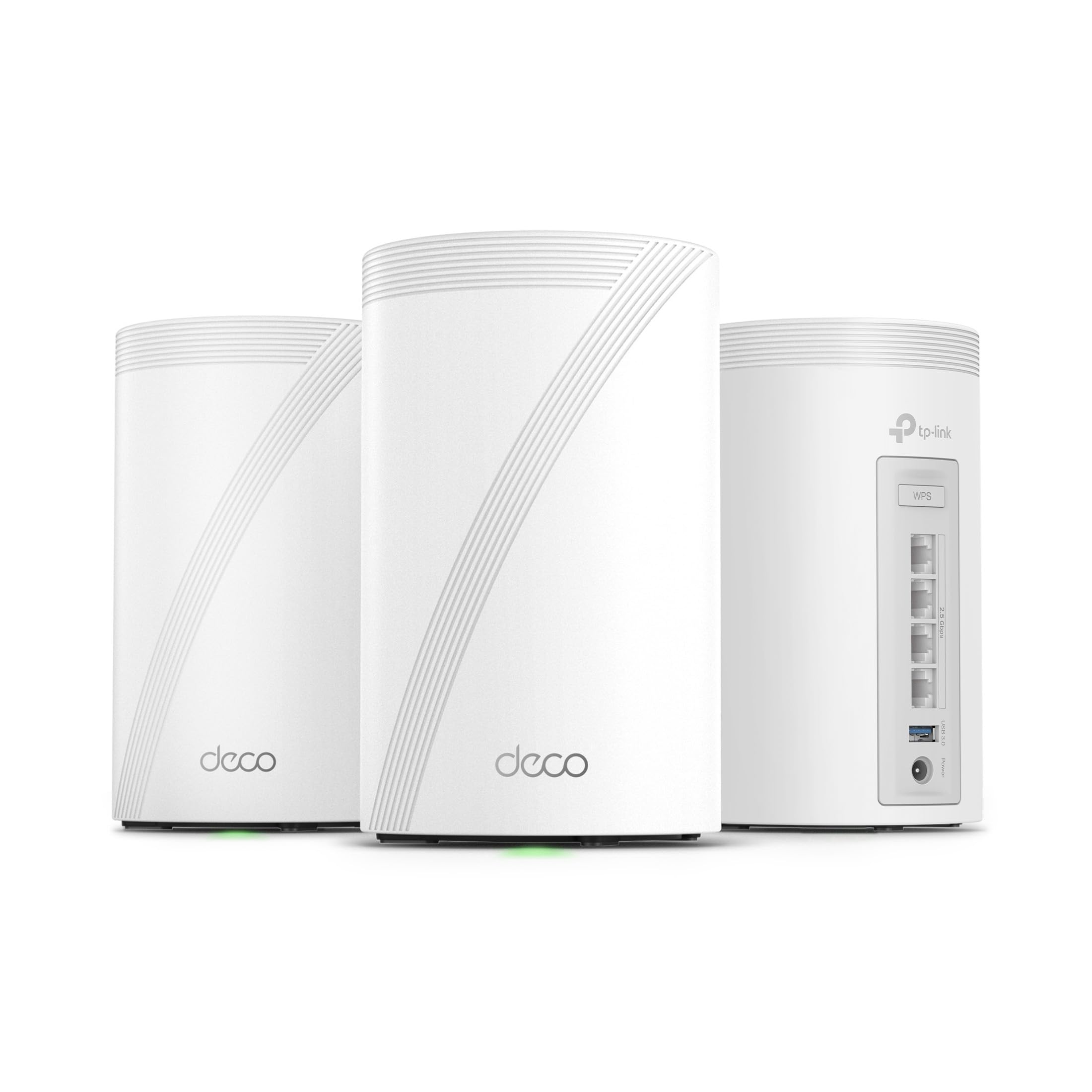
Standard: Wi-Fi 7, tri-band, BE10000
Streams: 6-stream
Ports: 4 x 2.5G ports with wired backhaul
Antennas: 4 x smart internal antennas
Coverage: Up to 7,600 sq ft
Features: VPN, HomeShield, AI-Roaming
TP-Link Deco 7 Pro Tri-Band WiFi 7 BE10000 Whole Home Mesh System (BE63 3-Pack)
The Deco 7 Pro is the flagship of this group. Four 2.5G ports per unit with wired backhaul support, four smart internal antennas, BE10000 tri-band throughput and coverage up to 7,600 square feet put it at the top of the specification sheet. HomeShield adds network-level security and parental controls, VPN support keeps remote access private, and AI-Roaming steers devices between units as they move through the house. The wired backhaul option is the standout feature for a shared entrance, because it lets each household’s traffic travel over cable between nodes rather than through the air.
This system suits a large shared home where several people work from home, stream and game at once, and where the network needs to be managed rather than just installed. It earns its place as the performance pick. The caution is that BE10000 throughput is only reachable with matching Wi-Fi 7 clients and a very fast internet plan — most households will pay for capability they cannot yet use.
Trade-off: The top-tier price and BE10000 rating are aimed at buyers with multi-gigabit plans and Wi-Fi 7 devices; others will see little benefit.
Before You Buy
- Coverage: Match the stated square footage to the whole house, not just one household’s rooms — a shared entrance often means a long or split floor plan that a single router cannot reach.
- Backhaul: Wired Ethernet backhaul is the single biggest upgrade for a shared home, since it keeps node traffic off the wireless bands. The Deco X55 and Deco 7 Pro both support it.
- Device count: Add up phones, laptops, TVs, consoles, smart speakers and doorbells across every household, then leave headroom — the 70-device and 100-device ratings here are ceilings, not targets.
- Standard: Wi-Fi 7 systems only pay off with Wi-Fi 7 devices and a fast internet plan; a Wi-Fi 6 system remains the value choice for older hardware.
- Bands: Tri-band models dedicate a radio to the backhaul and hold up better under heavy simultaneous use; dual-band models are cheaper but share capacity.
- Placement: Each unit needs a power outlet and some open space, so plan shelf or counter spots near the entrance and toward the far rooms before buying.
- Security features: Built-in parental controls and network security, such as HomeShield on the Deco 7 Pro, help when more than one household shares the same network.
Frequently Asked Questions
-
How many mesh units does a house with a shared entrance need?
Two households in a typical house usually need three units: one near the entrance where the line comes in, and two spread toward the far rooms. Larger or split floor plans may need a fourth. -
Is a mesh system better than an extender for a shared home?
Yes. A mesh system hands devices between units under one network name, while an extender creates a second network and often a dead zone at the handoff. -
Does a shared entrance hurt Wi-Fi coverage?
Shared walls, stairwells and entry corridors absorb signal. Placing a unit near the entrance and another past the dividing wall keeps both households covered. -
Do these systems support wired backhaul?
The TP-Link Deco models list Ethernet backhaul support, and the Deco 7 Pro has four 2.5G ports per unit. The NETGEAR Orbi models include a 2.5 Gig port for wired connections. -
Can two households share one mesh network safely?
Yes, with a system that offers guest networking and parental controls. HomeShield on the Deco 7 Pro and the security features on the Orbi models cover this. -
Is Wi-Fi 7 worth it over Wi-Fi 6 here?
Wi-Fi 7 pays off with newer devices, more simultaneous users and a fast plan. For a smaller shared home on standard broadband, the Wi-Fi 6 Deco X55 is the better value.
Bottom Line
For most shared-entrance houses, the TP-Link Deco 7 Pro BE63 3-Pack is the strongest choice: tri-band Wi-Fi 7, four 2.5G ports per unit with wired backhaul, and network management tools that suit more than one household on the same connection. Buyers on a tighter budget should start with the Deco X55, and those who want a large home covered at a mid-range price should look at the Orbi 770.
