Why there are Amazon links here: Brave Review is paid a commission for qualifying Amazon purchases made through the links below. Your price does not change, and using our links is entirely optional. How this works
RoamWiFi Mobile Hotspot vs GL.iNet GL-E5800 MUDI 7: Pay-As-You-Go or Own the Network
This comparison settles one decision: whether a traveler should buy a hotspot with data bundled in, or buy a router and supply the data separately. The RoamWiFi Mobile Hotspot is the first path — a pocket device that arrives ready to connect across 170+ countries. The GL.iNet GL-E5800 MUDI 7 is the second — a Wi-Fi 7 travel router that takes eSIM or physical SIM cards and leans on Ethernet and VPN features.
The short answer: the RoamWiFi suits occasional international travelers who want zero setup, and the MUDI 7 suits people who already know how to buy local data and want serious hardware. The sections below break down where the two diverge.
RoamWiFi Mobile Hotspot vs GL.iNet GL-E5800 MUDI 7 at a Glance
| Product | Key Spec | Best Use | Price Tier |
|---|---|---|---|
| RoamWiFi Mobile Hotspot | 4G LTE, 1GB US data for 30 days, 170+ countries, 10 devices | Short trips and first-time hotspot buyers | Budget |
| GL.iNet GL-E5800 MUDI 7 | Tri-band Wi-Fi 7, 5G, eSIM plus dual nano-SIM, 13.5h battery | Long trips, remote work, multi-SIM travel | Premium |
RoamWiFi Mobile Hotspot

Connectivity: 4G LTE
Included Data: 1GB US data, 30 days
Device Capacity: 10 devices
Coverage: 170+ countries
Contract: No contract
SIM: No SIM card needed
The RoamWiFi is a pocket-sized MiFi built around a simple promise: it works the moment it is switched on. Data is baked into the package, and the device connects across a long list of countries without the buyer hunting down a local SIM. The 10-device limit means a family or a small group can share one connection instead of paying for several plans.
Its natural buyer is the casual international traveler — someone taking a week-long trip who wants maps, messaging and email to work on arrival. The trade-off is that the included data is modest and the radio is 4G LTE, so heavy streaming or large uploads will burn through the allowance and the speeds will not match a 5G device.
Trade-off: The bundled data allowance is small and 4G LTE is a step behind 5G hardware, so the RoamWiFi is a convenience purchase rather than a performance one.
Check the current price on Amazon
GL.iNet GL-E5800 MUDI 7
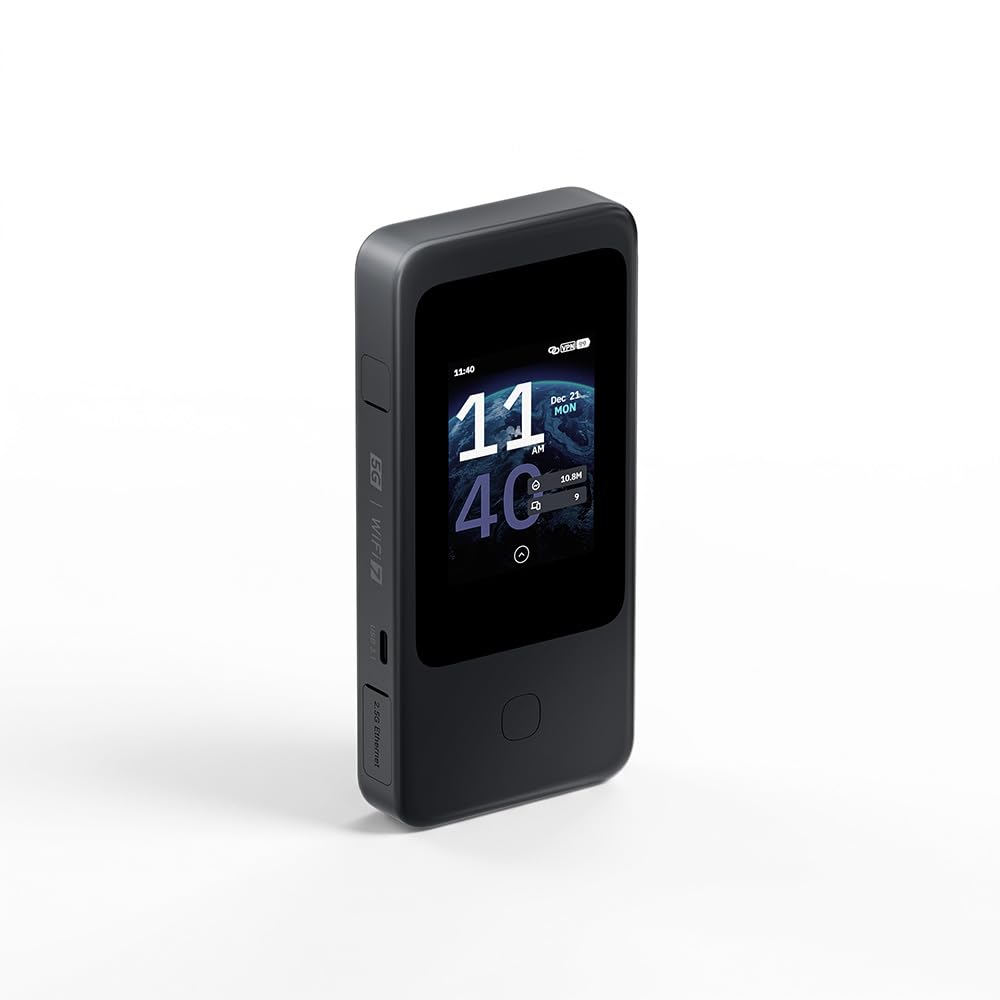
Wireless Standard: Tri-band Wi-Fi 7
Cellular: 5G
SIM Support: eSIM plus dual nano-SIM
Wired Port: 2.5G Ethernet
Display: 2.8-inch touchscreen
Battery: 13.5 hours
VPN Throughput: 700 Mbps
Model: GL-E5800 NA MUDI 7
The MUDI 7 is a travel router first and a hotspot second. It carries Wi-Fi 7 on three bands, a 5G modem, and room for an eSIM plus two physical nano-SIMs — which means a traveler can keep a home carrier, a local carrier and a travel eSIM loaded at once. The 2.5G Ethernet port and 700 Mbps VPN throughput point at a device built for hotel rooms, rented apartments and remote work rather than a phone-and-maps weekend.
The 2.8-inch touchscreen handles setup and status without a phone app, and the 13.5-hour battery covers a long working day away from an outlet. This is a device for buyers who are comfortable sourcing their own data plans and who want the hardware to keep up with them.
Trade-off: The MUDI 7 costs roughly three and a half times the RoamWiFi and arrives with no data included, so the real expense starts after purchase.
Check the current price on Amazon
Side-by-Side: Every Difference That Matters
| Attribute | RoamWiFi Mobile Hotspot | GL.iNet GL-E5800 MUDI 7 |
|---|---|---|
| Cellular Generation | 4G LTE | 5G |
| Wi-Fi Standard | Not a stated spec | Tri-band Wi-Fi 7 |
| SIM Requirement | No SIM card needed | eSIM plus dual nano-SIM |
| Included Data | 1GB US data, 30 days | None bundled |
| Coverage | 170+ countries | Dependent on chosen carrier |
| Connected Devices | 10 | Not a stated spec |
| Wired Networking | None stated | 2.5G Ethernet |
| Display | None stated | 2.8-inch touchscreen |
| Battery Life | Not a stated spec | 13.5 hours |
| VPN Performance | Not a stated spec | 700 Mbps |
| Contract | No contract | No contract |
| Price Tier | Budget | Premium |
The table makes the split obvious. RoamWiFi competes on what comes in the box; GL.iNet competes on what the box can do. One is a service wrapped around a modem, the other is a router that happens to have a modem inside.
Data: Bundled Versus Bring-Your-Own
The RoamWiFi includes 1GB of US data valid for 30 days, and the 170+ country coverage is the headline feature. That is enough for messaging, navigation and light browsing — not enough for video calls or streaming. Buyers who need more top up through the provider.
The MUDI 7 includes nothing. Every gigabyte comes from a carrier the buyer chooses, which is more work upfront but usually cheaper per gigabyte on longer trips. The eSIM plus dual nano-SIM arrangement is the real advantage: three data sources can live in one device.
Speed and Network Hardware
4G LTE versus 5G is the widest gap here. The RoamWiFi is fine for email and maps; the MUDI 7 is built for video calls, cloud uploads and anything that punishes latency. Tri-band Wi-Fi 7 widens the gap further — more devices can share the connection without the local network becoming the bottleneck.
The 2.5G Ethernet port matters for anyone plugging into a hotel wall jack or a wired apartment connection. The RoamWiFi has no wired option, so it is wireless or nothing.
Power, Endurance and Daily Handling
GL.iNet states 13.5 hours of battery for the MUDI 7, which covers a full working day. The RoamWiFi’s runtime is not part of its published spec, so buyers should plan on charging it nightly and carrying a power bank on long days out.
The MUDI 7’s touchscreen is a genuine convenience — network status, SIM switching and settings without reaching for a phone. The RoamWiFi keeps interaction minimal by design, which suits buyers who want to turn it on and forget it.
Security and Remote Work Features
The 700 Mbps VPN figure is the clearest signal of intent: the MUDI 7 is meant to run a VPN without collapsing throughput, which matters for remote workers on public networks. The RoamWiFi is a straightforward access point with no stated VPN capability to evaluate.
Price and Total Cost of Ownership
The RoamWiFi sits at the budget end and includes its first allowance of data. The MUDI 7 sits at the premium end before a single gigabyte is purchased. Over a two-week trip the gap narrows once data costs are counted, but the MUDI 7 only makes financial sense for frequent travelers or heavy users.
Which Should You Buy?
Choose the RoamWiFi Mobile Hotspot if: the trip is short, the work is light, and the priority is landing with working internet and no setup. It also suits buyers traveling with family or colleagues who need to share one connection across several devices.
Choose the GL.iNet GL-E5800 MUDI 7 if: the traveler is comfortable buying local data, needs 5G speeds and VPN throughput, or works remotely from hotels and rentals. The Ethernet port and triple-SIM flexibility pay off across repeated trips.
Skip the RoamWiFi if: the trip involves video calls, large uploads or weeks of heavy use — the data allowance and 4G radio will frustrate.
Skip the MUDI 7 if: the buyer wants a device that works out of the box with no plan shopping, or only travels once a year.
FAQ
-
Is the RoamWiFi Mobile Hotspot really SIM-free?
Yes. The product is sold as a no-SIM device with data included, so there is no card to source or install before the first connection. -
Does the GL.iNet MUDI 7 come with any data?
No. The router supports eSIM and dual nano-SIM, but the buyer supplies the plan separately. -
Can the RoamWiFi handle a family’s devices?
It supports up to 10 connected devices, which covers phones, tablets and a laptop for a small group. -
Which one is better for remote work?
The MUDI 7. Its 5G modem, 700 Mbps VPN throughput and 2.5G Ethernet port are aimed squarely at working travelers. -
How many countries does the RoamWiFi cover?
The product lists 170+ countries, well beyond a single-region travel SIM. -
Does the MUDI 7 need a contract?
No contract is required for the device itself; costs depend entirely on the SIM or eSIM plan chosen. -
Which is easier for a first-time hotspot buyer?
The RoamWiFi. It arrives ready to use, while the MUDI 7 assumes the buyer knows how to source and manage data plans. -
Can both be used in the US?
Yes. The RoamWiFi includes 1GB of US data for 30 days, and the MUDI 7 works with US carriers via its SIM slots.
Bottom Line
The RoamWiFi Mobile Hotspot wins on simplicity and upfront cost, and it is the right pick for short trips and light use. The GL.iNet GL-E5800 MUDI 7 wins on capability — 5G, Wi-Fi 7, triple-SIM flexibility and VPN headroom — and it is the better long-term purchase for anyone who travels often or works on the road. Buyers who want to decide in under a minute should pick by trip length: a week or less favors the RoamWiFi, and anything longer favors the MUDI 7.
