Why there are Amazon links here: Brave Review is paid a commission for qualifying Amazon purchases made through the links below. Your price does not change, and using our links is entirely optional. How this works
Best Mesh WiFi System for a House With Thick Internal Walls
Thick internal walls — brick, stone, plaster over lath — absorb WiFi signal in a way that open-plan homes never expose. A single router rarely reaches the far bedroom, and a weak extender just rebroadcasts a weak signal. The five systems below are the strongest answers to that problem, sorted for three kinds of buyers: the budget-conscious household that needs reliable coverage more than raw speed, the connected home with dozens of devices and heavy streaming, and the large or multi-story house where wired backhaul between nodes is the difference between "works" and "works everywhere."
The overview table below puts all five side by side so a reader can pick a shortlist in under a minute, then the full reviews explain the fit.
Overview of the Picks
| Product | Key Spec | Best Use | Price Tier |
|---|---|---|---|
| TP-Link Deco BE25 3-Pack | Dual-band BE5000, 2x 2.5G ports, up to 6,600 sq ft | Best value for most thick-wall homes | Budget |
| TP-Link Deco BE63 3-Pack | Tri-band BE10000, 4x 2.5G ports, up to 7,600 sq ft | Best for crowded, high-demand networks | Mid-range |
| NETGEAR Orbi 370 3-Pack | Dual-band, up to 6,000 sq ft, 70 devices | Best simple setup with room to spare | Mid-range |
| NETGEAR Orbi 770 3-Pack | Tri-band, up to 8,000 sq ft, 100 devices | Best for large homes and gigabit-plus plans | Premium |
| Amazon eero 6+ 3-Pack | Dual-band, up to 4,500 sq ft, 75+ devices | Best plug-and-play for smaller footprints | Mid-range |
TP-Link Deco BE25 3-Pack

Coverage: Up to 6,600 sq ft across 3 units
Standard: WiFi 7, dual-band BE5000
Streams: 4-stream
Ports: 2x 2.5G ports with wired backhaul
Features: VPN, MLO, AI-Roaming, HomeShield
Units: 3-pack
The Deco BE25 is the value pick of the group, and it earns that spot by doing the two things thick-wall homes need most: three separate nodes and 2.5G ports that support a wired backhaul link between them. A wired backhaul is the single biggest upgrade for a house with dense walls, because each node broadcasts from a full-strength signal rather than a degraded wireless hop. Dual-band WiFi 7 with MLO (multi-link operation) lets compatible devices use both bands at once, which helps in rooms where the signal has to travel through two or three walls.
This is the system for a household that wants modern WiFi 7 hardware without paying tri-band prices, and it covers a mid-size single-family home comfortably. The caution is inherent to dual-band: with only two bands, the mesh backhaul shares airtime with client devices, so in a very dense or very large home the throughput per device drops in a way a tri-band system avoids. Buyers with dozens of heavy-streaming devices should look upward.
Trade-off: Dual-band design means backhaul traffic competes with devices, so raw speed per client suffers in heavily loaded homes.
Check the current price on Amazon
TP-Link Deco BE63 3-Pack
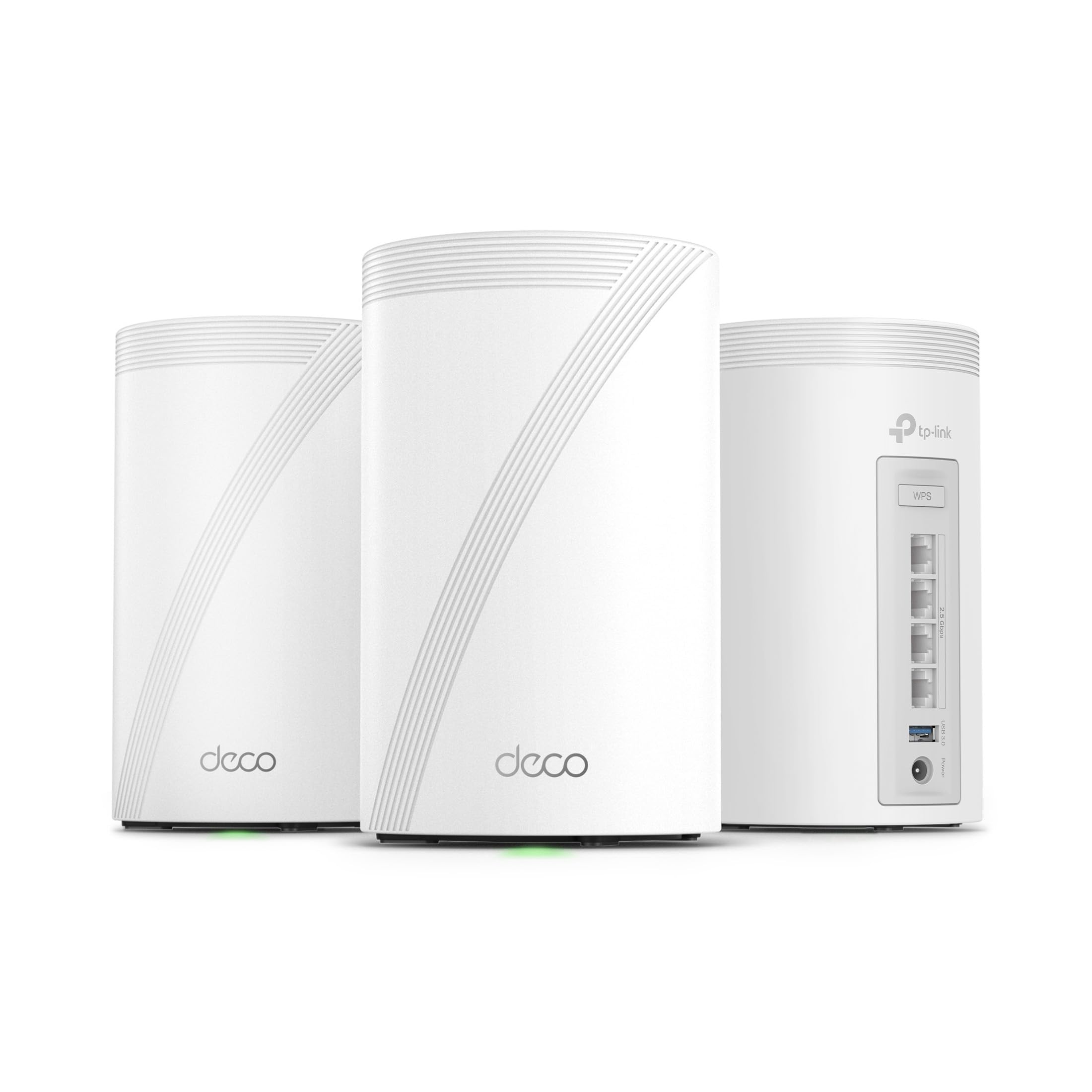
Coverage: Up to 7,600 sq ft across 3 units
Standard: WiFi 7, tri-band BE10000
Streams: 6-stream
Ports: 4x 2.5G ports with wired backhaul
Antennas: 4x smart internal antennas
Features: VPN, HomeShield, AI-Roaming
Units: 3-pack
The BE63 is the step-up pick and the best answer for a busy household behind thick walls. Tri-band design gives the mesh a dedicated band for node-to-node traffic, so the nodes stay fast even when phones, TVs and laptops are all pulling data at once. Four 2.5G ports per unit mean a wired backhaul is practical in nearly any layout, and the six-stream tri-band radio handles a large device count without the bottlenecks that dual-band systems develop under load.
This system suits a large family home with a fast internet plan, multiple 4K streams and a home office that cannot tolerate dropouts. The trade-off is price and size: it costs meaningfully more than the BE25, and buyers who do not have a plan fast enough to use tri-band will pay for headroom they never touch.
Trade-off: The premium over the dual-band Deco is real, and a modest internet plan will not reveal the difference.
Check the current price on Amazon
NETGEAR Orbi 370 3-Pack
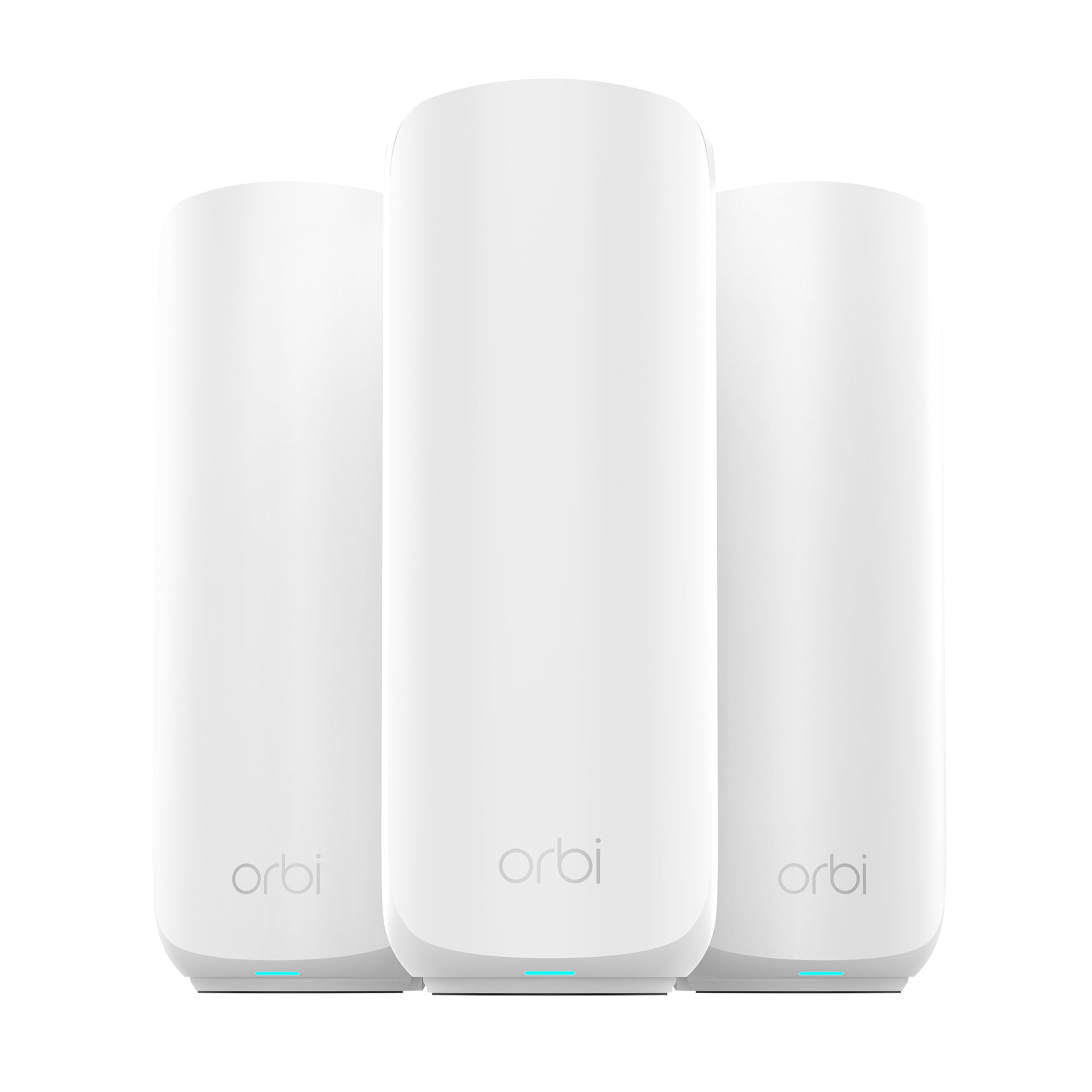
Coverage: Up to 6,000 sq ft across 3 units
Standard: WiFi 7, dual-band
Speed: Up to 5 Gbps
Devices: 70 devices
Ports: 2.5 Gig port
Setup: Easy set up, security features included
Units: Router + 2 satellite extenders
The Orbi 370 takes the opposite approach to the Deco: instead of a stack of ports and bands, it delivers a router plus two satellite extenders with a setup process built for people who do not want to think about networking. Orbi’s mesh handoff is well regarded for holding a connection as a person walks between rooms, which matters in a thick-wall house where devices constantly renegotiate which node they belong to. The 2.5 Gig port gives a fast wired link to the modem or a switch.
This is the pick for a household that wants coverage up to 6,000 square feet with minimal configuration and a clean, appliance-like design. The caution is the single 2.5 Gig port per unit: a wired backhaul across all three nodes is harder to arrange than on the Deco systems, so most buyers will run it wirelessly and rely on Orbi’s backhaul tuning to push through the walls.
Trade-off: Fewer high-speed ports per unit make a full wired backhaul impractical for most buyers.
Check the current price on Amazon
NETGEAR Orbi 770 3-Pack

Coverage: Up to 8,000 sq ft across 3 units
Standard: WiFi 7, tri-band
Speed: Up to 11 Gbps
Devices: 100 devices
Ports: 2.5 Gig port
Setup: Easy set up, security features included
Units: Router + 2 satellite extenders
The Orbi 770 is the largest system here and the one built for a big house that thick walls have made feel even bigger. Tri-band radios with a dedicated backhaul path keep node-to-node traffic off the client bands, and the 8,000 square foot rating covers most two-story homes with room for a garage or garden office. The 100-device rating is generous enough for a modern connected household with smart home hardware, consoles and work laptops.
This is the premium pick for buyers with a large footprint and a fast internet plan who want the coverage question settled once. The drawback is straightforward: it is the most expensive system on the list by a wide margin, and a smaller home will see no benefit over the Orbi 370 or the Deco BE25 for the extra outlay.
Trade-off: The highest price here buys coverage many homes simply do not need.
Check the current price on Amazon
Amazon eero 6+ 3-Pack
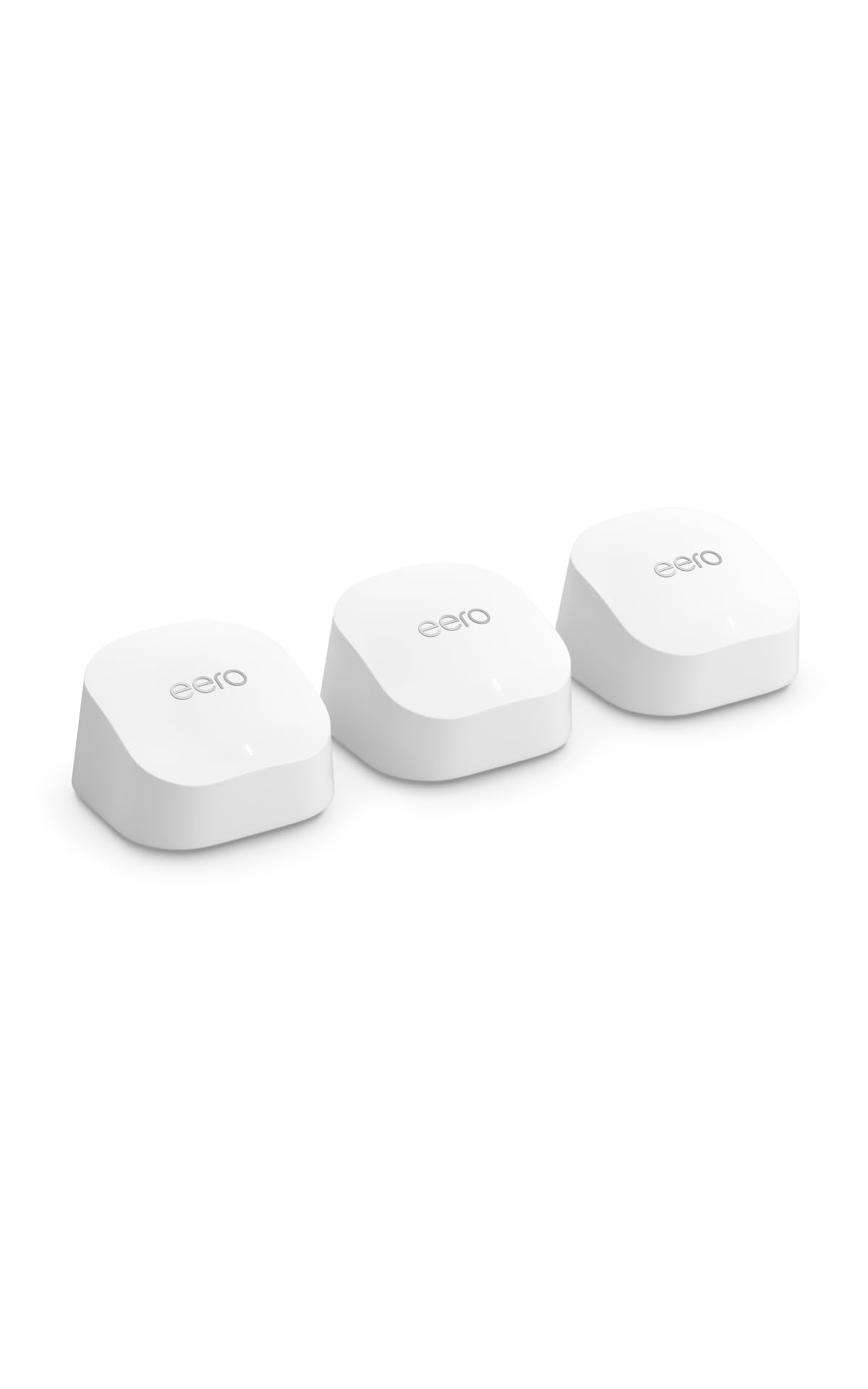
Coverage: Up to 4,500 sq ft across 3 units
Standard: WiFi 6, dual-band
Speed: Supports internet plans up to a Gigabit
Devices: 75+ devices
Setup: App-based, three identical units
Units: 3-pack
The eero 6+ is the simplest system to live with and the right choice for a smaller house or apartment where thick internal walls are the main obstacle rather than sheer square footage. Three identical units mean no router-versus-satellite distinction: each one goes where the signal is weak, and the app handles the rest. The 75+ device rating is plenty for a typical family, and support for gigabit plans keeps it relevant for years.
This is the pick for a renter or a first-time mesh buyer who values a frictionless setup and a compact footprint over WiFi 7 speeds. The caution is that it is a WiFi 6 dual-band system: on a very fast plan or in a home with many heavy users, it will be the slowest of the five, and 4,500 square feet leaves little margin in a large, thick-walled house.
Trade-off: WiFi 6 dual-band hardware and the smallest coverage figure here limit it to smaller or less demanding homes.
Check the current price on Amazon
Before You Buy
- Coverage rating versus wall thickness: Manufacturer square footage assumes open space; a house with thick internal walls should be treated as roughly one size larger than its floor plan suggests.
- Wired backhaul support: Systems with multiple 2.5G ports per unit allow nodes to be linked by Ethernet, which is the most reliable fix for signal loss through dense walls.
- Band count: Tri-band systems reserve a band for node-to-node traffic; dual-band systems share airtime and slow down under heavy load.
- Device count: Match the rating to the household’s phones, laptops, TVs, consoles and smart home hardware, not just the number of people.
- Internet plan speed: A system rated far above the broadband plan delivers no real-world gain; match the two.
- Placement: Nodes need line of sight through doorways where possible; a node behind a thick wall from its parent performs far worse than one in a hallway.
- Setup model: App-driven systems with identical units are easier to place and expand than router-plus-satellite kits.
Frequently Asked Questions
-
Will a mesh system really get through thick internal walls?
Yes, with the right node placement. Mesh systems win in thick-wall homes because multiple nodes shorten the distance and the number of walls between any device and its nearest node. -
Is wired backhaul worth it in an old house?
It is the single most effective upgrade where Ethernet can be run between nodes. Where cabling is impossible, a tri-band system with a dedicated backhaul band is the next best option. -
How many nodes does a thick-walled house need?
More than the square footage alone suggests. A house rated for two nodes in open space often needs three once interior walls are dense. -
Does WiFi 7 matter for wall penetration?
WiFi 7 improves efficiency and throughput rather than raw penetration. The bigger gains in a thick-wall home come from node count and backhaul quality. -
Can a mesh system be expanded later?
Yes. All five systems here are expandable with additional units of the same family, which is the simplest way to cover an extension or a converted garage. -
Should the cheapest system always win?
No. The cheapest system that covers the whole house reliably is the right buy; paying less for coverage that drops in the back bedroom is a false economy.
Bottom Line
For most houses with thick internal walls, the TP-Link Deco BE25 3-Pack is the best balance of coverage, wired backhaul flexibility and price, and it is the first system worth checking. Households with a large footprint, a fast plan and many devices should step up to the TP-Link Deco BE63 3-Pack, which solves the backhaul bottleneck that dual-band systems eventually hit.
