Why there are Amazon links here: Brave Review is paid a commission for qualifying Amazon purchases made through the links below. Your price does not change, and using our links is entirely optional. How this works
Best WiFi Extender for a House with a Garden Office
A garden office is only as useful as the signal that reaches it, and most main routers give up somewhere near the back wall. The five picks below cover the whole span: a budget TP-Link that handles the house side, three long-range units built for the push across a yard, and one mid-priced option that splits the difference. Homeowners running a single broadband line to a shed, a converted garage or a summerhouse will find a fit here. The overview table below sets the differences out first, so a decision can be made before reading a single review.
The Picks at a Glance
| Product | Key Spec | Best Use | Price Tier |
|---|---|---|---|
| TP-Link AC1200 WiFi Extender (RE315) | 1.2Gbps, 1600 Sq.ft, 32 devices, EasyMesh | Indoor coverage and a wired office device | Budget |
| 2026 New WiFi Extender Signal Booster | 1200Mbps, 12880 Sq.Ft, 105 devices | Long garden runs on a budget | Budget |
| 2026 Upgraded WiFi Extender for Home | 18000 Sq.ft, Ethernet port, 15X faster | Very large plots and heavy use | Premium |
| 2026 WiFi Extender Signal Booster for Home | 15000sq.ft, Ethernet port, 1-Tap setup | Fast setup for a mid-size garden | Premium |
| 2026 WiFi Extender Signal Booster, 15588 Sq Ft | 6X faster, Ethernet port, 1-Tap setup | Simple plug-in for most gardens | Premium |
Top Picks Reviewed
TP-Link AC1200 WiFi Extender (RE315)

Type: Dual-band wall-plug extender
Speed: AC1200, 1.2Gbps
Coverage: Up to 1600 Sq.ft
Devices: Up to 32
Ports: One Ethernet
Mesh: EasyMesh compatible
This is the smallest unit in the group and the one with the most mainstream pedigree. TP-Link builds it as a compact wall-plug repeater with dual-band output, so it rebroadcasts both the 5GHz and 2.4GHz streams rather than forcing everything onto the slower band. EasyMesh compatibility means it can join a mesh network rather than sitting on its own, and the single Ethernet port is the feature that matters most here — it lets a desktop, printer or VoIP handset in the garden office run on a cable instead of straining the wireless link. The 1600 Sq.ft figure describes a house-sized job, not a long garden run.
This pick suits a buyer whose garden office sits close to the house — a converted garage, a shed a few metres off the back wall, or an extension with a thin exterior wall. It earns its place as the budget anchor because the wired port turns a weak wireless hop into a stable connection for a single work machine. The trade-off is that 1600 Sq.ft and 32 devices are house-scale numbers, and a unit this compact is unlikely to push a clean signal to a building at the far end of a long lawn.
2026 New WiFi Extender Signal Booster, 12880 Sq.Ft

Type: Dual-band signal booster
Speed: 1200Mbps
Coverage: 12880 Sq.Ft
Devices: Up to 105
Bands: 5GHz / 2.4GHz
Setup: Simple installation
The cheapest route to a long-range claim in this lineup. The name pitches it at home and outdoor use, and the dual-band 1200Mbps radio matches the TP-Link on paper while carrying a coverage figure several times larger. The 105-device headroom is generous for a household, and the installation is described as simple rather than app-heavy, which suits a buyer who wants to plug in and walk away. It is a repeater first and foremost, so the office side of the link depends on where the unit is placed.
This one fits a buyer with a modest budget and a garden office that sits a clear line away from the house, with no brick outbuilding in between to kill the signal. It earns its place as the value long-range option, and the low price makes a second unit easier to justify. The trade-off is that a booster at this price is a straightforward repeater without mesh support, so it extends the existing network rather than improving how the router and extender talk to each other.
2026 Upgraded WiFi Extender for Home, 18000Sq.ft

Type: Long-range wireless repeater
Coverage: Up to 18000 Sq.ft
Speed claim: 15X faster signal amplifier
Ports: Ethernet
Compatibility: Works with 99% of routers
Setup: Standard pairing
The largest coverage claim in the group and the most expensive unit alongside its two siblings. This is a high-power repeater aimed at big plots, with an Ethernet port for a wired device and a compatibility claim that covers almost any router. The "15X faster" wording describes the amplification it applies to a weak incoming signal rather than an absolute speed, and buyers should read it that way. Build-wise it is a plug-in unit with external antennas in the usual style for this class.
It suits a buyer with a large garden, a detached office at a distance, and a router that cannot be moved closer to the back of the house. It earns its place as the premium pick for the biggest plots, where the extra reach is the whole point of the purchase. The trade-off is that no repeater beats physics: if the unit is placed where the incoming signal is already poor, the amplified output is poor too, and the top coverage figure assumes a strong source and open air.
2026 WiFi Extender Signal Booster for Home, 15000sq.ft
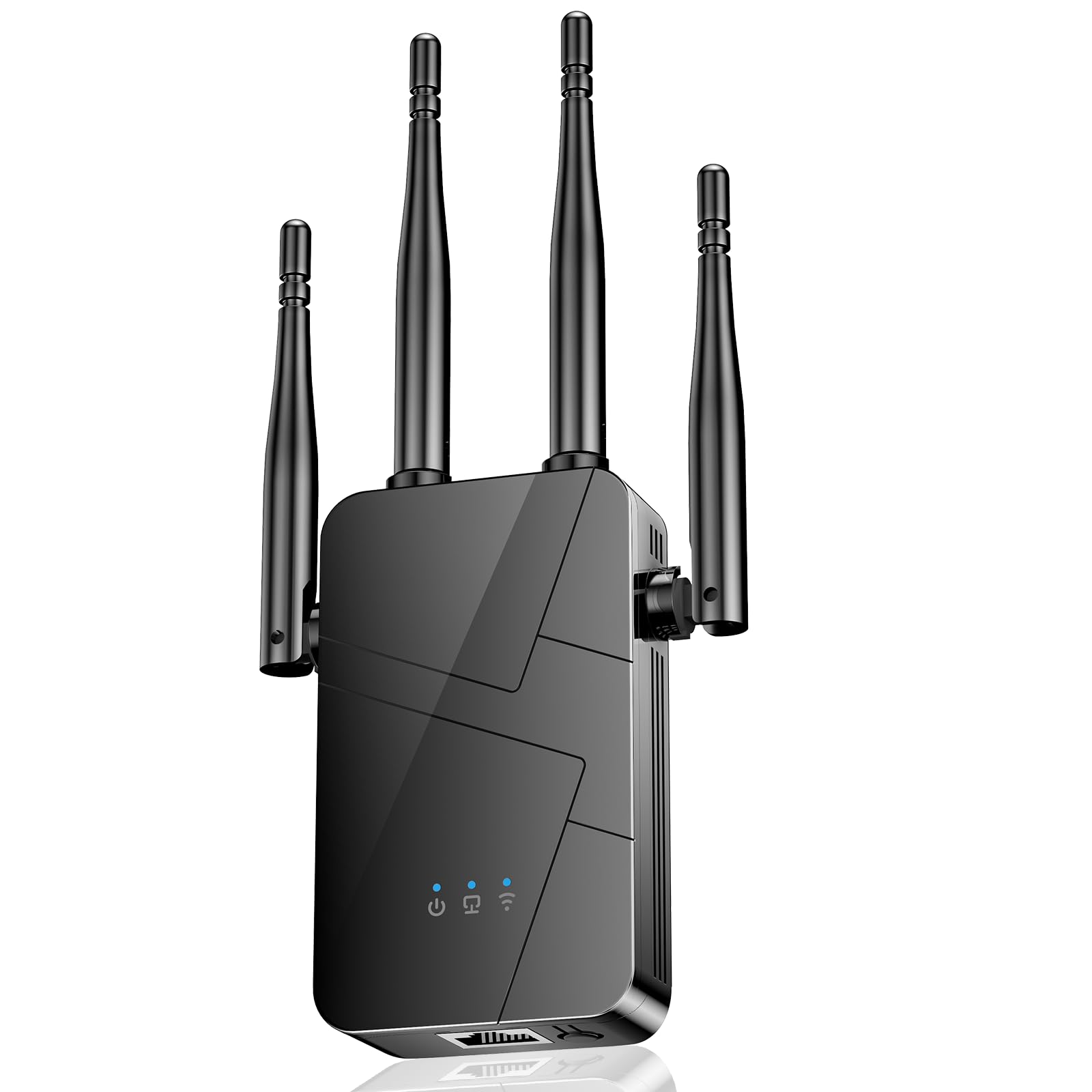
Type: Long-range wireless repeater
Coverage: Up to 15000sq.ft
Ports: Ethernet
Setup: 1-Tap
Compatibility: 99% of devices
Function: Router extender and signal amplifier
The most popular of the long-range trio, and the one built around speed of setup. The 1-Tap pairing is the headline feature: press the button on the router and the button on the extender, and the two pair without a laptop or a browser page. Coverage is quoted at 15000sq.ft and the Ethernet port is present for a wired device in the office. It works as both a router extender and a signal amplifier, which is standard for this category.
This pick suits a buyer who wants the garden office online in minutes and does not want to configure anything. It earns its place as the balanced premium option, with a coverage figure just under the top model and a setup that removes the usual friction. The trade-off is that one-tap pairing depends on the main router supporting the same push-button method, and older or ISP-locked routers may need the manual route instead.
2026 WiFi Extender Signal Booster, Long Range up to 15,588 Sq Ft
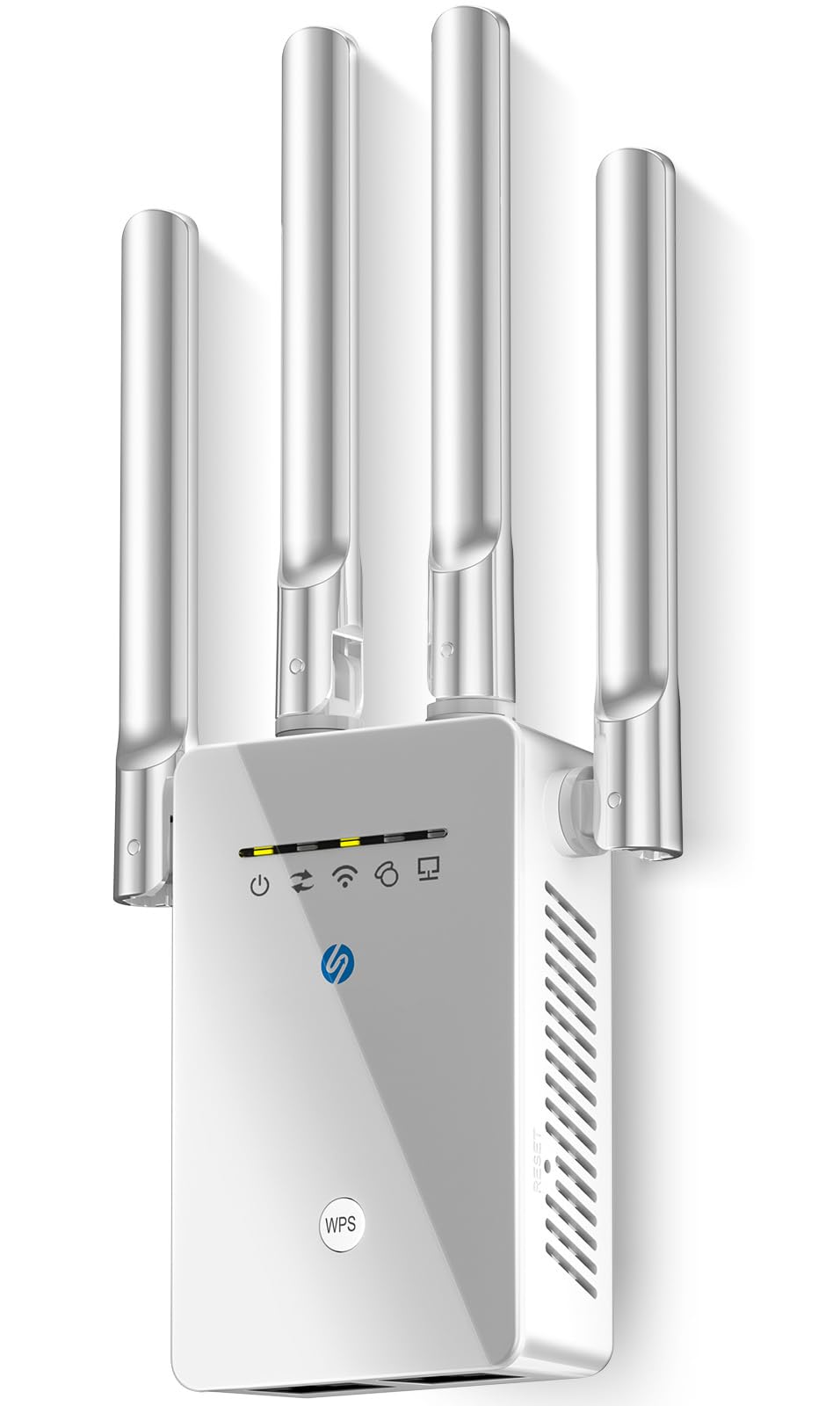
Type: Long-range wireless repeater
Coverage: Up to 15,588 Sq Ft
Speed claim: 6X faster
Ports: Ethernet
Setup: 1-Tap
Compatibility: Wireless routers
A close sibling to the model above, with a slightly different coverage figure and a more conservative speed claim. The 6X faster wording is the least inflated in the group, and the feature set is the same practical package: a wall-plug repeater with an Ethernet port, one-tap pairing and wide router compatibility. The 15,588 Sq Ft figure sits between the two other premium units, so the choice between them comes down to price and setup rather than capability.
This one suits a buyer who wants a straightforward plug-in for a garden office at medium distance and prefers a spec sheet that does not overpromise. It earns its place as the no-fuss alternative in the premium tier. The trade-off is that a repeater without mesh support halves throughput on the extended leg in the usual way, so a wired device in the office will always beat a wireless one for video calls and large uploads.
Before You Buy
- Distance: Measure from the router to the office door, not to the garden gate. A repeater needs a usable signal at its own position before it can extend anything.
- Walls: Brick, stone and foil-backed insulation cut signal far more than the coverage figures suggest. A window line or an external wall with a clear path helps.
- Ethernet: A port on the extender is the single most useful feature for an office. It lets a desk machine, printer or dock run on a cable.
- Mesh support: EasyMesh or a matching brand mesh keeps one network name and avoids manual switching between house and office.
- Bands: 5GHz is faster over short hops; 2.4GHz travels further through walls. Dual-band units cover both.
- Placement: The extender belongs roughly halfway between router and office, not in the office itself, so it has a signal worth boosting.
- Device count: A household with phones, laptops, cameras and a smart speaker can pass 30 devices quickly. Check the headroom.
Frequently Asked Questions
-
Will a WiFi extender reach a garden office at the end of a long lawn?
A long-range repeater can, provided it is placed where the router signal is still usable. Putting it in the office itself is the common mistake — it needs a good source signal to amplify. -
Is a wired connection in the garden office better than WiFi?
Yes, where it is possible. The Ethernet port on these extenders lets a desktop or dock run on a cable, which avoids the throughput loss that comes with repeating a wireless signal. -
Does the extender need to match the router brand?
Not necessarily. The TP-Link unit adds EasyMesh support, and the other four list broad router compatibility. One-tap pairing works best when both ends support the same push-button method. -
How many devices can these extenders handle?
The figures range from 32 on the TP-Link to 105 on the mid-priced long-range model. A typical home with phones, laptops, streaming boxes and smart devices sits comfortably inside the larger numbers. -
Will the extended network have a different name?
Repeaters often create a second network name unless mesh is in use. A mesh-compatible setup keeps one name and lets devices move between house and office without manual switching. -
Can an extender be used outdoors?
The mid-priced model is marketed for home and outdoor use, but the rest are indoor units. Any extender placed outside needs shelter from rain and direct sun.
Bottom Line
For most houses with a garden office, the TP-Link AC1200 WiFi Extender (RE315) is the pick that does the most useful work for the least money — the Ethernet port gives the office a stable wired link, and EasyMesh compatibility keeps the door open to a tidier network later. Buyers with a genuinely long garden and a detached office should step up to the 15000sq.ft model, where the 1-Tap setup and long-range radio make the extra spend worthwhile.
