Why there are Amazon links here: Brave Review is paid a commission for qualifying Amazon purchases made through the links below. Your price does not change, and using our links is entirely optional. How this works
Best Router for a Two Storey House with a Dead Spot
A dead spot in a two storey house is almost always a coverage problem, not a speed problem, and the fix is a system built for multiple floors rather than a single box in the hallway. The five picks below cover three buyer profiles: households that want a cheap, reliable mesh fix, homes packed with devices that need the newest bands, and anyone who wants the strongest possible signal between floors. The overview table sums up each pick in one line; the reviews explain who each one suits and where it falls short.
Overview of the Picks
| Product | Key Spec | Best Use | Price Tier |
|---|---|---|---|
| TP-Link Deco S4 (3-Pack) | AC1900 mesh, up to 5,500 sq. ft. | Budget whole-home mesh | Budget |
| TP-Link Deco XE75 (3-Pack) | AXE5400 tri-band WiFi 6E, up to 7,200 sq. ft. | Large, crowded homes | Mid-range |
| NETGEAR Orbi 370 (3-Pack) | WiFi 7 mesh, up to 6,000 sq. ft., 2.5G port | Fastest wired backhaul | Premium |
| NETGEAR Orbi RBK752P | AX5200 tri-band WiFi 6, up to 5,000 sq. ft. | Balanced two-floor coverage | Mid-range |
| TP-Link BE6500 (BE400) | Dual-band WiFi 7, up to 2,400 sq. ft. | Small homes, one strong router | Budget |
TP-Link Deco S4 Mesh AC1900 WiFi System (3-Pack)

Type: Mesh WiFi system, three units
Standard: AC1900
Coverage: Up to 5,500 sq. ft.
Ports: Gigabit Ethernet
Voice Control: Works with Alexa
Replaces: Existing router and range extender
The Deco S4 is the straightforward answer for a two storey house that needs one dead spot filled without spending much. Three units form a single network name, so phones and laptops hand off between floors instead of clinging to a weak signal from the far end of the house. The gigabit ports on each unit let a desktop or console connect by cable where the signal is weakest.
This is a WiFi 5 system, so it suits browsing, streaming and video calls rather than future-proofing. Buyers on a tight budget who want a mesh that simply works will find it the easiest entry point here.
Trade-off: Older wireless standard and no dedicated backhaul band, so heavy simultaneous 4K streaming and large file transfers across floors will feel slower than the newer picks.
Who it’s for: Budget-conscious households with a single stubborn dead spot. Not for: gamers or large families pushing lots of high-bandwidth traffic at once.
TP-Link Deco XE75 AXE5400 Tri-Band WiFi 6E System (3-Pack)

Type: Mesh WiFi system, three units
Standard: AXE5400 tri-band WiFi 6E
Coverage: Up to 7,200 sq. ft.
Bands: Includes 6GHz band
Security: WPA3
Management: AI-driven
The XE75 is the pick for a busy two storey house where the dead spot sits alongside a crowd of devices. The extra 6GHz band gives newer phones, laptops and tablets a cleaner lane, which matters in a house where everyone streams at once. AI-driven management handles channel selection and roaming without the owner fiddling with settings.
Coverage is rated well beyond a typical two floor home, so the third unit can sit in a garage, garden room or upstairs landing. WPA3 security is a sensible bonus for anyone who works from home.
Trade-off: The price climbs well above the entry-level mesh, and the 6GHz band only pays off for devices new enough to use it.
Who it’s for: Large, device-heavy homes that want current-generation WiFi. Not for: Small households on a strict budget or anyone with mostly older gadgets.
NETGEAR Orbi 370 Series WiFi 7 Mesh System (3-Pack)
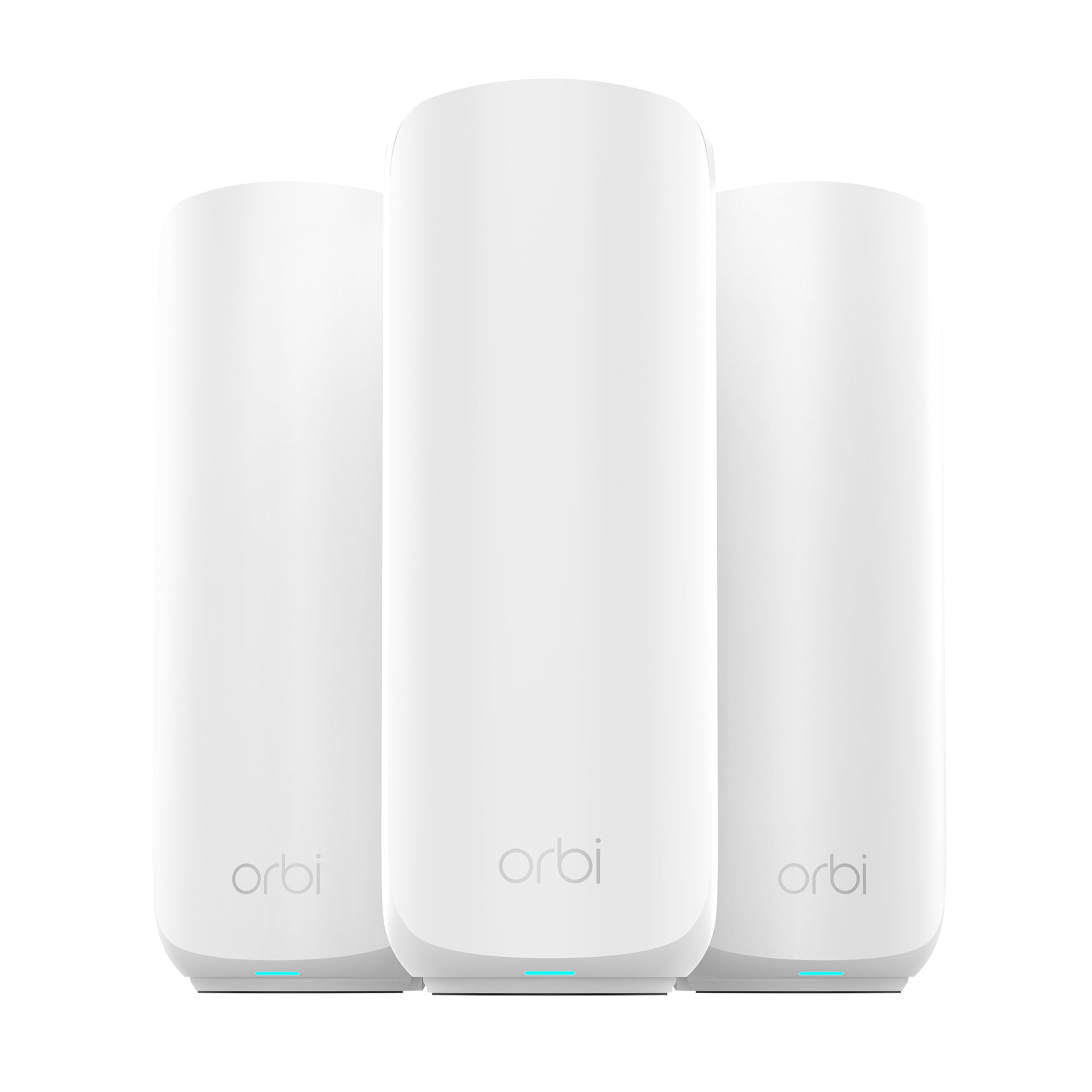
Type: Mesh WiFi system, router plus two satellites
Standard: WiFi 7, dual-band
Speed: Up to 5 Gbps
Coverage: Up to 6,000 sq. ft.
Devices: Up to 70
Ports: 2.5 Gig port
Setup: Easy set up
The Orbi 370 is the premium pick, built for homes that want the newest standard and a fast wired backbone between units. The 2.5 Gig port supports multi-gig internet plans, and WiFi 7 handles dense device loads with more headroom than WiFi 6 systems. A router plus two satellites is exactly the layout a two storey house needs: one unit at the entry, one upstairs, one at the far end.
Orbi’s satellite design is the reason it earns its price for anyone who can cable the units together. Buyers with gigabit-plus broadband will actually see the benefit.
Trade-off: The highest price here, and dual-band rather than tri-band, so the fastest speeds depend on a good wired backhaul and modern client devices.
Who it’s for: Buyers with fast internet who want WiFi 7 and can run cables. Not for: Anyone on a basic broadband plan or a tight budget.
NETGEAR Orbi Whole Home Tri-Band WiFi 6 Mesh System (RBK752P)

Type: Mesh WiFi system, router plus one satellite
Standard: AX5200 tri-band WiFi 6 (802.11ax)
Speed: Up to 5.2 Gbps
Coverage: Up to 5,000 sq. ft.
Devices: Up to 75
Security: Included security features
The RBK752P is the balanced choice: two units, one router and one satellite, which is often all a two storey house needs. The tri-band design gives the link between floors its own lane, so the upstairs unit keeps its speed instead of splitting it with every connected device. Security features are built in, and the device count covers a full family plus smart home gear.
It sits between the budget mesh systems and the WiFi 7 premium pick, which makes it the sensible middle for most buyers.
Trade-off: Only one satellite, so a long or L-shaped house may still need a third unit that this kit does not include.
Who it’s for: Standard two floor homes that want strong, stable coverage without the newest standard’s price. Not for: Very large or awkwardly shaped houses needing three or more units.
TP-Link BE6500 Dual-Band WiFi 7 Router (BE400)

Type: Single WiFi 7 router
Standard: BE6500 dual-band WiFi 7
Coverage: Up to 2,400 sq. ft.
Devices: Up to 90
Ports: Dual 2.5Gbps, USB 3.0
Processor: Quad-core CPU
Security: HomeShield, Private IoT
The BE400 is the single-router option, and it earns a place because a dead spot is sometimes just a weak router rather than a house that needs mesh. A quad-core CPU and WiFi 7 handle up to 90 devices, the dual 2.5Gbps ports feed fast wired gear, and USB 3.0 adds simple network storage. HomeShield and a private IoT network keep smart devices separated from the main network.
It suits a compact two storey house where the router can sit fairly centrally, or a buyer who wants WiFi 7 without paying for a multi-unit kit.
Trade-off: Rated coverage is the smallest here, so a long house or thick internal walls will likely still leave a dead spot that only a mesh node can fix.
Who it’s for: Small two floor homes with a central spot for the router. Not for: Large or spread-out houses, or anyone who already knows a single router cannot reach the far corner.
Before You Buy
- Coverage vs. floors: Match the rated square footage to the whole house, not just the dead room. Two storey homes also lose signal through floors, so a mesh kit beats a single router in most cases.
- Units: One unit per floor plus one extra is a reliable rule. Three-packs cover most two storey houses; two-unit kits suit compact layouts.
- Standard: WiFi 5 is fine for streaming and browsing; WiFi 6/6E and WiFi 7 matter for crowded homes, fast broadband and newer devices.
- Backhaul: A wired connection between units, where possible, keeps speeds high. Tri-band systems and 2.5G ports help most here.
- Ports: Check gigabit or 2.5G ports if desktops, consoles or NAS drives will be cabled.
- Device count: Count phones, laptops, TVs, consoles and smart home gear. A busy home can easily pass 50 devices.
- Placement: Central, elevated and out of cupboards. Mesh nodes need to be within range of each other, not tucked in the dead room itself.
Frequently Asked Questions
- Will a mesh system fix a dead spot in a two storey house?
Usually yes. Placing a node between the router and the dead area gives that spot a strong local signal instead of a weak one from the far end of the house. - Is a single WiFi 7 router enough for two floors?
Only in a compact, centrally planned home. Larger or long two storey houses generally need at least one satellite. - Does a three-pack cover more than two floors?
Often. Three units typically cover the ground floor, upstairs and one extra area such as a garage or garden room. - Do older devices work with WiFi 6E or WiFi 7 systems?
Yes. Newer systems stay backward compatible, though older devices will not get the speed benefit of the new bands. - Where should the units be placed?
Central, open and off the floor. Nodes should be spaced so each one is within good range of the next, not pushed to the far corner. - Is a wired connection between units worth it?
It is the single biggest upgrade for speed and stability. Where cable runs are possible, use them.
Bottom Line
For most two storey houses with a dead spot, the TP-Link Deco XE75 three-pack is the strongest overall choice: wide coverage, a cleaner 6GHz band for busy homes, and enough units to place one on each floor. Buyers on a budget should take the Deco S4, while anyone with fast broadband and cabling should step up to the NETGEAR Orbi 370.
