Why there are Amazon links here: Brave Review is paid a commission for qualifying Amazon purchases made through the links below. Your price does not change, and using our links is entirely optional. How this works
Best WiFi System for a House With Foil-Backed Insulation: 5 Mesh Picks That Punch Through
Foil-backed insulation is a signal killer. That shiny metallic layer that keeps heat in also reflects WiFi radio waves, which is why a router that worked fine in the old house suddenly can’t reach the back bedroom. The fix is a mesh system with enough nodes and, ideally, wired backhaul so the nodes don’t have to fight through the foil twice. This list covers five systems that suit three kinds of buyers: budget-conscious households that just need coverage, mid-range buyers who want WiFi 6E headroom, and large-home owners who want the fastest thing available. The overview table below shows the key differences at a glance.
The Picks at a Glance
| Product | Key Spec | Best Use | Price Tier |
|---|---|---|---|
| TP-Link Deco X55 AX3000 (3-Pack) | Up to 6,500 sq. ft., WiFi 6, 3 Gigabit ports per unit | Most foil-insulated homes on a budget | Budget |
| NETGEAR Orbi 970 Series (3-Pack) | Up to 10,000 sq. ft., WiFi 7, quad-band, 10 Gig port | Very large homes needing maximum throughput | Premium |
| Amazon eero Pro 7 (3-Pack) | Up to 6,000 sq. ft., tri-band WiFi 7, 5 Gbps plans | Simple setup with next-gen speed | Upper mid-range |
| TP-Link Deco X20 (3-Pack) | Up to 5,800 sq. ft., WiFi 6, 6 Ethernet ports total | Wired backhaul on a tight budget | Budget |
| TP-Link Deco XE75 AXE5400 (3-Pack) | Up to 7,200 sq. ft., WiFi 6E, 6GHz band | Large homes wanting a clean 6GHz channel | Mid-range |
Three patterns matter here. First, every one of these is a three-pack, which gives foil-heavy homes the node count needed to route around blocked walls. Second, the two cheapest picks both explicitly support Ethernet backhaul, which is the single biggest upgrade for a foil-insulated house. Third, the pricier systems add newer radio standards rather than more nodes, so the spending decision comes down to how much speed the household actually uses.
TP-Link Deco X55 AX3000 WiFi 6 Mesh System (3-Pack)

TP-Link Deco X55 AX3000 WiFi 6 Mesh System, Deco X55(3-Pack)
Coverage: Up to 6,500 sq. ft.
Standard: WiFi 6 (AX3000)
Ports: 3 Gigabit ports per unit
Backhaul: Supports Ethernet backhaul
Pack Size: 3 units
Role: Replaces router and extenders
The Deco X55 is the value play for a foil-insulated house, and the reason is the port count. Three Gigabit ports on every unit means each node can take a wired backhaul line and still leave two ports free for a TV, console or desktop. That matters because foil-backed insulation punishes wireless backhaul hardest — a node that has to receive and retransmit over the air through a foil wall loses half its usable throughput.
WiFi 6 with AX3000 throughput is plenty for streaming, video calls and a house full of phones and laptops. The three-pack coverage figure assumes open-ish conditions, so a foil-heavy layout should be treated as smaller than advertised.
Trade-off: The low per-unit price means older WiFi 6 radios rather than 6GHz, so dense apartment-block interference is handled less gracefully than on the tri-band picks.
Check the current price on Amazon
NETGEAR Orbi 970 Series WiFi 7 Mesh System (3-Pack)

NETGEAR Orbi 970 Series (2026 Release) WiFi 7 Mesh System, 3 Pack
Coverage: Up to 10,000 sq. ft.
Standard: WiFi 7, quad-band
Throughput: Up to 27 Gbps
Capacity: Up to 200 devices
Ports: 10 Gig port
Pack Size: Router plus 2 satellite extenders
The Orbi 970 is the no-compromise pick for a big house wrapped in foil. Quad-band WiFi 7 gives it a dedicated high-capacity lane for node-to-node traffic, and the 10 Gig port means a wired backhaul run can carry more than the wireless link ever could. For a large property where pulling cable is impractical in some rooms, that extra radio headroom is the difference between a usable signal and a dead zone.
The device capacity figure reflects a household with smart home gear, tablets, consoles and work laptops all connected at once. This is the system to consider when the budget exists and the goal is to solve the problem once.
Trade-off: The price is the highest on this list by a wide margin, and most households will never use the full throughput — the money buys headroom, not a visible everyday difference.
Check the current price on Amazon
Amazon eero Pro 7 Tri-Band Mesh Wi-Fi 7 Router (3-Pack)
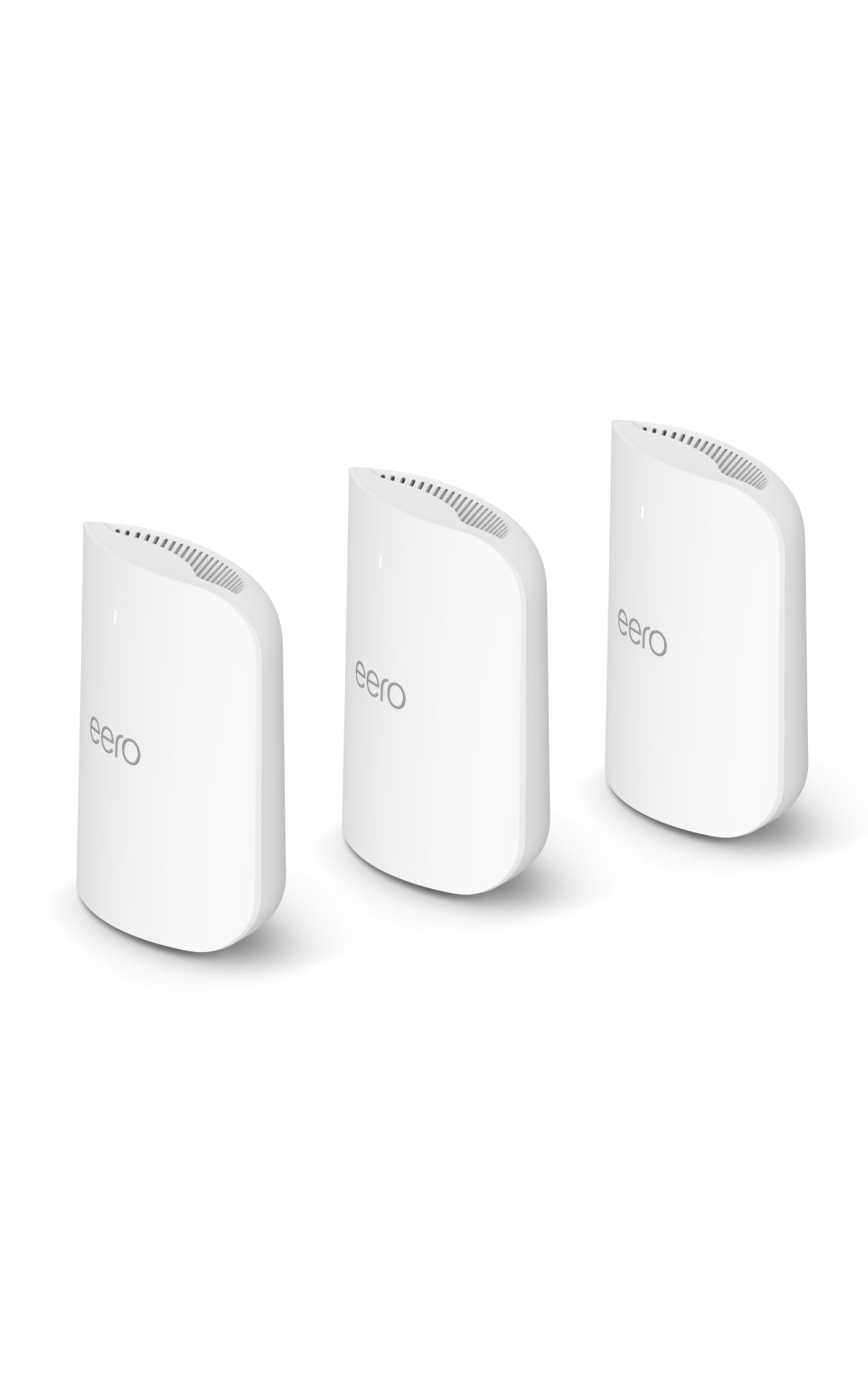
Coverage: Up to 6,000 sq. ft.
Standard: WiFi 7, tri-band
Internet Plans: Supports plans up to 5 Gbps
Pack Size: 3 units
Setup: App-guided
Role: Router and mesh nodes
The eero Pro 7 sits in the middle of this list and earns its place on simplicity. Tri-band WiFi 7 with support for internet plans up to 5 Gbps covers everything a modern household is likely to subscribe to, and the eero app handles setup and network management without a browser console or networking knowledge. For a foil-insulated house where the homeowner would rather not troubleshoot, that is a real feature.
The tri-band design gives node-to-node traffic its own lane, which helps when a satellite has to reach the main unit through a foil-blocked wall. Coverage is rated slightly below the Deco X55 despite the higher price, so the money goes into radio quality rather than raw square footage.
Trade-off: The app-first approach offers fewer manual tuning options than TP-Link’s interface, so tinkerers who want to set channels and priorities by hand will feel boxed in.
Check the current price on Amazon
TP-Link Deco X20 Dual-Band WiFi 6 Mesh System (3-Pack)

TP-Link Deco x20 Dual-Band WiFi 6 Mesh System, Deco X20 (3-Pack)
Coverage: Up to 5,800 sq. ft.
Standard: WiFi 6 (dual-band)
Ports: 6 Ethernet ports total
Backhaul: Supports wired backhaul
Pack Size: 3 units
Role: Replaces routers and extenders
The Deco X20 is the cheapest route into a mesh setup with wired backhaul support, and for a foil-insulated house that combination is the whole point. Six Ethernet ports across three units means a cable run to each satellite is possible without buying a switch, and a wired node behind a foil wall performs like a local access point instead of a repeater.
Dual-band WiFi 6 is the honest limitation. There is no dedicated backhaul radio, so any node that stays wireless shares airtime with client devices. In a house where all three nodes can be cabled, that weakness largely disappears.
Trade-off: The dual-band design and smaller coverage rating make this a poor fit for a large home where cabling is impossible — it is a wired-backhaul bargain, not a wireless miracle worker.
Check the current price on Amazon
TP-Link Deco XE75 AXE5400 Tri-Band WiFi 6E System (3-Pack)

TP-Link Deco XE75 AXE5400 Tri-Band WiFi 6E System, 3-Pack
Coverage: Up to 7,200 sq. ft.
Standard: WiFi 6E, tri-band
Band: Includes 6GHz
Security: WPA3
Pack Size: 3 units
Role: Replaces router and extender
The Deco XE75 is the sweet spot for a large foil-insulated home that wants the biggest coverage number without jumping to WiFi 7 pricing. The 6GHz band is the headline: it is comparatively empty of neighbor traffic, so devices that support it get a cleaner channel, and the tri-band layout gives node-to-node traffic more room to maneuver around blocked sightlines.
WPA3 security is standard on newer hardware and worth having for a household with a lot of connected devices. Coverage is rated above every other pick here except the Orbi, which makes it the practical choice for a sprawling single-story layout with several foil-wrapped exterior walls.
Trade-off: The 6GHz band has shorter range than 2.4GHz and struggles more with foil, so older devices and distant rooms still fall back to the slower bands — the fast lane only helps hardware that can use it.
Check the current price on Amazon
Before You Buy
- Backhaul: Ethernet backhaul is the single most effective fix for foil-backed insulation. Prioritize systems with enough ports per node to cable every unit.
- Node count: Treat advertised coverage as an open-floorplan figure. A foil-heavy house needs a node per zone, so a three-pack is a starting point, not a guarantee.
- Radio standard: WiFi 6E and WiFi 7 add cleaner bands, but only devices that support those bands benefit. Older hardware stays on 2.4GHz and 5GHz regardless.
- Ports: Count the wired devices in each room. Three Gigabit ports per unit leaves room for a backhaul line plus two devices; a single-port node forces a switch.
- Layout: Place nodes in line of sight where possible. Foil reflects signal, so a node tucked behind an insulated exterior wall is nearly useless.
- Compatibility: Mesh systems generally do not mix across brands. Plan to replace the existing router entirely rather than adding nodes to it.
Frequently Asked Questions
-
Does foil-backed insulation really block WiFi?
Yes. The metallic foil layer reflects radio waves rather than letting them pass, so signal strength drops sharply across an insulated wall. Mesh nodes on both sides of the barrier are the standard workaround. -
Is a mesh system better than a WiFi extender for a foil-insulated house?
Generally yes. Extenders rebroadcast a weakened signal and halve throughput; a mesh node with wired backhaul delivers full speed to the far side of the wall. -
How many mesh units does a foil-insulated house need?
It depends on layout, but plan for one node per major zone separated by an insulated wall. A three-pack covers most average homes; larger or unusually compartmented houses may need a fourth unit. -
Can Ethernet backhaul run through foil insulation?
The cable itself is unaffected by foil, but running it through an insulated exterior wall requires care around the vapor barrier. Interior cable runs between rooms are usually simpler. -
Is WiFi 7 worth it for a house with foil insulation?
Only if the household has WiFi 7 devices and a fast internet plan. The newer standard helps with capacity and node-to-node traffic, but it cannot defeat foil physics — placement and backhaul matter more. -
Will a mesh system work if every room is wrapped in foil?
It can, but only with a node in each zone connected by cable. Purely wireless meshes struggle when every path crosses a reflective barrier.
Bottom Line
For most foil-insulated homes, the TP-Link Deco X55 AX3000 three-pack is the pick that solves the problem at the lowest cost, because three Gigabit ports per unit make wired backhaul practical in every room that needs a node. Households with a very large floor plan and the budget to match should look at the Orbi 970, while the Deco XE75 is the middle path for buyers who want more coverage and a cleaner 6GHz channel without premium pricing.
