Why there are Amazon links here: Brave Review is paid a commission for qualifying Amazon purchases made through the links below. Your price does not change, and using our links is entirely optional. How this works
Best Mesh System for a House With a Garage Conversion
A converted garage is one of the hardest rooms in a house to cover: it usually sits at the end of the building, behind an exterior-grade wall, and often behind a fire door. The right mesh system solves that with a satellite placed at the conversion’s doorway, but only if the hardware has the range and the backhaul to hold a signal through it. The five picks below cover three buyer profiles: households on a budget who just need reliable coverage, families with lots of devices and gigabit internet, and owners building out a future-proof Wi-Fi 7 setup. The overview table below shows each pick’s key spec, best use and price tier; the full reviews follow.
The Picks at a Glance
| Product | Key Spec | Best Use | Price Tier |
|---|---|---|---|
| TP-Link Deco X55 (3-Pack) | AX3000, up to 6,500 sq ft | Budget whole-home coverage | Budget |
| NETGEAR Orbi 370 (3-Pack) | Wi-Fi 7, up to 6,000 sq ft | First Wi-Fi 7 upgrade | Mid-range |
| NETGEAR Orbi 770 (3-Pack) | Tri-band Wi-Fi 7, up to 8,000 sq ft | Busy homes with many devices | Upper mid-range |
| NETGEAR Orbi 970 (3-Pack) | Quad-band Wi-Fi 7, up to 10,000 sq ft | Large homes, top performance | Premium |
| TP-Link Deco 7 Pro BE63 (3-Pack) | Tri-band Wi-Fi 7, up to 7,600 sq ft | Wired backhaul to the garage | Upper mid-range |
1. TP-Link Deco X55 AX3000 WiFi 6 Mesh System (3-Pack)

Coverage: Up to 6,500 sq ft
Standard: Wi-Fi 6 (AX3000)
Ports: 3 Gigabit ports per unit
Backhaul: Supports Ethernet backhaul
Pack: 3 units
Replaces: Wireless router and extender
Check the current price on Amazon
The Deco X55 is the sensible starting point for a house with a garage conversion because it does the basics well without charging for features most homes never use. Each unit carries three Gigabit ports, which matters in a converted garage: a wired device there — a desk PC, a TV, a printer — can plug straight into the satellite instead of relying on Wi-Fi. Ethernet backhaul support means the units can be wired together if the house already has cabling run toward the conversion, and the system is designed to replace an existing router and extender rather than sit alongside them.
This pick suits budget-conscious households, renters, and anyone covering a conversion that is used as a bedroom, office or gym rather than a media room. It is not for buyers with multi-gig internet or a large collection of Wi-Fi 7 devices, since the hardware tops out at Wi-Fi 6 speeds.
Trade-off: Wi-Fi 6 hardware will feel dated sooner than the Wi-Fi 7 picks here, and the Gigabit ports cap wired throughput for anyone on a faster plan.
2. NETGEAR Orbi 370 Series WiFi 7 Mesh System (3-Pack)
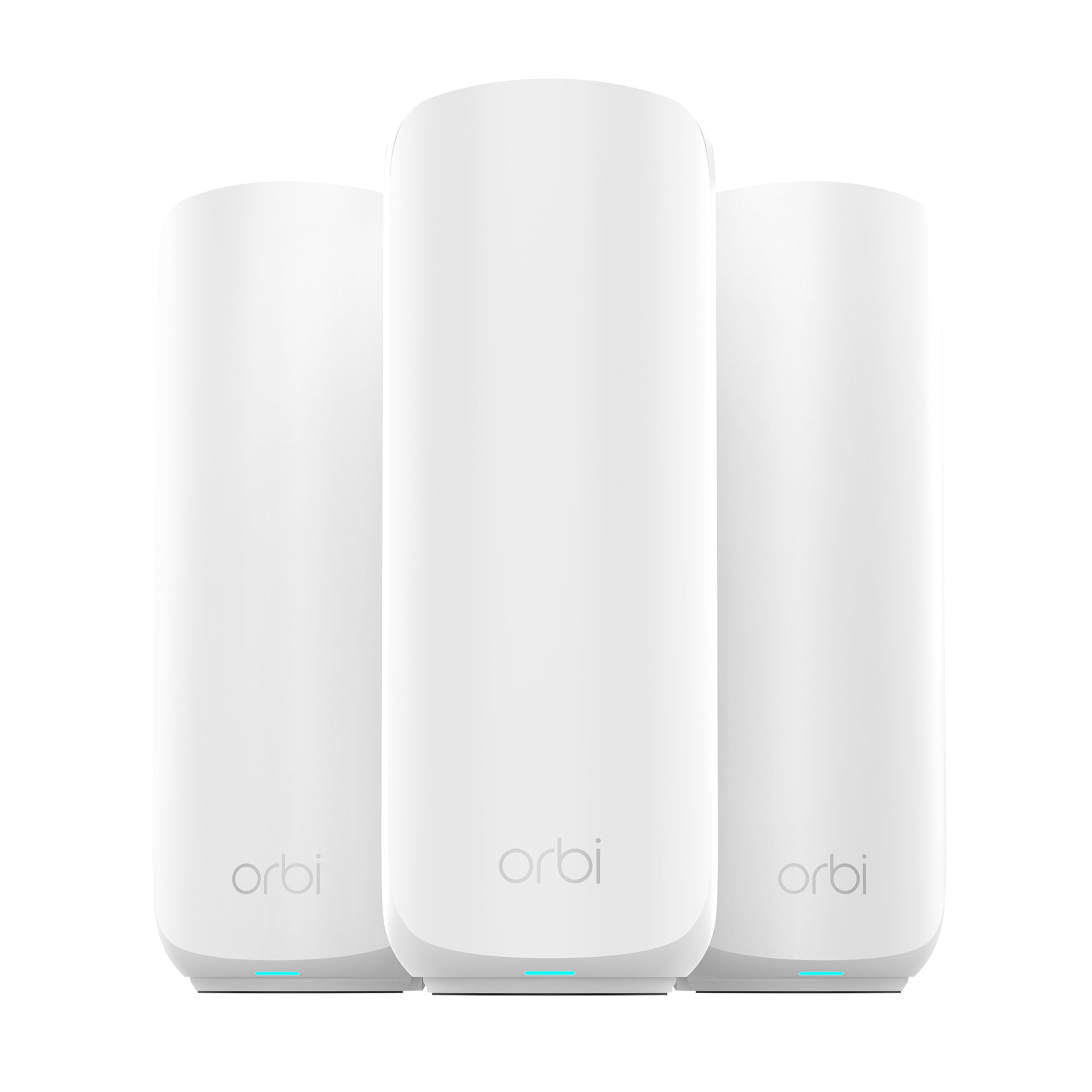
Coverage: Up to 6,000 sq ft
Standard: Wi-Fi 7, dual-band
Speed: Up to 5 Gbps
Devices: Up to 70
Port: 2.5 Gig port
Pack: Router + 2 satellite extenders
Check the current price on Amazon
The Orbi 370 is the entry point into Wi-Fi 7 for a house with a garage conversion, and its 2.5 Gig port is the detail that matters most. A wired connection from the main router to the satellite near the conversion can carry more than a Gigabit, which keeps the converted room fast even when the Wi-Fi signal has to push through a thick wall. Setup is designed to be simple, and the system includes built-in security features for households that want parental controls and network protection without a separate subscription appliance.
This pick suits families upgrading from an older router who want modern Wi-Fi without paying tri-band prices. It is not for very large homes or households running well over 70 connected devices, where the higher-tier Orbi models make more sense.
Trade-off: Dual-band Wi-Fi 7 delivers less total capacity than tri-band systems, so a house full of simultaneous 4K streams and game downloads will notice the ceiling.
3. NETGEAR Orbi 770 Series WiFi 7 Mesh System (3-Pack)

Coverage: Up to 8,000 sq ft
Standard: Wi-Fi 7, tri-band
Speed: Up to 11 Gbps
Devices: Up to 100
Port: 2.5 Gig port
Pack: Router + 2 satellite extenders
Check the current price on Amazon
The Orbi 770 adds a third radio band, and that extra band is what makes it a strong fit for a garage conversion that has become a busy room. Tri-band systems can dedicate a band to communication between the router and satellites, so the converted office or media room gets its own clean channel instead of competing with phones and laptops elsewhere in the house. Coverage is rated higher than the 370, and the device count rises to 100, which covers a typical family with smart home gear, consoles and work laptops.
This pick suits larger homes and households where the conversion is in constant use. It is not for buyers on a tight budget, since the tri-band hardware carries a clear premium over the dual-band Orbi 370.
Trade-off: The price jump over the 370 is significant, and most homes will not max out the extra capacity unless the conversion is used heavily all day.
4. NETGEAR Orbi 970 Series WiFi 7 Mesh System (3-Pack, 2026 Release)

Coverage: Up to 10,000 sq ft
Standard: Wi-Fi 7, quad-band
Speed: Up to 27 Gbps
Devices: Up to 200
Port: 10 Gig port
Pack: Router + 2 satellite extenders
Check the current price on Amazon
The Orbi 970 is the flagship of this group and the pick for a large property where the garage conversion sits far from the main router. Quad-band operation gives the system more room to route traffic between units, and the 10 Gig port means a wired link to the conversion can carry serious bandwidth if the house is cabled for it. Coverage is rated for up to 10,000 square feet and up to 200 devices, so a conversion used as a home theater, workshop or guest suite won’t strain the network.
This pick suits owners of large homes with multi-gig internet and a heavy device load. It is not for anyone who does not need the extra range or the 10 Gig port, because the price tier is firmly premium.
Trade-off: This is a lot of networking hardware for most houses, and the cost is hard to justify unless the home is genuinely large and the internet plan is fast enough to use it.
5. TP-Link Deco 7 Pro Tri-Band WiFi 7 BE10000 Mesh System (3-Pack)
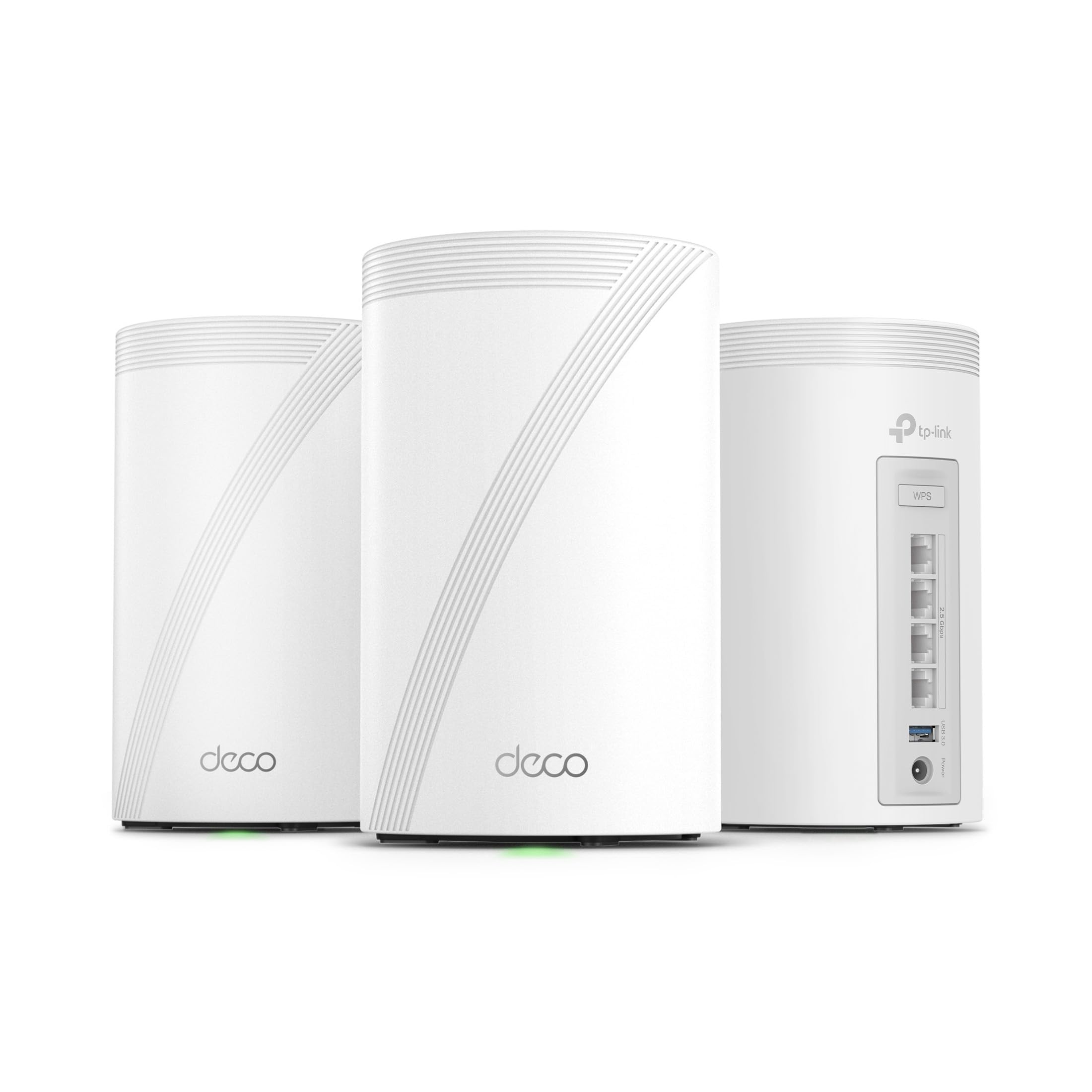
Coverage: Up to 7,600 sq ft
Standard: Wi-Fi 7, tri-band, 6-stream
Speed: Up to 10 Gbps
Ports: 4 x 2.5G ports, wired backhaul
Antennas: 4 x smart internal antennas
Features: VPN, HomeShield, AI-Roaming
Check the current price on Amazon
The Deco 7 Pro is the best mesh system for a house with a garage conversion when the goal is a wired link to the converted room. Four 2.5G ports per unit and wired backhaul support make it practical to run a single cable from the main router to the satellite at the conversion and get full-speed Wi-Fi there, rather than hoping a wireless hop survives the wall. AI-Roaming is designed to hand devices between units smoothly, which helps phones and laptops moving between the house and the converted space, and HomeShield adds network security controls.
This pick suits households that can run Ethernet to the conversion and want Wi-Fi 7 without flagship pricing. It is not for buyers who need the absolute maximum range, since the Orbi 970 covers more ground.
Trade-off: The four 2.5G ports are generous, but the system’s real advantage only appears with wired backhaul — a purely wireless install gives up much of what makes it special.
Before You Buy
- Wiring: Check whether Ethernet can be run from the main router to the conversion’s doorway. A wired backhaul turns any of these systems into a much faster link.
- Wall construction: A converted garage often has insulation, fire-rated board or masonry between it and the house. Plan to place a satellite at the conversion entrance rather than inside the room.
- Internet speed: Match the router’s ports to the plan. Gigabit plans are fine on the Deco X55; multi-gig plans need the 2.5G or 10G ports on the Wi-Fi 7 picks.
- Device count: Count phones, laptops, TVs, consoles and smart home gear. The Orbi 370’s 70-device rating is fine for most homes, but a busy household should step up.
- Coverage rating: Treat the square footage as a guide for open-plan space. A conversion with thick walls needs a satellite closer than the number suggests.
- Future-proofing: Wi-Fi 7 hardware costs more now but lasts longer. A budget Wi-Fi 6 system is the better value only if the plan is to replace it in a few years anyway.
Frequently Asked Questions
- Will a mesh system reach a converted garage? Yes, if a satellite is placed at the doorway between the house and the conversion. Putting the satellite inside the converted room usually weakens the link back to the router.
- Is Wi-Fi 6 enough for a garage conversion? For most uses — an office, a bedroom, a gym — Wi-Fi 6 is plenty. Wi-Fi 7 matters more when the conversion is a media room or the house has multi-gig internet.
- Do these systems support wired backhaul? The Deco X55 and Deco 7 Pro both support Ethernet backhaul, and the Orbi units carry fast ports for wired links. Wired backhaul is the single biggest upgrade for a difficult room.
- How many units are needed for a house plus conversion? A three-pack covers most homes: one router in the main living area and one satellite at or near the conversion. Very large homes may need an extra unit.
- Does a thick garage wall block Wi-Fi? It can. Masonry, foil-backed insulation and fire doors all reduce signal, which is why placement of the satellite matters more than the headline coverage number.
Bottom Line
For most houses with a garage conversion, the TP-Link Deco 7 Pro BE10000 three-pack is the best mesh system for the job: its four 2.5G ports and wired backhaul support make it straightforward to run a cable to the conversion and get full-speed Wi-Fi in the room that needs it most. Buyers on a budget should look at the Deco X55, and anyone covering a very large property should step up to the Orbi 970.
