Why there are Amazon links here: Brave Review is paid a commission for qualifying Amazon purchases made through the links below. Your price does not change, and using our links is entirely optional. How this works
Daran Portable Power Station 89.6Wh LiFePO4 Battery: Small Backup Power That Fits in a Bag
The Daran Portable Power Station is a compact 89.6Wh lithium iron phosphate battery pack with AC outlets, aimed at campers, commuters, and anyone who wants a small emergency backup that lives in a backpack rather than a garage. This review covers what the unit is built for, how its capacity and output translate into real-world use, and where the small format shows its limits. Readers weighing a first power station purchase will find the key decision points below, plus a direct link to current pricing on Amazon.
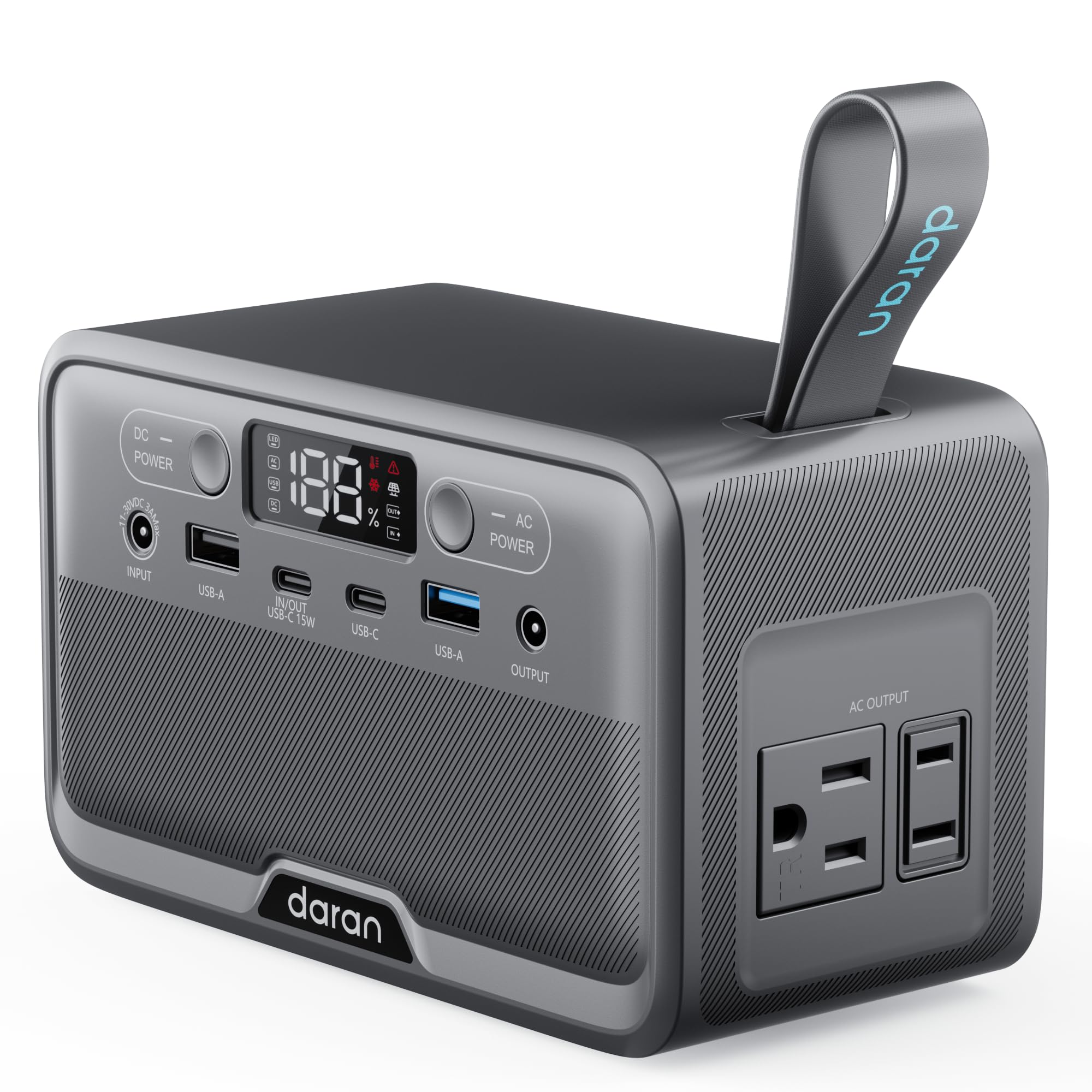
Features and Specifications
Battery Type: LiFePO4 (lithium iron phosphate)
Capacity: 89.6Wh
AC Output: 100W continuous, 200W peak
Charging: PD fast charging
Outlets: AC outlets plus USB charging
Solar Input: Compatible with an optional solar panel
Intended Use: Home backup, laptop charging, camping
The headline here is the battery chemistry. LiFePO4 is the same family used in many larger home backup systems, and it is generally chosen for a longer service life and greater tolerance for heat and repeated charge cycles than the older lithium-ion mixes found in budget power banks. At 89.6Wh, this unit sits in the "personal electronics" class rather than the appliance class — it is sized to top up devices, not to run a fridge.
The 100W continuous AC output with a 200W peak is the number that decides what the station can actually run. Continuous output covers laptops, camera batteries, fans, lights, routers, and phone charging. The peak figure is a short burst for motors and compressors at startup, which is why small devices with a surge draw can sometimes start on a station that would not run them steadily.
Build and Portability
The form factor is the point of this product. At 89.6Wh, the battery is small enough to sit in a daypack or a glovebox, and the "solar power bank" framing in the name signals a device meant to be carried rather than parked. Buyers shopping this tier are usually choosing between a large power bank and a small power station, and this unit is designed to bridge that gap by adding true AC outlets to a package that still travels easily.
LiFePO4 cells are denser and heavier per watt-hour than the cheapest lithium-ion alternatives, so a unit in this class tends to feel solid rather than featherweight. That is a fair trade for the chemistry’s durability, but it is worth setting expectations: this is a packable device, not a pocketable one.
Trade-off: The compact 89.6Wh capacity keeps the station backpack-friendly, but it means the unit is a device charger and short-outage stopgap, not a whole-appliance backup.
Capacity and Runtime
Capacity is where buyers most often misjudge a station this size. Watt-hours are the honest measure: 89.6Wh means roughly 89.6 watts delivered for one hour, or smaller loads for proportionally longer. A 60W laptop charger, for example, draws the battery down quickly; a phone or a set of LED lights draws very little and lasts far longer. The practical lesson is that this station is best thought of as a multi-day phone and laptop companion on a camping trip, not as a source of hours of appliance power.
Charging losses matter too. Every conversion from battery DC to AC outlet power loses some energy to heat, so real-world runtime always lands below the raw math. Buyers planning around a specific device should budget for that overhead rather than treating 89.6Wh as a guaranteed output figure.
For the home backup use case named in the product, the realistic role is keeping phones, a router, and a laptop alive through a short outage — enough to stay informed and connected, not enough to keep a household running.
Power Output and Charging
The 100W continuous AC rating sets a clear ceiling. Laptops, monitors, small fans, LED lamps, camera gear, and CPAP machines with modest draw all sit within reach; kettles, heaters, microwaves, and full-size appliances do not. The 200W peak gives a little headroom for startup surges, but buyers should treat it as a brief allowance, not a second operating limit.
PD fast charging is the quiet strength of the package. USB Power Delivery lets compatible phones, tablets, and laptops recharge at their faster supported rates, which matters on a station this small — every minute spent charging the station itself is a minute it is not out in the field. The unit can also be topped up from an optional solar panel, which turns it into a genuinely off-grid companion for multi-day trips where wall power is not available.
Trade-off: The 100W continuous ceiling rules out most kitchen and heating appliances, so buyers whose backup plan centers on cooking or climate control need a larger class of station.
Maintenance and Longevity
LiFePO4 batteries are generally the low-maintenance choice in this category. They tolerate being stored at partial charge better than older lithium chemistries, and they are less fussy about being left in a warm car or a sunny campsite. For a device that may sit unused for months between trips, that resilience is a real practical benefit.
The habits that protect any station in this class still apply: keep it out of prolonged direct sun, recharge it periodically rather than letting it sit fully drained, and store it somewhere dry. The optional solar panel pairing is best treated as a supplement for trips, not a primary charging method for daily use, since panel output varies with weather and angle.
Trade-off: The small battery means frequent recharging on active trips, and buyers who plan to run devices all day will spend more time managing charge than users of a mid-size station.
Who This Station Suits
This unit fits three buyer profiles well. Campers and hikers who want to keep phones, cameras, and a laptop charged over a weekend will appreciate the packable size and the solar option. Commuters and travelers who want a backup for a laptop bag get real AC outlets without hauling a brick. And households that want a minimal emergency kit for short outages get a device that stores easily and needs little attention.
It is not the right pick for buyers who want to run a fridge, a space heater, or power tools, and it is not aimed at van lifers or off-grid cabin owners who need sustained daily output. Those shoppers should look at mid-size or larger stations with higher continuous wattage.
Check the current price of the Daran Portable Power Station on Amazon
FAQ
-
What can the Daran Portable Power Station run?
It is built for devices within its 100W continuous AC limit — laptops, phones, tablets, cameras, fans, lights, and routers. The 200W peak covers brief startup surges, but appliances like kettles, heaters, and microwaves sit outside its range. -
How long does an 89.6Wh battery last?
Runtime depends entirely on the load. Small devices like phones and LED lights draw very little and last a long time; a laptop charger pulls the battery down much faster. Conversion losses mean real runtime always falls a little below the raw watt-hour math. -
Is LiFePO4 better than a regular lithium power bank?
LiFePO4 is generally chosen for longer service life and better tolerance of heat and repeated cycles. For a device that sits unused between trips, that chemistry is a meaningful advantage over budget lithium-ion packs. -
Can the station be charged with a solar panel?
Yes — the product is designed to work with an optional solar panel, which makes it a practical companion for camping and off-grid trips. Panel output varies with weather and positioning, so solar is best treated as a supplement rather than a daily charging method. -
Does it support fast charging for phones and laptops?
The unit includes PD fast charging, which lets compatible devices recharge at their faster supported rates. That matters on a small station, where charging efficiency directly affects how much time the battery spends ready to use. -
Is this a good home backup for power outages?
For short outages, yes — it keeps phones, a router, and a laptop alive so a household stays connected. It is not sized to run a fridge, heating, or other major appliances. -
How big and heavy is the unit?
The 89.6Wh capacity puts it in the packable class, small enough for a daypack or glovebox. LiFePO4 cells add some weight for their capacity, so it feels solid rather than ultralight. -
Can it run a CPAP machine?
A CPAP with modest draw can fall within the 100W continuous limit, but buyers should check their specific machine’s wattage and plan for heating and humidifier features that raise the draw. Runtime will be limited by the 89.6Wh capacity. -
Does the station need special maintenance?
No. LiFePO4 is a low-maintenance chemistry — keep it out of prolonged direct sun, recharge it periodically instead of storing it drained, and keep it dry. That is the extent of routine care. -
Who should skip this model?
Buyers who need to run kitchen appliances, power tools, heaters, or a fridge should choose a larger station with higher continuous output. This unit is a device charger and short-outage backup, not whole-home power.
Bottom Line
The Daran Portable Power Station makes sense for buyers who want a genuinely packable battery with real AC outlets, dependable LiFePO4 chemistry, and PD fast charging — campers, commuters, and households building a minimal emergency kit. Its 89.6Wh capacity and 100W continuous output are honest limits, not flaws, and anyone planning to run appliances or power tools should step up to a larger class. For everyone else, it is a small, well-judged backup that earns its place in a bag.