Why there are Amazon links here: Brave Review is paid a commission for qualifying Amazon purchases made through the links below. Your price does not change, and using our links is entirely optional. How this works
SITERLINK GS509A: Eight Alarms, One Box
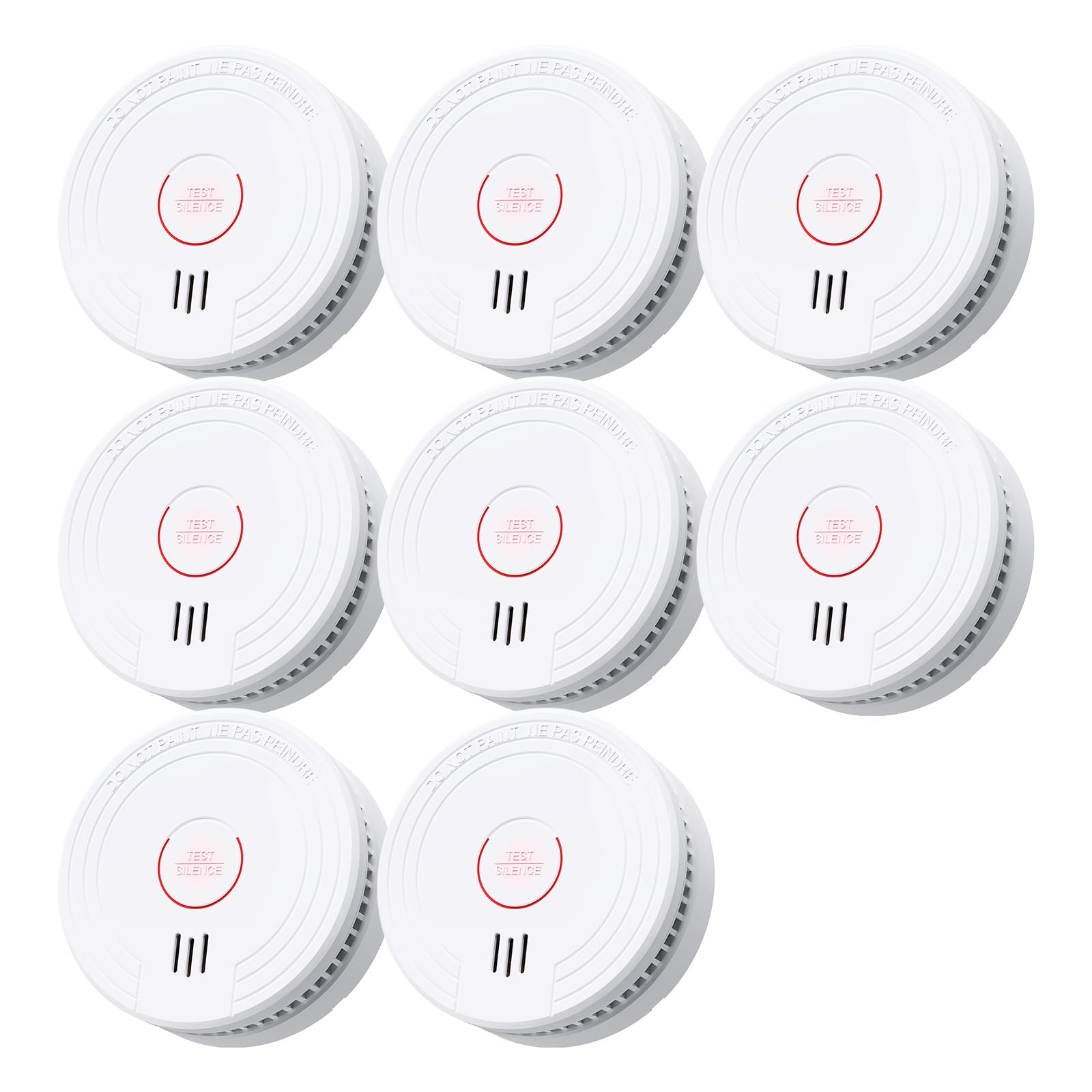
The SITERLINK GS509A is a dual-beam photoelectric smoke alarm sold as an eight-pack, which puts it squarely in the whole-house coverage category rather than the single-room replacement market. It suits a homeowner or landlord who wants one consistent alarm model across several rooms instead of matching odd leftovers. This review covers what the sensor design means in practice, how the test-silence button changes day-to-day ownership, and where the bundle format works against it.
Features and Specifications
Type: Dual-beam photoelectric sensor smoke alarm
Quantity: 8-pack
Power Source: Replaceable battery
Controls: Test-silence button
Indicator: LED light
Intended Use: Home fire detection
Model: GS509A-2NCDR
Dual-Beam Photoelectric Sensing
A photoelectric alarm uses a light source and a sensor arranged so that smoke entering the chamber scatters light onto the receiver. The dual-beam arrangement in this model means two light paths are monitored rather than one, which is the standard way manufacturers reduce false triggers from dust, steam and cooking haze. For a buyer, that translates to fewer nuisance alarms in hallways near bathrooms and kitchens.
Photoelectric sensing is generally the better match for smoldering fires — the slow, smoky kind that starts in upholstery, bedding or overloaded wiring. It is less responsive to fast, clean-burning flames than an ionization sensor, which is why many safety-conscious households mix alarm types. The GS509A is a single-technology product, so it fits best as the main coverage in living areas and bedrooms, with the buyer deciding separately whether a second sensing type belongs near the furnace or kitchen.
Battery Power and Placement
The replaceable battery design is the practical heart of this product. No wiring means no electrician, no ceiling junction box and no compatibility question with an existing hardwired loop. A buyer can mount these in a finished basement, a garage-adjacent mudroom, a rental unit or an older home with no alarm infrastructure at all.
The trade-off is maintenance. Battery-only alarms depend entirely on the owner remembering to swap cells, and a unit with a dead battery protects nothing. Eight alarms means eight replacement cycles on roughly the same schedule, which is either a minor annual chore or a genuine burden depending on the household. Buyers who want the alarm to handle its own power should look at a sealed long-life battery model instead.
LED Indicator and Test-Silence Button
The LED light gives a visible status cue at ceiling height without anyone climbing a ladder to check. That matters more than it sounds: in a multi-alarm installation, a quick glance down a hallway tells the owner which unit needs attention.
The test-silence button covers two jobs. The test function confirms the sensor and sounder still respond, which is the routine check most manufacturers recommend on a regular schedule. The silence function temporarily quiets an alarm that has triggered on cooking smoke or shower steam. Neither feature is unusual in this category, but both are the features buyers actually touch, and having them on every unit in the pack keeps behavior consistent from room to room.
Coverage Math for an Eight-Pack
Eight alarms is a lot for a small apartment and roughly right for a two- or three-bedroom house. A common layout puts one in each bedroom, one in the hallway outside the sleeping area, one on each level of the home, and one in the basement or utility area. That structure is what makes a bundle sensible: the buyer installs one model everywhere, so every alarm sounds the same, tests the same and takes the same battery.
Trade-off: Buying eight identical alarms commits the household to one sensing technology and one battery schedule across the whole home, and any unit that fails has to be replaced from the same line to keep the installation uniform.
CHECK PRICE: See the SITERLINK GS509A 8-pack on Amazon
Who the GS509A Suits — and Who It Does Not
The clearest fit is a landlord or new homeowner furnishing a whole property at once. Eight matching units mean a single spare battery type, a single set of instructions and a single replacement part number for years. The same logic applies to a household upgrading from old, mismatched alarms that came with the house.
It is also a reasonable pick for anyone who cannot or will not run wiring. Renters in units without hardwired alarms, owners of older homes, and anyone covering a detached garage or workshop get full coverage from a battery-only product with no installation cost beyond mounting.
It is not the right product for a buyer who needs one replacement alarm for a single hallway. Eight units is seven too many, and the storage question is real — spare alarms sitting in a closet for years before use. Nor is it aimed at someone who specifically wants ionization sensing, interconnected alarm networking, or a sealed battery that never needs changing. Those buyers should shop a different category entirely.
Installation and Maintenance Realities
Mounting is a screw-and-bracket job on a ceiling or high wall, and the pack format means the work happens eight times in one session rather than spread out. Buyers should plan the placement before opening the box — mapping bedrooms, hallways and levels first avoids drilling a bracket in the wrong spot and living with it.
Maintenance is the part that decides long-term satisfaction. A sensible routine is a monthly button test on each unit and a battery swap on a fixed annual date, done all at once so no alarm drifts out of schedule. The LED indicator makes the monthly walk-through fast, since a quick visual scan catches a unit that has gone quiet.
The limitation worth naming is that this is a standalone alarm. It makes noise where it is mounted; it does not tell the alarm in the next room to sound. In a large or multi-story home, a fire starting in the basement may not be heard promptly by someone sleeping on the second floor. Households that need every alarm to sound together should be shopping interconnected models, not this pack.
FAQ
-
What does dual-beam photoelectric mean on a smoke alarm?
It means the alarm uses two light paths inside its sensing chamber to detect smoke, a design that helps distinguish real smoke from dust and steam. The practical benefit is fewer false alarms compared with a simpler single-beam sensor. -
Does the SITERLINK GS509A need to be hardwired?
No. It runs on replaceable batteries, so it mounts without any electrical connection. That makes it suitable for older homes, rentals and outbuildings where running alarm wiring is impractical. -
How many alarms come in the GS509A-2NCDR pack?
Eight. The pack is intended for whole-home coverage — bedrooms, hallways and each level — rather than a single-room replacement. -
What is the test-silence button for?
It serves two purposes: testing that the alarm still responds, and temporarily quieting a unit that has triggered on cooking smoke or shower steam. Both functions are on the unit itself, so no ladder work is needed beyond reaching the button. -
Where should these alarms be installed?
The usual pattern is one in each bedroom, one in the hallway outside the sleeping area, one on every level of the home, and one in a basement or utility space. Placement should follow local code where it applies. -
How often do the batteries need replacing?
The manufacturer’s guidance in the box is the authority here, and a fixed annual date is the simplest way to keep eight units on the same schedule. A monthly button test catches a unit that has stopped responding between swaps. -
Will these alarms trigger from cooking or shower steam?
The dual-beam photoelectric design reduces that risk compared with basic sensors, but no alarm is immune to heavy steam or smoke directly beneath it. The silence button exists precisely for those moments. -
Do all eight alarms sound together if one detects smoke?
These are standalone units, so each alarm sounds where it is mounted rather than triggering the others. Homes that need whole-house interconnection should look at linked models instead. -
Is the LED light a nightlight or an emergency light?
It functions as a status indicator, showing that the unit is powered and operating. It is not intended as room lighting. -
Who should not buy the eight-pack?
A buyer who needs a single replacement alarm, or who wants interconnected alarms or a sealed never-change battery, should choose a different product. The pack only pays off when most of the units go straight onto ceilings.
Bottom Line
The SITERLINK GS509A 8-pack makes sense for one specific buyer: someone covering a whole home or rental property who wants matching dual-beam photoelectric alarms, no wiring, and a test-silence button on every unit. The battery-only design and the standalone (non-interconnected) operation are the two limits to accept going in. A household that needs just one alarm, or needs every unit to sound together, should spend its money elsewhere.