Why there are Amazon links here: Brave Review is paid a commission for qualifying Amazon purchases made through the links below. Your price does not change, and using our links is entirely optional. How this works
Best Hot Water Control for a Cylinder: 5 Top Valves Compared
Hot water control for a cylinder comes down to two jobs: keeping stored water hot enough to be useful, and making sure what leaves the tap never scalds. The five picks below cover both — a gas control thermostat for the heat source itself, and four thermostatic mixing valves that blend hot cylinder water down to a safe temperature at the outlet. Budget-minded DIY installers, plumbers fitting a standard 1/2-inch setup, and homeowners upgrading to a 3/4-inch tank booster will each find a fit. The overview table below sets the five side by side so a choice can be made in under a minute.
Overview of the Picks
| Product | Key Spec | Best Use | Price Tier |
|---|---|---|---|
| Rheem AP14270G Gas Control Thermostat | Natural gas, integrated thermostat and gas valve | Replacing the control on a gas water heater | Mid |
| FUGO Thermostatic Mixing Valve | 1/2 NPT, solid brass | Compact point-of-use blending | Budget |
| CMI Inc Thermostatic Mixing Valve | 3/4-inch male, PEX connections | PEX-based cylinder installations | Mid |
| Cash Acme Tank Booster | 3/4-inch, valve plus gauge and braided hose | Boosting usable hot water from a cylinder | Premium |
| G1/2 3-Way Thermostatic Mixing Valve | G1/2 NPS male, chrome, anti-scald | Under-sink and fixture-level control | Budget |
Rheem AP14270G Gas Control Thermostat

Type: Gas control thermostat and valve assembly
Fuel: Natural gas
Function: Regulates burner operation and water temperature
Finish: Gray
Footprint: 12.7 x 7.5 x 6.6 inches
Rheem AP14270G Gas Control Thermostat, Natural Gas , Gray , 12.7X7.5X6.6 inches
This is the one pick that controls the heat source rather than the outlet. It is a combined gas valve and thermostat that mounts to a natural gas water heater and governs when the burner fires and how hot the stored water gets. The gray body is a compact block with the gas connections and temperature dial built in, sized to fit the standard control cavity on a heater. It suits anyone replacing a failed control on a natural gas cylinder heater rather than adding a blending valve downstream.
Who It Suits: This pick earns its place for homeowners and service techs dealing with a dead or drifting gas control on a natural gas heater, where the fix is to restore proper temperature regulation at the source. It is a repair part, not an upgrade, and it does nothing for scald protection at the tap. Buyers should confirm the valve matches their heater’s fuel type and mounting pattern before ordering, since a natural gas control will not work on an LP unit.
Trade-off: It is a model-specific repair component, so a mismatch with the heater’s brand or cavity leaves the buyer with a part that will not fit.
FUGO Thermostatic Mixing Valve

Type: Thermostatic mixing valve
Connection: 1/2 NPT
Material: Solid brass
Function: Blends hot and cold water to a set temperature
Use: Hot water heater, shower, general water control
FUGO Thermostatic Mixing Valve, 1/2 NPT Solid Brass Temperature Control Valve
The FUGO is a compact brass valve that takes hot water from a cylinder and cold from the mains and blends them to a stable, safer outlet temperature. Solid brass construction gives it the corrosion resistance expected in a potable water line, and the 1/2 NPT threads are the common size for residential plumbing in the US. The body is small enough to tuck into a tight space near the heater or under a fixture, and the thermostatic element adjusts the blend as supply temperatures shift.
Who It Suits: This is the pick for a straightforward 1/2-inch installation where space is tight and the goal is anti-scald protection at a reasonable cost. It fits DIYers comfortable with threaded fittings and plumbers who want a serviceable brass valve. Buyers with 3/4-inch pipe runs or PEX-specific connections should look at the CMI or Cash Acme options instead, and anyone wanting an integrated gauge will find this one bare.
Trade-off: The low price tier means a plain valve with no gauge, no hose and no mounting hardware, so the buyer supplies the fittings and the means to verify outlet temperature.
CMI Inc Thermostatic Mixing Valve

Type: Thermostatic mixing valve
Connection: 3/4-inch male
Material: Brass body with PEX-compatible connections
Function: Temperature regulation for hot water heater and shower
Use: PEX plumbing systems
The CMI valve is built around 3/4-inch male connections and PEX compatibility, which makes it a natural fit for modern cylinder installations plumbed in PEX rather than copper. The larger connection size moves more volume than a 1/2-inch valve, so it suits a whole-house blend point at the heater outlet rather than a single fixture. It regulates temperature for the heater, shower and general water control, and the brass body is sized for a permanent inline install.
Who It Suits: This pick suits homeowners and installers working on a PEX system who need a 3/4-inch blend valve at the cylinder outlet and want a small-business brand alternative to the big names. It is a good middle ground for a whole-house anti-scald setup. Buyers on copper or CPVC runs, or those wanting a valve with a built-in temperature gauge, should weigh the Cash Acme instead.
Trade-off: PEX-focused connections narrow its appeal, and a buyer without PEX tooling or adapters may spend more on fittings than the valve saves.
Cash Acme 3/4 Inch Tank Booster Water Heater with Thermostatic Mixing Valve
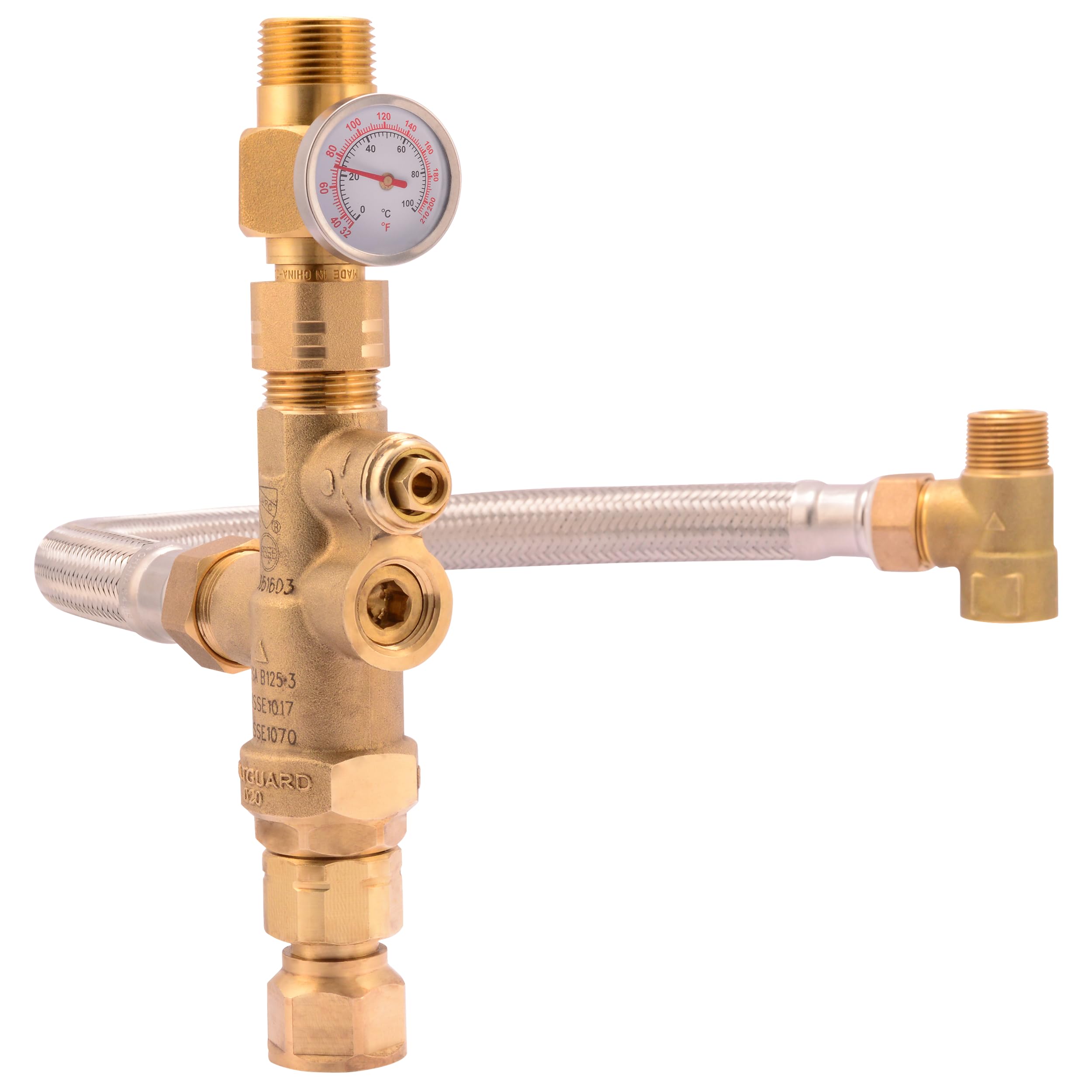
Type: Tank booster with thermostatic mixing valve
Connection: 3/4-inch
Included: Temperature gauge and braided hose
Compatible Pipe: PEX, PE-RT, CPVC, copper
Application: Domestic and commercial
The Cash Acme Tank Booster is the most complete kit here: a 3/4-inch thermostatic mixing valve bundled with a temperature gauge and a braided hose. The idea is to store cylinder water hotter for more usable capacity, then blend it down at the outlet so the extra heat never reaches the tap. It lists compatibility across PEX, PE-RT, CPVC and copper, which makes it the most flexible pick for mixed or unknown plumbing, and the included gauge takes the guesswork out of setting the outlet temperature.
Who It Suits: This is the premium pick for a homeowner who wants more hot water from an existing cylinder without replacing the tank, and for anyone who values having the gauge and hose in the box. It also suits light commercial use. Budget-focused buyers fitting a single fixture will find it overkill, and the higher price tier reflects the kit rather than the valve alone.
Trade-off: The premium price buys a kit, so a buyer who already owns a gauge and hose pays for extras they will not use.
G1/2 3-Way Thermostatic Water Mixing Valve

Type: 3-way thermostatic mixing valve
Connection: G1/2 NPS male
Material/Finish: Chrome
Function: Anti-scald, constant temperature blending
Use: Bathroom, under sink, faucets, shower, bath, bidet, garden
This chrome three-way valve handles hot and cold in and a blended outlet out, with a thermostatic element holding the temperature constant against supply swings. The G1/2 NPS male threads and chrome finish point to fixture-level use — under a sink, at a shower, or on a bidet — where appearance matters and the valve is visible. The anti-scald function is the headline, and the compact DN15 body fits into tight cabinet and wall spaces.
Who It Suits: This is the budget pick for a single fixture that needs scald protection, such as a shower or bidet, without opening up the whole-house plumbing. It suits renters-friendly retrofit jobs and anyone comfortable adapting NPS threads. Buyers sizing for a whole-house 3/4-inch blend point, or those who need NPT threads to match US fittings, should choose one of the other valves.
Trade-off: The very low price and NPS threading suggest a fixture-level part, so a buyer expecting a whole-house valve or exact NPT fit may need adapters.
Before You Buy
- Function: Decide whether the job needs a gas control at the heat source (Rheem) or a blending valve at the outlet (the other four). They solve different problems.
- Connection size: Match 1/2-inch for single fixtures and compact installs, 3/4-inch for whole-house blend points with higher flow.
- Thread standard: Confirm NPT versus NPS versus PEX-specific connections before ordering; adapters add cost and leak points.
- Pipe compatibility: The Cash Acme covers PEX, PE-RT, CPVC and copper; the CMI targets PEX, and the others suit threaded metal work.
- Included accessories: A gauge and hose in the box (Cash Acme) save a separate purchase; bare valves require the buyer to supply fittings and a thermometer.
- Fuel type: The Rheem control is natural gas only, so an LP heater needs a different part entirely.
- Care: Brass and chrome bodies wipe clean and resist scale, but blending valves benefit from periodic checking of the outlet temperature.
Frequently Asked Questions
-
What is the best hot water control for a cylinder?
It depends on the goal: a gas control thermostat like the Rheem regulates the heater itself, while a thermostatic mixing valve like the Cash Acme Tank Booster blends stored hot water down to a safe outlet temperature. -
Does a mixing valve reduce how much hot water a cylinder delivers?
No — blending allows the cylinder to be stored hotter, so the usable hot water at the tap can actually increase while the outlet stays safe. The Cash Acme kit is built around exactly that idea. -
Can a 1/2-inch valve replace a 3/4-inch one?
Only with adapters, and flow may suffer. Match the valve to the pipe size: 1/2-inch for fixtures, 3/4-inch for whole-house blend points. -
Is the Rheem control a scald-prevention device?
No. It regulates burner operation and stored water temperature at the source; scald protection at the tap comes from a thermostatic mixing valve downstream. -
Do these valves need maintenance?
Brass and chrome bodies are low-maintenance, but the thermostatic element should be checked periodically against a thermometer, and a gauge makes that quick. -
Can a homeowner install a mixing valve?
A confident DIYer can handle threaded fittings, but soldering or PEX crimping and local code requirements may call for a plumber.
Bottom Line
For most homeowners wanting the best hot water control for a cylinder, the Cash Acme 3/4 Inch Tank Booster is the top pick: it combines a 3/4-inch thermostatic mixing valve with a temperature gauge and braided hose, works across PEX, CPVC, copper and PE-RT, and delivers more usable hot water from an existing cylinder. Buyers on a tight budget fitting a single fixture can drop to the FUGO or G1/2 valve, and anyone repairing a natural gas heater should start with the Rheem control.