Why there are Amazon links here: Brave Review is paid a commission for qualifying Amazon purchases made through the links below. Your price does not change, and using our links is entirely optional. How this works
Ring Indoor Cam: A Small, Cheap Security Camera for One Room
The Ring Indoor Cam is a compact plug-in security camera for a single room — a nursery, a home office, an entryway, a shop counter. Buyers who want a simple 1080p view on a phone, two-way talk, and a low entry cost will find it fits the job. This review covers what the camera is built for, where its limits sit, and who should look elsewhere.
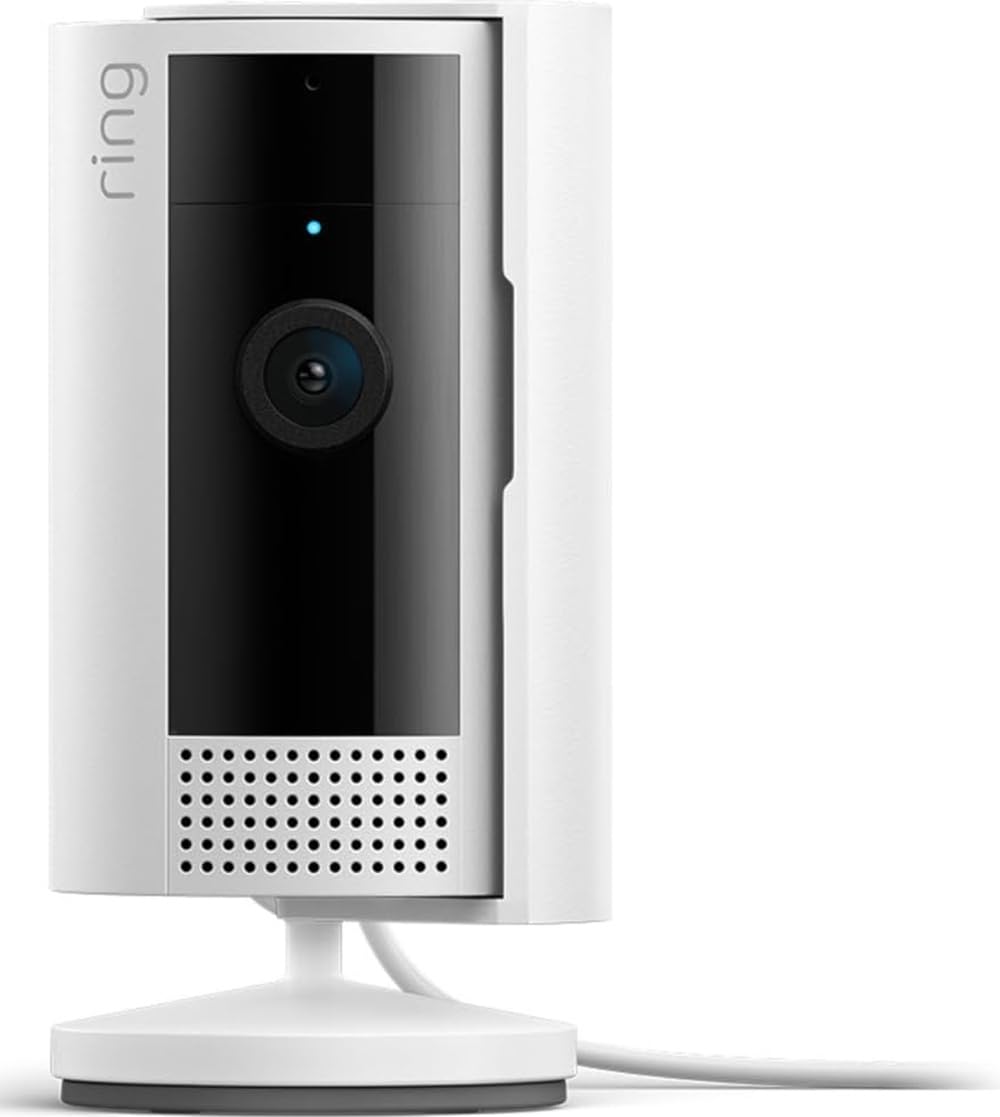
Features and Specifications
Type: Indoor security camera
Resolution: 1080p HD video
Intended Use: Home or business monitoring
Color: White
Power Source: Plug-in (wired)
Connectivity: Wi-Fi, controlled through the Ring app
Audio: Two-way talk
The camera is a small, white, wired unit that sits on a shelf, a counter or a desk, or mounts to a wall with its included hardware. It streams live video to a phone, and two-way talk lets the person watching speak through the camera’s speaker and hear what the room picks up. Because it runs on household power rather than a battery, it stays on continuously — no charging routine, but also no freedom to place it where an outlet isn’t.
The 1080p resolution is the standard for this price tier. It is enough to recognize a face across a room in good light and to read a doorway, but it is not a detail camera for reading a license plate at distance. Buyers who need sharper identification footage should expect to pay for a higher-resolution tier.
Build, Placement and Power
The housing is plastic and light, which is normal for an indoor camera at this price. That keeps it easy to reposition and easy to mount high on a wall or set on a cabinet, but it also means the unit is not built for weather or rough handling. It belongs indoors, in a spot where it won’t be knocked.
Power is the defining constraint. A plug-in camera needs an outlet within reach of its cable, so the practical question is not "where should a camera go" but "where is there an outlet and a good view at the same time." That usually means a corner near a desk, a shelf by a door, or a counter in a shop — not the ideal ceiling spot in the middle of a room.
Placement also affects privacy. An indoor camera pointed at a living space records the people who live there, not just intruders. Buyers should decide up front which room they want covered and whether the camera should be able to see into hallways or other rooms through an open door.
Video, Audio and App Control
The 1080p feed is the core of the product, and for a single-room view it does the job: a clear picture of a doorway, a crib, a register, or a workspace. Night performance is the part to think about carefully — indoor cameras in this class rely on infrared for dark rooms, which produces a black-and-white image that is serviceable for spotting movement but softer on detail than daytime footage.
Two-way talk is the feature that separates this camera from a plain recorder. It lets a buyer check in on a room and speak to whoever is there — a child, a pet, a delivery person at a counter — from the app. The audio is one-directional in the sense that it is a conversation tool, not a recording studio; buyers should expect it to be functional rather than crisp.
The Ring app is where the camera lives day to day: live view, motion alerts, and settings. The important caveat is that the camera’s usefulness is tied to the app and to the Ring ecosystem. Buyers who already run other Ring devices get a single dashboard; buyers who don’t are committing to one company’s software for their home security.
Storage and Subscription
This is the dimension that decides whether the camera is a good deal. Live viewing works without a plan, but recorded video and saved motion events depend on Ring’s subscription service. Buyers who want to review what happened overnight, or hand footage to police, should price the plan alongside the camera before deciding.
Local storage is not part of the design here. There is no memory card slot to fall back on, so the subscription is the recording path. That is common for the category, but it changes the true cost: the camera is inexpensive up front, and the ongoing plan is the real commitment.
Trade-off: The low purchase price is misleading on its own — recorded footage depends on a paid Ring plan, so the camera’s real cost is the subscription, not the box.
Who It Suits and Who It Doesn’t
The Ring Indoor Cam suits buyers who want one room covered cheaply and simply: a parent watching a nursery, a remote worker keeping an eye on a home office, a small-business owner watching a counter or stockroom, or a renter who wants a camera that mounts without major installation. It also suits households already using Ring devices, where the app and alerts are already part of the routine.
It does not suit buyers who want battery freedom and placement anywhere, who need high-resolution footage for identification, who refuse a subscription for recorded video, or who want a camera built for outdoor conditions. Those buyers are shopping in a different part of the market, and this camera will feel like a compromise.
Check the current price of the Ring Indoor Cam on Amazon
FAQ
-
Does the Ring Indoor Cam need a subscription?
Live viewing works without one, but saved recordings and motion event history require a Ring plan. Buyers who want to review footage later should budget for the subscription. -
Is the Ring Indoor Cam battery powered?
No. It is a plug-in camera that runs on household power, so placement depends on an outlet within reach of its cable. -
Can the Ring Indoor Cam be used outdoors?
It is designed for indoor use. The housing is not built for weather, so it belongs inside a home or business. -
Does it record video without Wi-Fi?
No. The camera connects over Wi-Fi and is controlled through the Ring app, so a working network is required. -
Can two people watch the camera at once?
The Ring app supports shared access, so more than one household member can view the camera from their own phone. -
Does it have two-way audio?
Yes. Two-way talk lets the person watching speak through the camera and hear the room, which is useful for check-ins and for speaking to someone at a door or counter. -
Is 1080p enough for a security camera?
For a single room in good light, 1080p is enough to recognize people and see what is happening. It is not the resolution to choose for reading detail at distance. -
Where should an indoor camera be placed?
High on a wall or on a shelf with a clear view of the doorway or the area of interest, and near an outlet. Buyers should also consider what else the camera can see through open doors. -
Can it be mounted on a wall?
Yes. The camera is designed to sit on a surface or mount to a wall, which makes it flexible for renters and small businesses. -
Is the Ring Indoor Cam a good fit for a small business?
For a single counter, register, or stockroom, yes — it is a low-cost way to keep an eye on one area. A larger space needs more cameras, not a better one.
Bottom Line
The Ring Indoor Cam is a sensible buy for one room, one outlet, and one simple job: a cheap, plug-in 1080p camera with two-way talk and app control, best for buyers already in the Ring ecosystem or willing to pay for a plan. Buyers who need battery placement, high-resolution footage, or subscription-free recording should look at a different class of camera. For everyone else, it is the low-cost way to start.