Why there are Amazon links here: Brave Review is paid a commission for qualifying Amazon purchases made through the links below. Your price does not change, and using our links is entirely optional. How this works
Reolink TrackMix PoE: Auto-Tracking Security for Wide-Area Coverage
The Reolink TrackMix PoE is a dual-lens pan-and-tilt security camera built for buyers who need one device to watch a wide outdoor area and follow movement across it. It pairs a 4K wide lens with a second telephoto lens, then uses auto-tracking to keep a moving subject in frame. This review covers its build, how the dual-lens system works, power and recording options, and who should skip it. Buyers ready to compare specs and pricing can jump to the Amazon listing.
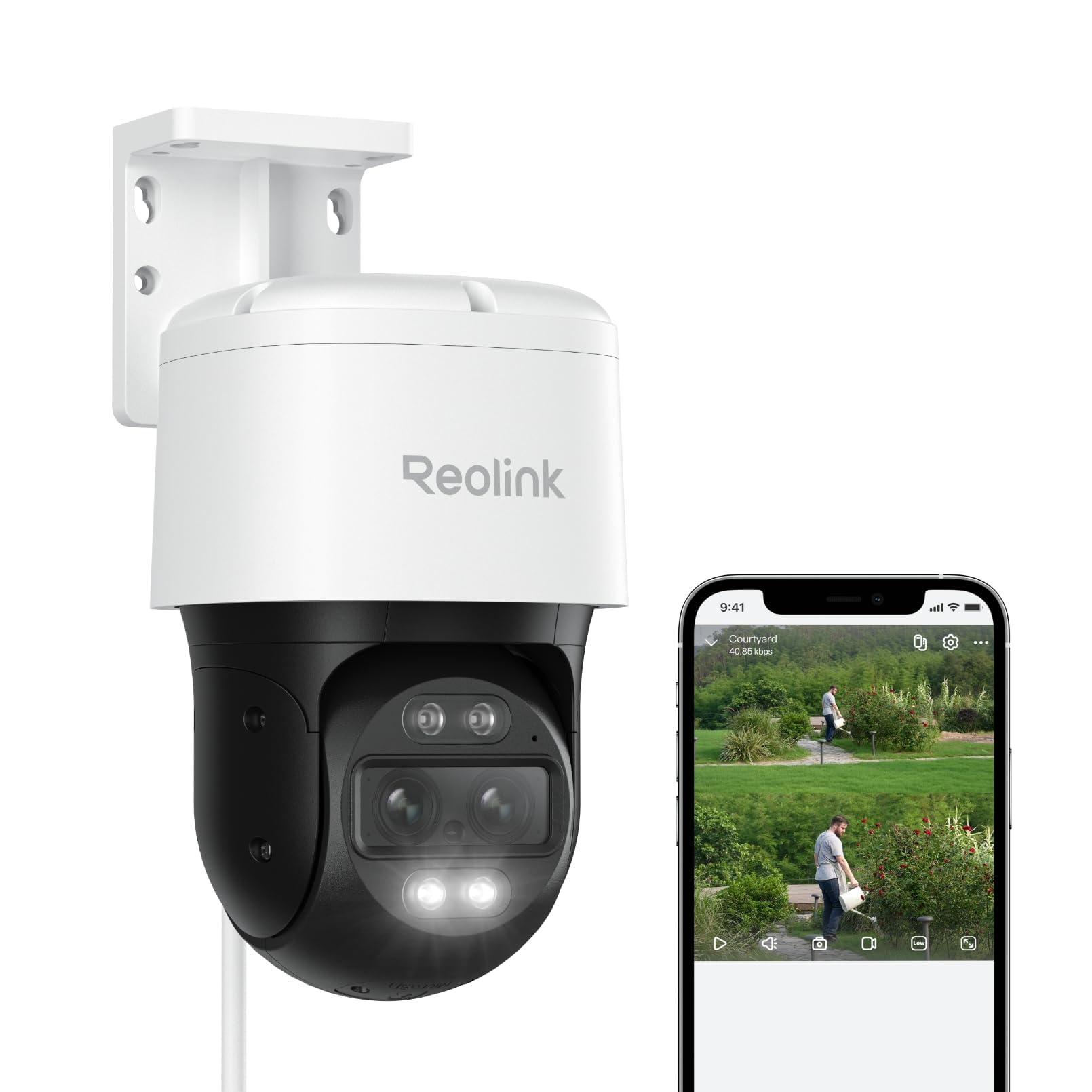
The TrackMix PoE sits in the middle of Reolink’s outdoor lineup: more capable than a fixed bullet camera, less expensive than a full multi-camera kit. Buyers shopping a single camera for a driveway, side yard, or parking area are the target audience. The sections below walk through the specifications, the trade-offs each feature carries, and the questions buyers ask before ordering.
Features and Specifications
Product Type: Dual-lens PTZ outdoor security camera
Resolution: 4K
Pan Range: 355°
Tilt Range: 90°
Zoom: 6X hybrid zoom
Night Vision: Color and IR
Recording: 24/7, up to 512GB microSD card
Power: PoE (Power over Ethernet)
Smart Features: Auto tracking, smart detection
The headline number is the 4K resolution, which gives the camera enough pixel density to read license plates and identify faces at a distance when the subject is well lit. The 355° pan and 90° tilt range mean a single unit can cover nearly a full circle and a wide vertical sweep, so a buyer mounting it under an eave can point it at a driveway, a gate, and a side door without adding cameras. The dual-lens design is the real differentiator: one lens captures the wide scene while the other zooms in on whatever the tracking system flags.
Power over Ethernet changes the installation math. A single cable carries both data and power, so the camera does not need a nearby outlet, and the run can be much longer than a USB or Wi-Fi camera allows. The trade-off is that PoE requires a PoE switch or injector and a wired network path to the mounting point, which rules out buyers who want a purely wireless setup.
Build and Design
The TrackMix PoE is an outdoor-first design, so the housing is built to sit exposed to weather rather than tucked under a porch. The pan-and-tilt mechanism is the part that matters most for longevity, because a moving camera has more wear points than a fixed one. Buyers mounting it in an exposed spot should expect to check the housing and the moving joint periodically for water intrusion and debris.
The dual-lens arrangement is a compact engineering choice rather than a cosmetic one. Instead of one lens that has to zoom digitally, the camera carries a wide lens and a telephoto lens side by side, and the 6X hybrid zoom blends optical reach with digital cropping. That gives the tracking system a sharper close-up to work with than a single-lens PTZ at the same price. The cost of that design is a slightly bulkier head than a fixed bullet camera, which matters when mounting space is tight.
Pan, Tilt, and Auto Tracking
The 355° pan and 90° tilt are the numbers that decide coverage. A full pan range means the camera can be aimed almost anywhere on the horizontal plane, and 90° of tilt covers the vertical sweep from ground level up to a roofline. For a buyer covering a driveway, a side gate, and a back door from one mount, that range is the reason to choose this model over a fixed camera.
Auto tracking is the feature that changes how the camera is used. When smart detection flags a person or vehicle, the camera pans and tilts to follow the subject and keeps it in frame, rather than recording a subject that walks out of the fixed field of view. That is a genuine upgrade for large yards and parking areas where a fixed camera would lose the subject at the edge of the frame. The caveat is that tracking depends on detection working cleanly; heavy foliage, blowing debris, or low contrast at night can cause the camera to lose a subject or chase a false trigger.
Dual-Lens Zoom and Night Vision
The 6X hybrid zoom is the practical payoff of the second lens. In daylight, the telephoto lens gives a tighter, sharper view of a subject at distance than digital zoom alone can produce, which is what makes identification possible at the far end of a long driveway. The hybrid label means the camera combines optical reach with digital cropping, so the sharpest results come at the lower end of the zoom range and soften as the camera pushes further in.
Color and IR night vision cover both lighting conditions. IR mode handles pitch-black scenes in monochrome, while color night vision keeps some color information when ambient light is present, which helps identify clothing and vehicle color. The honest limitation is that color night vision needs some light to work with; on a genuinely dark property, buyers should expect IR mode to do most of the overnight work. The dual-lens setup also means the camera is doing more processing than a single-lens model, which is worth knowing for buyers running several units on one recorder.
Power, Recording, and Storage
PoE power is the feature that separates this camera from the wireless crowd. One Ethernet cable delivers both power and a stable data connection, so the camera does not compete for Wi-Fi bandwidth and does not need a power adapter at the mounting point. That stability matters for 24/7 recording, because a wired link does not drop out the way Wi-Fi can when a neighbor’s network or a thick wall interferes.
Recording runs 24/7 to a microSD card of up to 512GB, which is a generous ceiling for a single camera and means buyers can run the camera standalone without a recorder. The trade-off is that a card-based setup puts the footage on the camera itself; a buyer who wants centralized storage or multi-camera playback will want to add a network video recorder, and the card slot is best treated as a local backup rather than the whole system. Buyers should also plan on a high-endurance card rated for continuous write cycles, since 24/7 recording is hard on standard cards.
Smart Detection and Alerts
Smart detection is what makes auto tracking useful rather than annoying. The camera distinguishes people and vehicles from general motion, so a tree branch or a passing cat is less likely to trigger a pan-and-follow sequence or a phone alert. For a buyer who has been flooded with false alerts from a basic motion camera, that filtering is one of the main reasons to move up to this model.
The practical caution is that detection settings need tuning after installation. Sensitivity set too high produces nuisance alerts from rain, insects, and shifting shadows; set too low, and the camera may miss a subject entering at the edge of the frame. Buyers should expect a short calibration period and should test the tracking behavior at different times of day before relying on it. Alerts and remote viewing depend on the Reolink app and a stable network connection, so the phone experience is only as good as the link to the camera.
Who It Suits and Who Should Skip It
This camera suits buyers with a wired network path and a large outdoor area to cover: a long driveway, a corner lot, a parking pad, or a side yard where a fixed camera would leave gaps. It also suits buyers who want a single camera to do the work of two, since the dual-lens design and auto tracking reduce the number of units needed for wide coverage. Homeowners with a PoE switch already in place get the most value, because the installation cost is mostly cable and time.
Buyers who should skip it fall into a few clear groups. Anyone without a way to run Ethernet to the mounting point will find the PoE requirement a dealbreaker, and a wireless camera is the better fit. Renters who cannot drill or run cable should look elsewhere. Buyers on a tight budget who only need to watch a single door can spend less on a fixed camera and get most of the coverage they need. And buyers who want a fully self-contained system with no app, no network, and no tuning should expect a steeper setup curve than a plug-and-play model.
Trade-off: The dual-lens PTZ design delivers wide coverage and real tracking, but it demands a wired PoE run and a period of detection tuning that a simple fixed camera never asks for.
Check the current price and availability on Amazon
FAQ
-
What does PoE mean on the Reolink TrackMix PoE?
PoE stands for Power over Ethernet. A single Ethernet cable carries both power and data to the camera, so no separate power adapter is needed at the mounting point. The camera does require a PoE switch or injector at the other end of the cable. -
Does the Reolink TrackMix PoE need Wi-Fi?
No. The camera connects over Ethernet, which is generally more stable than Wi-Fi for 24/7 recording. Remote viewing on a phone still needs the camera connected to a network with internet access. -
What is 6X hybrid zoom?
Hybrid zoom combines the optical reach of the telephoto lens with digital cropping to extend the zoom range. The sharpest results come at the lower end of the range, and the image softens as the camera pushes toward the maximum. -
Can the Reolink TrackMix PoE record without a recorder?
Yes. The camera records 24/7 to a microSD card of up to 512GB, so it can run as a standalone unit. Buyers who want centralized storage across multiple cameras will want to add a network video recorder. -
Does auto tracking work at night?
Auto tracking works in both color and IR night vision modes, but its reliability depends on how clearly the camera can see the subject. Low contrast, heavy foliage, and false triggers can cause the camera to lose a subject in poor lighting. -
What size microSD card should buyers use?
The camera supports cards up to 512GB. Because 24/7 recording writes constantly, a high-endurance card rated for continuous use is the safer choice than a standard card. -
Is the Reolink TrackMix PoE suitable for indoor use?
It is built as an outdoor camera, and its pan-and-tilt housing is designed for exposed mounting. Indoor buyers can use it, but a smaller indoor model is usually a better fit for the space and the mounting options. -
How much area can one camera cover?
The 355° pan and 90° tilt let one unit cover nearly a full horizontal circle and a wide vertical sweep. That range is what makes it a candidate for a driveway, a corner lot, or a side yard from a single mount. -
Does the camera need a subscription?
The camera records locally to a microSD card and does not require a subscription for that. Buyers who want cloud storage or advanced features should check the current Reolink app options before ordering. -
Who should not buy the Reolink TrackMix PoE?
Buyers who cannot run Ethernet to the mounting point, renters who cannot drill or cable, and shoppers who only need a single door watched on a tight budget are better served by a simpler or wireless camera.
Bottom Line
The Reolink TrackMix PoE is the right pick for buyers who have a wired network path and a wide outdoor area that a fixed camera cannot cover. The dual-lens 4K design, 355° pan, and auto tracking let one unit do the work of two, and the 512GB card support means it can run without a recorder. The PoE requirement and the detection tuning are real costs, but for the buyer with the wiring in place, this is a capable single-camera answer to wide-area coverage.
